Immune Pharmaceuticals (NASDAQ:IMNP) is a biopharmaceutical company developing therapeutics for the treatment of inflammatory diseases and cancer. The company’s lead asset, bertilimumab, is a monoclonal antibody that targets eotaxin-1, and is currently in Phase 2 clinical trials for the treatment of bullous pemphigoid (BP) and ulcerative colitis (UC). Additional future indications for bertilimumab include Crohn’s disease (CD), severe asthma, nonalcoholic steatohepatitis (NASH), and atopic dermatitis. The company is also developing NanomAbs®, a technology platform that allows for the targeted delivery of chemotherapeutic agents directly to cancer cells. Partnering opportunities are currently being explored for Amiket™, which is ready to begin Phase 3 clinical testing for the treatment of post-herpetic neuralgia (PHN), as well as two oncology therapeutics in Azixa® and Crolibulin™.
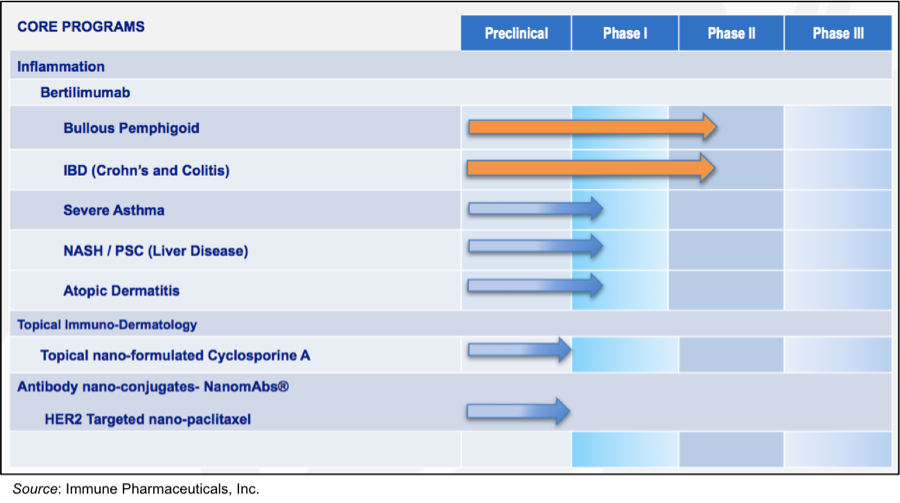
For the purposes of this update, we will focus on the development of bertilimumab in the treatment of inflammatory bowel diseases (IBD), which include UC and CD, and examine the current treatment options as well as the market potential for bertilimumab in these indications. For additional background on IBD, eotaxin-1, and bertilimumab please see this article.
Current Treatment Options for IBD
While there are no medical cures for IBD, certain medications have proven to be useful in controlling disease. The three main goals of IBD treatment are to induce remission as quickly as possible, maintain remission for as long a time period as possible, and improve the patient’s quality of life. Factors such as severity and location of disease, past treatments, side effects, and additional medical conditions the patient is suffering from must all be considered in approach to treatment. Generalized therapy classes are as follows:
- Aminosalicylates: These compounds can be given orally, rectally or both, and interfere with the inflammatory response. They are effective in treating mild to moderate UC and can be utilized to both induce remission and as maintenance therapy. They have not been shown to be effective in treating CD.
- Corticosteroids: These agents have been used in the treatment of IBD for over 60 years. They are powerful anti-inflammatory and immunosuppressive agents and are given to those who fail to achieve remission on aminosalicylates. They are only recommended for short-term use and are not utilized for maintenance therapy due to their undesirable long-term side effects and toxicity.
- Immunomodulators: These drugs weaken the activity of the immune system that in turn reduces the inflammatory response. They are used in patients who do not respond to aminosalicylates or corticosteroids and who need to maintain remission in CD.
- Antibiotics: These compounds are frequently used as a first-line treatment for CD, particularly for those patients who have fistulas or recurrent abscesses. There is no data to indicate antibiotics are useful in treating UC.
Past research into the etiology of inflammation pointed to tumor necrosis factor-alpha (TNF-α) as an ideal target for IBD therapy based on its pro-inflammatory effects on a range of innate and adaptive immune functions. As a result, a number of pharmaceutical companies have developed TNF-α inhibitors in the form of monoclonal antibodies:
- Infliximab (J&J’s Remicade®): Infliximab is a chimeric monoclonal antibody that is given as an intravenous (i.v.) infusion. Studies over the past 15 years in CD patients have shown that infliximab is effective in inducing remission, maintaining remission in treatment-refractory patients and preventing recurrence of disease in post-operative patients. Infliximab was approved for the treatment of CD in 1998 and for UC in 2005. Worldwide 2014 revenues for infliximab were $8.8 billion with approximately 35% of revenues owing to IBD treatment (EvaluatePharma). Infliximab will go off patent in the U.S. in 2018 while it has already gone off patent in Europe.
- Adalimumab (AbbVie’s Humira®): Adalimumab is a fully-human monoclonal antibody that is given by subcutaneous injection. This treatment has been shown to induce remission, maintain remission, and can be utilized in patients who are refractory to infliximab. As it is a fully-human antibody, there is a decreased likelihood of developing antibodies to treatment, an effect that contributes to a decrease in effectiveness of infliximab. In addition, the subcutaneous route of administration provides a viable alternative to those patients who experience infusion reactions with infliximab. Adalimumab is currently the world’s top-selling monoclonal antibody, with 2014 revenues of $12.7 billion and approximately one-quarter of those revenues derived from IBD indications (EvaluatePharma). Adalimumab patent coverage will expire in 2016.
- Certolizumab pegol (UCB’s Cimzia®): Certolizumab pegol is differentiated from infliximab and adalimumab in that it is a humanized Fab antibody fragment attached to polyethylene glycol. The lack of an Fc domain means it does not induce complement activation, antibody-dependent cellular cytotoxicity, or induction of apoptosis. Studies show that certolizumab pegol is efficacious in moderate to severe CD for both induction and maintenance of remission in patients who do not respond to standard therapy. Sales of certolizumab totaled approximately $1 billion in 2014. The drug is under patent protection until 2024.
- Golimumab (J&J’s Simponi®): Golimumab is produced by Johnson and Johnson as the follow-on to infliximab. It is a fully human antibody derived from TNF-α immunized transgenic mice that express human IgGs. It was originally approved in 2009 for the treatment of rheumatoid arthritis, psoriatic arthritis, and ankylosing spondylitis. The FDA approved golimumab for the treatment of moderate to severe CD and UC in 2013. Sales of golimumab totaled $1.8 billion worldwide in 2014.
While rare, there are serious side effects related to the use of anti-TNF-α therapy. The FDA has issued a black box warning covering the entire class of TNF-α inhibitors related to an increased risk of opportunistic infections from Legionella and Listeria, fungal infections, and the re-emergence of active tuberculosis in patients with latent mycobacterium tuberculosis infection. There have also been reports of a rare blood cancer (hepatosplenic T-cell lymphoma), primarily in adolescents and young adults being treated for UC or CD with anti-TNF-α therapy along with azathioprine.
In addition to TNF-α, additional molecules are the targets of IBD biological therapies:
- Natalizumab (Biogen’s Tysabri®): Natalizumab is a humanized monoclonal antibody that targets integrin α4 and works by disrupting leukocyte adhesion to the endothelium and subsequent migration into the gut mucosa. Clinical trial results suggest that natalizumab is less effective than TNF-α targeted therapies and the increased risk of progressive multifocal leukoencephalopathy (PML) has minimized its use as a first-line monoclonal antibody treatment. As such, natalizumab has only limited use in IBD indications.
- Vedolizumab (Takeda’s Entyvio™): Vedolizumab targets integrin α4β7 and blocks leukocyte trafficking to the gut in a selective manner, as opposed to the systemic effects of natalizumab. Importantly, there were no reported incidences of PML in Phase 3 trials of the compound. The FDA approved Vedolizumab in 2014 for moderate to severe UC and CD patients that failed TNF-α therapy. Total sales in 2014 were $254 million, however the drug is forecasted to have revenues of $1.7 billion by 2020 (EvaluatePharma).
While anti-TNF-α therapy has been successful for a large percentage of patients who are refractory to other conventional treatments, approximately 25-40% of patients who initially respond to anti-TNF-α therapy go on to develop severe side effects or have a loss of response to therapy over time (Baert et al., 2003; Sands et al., 2004; Colombel et al., 2007; Schreiber et al., 2007). Infliximab is typically the first monoclonal antibody used in the course of treatment, both because it has been around the longest and clinical trial results show it to be the most effective of the TNF-α targeted therapies. Infliximab is a chimeric antibody, meaning that it is part mouse (30%) and part human (70%). Because of this, patients typically develop anti-infliximab antibodies against the “mouse” portion of the protein, and thus after some time these patients develop resistance to therapy due to its inactivation by the immune system.
Patients who develop resistance to infliximab typically transition to another anti-TNF-α therapy. Adalimumab was shown to be effective for patients who become refractory to infliximab even though they both target TNF-α (Ma et al., 2009). Typically, only patients who have severe disease and are refractory to anti-TNF-α therapy will be put on natalizumab, although vedolizumab is likely to continue to gain support due to its improved safety profile and efficacy compared to natalizumab.
How the biological agents that treat UC and CD will be positioned in the clinic will ultimately be determined in part by the FDA and EMA label and the position of pertinent guideline-issuing committees such as the American College of Gastroenterology. There is a debate currently ongoing amongst gastroenterologists about the proper place for monoclonal antibodies in the hierarchy of medical therapies for IBD. The more conservative approach that most doctors have utilized is the so-called “step-up” approach, in which traditional therapies (aminosalicylates, corticosteroids, and immunomodulators) are exhausted first before moving on to monoclonal antibody therapy.
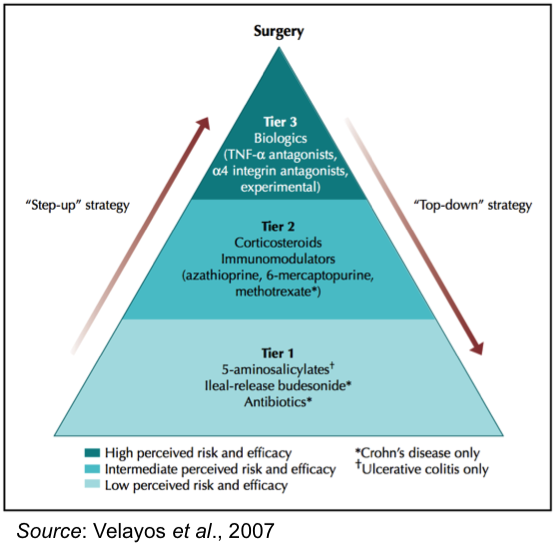
Recently, given the evidence that monoclonal antibody therapy is superior to traditional IBD therapies, is generally well-tolerated, and may reduce incidence of surgery, there is a movement by gastroenterologists toward so-called “top-down” therapy where monoclonal antibodies are utilized early in the disease course for moderate to severe disease (D’Haens, 2010).
The conventional “step-up” therapy approach has not altered surgical rates for IBD patients even with the introduction of biological therapies. Thus, the hypothesis is that administering monoclonal antibody therapy early in the disease course could alter the natural history of the disease and reduce steroid dependency and surgery while promoting mucosal healing.
Even with these treatment options, approximately 30% of UC and 80% of CD patients will go on to require surgery, typically after an extended period of time following initial diagnosis (> 20 years). For UC, the standard surgical option is removal of the colon and rectum with some patients eligible for an ileo pouch-anal anastomosis (IPAA), which precludes the necessity of an external bag for the collection of fecal waste. The type of surgery for CD depends on the reason for surgery and the location of the disease. Unlike UC, surgery does not cure CD, with 30% of patients experiencing a flare within 3 years after surgery and 60% having recurrence within 10 years. The avoidance of surgery continues to be a serious unmet medical need for IBD patients.
Clinical Development of Bertilimumab in IBD
Bertilimumab is an IgG4 monoclonal antibody that binds to eotaxin-1 with very high affinity and specificity. It is being developed as a treatment for both UC and CD in part based on the following observations:
- IBD patients have elevated levels of eotaxin-1 in their serum compared to controls (Chen et al., 2001; Mir et al., 2002)
- In pediatric UC patients, levels of eotaxin-1 messenger RNA (mRNA) in the rectosigmoid colon positively correlated with rectosigmoid eosinophil numbers and the levels positively correlated with disease severity (Ahrens et al., 2008).
- Eotaxin-1 is increased in the serum of UC patients compared to controls (Coburn et al., 2013)
- Blocking eotaxin-1 in a mouse model of colitis prevents eosinophil influx, clinical disease, injury, and death (Vieira et al., 2009)
Immune has initiated a Phase 2 clinical trial of bertilimumab in patients with active moderate to severe UC (NCT01671956). This is a randomized, double blind, placebo-controlled, parallel group, multi-center study that will evaluate the clinical efficacy and pharmacokinetic profile of bertilimumab in approximately 42 adult patients. Eligible patients will be randomly assigned in a 2:1 ratio to one of two treatment groups, either bertilimumab at 10 mg/kg or matching placebo. Importantly, key inclusion criteria include high eosinophilia, as confirmed by eotaxin-1 levels (≥ 100 pg/mg protein) from a colon biopsy. The study will consist of three periods: a screening period of up to two weeks, a 4-week double-blind treatment period (three IV infusions at 2-week intervals), and a safety and efficacy follow-up period of approximately 9 weeks.
The primary endpoint is clinical response using the UC Mayo Clinic Index two weeks after final dosing. The Mayo Clinic Index was developed in 1987 and is a scoring mechanism that takes into account stool frequency, rectal bleeding, endoscopic findings, and physician’s global assessment (Schroeder et al., 1987). The score ranges from 0-12, with the higher score indicating more severe disease. For Immune’s Phase 2 trial, the primary outcome of the study is the decrease in Mayo score from baseline of at least three points and at least 30%. Secondary endpoints include mucosal injury, eotaxin-1 and eosinophil levels in the mucosa, and clinical remission (Mayo score ≤ 2). As this is a proof-of-concept trial, statistical significance is not necessarily required to proceed to a Phase 2b trial, however some efficacy signal along with a clean safety profile will need to be exhibited. We expect results from this trial near the end 2016.
Significant Opportunity for Bertilimumab in IBD
The treatment of IBD represents an enormous opportunity for Immune. While difficult to pin down exact numbers, we estimate that in the U.S. approximately 750,000 people suffer from UC and another 675,000 suffer from CD (Molodecky et al., 2012). Since CD is often more severe than UC, we estimate that approximately 25% of CD patients and 7% of UC patients are currently on biologic therapy, which represents a majority of the patients with moderate to severe disease. Of those patients, we estimate that 33% will have high eotaxin-1 levels, thus making them eligible for treatment with bertilimumab. This represents a target population in the U.S. of approximately 17,000 and 56,000 patients for UC and CD, respectively.
We model for Phase 3 trials of bertilimumab in UC and CD to conclude in 2020 with regulatory filings occurring shortly thereafter and approval for bertilimumab in 2021. We assume that Immune will partner bertilimumab for the Phase 3 program, and currently model for a 15% royalty on worldwide sales. Based upon peak market share in the U.S. of 45% of eotaxin-1 high patients, we model for peak sales of bertilimumab in the U.S. for IBD of $1.5 billion, with an additional $1.0 billion in peak revenues from sales overseas. After applying a 20% discount rate and 35% probability of success, this leaves the net present value of bertilimumab in IBD of $157 million, or approximately $3.50 per share based on a fully diluted share count of approximately 46 million shares. Given that Immune’s stock is trading for less than $1.50 means that the opportunity in IBD alone is being significantly undervalued, and that doesn’t even take into account 1) the potential for bertilimumab in additional indications (NASH, atopic dermatitis, asthma); 2) the potential for NanomAbs; and 3) the potential for nano-formulated Cyclosporine A.
Conclusion
The treatment of IBD represents a tremendous opportunity for Immune, as the combined sales of drugs targeting CD and UC is expected to be approximately $14.8 billion in 2020 (EvaluatePharma). While there are a number of drugs currently in development (such as etrolizumab, ozanimod, and tofacitinib), bertilimumab is likely to be the first to use a “personalized medicine” approach to treating IBD by only targeting those patients most likely to respond to treatment with high eotaxin-1 levels. We should have a clearer sense of whether this strategy is likely to be successful, which we believe it will be, when data from the ongoing Phase 2 study becomes available, which we currently believe will occur at the end of 2016.
Recently, Immune’s CEO, Dr. Daniel Teper, established a stock trading plan with respect to purchases of up to $250,000 of the company’s common stock. His transactions thus far under the plan:
Sep. 1, 2015: Purchased 7,569 shares @ $1.29
Oct. 5, 2015: Purchased 40,700 shares @ $1.23
Oct. 13, 2015: Purchased 13,000 shares @ $1.30
In addition, two members of the company’s Board of Directors have each purchased 50,000 shares of common stock at $1.47 and $1.48 per share. Insider buying such as this is just one more indication that the company is currently undervalued as management expects the share price to increase in the future.
Upcoming milestones for the company include data from the ongoing Phase 2a study of bertilimumab in BP in the first half of 2016 (with subsequent orphan drug designation likely from the FDA soon thereafter), partnering of Amiket and subsequent initiation of a Phase 3 study in post-herpetic neuralgia, and IND filings for NASH and atopic dermatitis for bertilimumab by the second half of 2016. We believe Immune is currently quite undervalued, as our price target is $6, with the majority of that being derived from the opportunity for bertilimumab in IBD and BP. We continue to rate the stock a ‘Buy’, as the company continues to be flying under the radar of most investors, thus representing a potentially lucrative investment as data from clinical studies of bertilimumab begins to be reported next year.
SUBSCRIBE TO ZACKS SMALL CAP RESEARCH to receive our articles and reports emailed directly to you each morning. Please visit our website for additional information on Zacks SCR and to view our disclaimer.