By David Bautz, PhD
NASDAQ:CTRV
We are initiating coverage of ContraVir Pharmaceuticals, Inc. (NASDAQ:CTRV) with an Outperform rating and a $6.00 price target.
ContraVir Pharmaceuticals, Inc. is a biopharmaceutical company developing treatments for viral diseases. The company is developing FV-100, an orally available, small molecule nucleoside analogue prodrug for the treatment of herpes zoster, commonly referred to as shingles, which is an infection caused by the reactivation of the varicella zoster virus (VZV). The company is focused on the development of FV-100 for the prevention of post-herpetic neuralgia (PHN), a debilitating neuropathic pain syndrome that is the most common complication of shingles. The company will be initiating a Phase 3 clinical trial for FV-100 in the second quarter of 2015.
In addition, the company is developing CMX157, a prodrug of tenofovir, a nucleotide analog inhibitor of reverse transcriptase that is currently approved for the treatment of human immune deficiency virus (HIV) and chronic hepatitis B infection and is sold by Gilead Sciences (GILD) as Viread®. ContraVir is planning to initiate a Phase 2 clinical trial of CMX157 in hepatitis B patients in the next 12-18 months.
Varicella-Zoster Virus
The varicella-zoster virus (VZV) is a human alphaherpesvirus that causes varicella (chickenpox) and herpes zoster (shingles). Before the advent of a vaccine, chickenpox was a common childhood illness associated with fever and a generalized pruritic vesicular rash. As is common with all alphaherpesviruses, which includes herpes simplex virus types 1 and 2 (HSV-1 and HSV-2), VZV is capable of establishing lifelong latent infection in the cells of the peripheral nervous system after the initial infection (Weller, 2011). For reasons that are not yet fully understood, some individuals with a previous primary VZV infection will go on to develop shingles. There is no seasonal pattern associated with the development of shingles, thus indicating that the condition arises from reactivation of the latent virus as opposed to new exposures to VZV (Arvin, 1996). This also indicates that shingles is generally not spread from one individual to another, and only those individuals who have had chickenpox are at risk for developing shingles.
…Background On Shingles…
Patients with shingles typically have a unilateral radicular pain (a type of pain that radiates into the lower extremities directly along the course of a spinal nerve root) and a vesicular rash that is usually limited to a single dermatome (an area of the skin that is supplied by a single spinal nerve).
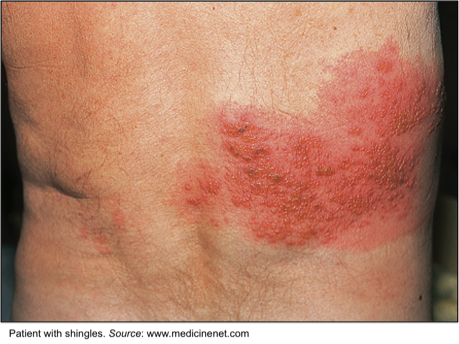
Over 90% of adults in the U.S. have serological evidence for VZV infection, thus putting them at risk for developing shingles (Choo et al., 1995). The incidence of shingles in the U.S. has increased from approximately 3.2 per 1,000 persons in the 1990’s to an estimated 10.0 per 1,000 persons age 22 years and older in 2010 (Yawn, et al., 2013). Advanced age appears to be a key risk factor for developing shingles, with the incidence rising from 1.6 per 1,000 persons in those ages 20-29 to 12.0 per 1,000 persons in those over 80 years of age. Immunosuppression is another risk factor, whether resulting from cancer or immunosuppressive treatments. Recent epidemiological studies show that the incidence of shingles is increasing, due in part to the aging of the population of many industrialized countries along with the increased use of immunosuppressive agents and an increase of immunocompromised individuals due to cancer therapy.
The pain associated with shingles is typically reported to be a deep aching or burning along with altered sensitivity to touch, exaggerated response to stimuli, or electric shock-like pains. Most patients will experience some form of pain for a few weeks. A majority of patients will experience further pain that lasts from anywhere from one to three months. For approximately 15-20% of patients the pain is persistent for more than three months, at which point it is referred to as post-herpetic neuralgia (PHN).
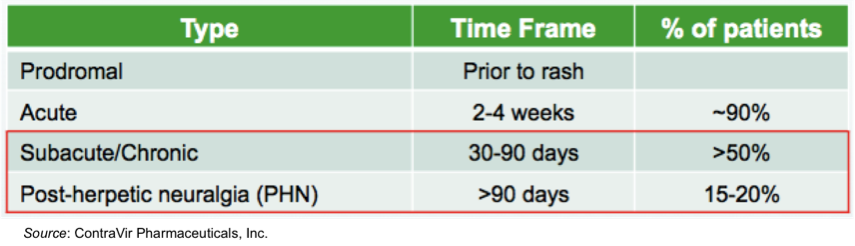
…Post-Herpetic Neuralgia…
PHN is one of a number of types of neuropathic pain (NP), which is a chronic pain caused by tissue damage or disease that affects the somatosensory system, which is the part of the sensory system associated with the conscious perception of touch, pressure, pain, temperature, position, movement, and vibration. The pain associated with PHN can be severe and debilitating and in many patients it has a negative impact on the quality of life by affecting mood, sleep, and overall well-being (Magrinelli et al., 2013; Johnson et al., 2010).
In some patients, pain and temperature detection systems are hypersensitive to light mechanical stimulation (allodynia). Other patients may have severe and spontaneous pain with no allodynia. Since pain is unique to each individual, the words that describe PHN vary considerably and include pricking, tingling, burning, stabbing, or aching. While the exact mechanism is unclear, the pain appears to result from injury of the peripheral nerves brought about by the virus and the associated inflammatory response.
The type of pain along with the variability of its duration makes PHN a very difficult condition to properly treat, and suggests that multiple pathophysiological mechanisms are likely to be involved in its manifestation. Numerous medications have been evaluated in clinical trials to treat PHN, including gabapentin (Neurontin®, Gralise®), pregabalin (Lyrica®), topical lidocaine, topical capsaicin, and gabapentin enacarbil (Horizant®), each of which has received FDA approval for the PHN indication. In addition, the American Academy of Neurology also recommends tricyclic antidepressants and opioids as first-line treatments for PHN.
Pain associated with PHN is often refractory to treatment and many patients require more than one agent to achieve significant pain relief. Also, approximately 40-50% of patients with PHN do not respond to any treatment, with other patients experiencing limited efficacy. Thus, given the difficulty in treating PHN, the ability to prevent or limit the onset of PHN would offer a unique treatment option for shingles patients.
…Current Treatment Options for VZV…
There are currently three antiviral therapies approved by the FDA for the treatment of shingles: famciclovir, acyclovir, and valacyclovir. Clinical trials of these compounds have shown them to be successful in lessening the dermatological symptoms of shingles patients when treatment begins within 72 hours of the first appearance of a shingles-related rash or lesion. However, there are a number of drawbacks with the currently available antivirals, such as 1) none are approved for the reduction of shingles-associated pain or prevention of PHN; 2) they must be taken multiple times per day; and 3) dosing must be adjusted for patients who have renal insufficiency to avoid potential adverse events.
FV-100
FV-100 is an orally available, small-molecule nucleoside analog of CF-1743 that is under development by ContraVir for the treatment of shingles and the prevention of PHN. Both compounds belong to a group of molecules known as bicyclic nucleoside analogues (BCNAs), and are differentiated from the acyclic purine nucleoside acyclovir and the related compound famciclovir based on their specificity, as acyclovir and famciclovir are significantly more active against HSV than VZV, thus the reason for the higher clinical dosing of acyclovir/famciclovir/valacyclovir for treating shingles.
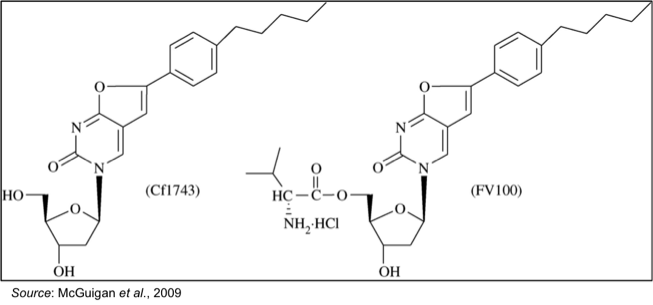
A Phase 2 clinical trial showed FV-100 reduced incidence of PHN. While the study was not powered to show a statistically significant difference, a 37% relative reduction in the risk of PHN for patients taking 400 mg FV-100 is likely a clinically meaningful result.
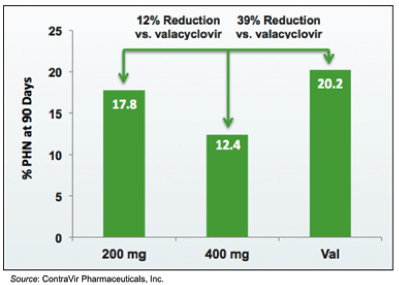
…FV-100 Clinical Plan…
Based upon the Phase 2 results, the company is planning on specifically focusing on the prevention of PHN to differentiate FV-100 from currently available antivirals, as none of them are approved for that indication. The company will be initiating “Clinical Study 007” late in the first quarter or early second quarter of 2015. During the second half of 2014, the company was granted a Type B meeting with the FDA to discuss the proposed design of the trial. The meeting took place early in the first quarter of 2015, with the most important outcome from the meeting being that Study 007 will be regarded as a Phase 3 trial suitable for supporting an NDA filing.
The 007 trial will be a global, multi-center, randomized, double-blind, parallel group, comparative study of FV-100 and valacyclovir at up to 200 centers. The total patient population will be approximately 825 evenly split between three groups: 400 mg FV-100 dosed once a day for seven days, 400 mg FV-100 dosed twice a day for seven days, or 1000 mg valacyclovir dosed three times a day. The patients will be followed for 120 days after treatment. The primary endpoint will be the difference in incidence of PHN between FV-100 and valacyclovir treated patients.
For statistical analysis, it is assumed that no more than 11% of twice-daily FV-100 treated patients and no fewer than 20% of valacyclovir treated patients will experience PHN at Day 120. With 825 total subjects (275 in each group), the trial will be 80% powered to detect the aforementioned difference in incidence of PHN vs. the control, assuming a two-sided 5% significance level.
Hepatitis B Virus
The hepatitis B virus (HBV) is a member of the hepadnavirus family that causes both acute and chronic liver infections. It is estimated that approximately 350-400 million people worldwide have a chronic, lifelong infection. HBV can be classified into 10 genotypes (A to J) based upon an inter-group divergence of more than 8% or more in the complete nucleotide sequence (Stuyver et al., 2000; Arauz-Ruiz et al., 2002; Olinger et al., 2008; Tatematsu et al., 2009). Recent evidence suggests clinical outcome and response to antiviral therapy may be impacted by HBV genotype.
Acute infection with the hepatitis B virus typically results in a loss of appetite, nausea, vomiting, body aches, mild fever, and jaundice. More than 90% of people infected with the hepatitis B virus will recover and be completely free of the virus within six months. According to the World Health Organization, the likelihood of developing a chronic hepatitis B infection is highly dependent upon the age when the infection occurs (WHO fact sheet N°204):
- 80-90% of infants infected during the first year of life develop chronic infections;
- 30-50% of children infected before the age of six develop chronic infections;
- Less than 5% of otherwise healthy adults will develop chronic infection;
- 15-25% of adults who develop chronic infection during childhood will die from hepatitis B associated liver cirrhosis or cancer
…Tenofovir…
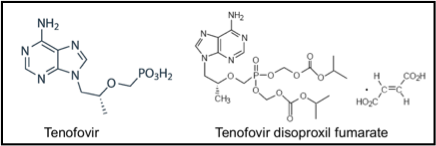
Tenofovir is an nucleotide analog inhibitor of reverse transcriptase, an enzyme involved in a number of diverse roles during different stages of HBV replication (Jones et al., 2013). Tenofovir was originally synthesized in the mid 1980’s and was initially shown to have anti-HIV activity. However, due to its very limited bioavailability the compound did not have the potential for widespread use. Tenofovir disoproxil fumarate (TDF) is a prodrug of tenofovir that was developed to allow for oral administration of the drug. TDF was approved by the FDA for the treatment of HIV in 2001 and for the treatment of chronic HBV infection in 2008. The drug is marketed under the name Viread® by Gilead Sciences.
Gilead has developed tenofovir alafenamide fumarate (TAF) as a follow-on compound to TDF. TAF is reported to have greater antiviral activity than TDF along with better penetration into lymphoid tissues (Eisenberg et al., 2001). In addition, TAF exhibits similar efficacy to TDF but at much lower concentrations, as shown in a Phase 1 study where a TAF dose 10 times less than TDF offered superior antiviral activity (Ruane et al., 2013). Lastly, the higher intracellular concentration of tenofovir following metabolism of TAF supports the notion that kidney toxicity will be reduced compared to treatment with TDF. Gilead is currently testing TAF in two clinical trials for chronic HBV.
…CMX157…
CMX157 is a prodrug of tenofovir that utilizes a proprietary lipid technology developed by Chimerix, Inc. The proprietary technology is utilized to covalently modify a drug molecule with a lipid side-chain that mimics a naturally occurring phospholipid component of cell membranes. The lipid-conjugated molecule can then utilize natural uptake pathways to achieve oral bioavailability, enhance uptake into cells, avoid many toxicities, and yield higher intracellular concentrations of drug.
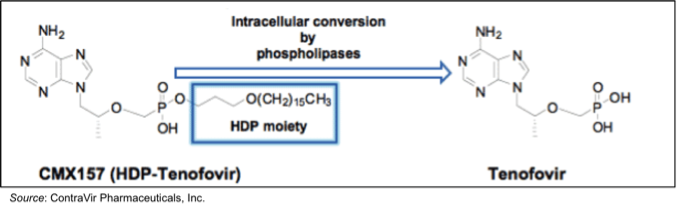
Chimerix tested CMX157 in a Phase 1 trial in 2010. It was a randomized, double blind, placebo controlled, single dose escalation study conducted in healthy volunteers. The purpose of the study was to evaluate the safety, tolerability, and pharmacokinetics of CMX157. Along with CMX157, subjects were also dosed with Viread® to permit comparison of active tenofovir inside patient cells.
Data from the Phase 1 study showed that CMX157 was both safe and well tolerated. The data generated from the study support the notion that CMX157 may have a better safety profile than Viread® as the novel structure of CMX157 resulted in a high intracellular concentration of the active antiviral agent tenofovir diphosphate and decreased levels of circulating tenofovir, which means there is decreased potential for renal side effects associated with Viread®.
Financial Position and Capital Structure
At the end of the second quarter of FY 2015 (December 31, 2015) ContraVir reported $8.8 million of cash. The company’s cash position was strengthened by a recent private placement of 980,000 shares of Series A Convertible Preferred Stock that provided gross proceeds of $9.8 million. The company’s cash burn for the first and second quarters of FY 2015 was $1.1 and $1.4 million, respectively. We estimate the burn rate will increase in the coming quarters due to the initiation of the Phase 3 trial for FV-100. While we believe the company’s current cash position will be enough to fund operations through the end of the calendar year 2015, we would not be surprised to see an additional financing in mid to late 2015.
The Series A Preferred Stock is convertible at any time into shares of common stock at a conversion price of $0.48 per share, which represents 20.4 million shares. In addition, the company licensed CMX157 from Chimerix in exchange for 120,000 shares of Series B Preferred Stock, which are convertible into shares of common stock at a conversion price of $1.12 per share, which represents 1.1 million shares.
The company reported 22.3 million shares outstanding as of February 9, 2015, and when adding in the 4.7 million warrants, 0.3 million currently exercisable stock options, and the shares upon conversion of the Series A and B Preferred Shares gives a fully diluted share count of 48.8 million. This gives the company a current fully diluted market cap of approximately $200 million.
…Large Opportunity for FV-100…
The current treatment options for shingles include famciclovir, acyclovir, and valacyclovir. All of these compounds work similarly in that they inhibit replication of viral DNA by: 1) inhibiting viral DNA polymerase; 2) incorporating into and terminating the elongating DNA strand; and 3) inactivating the viral DNA polymerase. However, none of those compounds is currently approved for the treatment of shingles associated pain or PHN. While FV-100 appears to have a similar mechanism of action, ContraVir is hoping to position the compound as the first shingles medication that is approved for the prevention of PHN.
There are approximately one million shingles cases in the U.S. every year, with the incidence continuing to rise. This phenomenon could be due to an aging population or the increased use of the varicella vaccination, which may limit the re-exposure of individuals to VZV that can boost VZV-specific immunity. Regardless of the cause, a compound that could limit the incidence, severity, and/or duration of PHN would have the ability to gain a large market share in the treatment of shingles.
…The Phase 3 Results will be Key…
How successful FV-100 becomes will be entirely dependent upon the data from the Phase 3 trial and whether the compound is clearly differentiated from the currently available treatment options. In order to justify premium pricing compared to the generic medications now available, we believe that FV-100 will need to show clear efficacy in its ability to alter multiple aspects of PHN. Specifically, we believe there are three important parameters surrounding PHN that must be addressed, which are (in order of importance):
- The incidence of PHN
- The severity of PHN
- The duration of PHN
If FV-100 were shown to clearly and significantly modify PHN in those three areas, then ContraVir would have a highly successful drug. As we look ahead to the Phase 3 trial, we can imagine a number of scenarios that may occur based on the results:
- FV-100 demonstrates a statistically significant decrease in PHN incidence as well as a decrease in both the severity and duration of PHN in those who suffer from it. This is the best-case scenario for the company and would likely lead to favorable pricing and market penetration. Under this scenario we believe FV-100 has strong differentiating characteristics with peak potential sales in the $700 million range.
- FV-100 demonstrates a statistically significant decrease in PHN incidence but does not affect the severity and duration of PHN. This is the most likely scenario and would still represent a sizable opportunity for ContraVir as we believe patients and physicians would still be quite open to a compound that decreased the chance of developing a debilitating condition such as PHN; however, we do not see as strong a pricing and reimbursement opportunity with FV-100. Under this scenario we believe FV-100 has peak potential sales in the $450 million range.
- FV-100 does not cause a statistically significant decrease in PHN incidence, severity, or duration. This is the least likely scenario, as we believe based on the Phase 2 results that FV-100 has a good chance of at least decreasing the incidence of PHN. While this would represent the smallest opportunity for FV-100, the drug would likely still be utilized by a certain subset of physicians and patients. The last scenario would likely restrict any type of premium pricing or sizable market share for FV-100, and under this scenario we forecast peak sales of approximately $250 million.
…Additional Upside Possible with CMX157…
Tenofovir is an inhibitor of reverse transcriptase, an enzyme involved in a number of diverse roles during different stages of HBV replication. However, due to its very limited bioavailability, the compound did not have the potential for widespread use. Tenofovir disoproxil fumarate (TDF) is a prodrug of tenofovir that was developed to allow for oral administration of the drug. TDF was approved by the FDA for the treatment of HIV in 2001 and for the treatment of chronic HBV infection in 2008. The drug is marketed under the name Viread® by Gilead Sciences. We estimate that approximately $500 million in sales of Viread® are for the treatment of HBV infections.
CMX157 is a prodrug of tenofovir that utilizes a proprietary lipid technology developed by Chimerix, Inc. The lipid-conjugated molecule can then utilize natural uptake pathways to achieve oral bioavailability, enhance uptake into cells, avoid many toxicities, and yield higher intracellular concentrations of drug. Data from Phase 1 studies suggests CMX157 may have lower toxicity than Viread® and the potential for reduced renal side effects.
Superior efficacy and a more benign safety profile would likely mean that CMX157 could take a significant market share from Viread® for the treatment of HBV infections. However, Gilead has developed tenofovir alafenamide fumarate (TAF) as a follow-on compound to TDF. TAF is reported to have greater antiviral activity than TDF along with better penetration into lymphoid tissues. In addition, TAF exhibits similar efficacy to TDF but at much lower concentrations, as shown in a Phase 1 study where a TAF dose 10 times less than TDF offered superior antiviral activity. Lastly, the higher intracellular concentration of tenofovir following metabolism of TAF supports the notion that kidney toxicity will be reduced compared to treatment with TDF.
Even if CMX157 has superior efficacy and reduced side effects compared to Viread®, in order to gain appreciable market share it will be necessary for CMX157 to also exhibit characteristics at least on par with TAF, if not better. At this juncture we are assuming that CMX157 will have equivalent efficacy to TAF, which will enable the compound to capture some portion of the market.
Potential upside for CMX157 exists with the possibility of combination therapies, particularly since the patent life for CMX157 extends to 2031, thus giving ContraVir an extended amount of time to test out various combination therapies. While a potential positive for the value of CMX157, at this juncture it is not possible to include potential combination therapies in our valuation model.
Valuation methodology
For FV-100 we model that the -007 trial will conclude in 2016, with an NDA filing in 2017, and approval by the FDA in 2018. We have performed a weighted average discounted cash flow analysis that takes into account the three scenarios discussed above, the likelihood for each outcome, and the pricing/peak market share for each outcome:
- Best = 25% probability, 32% peak market share, $350 / Rx
- Base = 50% probability, 25% peak market share, $290 / Rx
- Lowest = 15% probability, 19% peak market share, $210 / Rx
- Failure = 10% probability, not approved
We use a 22% discount rate and model sales out to 2028, when the FV-100 composition of matter patent expires. Estimated peak revenues under each of the scenarios are: Best = $700 million; Base = $450 million; Lowest = $250 million. This leads to a current valuation for FV-100 of $285 million.
For CMX157, we estimate that a Phase 2 trial gets underway in 2015, a Phase 3 trial in 2017, with an NDA filing and approval in 2019 and 2020. For modeling, we estimate that CMX157 will be as efficacious as TAF, thus we forecast that the drug would cost $12,000 per year in 2015 (the approximate current cost of Viread®), with inflationary increases for the ensuing years. We model peak market share of 20%, which we believe would occur in 2023 and would generate approximately $200 million in revenue. We apply a 22% discount rate and assign a 33% probability of approval. This leads to a current valuation for CMX157 of $31 million.
We combine the valuations for FV-100 and CMX157 along with the company’s current cash position of $8.8 million and an estimated $25 million of capital requirements to arrive at a present value for ContraVir of $300 million. The company currently has a fully diluted share count of 48.8 million (See “Financial Position and Capital Structure”), which leads to a fair value of approximately $6.00 per share.
Potential Risks to our Thesis
FV-100 is not superior to valacyclovir in any outcome in the 007 trial: While we do not believe that this is a likely outcome, based upon the clear trends toward superiority in the Phase 2 trial, there is still a possibility that FV-100 will not show superiority to valacyclovir in any of the outcomes regarding PHN. If this were to occur, we would be forced to drastically reduce our valuation of ContraVir, as the majority of the company’s value at this point is in FV-100.
CMX157 does not show efficacy in treating chronic HBV infections, or is not differentiated from TAF: CMX157 has only been tested in a Phase 1 trial in healthy volunteers, thus we do not have any data on how patients with chronic HBV infections will respond to treatment. In addition, with TAF currently in Phase 3 trials for treating chronic HBV infections, that compound could have a “first to market” advantage. In order to gain appreciable market share, CMX157 will need to be at least as effective as TAF in regards to treatment and decreased side effects.
READ THE LATEST FULL RESEARCH REPORT HERE
SUBSCRIBE TO ZACKS SMALL CAP RESEARCH to receive our articles and reports emailed directly to you each morning. Please visit our website for additional information on Zacks SCR and to view our disclaimer.