By David Bautz, PhD
TSX:BLU.TO
OTC:BLUSF
Financial Update (in Canadian dollars)
On August 12, 2015, Bellus Health, Inc. (TSX:BLU.TO) (OTC:BLUSF) announced financial results for the second quarter of 2015. Revenues for the quarter totaled $0.59 million, compared to $0.42 million in the corresponding period of 2014. The increase in revenue is primarily attributable to higher revenue recognized for accounting purposes in 2015 in relation to the service agreement with Auven Therapeutics for Kiacta™.
Operating expenses for the quarter consisted of $0.86 million in G&A and $0.17 million in R&D, compared to $0.85 million in G&A and $0.37 million in R&D in the corresponding period the previous year. The decrease in G&A expenses was primarily due to lower expenses recognized in 2015 in relation to the company’s deferred share unit and stock option plans. The decrease in R&D expenses was primarily attributable to lower expenses incurred in the development of Shigamab™ during 2015. Net loss for the quarter was $0.43 million, or $0.01 per share.
As of June 30, 2015 the company had cash, cash equivalents, and short-term investments of approximately $10.7 million. We remind investors that the cost of the confirmatory Phase 3 study with Kiacta™ is in the area of $60 million; however, this amount is being fully funded by Bellus’ partner, Auven Therapeutics. As such, we estimate Bellus’ current cash balance of $10.7 million is enough to finance the company’s operations beyond the end of the Kiacta™ Phase 3 study and reporting of topline results in mid-2016.
Update on Kiacta™ Phase 3 Clinical Trial
Bellus’ lead compound is Kiacta™, a drug candidate currently in a confirmatory Phase 3 trial for the treatment of AA Amyloidosis, an orphan disease arising from the improper extracellular deposition of serum amyloid A (SAA) protein fragments. The condition leads to renal dysfunction and typically progresses quickly to end-stage renal disease and death. There is currently no cure for AA Amyloidosis.
Amyloid A Amyloidosis
Amyloidosis comprises a generic term for a heterogeneous group of diseases that are characterized by the deposition of normally soluble proteins in the extracellular space in the form of insoluble fibrils. Amyloid A (AA) amyloidosis is the most common form of systemic amyloidosis. Also called secondary amyloidosis, it is most commonly associated with rheumatic diseases (such as rheumatoid arthritis) in developed countries, while in developing countries the most common cause is chronic infection. The fibrilar deposits are composed of fragments of the acute phase protein serum amyloid A (SAA), which is produced in high quantities during the inflammatory response. The kidney, liver, and spleen are the major sites of involvement. The disease is typically not diagnosed until overt kidney damage is detected in the form of proteinuria, nephrotic syndrome, or other failure in renal function. We estimate there are approximately 12,300 AA amyloidosis patients eligible to receive Kiacta™ in the world, with approximately 6,800 in the U.S., 3,500 in the E.U., and an additional 2,000 in the rest of the world.
Brief Background on Kiacta™
Kiacta™ (eprodisate) is a small, negatively charged molecule that shares certain structural similarities with heparin sulfate and is known to bind to A-SAA (Manetti et al., 2008). Kiacta™ binds to the glycosaminoglycan (GAG) binding site of A-SAA and competes with naturally occurring GAGs, thus inhibiting amyloid fibril polymerization and deposition in tissues (Ancsin et al., 1999).
Kiacta™ was previously evaluated for the treatment of AA amyloidosis in patients with renal involvement in a Phase 2/3 trial that was conducted from 2001 to 2004 (Dember et al., 2007). Treatment with Kiacta™ was associated with a 42% reduction in the risk of worsening renal disease (hazard ratio, 0.58; 95% confidence interval [CI], 0.37 to 0.93; P = 0.025). Even after adjusting for potentially important baseline variables (e.g., renal function, underlying disease, etc.) and for SAA concentration the risk reduction was still maintained. There was no effect on urinary protein excretion, with the benefit of Kiacta™ on the primary composite end point being due to its effect on progression of renal disease. In addition, there was no significant difference between the two groups in the risk of death.
Kiacta™ Phase 3 Confirmatory Study
The Kiacta™ Phase 3 confirmatory study (NCT01215747) completed enrollment in January 2015, with a total of 261 AA amyloidosis patents participating in the study. The study had previously reached its target enrollment of 230 patients earlier in 2014; however, the enrollment was extended beyond 230 patients as eligible patients who were in the pre-screening and screening process at the time the target enrollment was reached were allowed the opportunity to enroll in the study.
To qualify for the study, patients must have had confirmed AA Amyloidosis demonstrated by positive biopsy using congo red staining and immuno-histochemistry or electronmicroscopy. Patients must have had persistent proteinuria greater than 1 gram and a CrCl level greater than 25 ml/min at two distinct visits over a 24-hour period. Randomization was 1:1 between Kiacta™ and the placebo. Enrollment took place at over 70 sites in 30 countries around the globe.
The confirmatory Phase 3 study is an event-driven trial that will end when 120 patients have experienced renal decline and for which the company has obtained a U.S. FDA Special Protocol Assessment (SPA). Renal decline, the primary endpoint of the study, is a composite assessment of persistent increase in serum creatinine ≥ 80%, persistent decrease in creatinine clearance ≥ 40%, or progression to end-stage renal disease / dialysis. The primary efficacy analysis is the ‘Time to first worse event (log rank test)’ stratified by baseline proteinuria (3 g/day) and eGFR (60 ml/min).
As with most other clinical trials, there are occasional meetings of the Data Safety Monitoring Board (DSMB) as part of the Phase 3 study for Kiacta™. The DSMB independently assesses the safety of Kiacta™ treatment throughout the study. The DSMB last met in July 2015 and recommended that the study continue as per protocol.
As of mid-August 2015, the company reported that approximately 85% of the required 120 events to complete the study have occurred. We now anticipate that the study will conclude before the end of the first quarter of 2016, and that top-line data will be available by mid-2016.
We remind investors that Kiacta™ is partnered with the global private equity firm Auven Therapeutics. Auven is conducting the Phase 3 trial and funding 100% of the development costs, which are estimated to cost in excess of US$60 million.
IND for Sarcoidosis Clinical Trial to be Filed in 2015
Bellus and Auven previously announced the signing of a license agreement with Mount Sinai Hospital under which Auven obtained the rights to develop Kiacta™ as a treatment for chronic sarcoidosis.
Sarcoidosis is a multisystem inflammatory disease that is characterized by the presence of granulomas, which are a collection of immune cells that form when the immune system attempts to isolate substances it deems as foreign but can’t eliminate. Approximately 120,000 people in the U.S. have the condition, and while most patients go on to recover approximately 30% will develop a chronic, debilitating disease. The disease is responsible for killing 1-5% of patients in which it occurs. Corticosteroids are the current first line treatment for sarcoidosis patients, however nonsteroidal immunosuppressants such as methotrexate and azathioprine are also utilized.
The current plan for the development of Kiacta™ as a treatment for sarcoidosis is for Auven to conduct a Phase 2/3 clinical trial to evaluate the drug’s safety and effectiveness. We anticipate the study protocol being finalized shortly and the filing of an Investigational New Drug (IND) application to occur before the end of 2015. The Phase 2 trial should take approximately 18 months to complete. Just as with the confirmatory trial in AA amyloidosis, all costs related to the development of Kiacta™ in sarcoidosis will be borne by Auven. Any proceeds from potential future revenue of Kiacta™, including the rights to Kiacta™ for sarcoidosis, are subject to the proceeds sharing agreement between Bellus and Auven.
Shigamab™ Preclinical Studies Ongoing
Shigamab™ is a monoclonal antibody therapy being developed for the treatment of Hemolytic Uremic Syndrome caused by Shiga toxin-producing E. coli (sHUS), which principally affects the kidneys and often leads to acute dialysis, and in certain cases chronic kidney disease and death, primarily in children. Bellus has been granted Orphan Drug designation for Shigamab™ in the U.S. and EU for sHUS.
During 2014, in studies performed in collaboration with the Uniformed Services University of the U.S. Department of Defense, Shigamab™ was shown to reduce toxicity of Shiga toxin type 2 in a sHUS mouse model, even following delayed treatment, as measured by body weight loss, renal biomarkers and renal histopathology. Further pre-clinical studies are being conducted to evaluate Shigamab™ in the treatment of toxicity of Shiga toxin type 2. A clinical advisory board meeting will be held in September 2015 to discuss the design of the Phase 2 clinical trial protocol.
Conclusion: Valuation & Recommendation
We are valuing the company based on the potential for Kiacta™ in AA Amyloidosis. There is the potential for upside to our valuation based on moving Kiacta™ into new areas such as sarcoidosis and with pre-clinical monoclonal antibody candidate Shigamab™, as neither of those indications are currently in our model.
Orphan drugs, which Kiacta™ is considered since it is targeting a population of approximately 12,000 worldwide, typically command premium pricing, which is shown in the following chart.
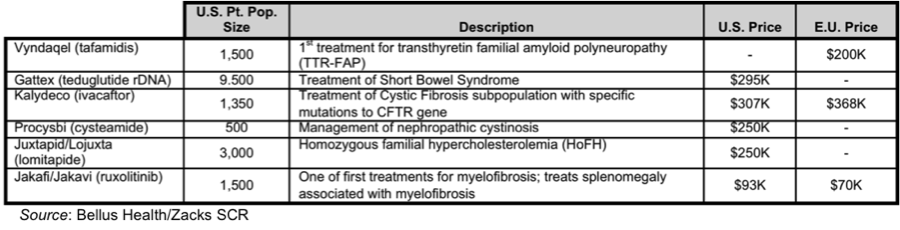
We are modeling for Kiacta™ to be priced at $200,000/year in the U.S., $150,000/year in the E.U., and have peak market share of 30%. Based upon these values, we forecast Kiacta™ to have peak revenues of between $500 and $750 million. Applying a discount rate of 20%, free cash flow as 65% of revenues, and a 75% probability of success for the Kiacta™ Phase 3 clinical trial gives us a target price of $2.50. Given the current stock price, we believe that Bellus continues to be significantly undervalued and offers investors tremendous upside at the current valuation. As a reminder, Bellus and Auven have hired Lazard to facilitate the sale of Kiacta™, which we believe increases the likelihood that a larger pharmaceutical company will end up acquiring the drug most likely after results from the Phase 3 trial are announced.
READ THE LATEST FULL RESEARCH REPORT HERE
SUBSCRIBE TO ZACKS SMALL CAP RESEARCH to receive our articles and reports emailed directly to you each morning. Please visit our website for additional information on Zacks SCR and to view our disclaimer.