By: Nisha Hirani, MD & David Bautz, PhD
NASDAQ:LPCN
Lipocine Inc. (NASDAQ:LPCN) is a specialty pharmaceutical company that has an oral drug delivery technology system, Lip’ral™, for products that affect the health of men and women. The Lip’ral™ promicellar technology is a patented platform based on lipid compositions which form an optimal dispersed phase in the gastrointestinal environment for improved absorption of insoluble drugs. The company is currently developing three product candidates in conjunction with this system (LPCN 1021, LPCN 1111, and LPCN 1107) that are designed to enhance the pharmacokinetic parameters of the drugs, facilitate lower dosing requirements, reduce side effects, and limit gastrointestinal interactions that would otherwise decrease the effectiveness of the compounds.
Business Update
We continue to remain optimistic regarding the Lipocine story. For the purpose of this research report, we would like to offer a quick update regarding LPCN 1107 and LPCN 1111 in addition to shedding some light on the Repros Therapeutics’ enclomiphene citrate story in regards to LPCN 1021, and how this should be viewed by Lipocine investors.
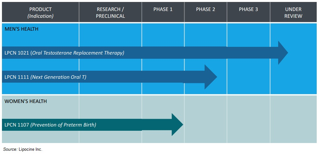
Lipocine is developing LPCN 1107 as the first oral hydroxyprogesterone caproate (HPC) for the potential treatment of prevention of preterm birth (PTB) by formulating HPC with the Lip’ral™ technology. An oral formulation of HPC would offer a number of advantages over the current injectable formulation of the drug, including elimination of pain and reaction at the injection site as well as eliminating weekly trips to the doctor’s office for administration of the compound. In approximately 12% of pregnancies, babies are born prior to 37 weeks gestation, which is the definition of preterm birth. Preterm birth is associated with a wide range of problems, including breathing issues, feeding difficulties, cerebral palsy, developmental delay, vision problems, and hearing impairment. In addition, preterm birth remains the leading cause of infant mortality, accounting for as many as 75% of perinatal deaths (Ananth et al., 2006).
On September 28, 2015, Lipocine announced initiation of its Phase 2 multi-dose PK dose finding clinical study with the first subject dosed with LPCN 1107. The primary objective of the study will be study pharmacokinetics over an extended period of time in pregnant women at multiple dose strengths of oral administration of LPCN 1107. With two Phase 1 proof-of-concept studies in both pregnant and non-pregnant women completed, we believed that this dose selection Phase 2 study would commence in the fourth quarter 2015 or first quarter 2016, so we are happy to report that the first patient has been dosed earlier than we expected during the third quarter 2015. We believe that top-line results will be reported during the first quarter 2016. Once this study is completed, Lipocine plans to schedule an End-of-Phase 2 meeting with the FDA regarding the Phase 3 development plan. We think this meeting will occur at some point during the second quarter 2016. If all goes well, we believe that LPCN 1107 will be Phase 3 ready by mid-late 2016. We continue to believe that the area of preterm birth, even in countries as developed as the United States, is an area of unmet need, and at this point, we see a path forward for LPCN 1107 and look forward to watching the LPCN 1107 story unfold.
As a reminder, LPCN 1107 received orphan drug designation in June 2015 by the FDA and has the potential to become the first oral HPC product for the prevention of pre-term birth in women with a prior history of at least one pre-term birth. In order to obtain orphan drug exclusivity upon approval, we would like to mention that LPCN 1107 will need to demonstrate clinical superiority to the same drug already approved for the same orphan indication. This can be achieved, for instance, by demonstrating clinical superiority through establishing that the product offers a "major contribution to patient care."
LPCN 1111, is the next-generation oral TRT version of LPCN 1021, that has the potential for once daily dosing through the Lip’ral™ technology. With positive Phase 2a data in place, a Phase 2b trial is expected to begin in the fourth quarter of 2015, and an End-of-Phase 2 meeting with the FDA should occur at some point during the second quarter 2016. We believe that it should be Phase 3 ready by mid-2016. As per management guidance, LPCN 1111 is about 24 months behind LPCN 1021. In our view, based on Phase 2a data, this drug looks like a potential game-changer for TRT.
- LPCN 1021
On August 28, 2015, Lipocine Inc. submitted a 505(b)(2) New Drug Application (NDA) to the U.S. Food and Drug Administration (FDA) for Lipocine’s lead asset LPCN 1021. LPCN 1021 is a testosterone replacement therapy (TRT) designed for oral twice daily dosing in adult hypogonadal males with low testosterone. We should find out the status of the application in November 2015, and if it is indeed accepted, we expect a PDUFA date will be set for some time in June 2016, following the standard 10-month review period. Lipocine has continually executed on the timeline previously laid out for developing LPCN 1021, and we are happy to report that the company filed the NDA with the FDA as per prior guidance.
Results from the Phase 3 Study of Oral Androgen Replacement ("SOAR") trial was part of the NDA submission. SOAR was a randomized, parallel-group, active-controlled, open-label Phase 3 clinical study of oral testosterone replacement therapy (TRT) in hypogonadal males with low testosterone as indicated by a level of < 300 ng/dL. In total, 315 subjects at 40 different sites were randomized for a total of 52 weeks of treatment with 210 subjects randomized to receive LPCN 1021, while the remaining 105 subjects were randomized to receive the active control, Androgel®.
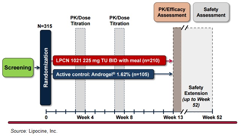
As a reminder, the study met its primary efficacy endpoint by successfully restoring testosterone levels to the normal range in 88% of the subjects. Additionally, 85% of the subjects reached their final dose with no more than one dose titration. LPCN 1021 treatment was well-tolerated with no hepatic, cardiac, gastrointestinal, or drug related serious adverse events. Our previous updates discuss LPCN 1021 data from the Phase 3 SOAR trial, the food effect study, and 52 week safety extension arm study in depth. We continue to believe the oral formulation of LPCN 1021, if approved, may improve patient compliance as it appears to be a generally safe, effective, and a more convenient TRT option as compared to topical and injectable TRT products that are currently on the market. LPCN 1021 will have to adhere to all of the new regulations set forth by the FDA if approved. For instance, cautionary language will be required on the label for possible cardiovascular and stroke related risk with TRT, and the lack of benefit and safety of TRT in age-related hypogonadism.
LPCN 1021 Competitive Landscape…
There has been increased interest in developing oral testosterone replacement therapies (TRT) as well as testosterone therapies that are not considered testosterone replacement. We have discussed the competitive landscape for LPCN 1021 in previous updates, and with recent news surrounding Repros Therapeutics Inc. ® (NASDAQ: RPRX) seeking U.S. approval for enclomiphene citrate (formerly known as Androxal®), we believe it is important to reiterate the differences between LPCN 1021 and enclomiphene citrate. We believe there is a lot of investor chatter surrounding the upcoming advisory panel meeting and potential approval of the drug. The FDA's Bone, Reproductive and Urologic Products Advisory Committee will meet on November 3, 2015 to review Repros’ NDA for enclomiphene citrate for the treatment of overweight men with low testosterone due to secondary hypogonadism wishing to restore normal testicular function. A final response from the FDA regarding the approval status for enclomiphene is expected by November 30, 2015.
Enclomiphene and LPCN 1021 have different mechanisms of action and different regulatory approval processes. Since enclomiphene is not a TRT, we believe that if there are any negative sentiments from the upcoming Ad Comm or if enclomiphene does not receive approval, this should not affect Lipocine and should not impact LPCN 1021’s approval. Any regulatory setback would weigh tremendously on the Repros stock, but in our opinion, should not impact the fundamental valuation of Lipocine Inc. We will discuss why we believe this is the case in further detail below.
Background on Repros & Enclomiphene
Repros Therapeutics Inc.® is a development stage pharmaceutical company that develops drugs to treat reproductive system and hormonal disorders. The company currently has two pipeline candidates, one for male secondary hypogonadism (enclomiphene), and another for uterine fibroids and endometriosis (Proellex®).
Repros is developing enclomiphene (formerly known as Androxal®), an orally active, single isomer of clomiphene citrate that has been shown to be effective in treating secondary hypogonadism in overweight men of reproductive age with low testosterone wanting to restore normal testicular function. It is a small molecule compound that works by inhibiting the effects of estrogen on the pituitary gland thus stimulating the release of hormones that induce testosterone production. Unlike testosterone administration, it does not adversely affect the testes or fertility.
Enclomiphene is a SERM, not a traditional TRT
Selective estrogen receptor modulators, or SERMs, are often used to treat conditions related to postmenopausal women's health, including hormone responsive cancer (such as breast cancer) and osteoporosis, and include tamoxifen, raloxifene and toremifene (Maximov et al., 2013). Clomiphene citrate (Clomid), also a SERM, has been used off-label to treat secondary male hypogonadism, but does not always work consistently. Secondary hypogonadism is associated with obesity and Repros believes it is among the most common causes of low testosterone in men. In secondary hypogonadism associated with obesity, estrogen suppresses pituitary secretions of important hormones that are necessary for testosterone production by the testes.
Repros’ enclomiphene citrate is a SERM (sometimes referred to as anti-estrogen), and works centrally by blocking estrogen at the level of the hypothalmixc-pituitary axis increasing LH levels, which results in increased testosterone production. In other words, it restores pituitary gland secretions which stimulates the testes to produce testosterone. Repros has tweaked the drug so that it appears to be more effective than Clomid. It is important to understand that a SERM, like enclomiphene, is not a form of testosterone.
The enclomiphene agent is not a traditional TRT, in that rather than administering testosterone to the body, it is a compound that stimulates the body to make more testosterone. It is being targeted specifically for the treatment of secondary hypogonadism, while LPCN 1021, if approved, will be labeled for the treatment of both primary and secondary hypogonadism. However, there is some overlap between the two conditions, in that doctors have prescribed the use of TRT for the treatment of low testosterone due to aging or other medical conditions (obesity, diabetes, etc.). Thus, enclomiphene and LPCN 1021 could theoretically be utilized to treat some of the same patients.
Repros has reported results from two Phase 3 studies of Androxal® with results showing that treatment with Androxal® does not affect sperm production, while treatment with a topical TRT decreases sperm concentration (below). In addition, Androxal® was shown to increase the average testosterone values for the treated group.
The Enclomiphene Timeline
As way of background, Repros had scheduled a Type B Pre-NDA meeting with the FDA in September 2014, and that meeting was changed to a Type C meeting in December 2014 with an announcement that no additional clinical trials would be necessary. The NDA was subsequently filed on February 2, 2015, and the FDA accepted the NDA on April 1, 2015. It was then announced that the FDA assigned a Prescription Drug User Fee Act (PDUFA) goal date of November 30, 2015. The Division of Bone, Reproductive and Urologic Products of the U.S. FDA has scheduled the advisory committee (Ad Comm) to review the company’s NDA for its enclomiphene product candidate on November 3, 2015.
If the enclomiphen citrate product receives approval, it would be available in 12.5 milligram (mg) and 25 mg capsules for the proposed treatment of secondary hypogonadism in fertile men (with more than 15 million sperm/milliliter), younger than 60 years of age with a Body Mass Index (BMI) of greater than 25 kilograms (kg)/meters squared (m2). In our opinion, this is a relatively narrow label of usage since there are age, fertility and weight restrictions. We believe that Repros is also exploring the possibility of expanding enclomiphene’s label for use in hypogonadal men with type 2 diabetes, and the company has an active IND open with the FDA’s Division of Endocrine and Metabolic Products for this indication.
We would like to point out that Repros announced that the FDA Advisory Panel that met on September 17, 2014 to discuss the appropriate population suited to testosterone replacement therapy (TRT) did not directly apply to Androxal® since it is not a form of testosterone.
Enclomiphene Seeks Approval Outside the U.S.
On April 6, 2015, it was announced that the European Medicines Agency (EMA) informed Repros that its enclomiphene citrate capsules were eligible for submission for a centralized marketing authorization application (MAA) as a New Active Substance (NAS). We are not sure if this will be ultimately approved, but if the MAA is successful, centralized marketing authorization would be valid in all European Union member states, as well as in the European Economic Area, a total of 31 countries. It is our understanding, that if enclomiphene citrate is granted New Active Substance status, this will allow an application to be made for a supplementary protection certificate which, if approved, could extend the exclusivity period of the drug. We believe that Repros plans to submit the regulatory application in the EU during the first half of 2016.
We believe that all of this means that Repros is still ahead of Lipocine by approximately six months; however, we will be unable to gauge how the agencies will view the enclomiphene citrate agent and how likely it is to be approved. Regardless, we think it is important for investors to take away that enclomiphene citrate (formerly known as Androxal®) is targeting a different indication and intended patient population than TRTs such as LPCN 1021.
Conclusion & Recommendation
Although, Lipocine shares have fallen more than 27% since our August 2015 update, we still remain proponents of the company. We believe the recent pullback presents investors with an interesting buying opportunity. We think Hillary Clinton’s comments regarding drug pricing created a broad sell-off in the biotechnology and pharmaceutical industries that impacted small cap biotech names even more so than the larger cap biotechs. We do not believe Clinton’s comments will have any long-term impact on the fundamental Lipocine story. We believe the recent decline in share price of Lipocine due to the industry correction should be considered a great buying opportunity.
With the NDA submitted, we still see LPCN 1021 as having significant potential, and we should have a better sense of the path forward for the drug if the NDA is accepted in November 2015. We would also like to reiterate to investors that we believe the outcome of the Repros’ Ad Comm/PDUFA date should not impact the fundamental value of Lipocine. Enclomiphene citrate and LPCN 1021 have different mechanisms of action and different regulatory approval processes. We remain bullish on Lipocine shares as an investment in the specialty pharmaceutical sector because we think the company has a promising pipeline. We would like to bring attention to several near term value drivers, which are outlined below:
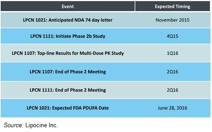
With the NDA submitted, we expect LPCN 1021 will see U.S. approval around the middle of 2016, and model peak U.S. sales in the $400 million range. We remind investors that there is a second-generation version of the drug, LPCN 1111, currently in Phase 2 trials that could expand the potential peak U.S. sales to over $600 million. We believe that LPCN 1111 is roughly 24 months behind LPCN 1021 in development. Additionally, it is important to point out that LPCN 1111 is intended to be a once daily dosing product, as compared to the twice-daily dosing profile of LPCN 1021.
We believe the news that LPCN 1107 has received U.S. orphan drug designation and that the first patient has been dosed in the dose selection Phase 2 study ahead of schedule are significant positives for the company. Orphan designation not only protects the intellectual property of the drug, but also allows for aggressive pricing and reduced development and regulatory costs. As noted above, we model peak U.S. sales of LPCN 1107 of approximately $275 million.
As of June 30, 2015, Lipocine had cash, cash equivalents, and marketable investment securities of $53.4 million. We believe the current cash balance is sufficient to fund operations for the next two years, assuming that LPCN 1021 is approved in 2016. The current market capitalization is approximately $255 million, and we still view the shares as undervalued. Our NPV analysis on the three product candidates pegs fair value at about $390 million, or approximately $20 per share, and we are maintaining a ‘Buy’ rating on the stock. We still believe that Lipocine represents a very attractive investment opportunity at the current price.
FOLLOW NISHA ON TWITTER!
READ THE LATEST FULL RESEARCH REPORT HERE
SUBSCRIBE TO ZACKS SMALL CAP RESEARCH to receive our articles and reports emailed directly to you each morning. Please visit our website for additional information on Zacks SCR and to view our disclaimer.