By: Nisha Hirani, MD, and David Bautz, PhD
NASDAQ:LPCN
We continue to remain advocates of Lipocine, Inc. (NASDAQ:LPCN). In addition to offering a financial and business review for the second quarter in this report, we would also like to offer an update regarding Lipocine’s assets, and why we continue to remain positive in regards to the Lipocine story. We still believe that the stock represents an attractive long-term investment opportunity, and are maintaining our price target of $20, and continue to rate the stock a ‘Buy’.
Financial Review
On August 11, 2015, Lipocine (LPCN) reported financial results for the second quarter ending June 30, 2015. As expected, the company did not report any revenues in the quarter. Net loss was $4.2 million, or $0.26 per share, for the second quarter of 2015, as compared with a net loss of $7.0 million, or $0.55 per share, for the second quarter of 2014.
Research and development expenses were $3.2 million for the second quarter of 2015, compared with $6.0 million for the second quarter of 2014. This decrease in research and development expenses was due to reduced external service provider costs associated with clinical research and contract manufacturing costs. For the second quarter of 2015, general and administrative expenses were $1.1 million, compared to $1.0 million for the same period in 2014. R&D as well as G&A expenses were in-line with our expectations for the quarter.
As a reminder, Lipocine completed an underwritten public offering of 5.3 million shares of its common stock at $6.50 per share on April 29, 2015. Lipocine walked away with net proceeds of approximately $32.5 million after fees.
Operating burn for the second quarter of 2015 was $4 million. As of June 30, 2015, Lipocine had cash, cash equivalents, and marketable investment securities of $53.4 million, compared with cash and cash equivalents of $27.7 million as of December 31, 2014. This includes net proceeds of $32.5 million from the public offering mentioned above.
We continue to believe the current cash balance is sufficient to fund operations for the next two years. We believe that the recent completion of the public offering will allow Lipocine to step up development efforts of LPCN 1111 and LPCN 1107, in addition to focusing on the on-going pre-commercial LPCN 1021 activities. Assuming that LPCN 1021 is approved in 2016, we believe operating expenses will rise in anticipation of the company hiring an adequate sized sales force to promote the drug, in addition to expenses related to maintaining, expanding, and protecting its IP portfolio, and other activities to prepare for the commercialization launch.
As a reminder to investors, our update from March 2015 outlined the case for why we believe LPCN 1021, the company’s oral testosterone replacement therapy, has significant potential for commercial success. Our update from July 2015 offered an update regarding Lipocine’s assets, and why we continue to remain optimistic regarding the Lipocine story. We continue to believe the stock represents an attractive long-term investment opportunity, and will proceed to focus on second quarter 2015 business highlights below.
A Brief Overview of Lipocine Inc.
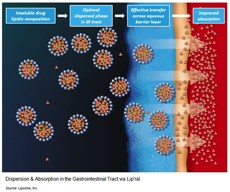
Lipocine, Inc. is a specialty pharma company that has an oral drug delivery technology system, Lip’ral™, for products that affect the health of both men and women. The Lip’ral™ promicellar technology is a patented platform based on lipid compositions which form an optimal dispersed phase in the gastrointestinal environment for improved absorption of insoluble drugs (below).
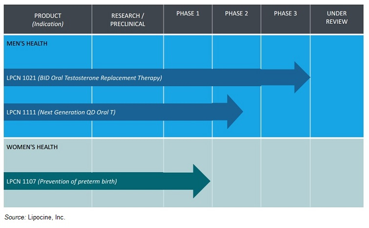
The company is currently developing three product candidates in conjunction with this system (LPCN 1021, LPCN 1111, and LPCN 1107) that are designed to enhance the pharmacokinetic parameters of the drugs, facilitate lower dosing requirements, reduce side effects, and limit gastrointestinal interactions that would otherwise decrease the effectiveness of the compounds (below).
Business Update & Second Quarter Highlights
Since it has been quite a busy quarter for Lipocine, we believe it is important to draw attention to several key highlights below.
…Encouraging Food Effect & Safety Data for LPCN 1021…
Lipocine’s lead asset, LPCN 1021, is a testosterone replacement therapy (TRT) designed for oral twice daily dosing in hypogonadal men with low testosterone. The company has wrapped-up the extension study of a pivotal Phase 3 clinical trial run under protocols in-line with FDA guidelines for approval of TRTs. On April 30, 2015, Lipocine announced completion of the last patient visit in the safety assessment portion of its SOAR (Study of Oral Androgen Replacement) Phase 3 clinical study (NCT02081300). As a reminder, Lipocine announced positive top-line efficacy results from the study back in September 2014. SOAR evaluated the safety and efficacy of oral LPCN 1021 in hypogonadal men with low testosterone, and showed positive results with respect to the trial's primary efficacy endpoint with no serious drug related or cardiovascular adverse events to date.
LPCN 1021 “Food Effect” Study
On June 15, 2015, Lipocine announced successful completion of its ongoing "food effect" study for LPCN 1021, which was conducted per the FDA requirement for submitting the NDA. The study was an open-label, randomized, four-period, four-treatment, crossover, single-dose trial evaluating bioavailability and pharmacokinetics of LPCN 1021 as a function of food fat content in hypogonadal males. The study was conducted at a single site and enrolled 14 hypogonadal males between the ages of 18 and 80, with 13 patients completing the study.
We review these preliminary results from the “food effect” study in more detail in our full report, and see the results as excellent news for Lipocine as the study showed consistent and predictable therapeutic levels of testosterone when administered with a meal with no apparent significant sensitivity to meal fat content. As per previous guidance, we still believe that management plans to submit these preliminary results from the “food effect” study to the FDA for review and comment prior to submitting the NDA.
LPCN 1021 Safety Data from Phase 3 Trial
As a reminder to investors, SOAR was a randomized, parallel-group, active-controlled, open-label Phase 3 clinical study of oral testosterone replacement therapy (TRT) in hypogonadal males with low testosterone as indicated by a level of < 300 ng/dL. In total, 315 subjects at 40 different sites were randomized for a total of 52 weeks of treatment with 210 subjects randomized to receive LPCN 1021, while the remaining 105 subjects were randomized to receive the active control, Androgel®.
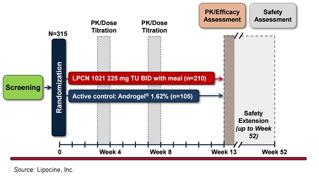
On June 29, 2015, Lipocine announced 52-week safety results from the SOAR Phase 3 clinical study evaluating efficacy and safety of LPCN 1021. LPCN 1021 was well-tolerated with no hepatic, cardiac or drug-related serious adverse events observed. We review the data in our full report, but overall, we believe these results show that LPCN 1021 was well-tolerated during the 52 weeks of dosing with no hepatic, cardiac, or drug-related serious adverse events. All in all, we believe LPCN 1021 fared pretty well against the competition, and that the adverse event profile for LPCN 1021 is comparable to the active control, Androgel® 1.62%. We continue to believe the oral formulation of LPCN 1021, if approved, may improve patient compliance as it appears to be a generally safe, effective, and more convenient TRT option as compared to topical and injectable TRT products that are currently on the market.
…LPCN 1107 Receives Orphan Drug Designation for the Prevention of PTB…
Lipocine is developing LPCN 1107 as the first oral hydroxyprogesterone caproate (HPC) product for the prevention of preterm birth (PTB) by formulating HPC with the Lip’ral™ technology. An oral formulation of HPC would offer a number of advantages over the current injectable formulation of the drug, including elimination of pain and reaction at the injection site as well as eliminating weekly trips to the doctor’s office for administration of the compound.
On June 2, 2015, Lipocine announced that the U.S. Food and Drug Administration (FDA) granted orphan drug designation to LPCN 1107, the company's oral HPC product candidate, a potential treatment for the prevention of PTB. In order to obtain orphan drug exclusivity upon approval, we would like to mention that LPCN 1107 will need to demonstrate clinical superiority to the same drug already approved for the same orphan indication. This can be achieved, for instance, by demonstrating clinical superiority through establishing that the product offers a "major contribution to patient care."
Lipocine announced its development plans for LPCN 1107 on June 8, 2015. Lipocine received a Type C written response from the FDA that outlined next steps in the development of the product as a potential treatment for the prevention of PTB. Based on this FDA feedback, Lipocine plans to complete formulation optimization of LPCN 1107, and then will conduct a multiple-dose pharmacokinetic dose selection study in pregnant women. With two Phase 1 proof-of-concept studies in both pregnant and non-pregnant women completed, we believe that this dose selection Phase 2 study will commence in the fourth quarter 2015 or first quarter 2016. Once this study is completed, Lipocine plans to schedule an End-of-Phase 2 meeting with the FDA regarding the Phase 3 development program. If all goes well, we believe that LPCN 1107 will be Phase 3 ready by mid 2016. We continue to believe that the area of preterm birth, even in countries as developed as the United States, is an area of unmet need, and at this point, we see a path forward for LPCN 1107, and look forward to watching the LPCN 1107 story unfold.
Conclusion & Recommendation
With all of the positive news for Lipocine over the past quarter, we remain convinced that the company continues to move even closer to the NDA submission for lead asset LPCN 1021. The market has begun to appreciate this as well, as the share price has increased nearly 160% since our March 2015 report! We remain big proponents of Lipocine as an investment in the specialty pharmaceutical sector. We would like to bring attention to several near term value drivers, which are outlined below:
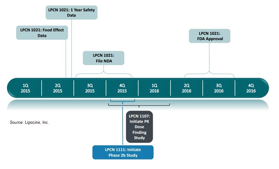
Full data from the recently completed Phase 3 clinical trial with LPCN 1021 was presented at the American Urological Association annual meeting in May 2015. The company is currently preparing the NDA to seek approval for LPCN 1021, and is still on track to submit the application to the U.S. FDA in the next few months. We expect LPCN 1021 will see U.S. approval around the middle of 2016, and model peak U.S. sales in the $400-500 million range. We remind investors that there is a second-generation version of the drug, LPCN 1111, currently in Phase 2 trials that could expand the potential peak U.S. sales to over $600 million. We believe that LPCN 1111 is roughly 24 months behind LPCN 1021 in development. Additionally, it is important to point out that LPCN 1111 is intended to be a once daily dosing product, as compared to the twice daily dosing profile of LPCN 1021.
We believe the news that LPCN 1107 has received U.S. orphan drug designation is a significant positive for the company. It not only protects the intellectual property of the drug, but also allows for aggressive pricing and reduced development and regulatory costs. As noted above, we model peak U.S. sales of LPCN 1107 of approximately $275 million. We look forward to the dose selection Phase 2 study to commence in the fourth quarter 2015 or first quarter 2016.
As a reminder, on April 29, 2015, Lipocine completed an underwritten public offering of 5.3 million shares of its common stock at $6.50 per share. Lipocine received net proceeds of approximately $32.5 million after fees. As a result of the public offering, and as of June 30, 2015, Lipocine had cash, cash equivalents, and marketable investment securities of $53.4 million. We believe the current cash balance is sufficient to fund operations for the next two years, assuming that LPCN 1021 is approved in 2016.
Although the current market capitalization is over $345 million, and has increased over 55% since our last update at the end of July 2015, we still view the shares as undervalued. We have updated our NPV analysis on the three product candidates discussed above, and our analysis pegs fair value at about $390 million, or approximately $20 per share, and we are maintaining a ‘Buy’ rating on the stock. We continue to believe that Lipocine represents a very attractive investment opportunity at the current price.
READ THE LATEST FULL RESEARCH REPORT HERE
SUBSCRIBE TO ZACKS SMALL CAP RESEARCH to receive our articles and reports emailed directly to you each morning. Please visit our website for additional information on Zacks SCR and to view our disclaimer.