By David Bautz, PhD
OTC:MBVX
MabVax (OTC:MBVX) is a clinical-stage cancer immunotherapy company engaged in the discovery, development, and commercialization of proprietary human monoclonal antibody products and vaccines for the diagnosis and treatment of cancer. The company currently has two cancer vaccines in Phase 2 clinical trials with another cancer vaccine ready to enter a Phase 2 trial in 2016. The lead antibody candidate is being developed for three separate indications: as a therapeutic for the treatment of metastatic pancreatic and colorectal cancer; as a diagnostic agent for pancreatic cancer; and as an antibody-drug conjugate.
Novel Antibody Discovery Platform
MabVax has generated >100 fully human antibody leads from the use of a novel antibody discovery platform. Instead of using transgenic mice or phage display, MabVax generates fully human antibodies from B-cells extracted from patients immunized with proprietary cancer vaccines. This is the only example we know of where fully human monoclonal antibodies targeting cancer are generated from immunized patients.
Deriving fully human monoclonal antibodies from vaccinated patients is a novel approach to generating therapeutic antibody candidates and comes with a number of advantages over traditional antibody discovery programs. These advantages include:
1) There is no need to genetically modify a murine derived antibody or perform any type of in vitro affinity maturation, as the patient’s immune system has already performed that work.
2) The self-censoring mechanism of the human immune system prevents that production of “self-harming” antibodies. Thus, any antibodies derived from a vaccinated patient that responds well to the vaccine are less likely to result in unwanted side effects.
3) A “proof-of-concept” experiment has already been performed; a source patient who had a positive clinical outcome provides anecdotal evidence for clinical activity of any derived antibodies.
The lead antibody in MabVax’s pipeline is HuMab-5B1, which has demonstrated exceptionally high affinity (Kd = 140 pM) and specificity for sialyl Lewisa (sLea), a carbohydrate antigen that is over-expressed on a number of different epithelial tumor types including pancreatic, colon, stomach, ovarian, breast, and small-cell lung cancers, as shown in the following figure.
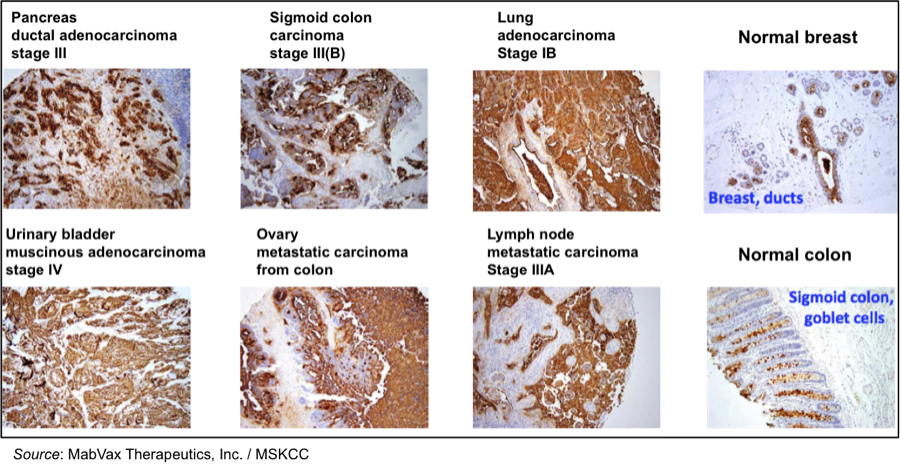
HuMab-5B1 was derived from a patient with Stage IV breast cancer who was originally vaccinated with a sLea vaccine at the end of 2008. A total of seven patients were vaccinated at that time with the sLea vaccine and six of them are still alive today. The patient from whom 5B1 was derived remains disease free to this day.
HuMab-5B1 (designated MVT-5873 for therapeutic and MVT-2163 for diagnostic purposes) has shown utility in the following applications:
- As a therapeutic agent, MVT-5873 has shown efficacy in pre-clinical models of pancreatic, colon, and small-cell lung cancers. MabVax is planning to initially target metastatic pancreatic and colorectal cancer and file a first in human Phase 1 IND before the end of 2015 and begin clinical trials shortly thereafter.
- As a diagnostic agent, MVT-2163 (89Zr-DFO-HuMab-5B1) showed very little background and clear uptake by the tumor. MabVax is planning to utilize MVT-2163 as a diagnostic agent for pancreatic cancer and file a first in human Phase 1 IND before the end of 2015 and begin clinical trials shortly thereafter.
- As an antibody-drug conjugate (ADC), HuMab-5B1 showed potent in vitro and in vivo activity including limiting the growth of BxPC3 xenografts. Pre-clinical studies are on-going to select a lead candidate ADC with the company likely to initiate clinical trials in 2017.
MabVax is planning to file an investigational new drug (IND) application with the FDA for MVT-5873 before the end of 2015 and initiate a Phase 1 clinical trial to examine the safety and pharmacokinetics in a group of patients with different cancer types shortly thereafter. We anticipate preliminary results from this study being available in the first half of 2016 with full results available later in the year. Following the Phase 1 study, MabVax is planning to initiate a Phase 2 clinical trial that will enroll approximately 150 patients and require two to three years to complete. The program will likely be eligible for Orphan Drug Designation since pancreatic cancer only affects approximately 50,000 individuals each year. The Phase 2 study would likely require $10 million to complete, however the MVT-5873 program has garnered the interest of several larger biopharmaceutical companies based on the positive pre-clinical testing, xenographic animal model experiments, and toxicology results generated thus far and the company would consider partnering after the Phase 1 study is complete if acceptable terms can be established. The robust pipeline of follow-on antibodies already generated means the company can partner MVT-5873 early on as a means of generating non-dilutive capital.
The regulatory pathway for a diagnostic agent such as MVT-2163 is considerably less expensive and time consuming than for a therapeutic agent as it requires less intensive clinical trials. New diagnostic agents must be compared to validated standard diagnostic testing techniques. Initial work is performed in limited Phase 1 and 2 studies with a portion of the validation work coming from comparing published data from the standard technologies to the new product data. This approach can allow for more rapid development and approval of a new diagnostic agent. MabVax is planning to file an IND prior to the end of 2015 and initiate a Phase 1a clinical trial shortly thereafter. We estimate a total of 50 patients will be necessary to get MVT-2163 through Phase 2 trials at a total cost of approximately $5 million.
For the ADC, the company plans to continue preclinical testing and select the optimal linker by the end of 2016. In 2017, the company will perform GMP manufacturing of HuMab-5B1-toxin ADC and file an IND such that Phase 1 studies can be initiated.
MabVax Vaccine Program
MabVax has three cancer vaccines under active development targeting recurrent sarcoma, ovarian cancer, and neuroblastoma. The vaccines targeting recurrent sarcoma and ovarian cancer are currently in proof of concept Phase 2 clinical trials, while the neuroblastoma vaccine has completed an initial Phase 1 trial at Memorial Sloan Kettering Cancer Center (MSKCC) and a Phase 2 trial should commence in 2016.
The sarcoma vaccine is currently in a randomized, multi-center, double blind Phase 2 clinical trial that was initiated in July 2010 with 136 patients who had Stage IV metastatic sarcoma but were cleared by surgery (NCT01141491). The patients received 10 vaccinations over an 84-week period. The study was powered to show a statistical improvement in both progression free survival (measured at the mid-point of the study) and overall survival. The company reported that the sarcoma vaccine elicited an antibody response intended to kill circulating tumor cells and micrometastases in all but one of the vaccinated patients. However, the Drug Safety Monitoring Board (DSMB) concluded that the study did not reach statistical significance for its primary efficacy endpoint of a 50% improvement in progression free survival. The study has not yet accumulated a sufficient number of events to evaluate the secondary endpoint of overall survival. Prior to initiating the study, the FDA indicated that the overall survival endpoint would be considered the primary endpoint for the measurement of efficacy. Thus, patients will be followed until sufficient numbers of events (deaths) have occurred to allow analysis of the overall survival endpoint. We anticipate results from this study to be reported in 2016.
The ovarian cancer vaccine is currently in a randomized, multi-center, double blind Phase 2 clinical trial that was initiated in July of 2010. Importantly, a NIH grant award co-authored by Dr. Philip Livingston is fully funding the trial, which is being managed by the Gynecologic Oncology Group (GOG). MabVax has contributed to the development of the IND and provided financial support for the manufacture of the clinical material. A total of 164 patients with Stage IV ovarian cancer were enrolled. They had been treated with cytoreductive surgery and chemotherapy and were in complete clinical remission as defined by CA-125 levels in the normal range, negative physical examination, and no evidence of disease by CT scan. Patients were vaccinated 10 times over 84 weeks and monitored throughout the study period. The study was powered to show a statistical improvement in both progression free survival (measured at the mid-point of the study) and overall survival. The study has not achieved a sufficient number of events to trigger the mid-point analysis. We anticipate results from the overall survival endpoint will be announced in 2016.
The neuroblastoma vaccine was tested in a Phase 1 clinical trial at MSKCC along with the immunostimulant β-glucan (Kushner et al., 2014). The study was conducted in high-risk patients who were in second (or later) complete, very good partial, or partial remission. Subjects received seven subcutaneous injections over 52 weeks. Thirteen of 15 subjects received the entire 12-month treatment protocol. No dose limiting toxicity was noted in any of the subjects and most subjects had detectable anti-vaccine antibodies. Twelve remain relapse-free at 29-40 (median 36) months post-treatment. One patient had a focal relapse (recurrence of the cancer at a specific spot) at 21 months while two other subjects had early focal relapses (2.3 and 4.6 months). Progression free survival (PFS) was 87±9% at 12 months and 78±11% at 24 months. Overall survival is 100% with a follow-up of >22 months. These data are particularly encouraging given an expected relapse rate at 12 months of 50% to 60% (Maris et al., 2010).
Conclusion and Recommendation
For valuation purposes we utilize a probability-adjusted discounted cash flow model to derive net present values for MVT-5873, MVT-2163, and the three cancer vaccines.
- For MVT-5873, we model a 20% probability for approval in 2021 and peak U.S. sales of $0.8 billion and $1.9 billion in pancreatic and colorectal cancer, respectively.
- For MVT-2163, we model a 25% probability for approval in 2020 and peak U.S. sales of $60 million.
- For the sarcoma vaccine, we model a 15% probability for approval in 2020 and peak U.S. sales of $125 million.
- For the ovarian cancer vaccine, we model a 15% probability of approval in 2020 and peak U.S. sales of $300 million.
- For the neuroblastoma vaccine, we model a 10% probability of approval in 2021 and peak U.S. sales of $45 million.
All told, we estimate a net present value for MabVax of $225 million, which divided by the company’s current fully diluted share count of 50.3 million shares leads to a fair value of $4.50. We rate the stock a ‘Buy’ and believe it is a compelling long-term play in the cancer immunotherapy space.
CLICK HERE TO READ THE LATEST FULL RESEARCH REPORT
SUBSCRIBE TO ZACKS SMALL CAP RESEARCH to receive our articles and reports emailed directly to you each morning. Please visit our website for additional information on Zacks SCR and to view our disclaimer.