By Brian Marckx, CFA
NYSE:MDGN
Q1 Results, Operational Update: TARGTEPO Extends Efficacy Duration, PD Trial Underway, CHOP Opportunities…
Medgenics (NYSE:MDGN) reported first quarter financial results and revealed additional positive progress of the ongoing dose-ranging clinical trial in ESRD patients. The company also provided an update on the status and plans for their other previously disclosed development programs which includes other EPO-related targets and a GLP platform. In addition, management talked further about their new collaboration with CHOP and the vast potential this database could provide in terms of discovering other orphan and rare disease targets which may be able to be effectively treated with their TARGT Biopump technology. We characterize both the clinical and operational update as highly encouraging with positive developments on both fronts and no significant adverse surprises which further bolsters our outlook and opinion that the shares remain priced at an attractive entry point.
Q1 operating expenses were $7.9M, slightly lower than our $8.2M estimate but up considerably from $5.2M in the year-earlier period, mostly due to ramping R&D activity as well as higher stock-based compensation in the most recent quarter. Net loss and EPS, excluding non-cash revaluation of warrant liabilities (which increased significantly with the ~60% growth in the stock price during Q1), was $7.9M and ($0.32), largely in-line with our $8.1M and ($0.34) estimates.
Cash used in operating activities was $8.1M but, excluding changes in working capital, this was $4.7M. Cash balance at the close of Q1 was $25.2M.
MDGN-201 Update: No new drop-outs, one patient now stable through 10 months, mid-dose now enrolling…
As a reminder, MDGN-201 is the study using TARGTEPO with a new generation vector to produce natural erythropoietin in patients with chronic kidney disease and end-stage renal disease. Goal of the trial is to maintain hemoglobin in a pre-defined range (9g/dl - 12g/dl) for more than six months. It is dose-escalating with up to 18 patients (three cohorts of up to six patients each). Patients are removed from ESAs after a run-in period. Following reimplantation of TARGTEPO rescue recombinant EPO will not be used until TARGTEPO stops producing natural EPO.
Management has provided ongoing updates on progress of the study which included the most recent prior update in mid-February. At that time all six low-dose patients had been enrolled and implanted with TARGTEPO. While two of the six had been removed from the study, the other four showed stable hemoglobin levels including one patient that had been treated for eight months.
Of the two drop-outs, one required rescue recombinant EPO, although this was not until five months post-implantation. Given that this patient was implanted with only two TARGTEPO micro-organs (in the lowest-dose cohort) that five month duration before requiring rescue EPO is very encouraging for the potential efficacy of TARGTEPO. And the other patient that was removed from the study, which was two months after implantation, required rescue EPO following surgery which was unrelated to the TARGT therapy.
So as of mid-February four of the six low dose patients remained in the study with stable hemoglobin levels within the target range. Patient 1 (3 TARGTEPO implanted) was stable through eight months, patient 4 (2 TARGTEPO implanted) was stable through four months, patient 5 (3 TARGTEPO implanted) was stable through three months and patient 6 (3 TARGTEPO implanted) was stable through two months.
The most recent update, provided on the Q1 earnings call last Friday (4/17), revealed that all four of these patients remained in the study. Patients 1, 4 and 6 remained at stable hemoglobin levels through 10 months, 6 months and 4 months, respectively. Patient 5 remained in the study through 5 months although was under evaluation as he had refused 3 of 4 depo-medrol injections which is a violation of the trial protocol.
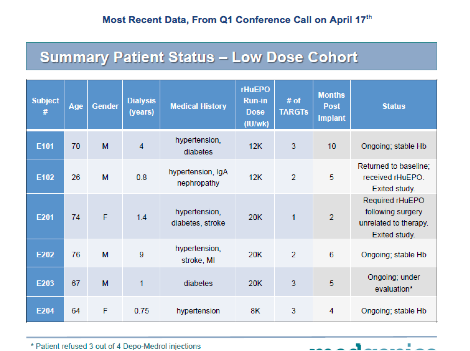
We continue to characterize the results as highly promising with growing encouragement as hemoglobin remains stable with longer duration of the study. With one patient now at 10 months and another through 6 months, there is firming validation of TARGT efficacy. And with no treatment-related adverse events, safety has not been an issue.
Mid-dose enrollment has commenced. Similar to the low-dose group, the mid-dose cohort will include up to six patients. While the low dose consisted of TARGTEPO in the range of 15-25 IU/kg/day, the mid-dose cohort will receive EPO of 35-45 IU/kg/day. Two mid-dose patients are now enrolled with all six expected to enter the study by mid-year. The expectation is that this mid-dose cohort may experience greater duration of effect within the target hemoglobin range.
Update on Other EPO-Related Programs: PD Initiated in Israel, IND Filed, MDS Timeline Slightly Delayed…
As a reminder, last October MDGN announced that they expected to pursue several indications related to TARGTEPO. Those being (also see chart below):
- ESRD patients that are hypo-responsive to ESAs - a U.S. population that the company estimates at approximately 40k - 70k
- Beta Thalassemia, a rare blood disorder associated with anemia (i.e. - low hemoglobin) and low levels of EPO. The company estimates that there are ~16k people in the U.S. and Europe combined that suffer from Beta Thalassemia.
- anemic CKD patients which are candidates for transplant - a population MDGN estimates at about 10k in the U.S.
- peritoneal dialysis patients – estimated at about 20k people in the U.S.
- myelodysplastic syndrome – about 60k people in the U.S.
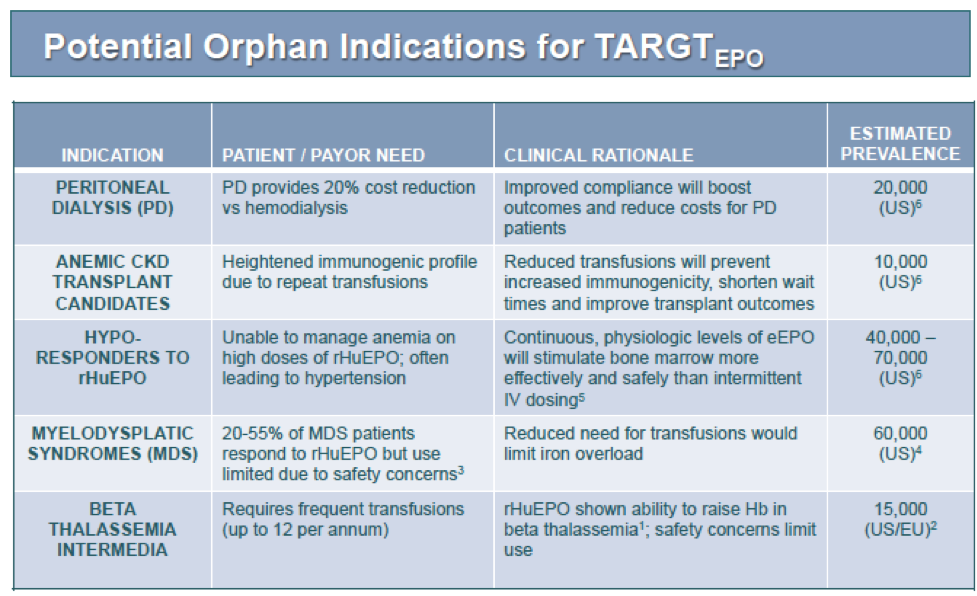
MDGN has already made meaningful progress towards moving these programs along. This includes the recent initiation of a peritoneal dialysis (PD) clinical study in Israel and the filing of an IND seeking approval to initiate clinical studies in the U.S. The IND will cover PD, anemic transplant patients and hypo-responders. MDGN hopes to have the U.S. study, which will also be dose-ranging, initiated around the middle of the current year.
An Israeli-based myelodysplatic syndrome (MDS) clinical study, previously expected to commence in Q2, has been pushed back to the second half of this year as MDGN locks down regulatory approval to start the study. Beta thalassemia is the last of the already announced EPO-related programs which is expected to begin (pre-clinical) following a meeting with Israeli regulators which should happen in the coming weeks.
GLP Program: Progress Continues, NPS Pharma May Be Interested…
Management spent only limited time talking about their GLP-2 program on the Q1 call, only noting that they continue to make progress and, interestingly, that they have been in discussions with NPS Pharmaceuticals (NPSP) which, apparently may have interest in MDGN’s GLP-2 program.
As a reminder in October MDGN announced that along with several TARGTEPO indications, they would also pursue, in parallel with the EPO targets, endogenous peptides.
The short half lives of small endogenous peptides provides therapeutic challenges when administered externally - including the need to use high doses and short effect. Since TARGT would produce the peptide naturally and provide a continuous flow (at the "correct" concentration), these challenges could potentially be overcome.
The company's initial focus will be on glucagon-like peptide-2 (GLP-2), which is produced naturally by the intestinal endocrine L cell and certain neurons. It promotes intestinal growth and enhances intestinal function. It's half life is approximately only 5 - 7 minutes. In addition to GLP-2, MDGN expects to pursue several other peptides during 2015.
MDGN expects to target short bowel syndrome, an orphan indication with TARGTGLP-2. Short bowel syndrome (SBS) is typically the result of surgical removal of part of the small intestine as a result of a variety of disorders. SBS patients often suffer from malabsorption and may require intravenous nutrition. It is estimated that there are approximately 3k - 5k SBS patients in the U.S.
Gattex (teduglutide), marketed by NPS Pharma, is a GLP-2 analog that has orphan designation for SBS and was approved by FDA in late 2012. Gattex promotes intestinal absorption and is dosed once per day via subcutaneous injection. NPS has priced the therapy at approximately $295k per person per year. It is estimated that there are approximately 3k - 5k SBS patients in the U.S. As such the calculated potential market for Gattex is $1B+.
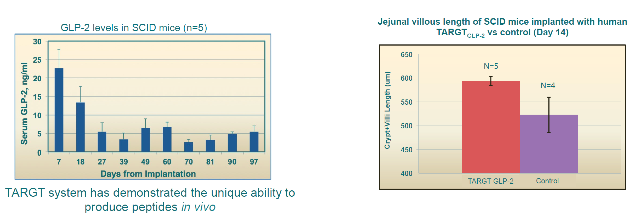
Gattex suffers from certain drawbacks however. Such as being associated with nausea/vomiting, which may be a result of the rapid peak from the bolus injection which is characteristic of injected peptides. TARGTGLP-2 could potentially eliminate or reduce peaks and troughs and potential related health risks associated with bolus injections. Development of TARGTGLP-2 is in preclinical stage and has been used in mice which showed secretion of GLP-2 for a term of 100 days.
At the January 2015 Biotech Showcase presentation MDGN announced SCID mouse data of GLP-2 following 100 days after implantation which indicated the micro-organ has been able to produce GLP-2 through 100 days with only a slight peak through about the first two weeks. Also presented was SCID mouse data versus sham control which demonstrated a biological effect of the GLP-2 micro organ (data was through two weeks).
Significant Potential Opportunities from CHOP…
Management is clearly excited over the potential orphan / rare disease targets that could materialize from the massive CHOP (The Children’s Hospital of Philadelphia) genetic database. The collaboration with CHOP was just consummated in November of last year and MDGN has already made substantial headway in weeding through the database and with identifying potential areas of interest. CHOP offers not only the potential to massively broaden the scope and depth of potential targets,it also offers the opportunity to significantly shorten the development and eventual commercialization timeline.
As management explained on the call, they (and their colleagues at CHOP) believe there is real potential to exploit orphan / rare disease targets that are already supported by animal models but may have failed in human studies based on a variety factors, including non-optimal study populations. MDGN’s process is to lead with genomic view in order to more specifically identify and characterize initial candidates and then drill down through a progressive approach to identify the cause of a particular disease and narrow down potential therapeutic options. The company believes applying this approach can reduce the time that it takes to get a candidate from development inception to regulatory submission from a typical average of ten to fifteen years to just five or six years. Management laid out certain criteria that they will use in helping identify areas of interest and to aid in narrowing their focus. Initial candidates could be identified sometime later this year.
CNS Targets…
MDGN recently entered into a collaboration with Harvard University to explore potential opportunities of their technology in central nervous system disorders, an area that has proven difficult to treat with traditional drugs. Development is still in pre-clinical.
Maintaining Outperform Rating
We remain ever-more encouraged with the data coming from the MDGN-201 clinical trial. At least three (and possibly four) of the six lowest-dose cohort patients appear to have been effectively treated with TARGTEPO through at least four months, including one patient through six months and another through ten months. In addition, hemoglobin levels have been maintained in the target range with no serious treatment related adverse events. Mid-dose enrollment has commenced with full enrollment expected towards mid-year. Mid-dose may show longer duration of efficacy and may provide even greater insight into the utility of TARGTEPO and MDGN’s micro-organ technology.
Data from additional studies, which could be available later this year, could provide even more information on the utility of the TARGT technology. PD trial is now underway in Israel and could begin in the U.S. by summer. MDS study could also be up and running in Israel in the coming months. The GLP-2 program, while still in preclinical studies, has shown initial promise and has spurred interest from NPS Pharma. The CHOP relationship should provide an accelerated and broadened pathway in development of these and (almost certainly) additional, yet-to-be announced, orphan targets. MDGN is continuously and rapidly increasing the number of shots on goal and following their low-risk strategy.
We are maintaining our Buy rating. See below for free access to our most recent report on MDGN.
READ THE LATEST FULL RESEARCH REPORT HERE
SUBSCRIBE TO ZACKS SMALL CAP RESEARCH to receive our articles and reports emailed directly to you each morning. Please visit our website for additional information on Zacks SCR and to view our disclaimer.