By Brian Marckx, CFA
NYSE:MDGN
TARGTEPO Trial Data Continues To Look Promising, Add’l Data Expected To Be Forthcoming
In mid-October Medgenics (NYSE:MDGN) presented initial results from the MDGN-201 study which is using TARGTEPO with a new generation vector to produce natural erythropoietin in patients with chronic kidney disease and end-stage renal disease. TARGTEPO produces natural erythropoietin. If effective TARGTEPO could potentially replace erythropoietin stimulating agents (ESAs), which are injected into CKD/ESRD patients to maintain hemoglobin levels. ESAs have serious drawbacks, however, including that they are expensive, cause spikes in serum EPO levels and have been associated with cardiac risks.
Goal of the trial is to maintain hemoglobin in a pre-defined range (9g/dl - 12g/dl) for more than six months. It is a dose-escalating study with up to 18 patients (three cohorts of up to six patients each). Patients are removed from ESAs after a run-in period. Following reimplantation of TARGTEPO rescue recombinant EPO will not be used until TARGTEPO stops producing natural EPO.
The data announced in October were from three patients, all of which were given the lowest dose. Lowest dose is characterized as EPO of 18-25 IU/kg/day. Results from patient one (3 TARGTEPO micro-organs implanted), two (2 TARGTEPO implanted) and three (1 TARGTEPO implanted) were through four months, two months and one month following implantation of TARGTEPO. In our opinion the results were highly promising (see our October 16 report), showing that hemoglobin levels were maintained in the 9g/dl - 12g/dl range in all three patients and serum EPO levels were much more well-controlled during the TARGTEPO therapy as compared to the run-in period when the patients were given ESA's.
In addition, the data indicated a potential sign of increasing reticulocytosis in patient #1 (i.e. - the one in treatment the longest, four months). Reticulocytosis is where the body starts producing more immature red blood cells and evidence of such would be a significant development as it may indicate that TARGTEPO therapy may help induce the body's natural function in producing red blood cells.
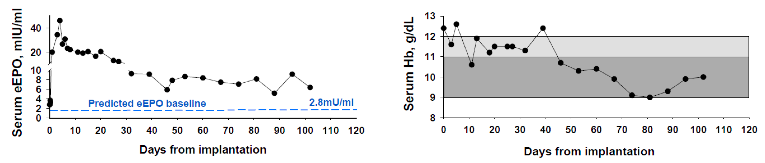
Then in November the company announced follow-on data which included one more month of follow-up. Patients one (3 TARGTEPO implanted, followed through four months) and patient two (2 TARGTEPO implanted, followed through three months) continued to show highly positive results with stabilizing serum EPO and hemoglobin levels maintained in the 9g/dl - 12g/dl range. In addition, again there was evidence of potential reticulocytosis – this time in both patients one and two.
Patient #1 Five Months of TARGTEPO Therapy: stable EPO at 30 days and Hb in target range of 9g/dl - 12g/dl
Patient three, through two months, required recombinant EPO as a result of surgery. The surgery was not related to TARGTEPO therapy, however. This patient has since been removed from the study.
Most Current Data, Presented at Biotech Showcase, Continues To Be Positive…
Management announced the most recent follow-up data from MDGN-201 at a presentation at Biotech Showcase on January 13. The data continues to be very promising. Patient 1 (3 TARGTEPO implanted), through seven months post-implantation continues to show stable hemoglobin levels within the target range. And while patient 2 (2 TARGTEPO implanted) required rescue recombinant EPO, this was not until five months post-implantation. Given that patient two was implanted with only two TARGTEPO micro-organs (in the lowest-dose cohort) that five month duration before requiring rescue EPO is very encouraging for the potential efficacy of TARGTEPO.
Initial data on the three final low-dose cohort patients was also announced. Patient 4 received two micro-organs with data through two months, patient 5 received three micro-organs with data through two months and patient 6 received three micro-organs with data through one month. While patient-specific data was not part of the presentation, management did note that all three of these patients remain in the study and are showing hemoglobin levels within the target range.
Most Recent Data, Presented at Biotech Showcase on January 13
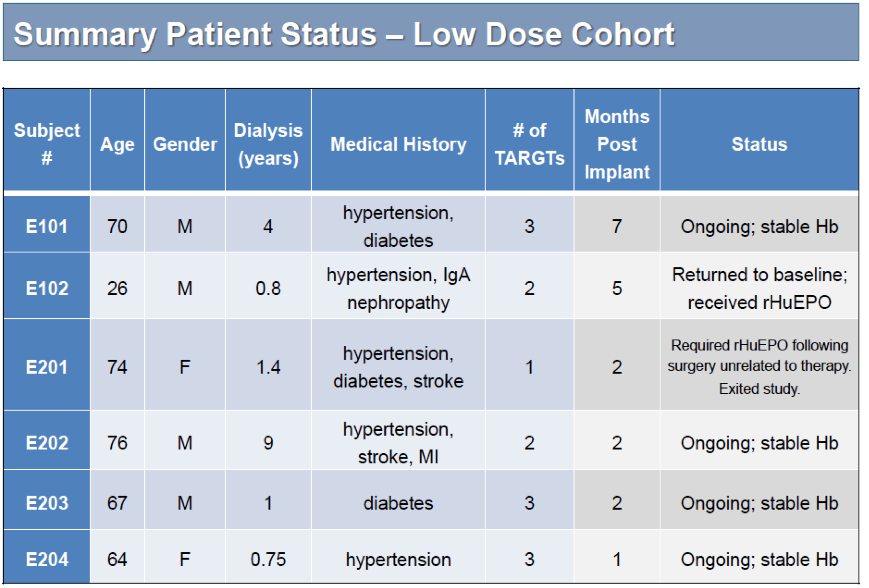
Also, important to remember is that this data is still from the lowest dose cohort, with mid and highest dose arms still to come and which could very well show longer duration of efficacy. In addition, safety has not been an issue with no treatment related adverse events. Exposure to EPO with TARGTEPO in this lowest-dose cohort is about 100x less than if the patients were being treated with recombinant EPO – and even the highest dose cohort patients will be exposed to only a small fraction of what would be the case with recombinant EPO. Again, recombinant EPO has been associated with serious safety risks, including cardiovascular complications.
The company is now in the process of beginning enrollment in the mid-dose cohort, which similar to the low dose group, will include up to six patients. The low-dose cohort received EPO of 15-25 IU/kg/day, the mid-dose cohort will receive EPO of 35-45 IU/kg/day. The expectation is that this mid-dose cohort will experience greater duration of effect within the target hemoglobin range.
Update on Orphan Targets
In mid-October MDGN announced that they expected to pursue several indications related to TARGTEPO. Those being:
- ESRD patients that are hypo-responsive to ESAs - a U.S. population that the company estimates at approximately 40k - 70k
- Beta Thalassemia, a rare blood disorder associated with anemia (i.e. - low hemoglobin) and low levels of EPO. The company estimates that there are ~16k people in the U.S. and Europe combined that suffer from Beta Thalassemia.
- anemic CKD patients which are candidates for transplant - a population MDGN estimates at about 10k in the U.S.
- peritoneal dialysis patients – estimated at about 20k people in the U.S.
- myelodysplastic syndrome – about 60k people in the U.S.
See our October 16 report on MDGN for a more in-depth discussion about the opportunity in ESRD patients hypo-responsive to ESAs and beta thalassemia. MDGN noted in its January 13 presentation that they hope to initiate phase II studies in all five of these potential TARGTEPO –related orphan targets during 2015. The chart below indicated expected timing for each indication.
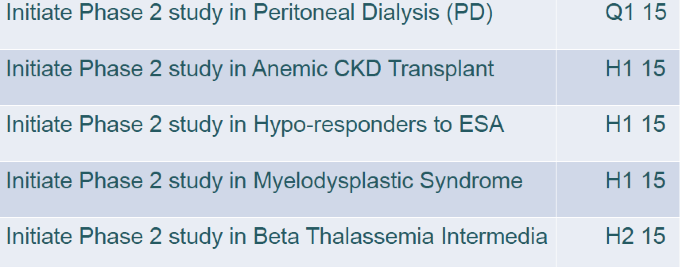
All of these phase II studies will be small signal finding studies which reduces risk and allows for fairly rapid read-out with minimal expense. And all these indications encompass target markets worth at least $500 million each.
Management also provided an update on its peptide program. As a reminder in October MDGN also announced that along with several TARGTEPO indications, they would also pursue, in parallel with the EPO targets, endogenous peptides.
The short half lives of small endogenous peptides provides therapeutic challenges when administered externally - including the need to use high doses and short effect. Since TARGT would produce the peptide naturally and provide a continuous flow (at the "correct" concentration), these challenges could potentially be overcome.
The company's initial focus will be on glucagon-like peptide-2 (GLP-2), which is produced naturally by the intestinal endocrine L cell and certain neurons. It promotes intestinal growth and enhances intestinal function. It's half life is approximately only 5 - 7 minutes. In addition to GLP-2, MDGN expects to pursue several other peptides during 2015.
MDGN expects to target short bowel syndrome, an orphan indication with TARGTGLP-2. Short bowel syndrome (SBS) is typically the result of surgical removal of part of the small intestine as a result of a variety of disorders. SBS patients often suffer from malabsorption and may require intravenous nutrition. It is estimated that there are approximately 3k - 5k SBS patients in the U.S.
Gattex (teduglutide), marketed by NPS Pharma, is a GLP-2 analog that has orphan designation for SBS and was approved by FDA in late 2012. Gattex promotes intestinal absorption and is dosed once per day via subcutaneous injection. NPS has priced the therapy at approximately $295k per person per year. It is estimated that there are approximately 3k - 5k SBS patients in the U.S. As such the calculated potential market for Gattex is $1B+.
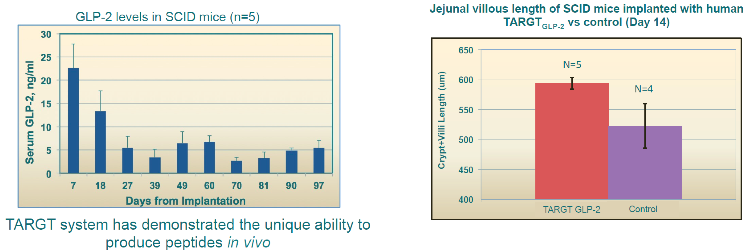
Gattex suffers from certain drawbacks however. Such as being associated with nausea/vomiting, which may be a result of the rapid peak from the bolus injection which is characteristic of injected peptides. TARGTGLP-2 could potentially eliminate or reduce peaks and troughs and potential related health risks associated with bolus injections. Development of TARGTGLP-2 is in preclinical stage and has been used in mice which showed secretion of GLP-2 for a term of 100 days.
At the Biotech Showcase presentation MDGN announced SCID mouse data of GLP-2 following 100 days after implantation which indicated the micro-organ has been able to produce GLP-2 through 100 days with only a slight peak through about the first two weeks. Also presented was SCID mouse data versus sham control which demonstrated a biological effect of the GLP-2 micro organ (data was through two weeks).
CAG Biobank Provides Important Resource for Orphan Development
Medgenics’ collaboration with The Children’s Hospital of Philadelphia (CHOP), announced in November, provides the company with a massive biobank of genetic data and is expected to accelerate and expand development in various orphan indication endeavors.
Maintaining Outperform Rating
We remain ever-more encouraged with the data coming from the MDGN-201 clinical trial. Two of the three lowest-dose cohort patients appear to have been effectively treated with TARGTEPO through at least five months with one patient treated through the current seven months - and still remains in the study. Hemoglobin levels have been maintained in the target range with no serious treatment related adverse events. MDGN will begin enrolling for the mid-dose cohort which may show longer duration of efficacy and may provide even greater insight into the utility of TARGTEPO and MDGN’s micro-organ technology.
MDNG expects to initiate several other early phase clinical studies in additional TARGTEPO targets over the next several weeks/months with initial data potentially available in the near-term. The GLP-2 program, while still in preclinical studies, has shown initial promise. The CHOP relationship should provide an accelerated and broadened pathway in development of these and (almost certainly) additional, yet-to-be announced, orphan targets. MDGN is continuously and rapidly increasing the number of shots on goal and following their low-risk strategy.
We are maintaining our Outperform rating. See below for access to our 27 page report on MDGN.
READ THE LATEST FULL RESEARCH REPORT HERE
SUBSCRIBE TO ZACKS SMALL CAP RESEARCH to receive our articles and reports emailed directly to you each morning. Please visit our website for additional information on Zacks SCR and to view our disclaimer.