By David Bautz, PhD
Phase 2 Study of MN-166 in ALS Expanded
NASDAQ:MNOV
MediciNova, Inc. (NASDAQ:MNOV) recently amended the ongoing Phase 2 clinical trial of MN-166 in patients with amyotrophic lateral sclerosis (ALS) to allow the inclusion of more advanced patients who are on non-invasive ventilation (NIV). Below is an overview of ALS, MN-166, the Phase 2 trial, as well as the market potential for MN-166 should it prove to be beneficial for ALS patients.
Background on ALS
Amyotrophic lateral sclerosis (ALS) is a rapidly progressing neurodegenerative disease whereby the nerve cells in the brain and spinal cord that control muscle movement degenerate. This rapid degeneration of the motor neurons eventually leads to death, typically in three to five years after patients are first diagnosed. As the motor neurons cease to function properly, they can no longer send signals to the muscle fibers, and thus voluntary muscle action is progressively affected. Eventually, patients in later stages of the disease may become completely paralyzed which includes losing the ability to control their breathing. In the U.S., approximately 30,000 people are currently living with ALS.
The rate at which the disease progresses varies from patient to patient and is measured utilizing a scoring system called the “ALS Functional Rating Scale Revised” (ALSFRS-R) (Cedarbaum et al., 1999). This scoring system consists of a series of 12 questions on basic tasks (speech, salivation, swallowing, handwriting, cutting food, dressing and hygiene, turning in bed, walking, climbing stairs, dyspnea, orthopnea, and respiratory insufficiency) that are rated on a five-point scale where 0 = can’t do and 4 = normal ability. The individual items are summed to produce a score of between 0 = death and 48 = best.
There is only one drug approved by the FDA for the treatment of ALS. Sanofi’s Riluzole® (rilutek) has been shown to improve survival, but only for two to three months. The compound works by preferentially blocking tetrodotoxin (TTX)-sensitive sodium channels that are associated with damaged neurons (Song et al., 1997). Rilutek does not reverse damage already done to motor neurons, and people taking it must be monitored for liver damage (approximately 10% incidence). Sales of Riluzole® peaked at around $50 million per year. It is now available as a generic.
The remaining treatments for ALS are designed to relieve symptoms and improve quality of life. This supportive care includes a multidisciplinary approach that may include medications to reduce fatigue, control spasticity, reduce excess saliva and phlegm, limit sleep disturbances, reduce depression, and limit constipation. However, none of these treatments reduces disease progression or addresses the underlying cause of the disease.
Pathogenesis of ALS
The neurodegeneration found in ALS is accompanied by a sustained inflammation (“neuroinflammation”) in the brain and spinal cord. Astrocytes, microglia, and immune cells are the key cellular modulators of neuroinflammation and have all been shown to actively participate in ALS pathogenesis (McCombe et al., 2011; Philips et al., 2011).
Microglia are the resident immune cells of the central nervous system (CNS) and become activated due to disease or injury and elicit a very strong pro-inflammatory response (Hanish et al., 2007). Activated microglia are observed in ALS patients in the motor cortex, motor nuclei of the brainstem, the entire corticospinal tract, the spinal cord, and within the cerebrospinal fluid (Kawamata et al., 1992). Microglia have been implicated in ALS initiation (Gerber et al., 2012) and were shown to switch from an activated to a neurodegenerative phenotype as ALS progresses (Weydt et al., 2004). Taken together, these data indicate that activated microglia, and the inflammatory process associated with them, could be a promising therapeutic target for treating ALS.
MN-166
MN-166 (ibudilast) is an anti-inflammatory drug that has been utilized for over 20 years in Japan to treat asthma (Rolan et al., 2009). It acts as a phophodiesterase (PDE) inhibitor (Suzumura et al., 1999) and preferentially inhibits PDE-4 (Huang et al., 2006). The drug has shown anti-inflammatory activity in both the peripheral immune system and in the CNS via attenuation of glial cells, which play a role in certain neurological conditions. In addition, delivery of a PDE-4 inhibitor was shown to lead to enhanced differentiation of oligodendrocyte progenitor cells within areas of demyelination and a consequent acceleration of remyelination (Syed et al., 2013).
Preclinical work performed with MN-166 showed that the compound can suppress neuronal cell death induced by activated microglia (Mizuno et al., 2004). MN-166 was shown to suppress the production of TNF-α and IL-6 by microglia as well as enhance the production of the anti-inflammatory cytokine IL-10 and neurotrophic factors such as NGF, GDNF, and NT-4. These data are in agreement with an earlier study of MN-166 in a chronic cerebral hypoperfusion model that showed it could inhibit the activation of microglia cells and prevent the formation of white matter lesions (Wakita et al., 2003). This inhibitory effect was shown to be dose dependent and involve the suppression of TNF-α production.
MN-166 Phase 2 ALS Study
In September 2014, MediciNova initiated a Phase 2 study of MN-166 in patients with ALS (NCT02238626). This is a single center, randomized, double blind, placebo controlled six-month study to evaluate the safety, tolerability, and clinical responsiveness of MN-166 (60 mg/day) when administered as an adjunct to riluzole (100 mg/day) in 60 subjects with ALS. Patients in the study will be randomized 2:1 to receive either MN-166 or placebo. The study will consist of a three month screening phase, a six-month double blind treatment phase, and an open label six-month phase and is taking place at the Carolinas Healthcare System in Charlotte, NC. The primary endpoint of the study is the safety and tolerability of MN-166 when administered with riluzole in ALS patients. A number of secondary endpoints are being evaluated including change in ALSFRS-R, respiratory function, muscle strength, and non-invasive ventilation.
On April 21, 2015, MediciNova announced positive interim safety data from the study that showed no difference in safety or tolerability between MN-166 and placebo in the first 21 subjects enrolled in the study following three months of treatment. Importantly, the independent safety medical monitor recommended that the study continue as planned. In February 2015 the company announced the enrollment of 30 of the 60 patients for the trial. Based on the rate of enrollment thus far, we estimate that the trial will complete enrollment before the end of 2015, with final results from the 6-month core period of the trial being available in mid to late 2016.
On September 2, 2015, MediciNova announced that the first ALS patient using non-invasive ventilation (NIV) was enrolled in the company’s ongoing Phase 2 clinical trial of MN-166 (NCT02238626). As ALS progresses, the muscles that control breathing become weaker, which leads to impairment of breathing function and an increased susceptibility for lung infections. In addition, patients may experience shortness of breath, fatigue, sleep apnea, and weakened cough. NIV is administered through a removable face mask that is placed around the nose and mouth and is utilized by ALS patients that can still breathe on their own but are beginning to experience the aforementioned effects of decreased breathing capabilities. The use of NIV typically signifies that a patient is more advanced in the course of the disease than a patient not using NIV.
MediciNova amended the clinical protocol to allow for the recruitment of 60 patients with advanced ALS using NIV in addition to the already planned recruitment of 60 patients with ALS that are not using NIV. We anticipate that the two sets of patients (non-NIV and NIV) will be evaluated separately, thus depending upon the rate of enrollment, the data for the NIV patients may not be available until 2017.
Market Opportunity in ALS
ALS is diagnosed in approximately 5,600 people in the U.S. every year and there are an estimated 30,000 patients who are currently living with the disease. With the cost to care for a patient with advanced stage disease estimated to be as high as $200,000, this represents a direct cost of more than $6 billion each year to the healthcare system.
As mentioned previously, there are very limited treatment options for patients with ALS. Riluzole is the only FDA approved medication shown to slow the progress of ALS. Prior to loss of patent exclusivity, Rilutek® cost approximately $12,000 per year and had sales peak in 2012 of $50 million. This suggests that around 4,200 ALS patients were taking Rilutek® in 2012, or around 15% of the entire U.S. ALS population. Both baclofen and diazepam are used to control muscle spasms, stiffness, or tightening that interfere with daily activities. Trihexyphenidyl and amitriptyline are used to treat patients who have excess saliva and secretions as well as emotional changes. None of the aforementioned drugs alters the course of the diseases.
ALS is a highly complex disease that has multiple pathways of degeneration. Previous ALS drug development efforts have typically focused on one specific mechanism of action, and those have largely been met with failure. MediciNova is attempting to exploit the neuroprotective actions of MN-166 as well as the compounds ability to induce production of neurotrophic factors, which are specialized proteins that promote neuron growth, differentiation, and survival. Given the limited treatment options and high costs associated with patient care, we believe an effective ALS treatment would command a premium price, possibly as high as $100,000 per patient per year. Conservatively assuming that only one-third of ALS patients took the drug (10,000 patients), this would generate sales of $1.0 billion per year.
Public Offering Brings in Significant Cash
On Aug. 24, 2015, MediciNova announced the closing of an underwritten public offering where the company sold 5 million shares of common stock for $3.50 per share and raised gross proceeds of $17.5 million. Importantly, the company further disclosed in an 8-K filing that Fidelity Investments (FMR LLC) acquired 3.5 million shares and now owns over 11% of the total number of shares outstanding. We are pleased to see that MediciNova is attracting high quality institutional investors, which should help to instill investor confidence and could lead to additional investments from other institutional investors in the future.
MN-001 Clinical Development Update
MN-001 is a novel, orally available small molecule compound that works through several mechanisms to produce anti-fibrotic and anti-inflammatory effects in preclinical models. The compound is a leukotriene (LT) receptor antagonist, a PDE inhibitor (mainly 3 and 4), and also inhibits 5-lipoxygenase (5-LO). The 5-LO/LT pathway is though to be a pathogenic factor in fibrosis development (Zeldin et al., 2002). Previously, the company had tested MN-001 as a treatment for asthma and completed a Phase 2 study with positive results. The compound has been tested in over 600 subjects and was considered generally safe and well tolerated.
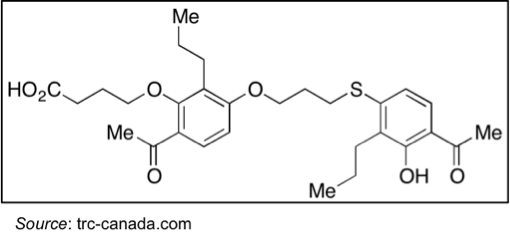
Medicinova has recently announced clinical trial details for MN-001 in the treatment of both idiopathic pulmonary fibrosis (IPF) and nonalcoholic steatohepatitis (NASH).
IPF: The study will be a randomized, placebo controlled, double blind 6-month study followed by a 6-month open-label extension phase to examine the safety and efficacy of MN-001 in moderate to severe IPF patients (NCT02503657). The drug will be administered twice daily at 750 mg per dose over a 26-week period. The study is expected to enroll 15 patients that will be randomized 2:1 to receive MN-001 or placebo. After the 26-week double-blind period, there will be a 26-week open label extension phase where patients who received placebo will be administered drug and those who previously received drug will be allowed to stay on treatment. The primary outcome of the study is change from baseline in forced vital capacity (FVC) at 26 weeks, a measure of lung function. There are a number of secondary outcomes including safety and tolerability of MN-001 and various measures of the rate of decline in disease activity. We anticipate results from the double-blind portion of the study to be available in the first half of 2017.
NASH: The Phase 2 trial will be a single center, proof-of-concept, open label study designed to evaluate the efficacy, safety, and tolerability of MN-001 in NASH patients with hypertriglyceridemia. Approximately 20 patients between the ages of 21 and 65 with a histologically confirmed diagnosis of NASH within 6 months prior to the baseline visit and an elevated serum triglyceride level (> 150 mg/dL) will be enrolled. Patients will be given 250 mg MN-001 orally once a day for the first 4 weeks and then 250 mg twice a day for an additional 8 weeks. The study timeline consists of a 4 month screening phase followed by a 12 week treatment phase and a follow-up visit one week after the last dose. The primary endpoints of the study are to evaluate the effect of MN-001 on triglyceride levels and cholesterol efflux capacity in NASH subjects with hypertriglyceridemia. Secondary endpoints include safety and tolerability of MN-001, pharmacokinetic profile of MN-001/MN-002 (a metabolic by-product of MN-001), effects of MN-001 on high-density lipoprotein cholesterol (HDL-C), low-density lipoprotein cholesterol (LDL-C), and total cholesterol level, and effects of MN-001/002 on liver enzymes and percent fat in liver assessed using MRI at week 12.
As a reminder, in April 2015 the company announced the FDA had granted Fast Track Designation for MN-001 for the treatment of NASH patients with fibrosis. Fast Track designation is given to drugs that are intended for the treatment of a serious or life-threatening disease or condition and that demonstrate the potential to address unmet medical needs for the disease or condition. Importantly, a company with a drug that receives Fast Track designation may be eligible for some or all of the following:
- Increased interactions with the FDA to discuss the drug's development plan and ensure collection of appropriate data needed to support approval.
- Accelerated Approval - approval based on an effect on a surrogate, or substitute endpoint reasonably likely to predict clinical benefit, or on a clinical endpoint that can be measured earlier than irreversible morbidity or mortality.
- Priority Review - with an FDA goal for completing review within six months of submission.
- Rolling Review - which means that a sponsor can submit completed sections of its New Drug Application (NDA) for review by the FDA, rather than waiting until every section of the application is completed before the entire application can be reviewed.
Conclusion and Recommendation
In addition to targeting ALS, MN-166 is also currently being tested as a treatment for progressive multiple sclerosis (MS) and various addiction disorders. The treatment of MS and ALS are both blockbuster opportunities for the drug, with potential peak sales of $5 billion for MS and $2.5 billion for ALS. We are intrigued that the ALS study has been expanded to include patients that are further along in the course of their disease. While we are unsure if this is due to a trend developing in the unblinded data from patients not using NIV, we may learn more when available data from the study is presented in December 2015.
With the recent financing, MediciNova is perhaps moving away from the strategy the company had been employing of using investigator-sponsored early-stage clinical trials for testing the company’s compounds, as opposed to financing larger studies. While we think the company will always be open to working with investigators who acquire government or private funding, now that the company has what we estimate will be approximately $22 million at the end of the third quarter of 2015, there are many more options available for moving the company’s assets through clinical testing in a timely manner. Upcoming catalysts include the presentation of interim data on the ALS study in December 2015, the initiation of clinical trials for MN-001 in IPF and NASH, and the interim data from the MS study in the second half of 2016. Our probability adjusted discounted cash flow model gives a target price of $8 per share, and we continue to have a ‘Buy’ rating on the stock.
READ THE LATEST FULL RESEARCH REPORT HERE
SUBSCRIBE TO ZACKS SMALL CAP RESEARCH to receive our articles and reports emailed directly to you each morning. Please visit our website for additional information on Zacks SCR and to view our disclaimer.