By David Bautz, PhD
OTC:MTNB
Financial Update
On November 11, 2015, Matinas BioPharma Holdings, Inc. (OTC:MTNB) announced financial results for the third quarter of 2015 and provided a business update. Matinas generated contract research revenue from the National Institutes of Health (NIH) of $60K related to the development of MAT2203 and MAT2501. We anticipate that the contract revenue will be significantly less for the next two quarters.
Net loss for the quarter was $2.2 million, and consisted of $0.9 million of R&D expense and $1.3 million of G&A expense. The company has enacted a number of cost saving measures to keep expenses relatively flat or slightly lower in the near term, however over the long term the company’s expenses will increase substantially as the company’s product candidates are advanced through clinical development.
Cash burn for the third quarter of 2015 totaled $2.1 million. As of September 30, 2015, the company had cash and cash equivalents of $4.4 million. As a reminder to investors, on April 9, 2015, Matinas closed on an $8.5 million private placement financing that included significant insider participation. The company issued 20.0 million shares of common stock at $0.50 per share. The company also issued 20.0 million five-year warrants to investors at $0.75 per share. The warrants are callable by Matinas if the stock trades above $3.00 per share for 20 consecutive days. If exercised, the warrants would provide an additional $14.25 million in cash to the company. The placement agent, Aegis Capital, also received 2.0 million warrants at $0.50 per share and 2.0 million warrants at $0.75 per share. We believe the company has enough cash to fund operations through the first quarter 2016.
Business Update
Matinas is a clinical stage biopharmaceutical company focused on the development of safe and effective broad-spectrum antifungal and antibacterial therapies for the treatment of serious and life-threatening infections through the use of the company’s proprietary lipid-crystal nano-encapsulation drug delivery cochleate platform.
Background on Nano-particle Drug Delivery
Matinas is developing a novel drug delivery technology that was acquired from Aquarius Biotechnologies in January 2015. The purpose of the technology is to allow the safe oral administration of drugs that are seldom used due to their toxic side effect profiles. The drug delivery platform is centered on the use of cochleates, which are stable, crystalline phospholipid-cation delivery vehicles that are composed of soybean phosphatidylserine (PS) and calcium. The compounds have a unique multilayered structure and no internal aqueous space. “Encochleated” molecules within the interior of the cochleate structure remain intact resulting in an increase of oral bioavailability, lower toxicity, and the opportunity for intracellular targeting. As the following figure shows, cochleates are produced from a large, continuous, solid, lipid bilayer sheet rolled up in a spiral or as stacked sheets, with no internal aqueous space.
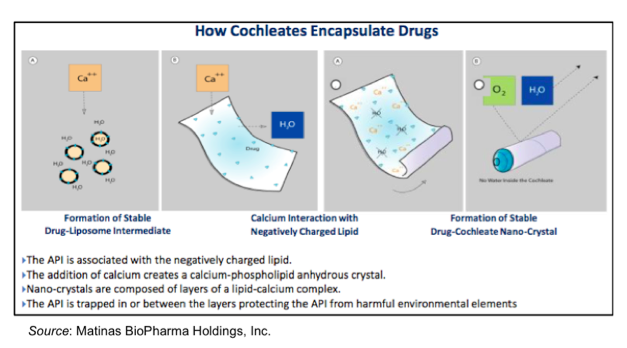
The technology has a number of unique attributes, including:
- The unique structure of the cochleate means that the compounds inside are protected even though the outer layers of a cochleate may be exposed to harsh environmental conditions or enzymes (i.e., the digestive tract)
- The technology allows for targeted delivery to the site of infection, as the cochleates are taken up by macrophages, which then travel to the site of infection and release the drug cargo
- Toxic drugs are sequestered until transported to the site of infection, thus decreasing their side effects
- Cochleates themselves appear to have a nontoxic profile
Theoretically, the technology could be utilized to develop an orally bioavailable formulation of any number of different types of compounds, however Matinas is initially focusing on using the technology to improve the safety and oral bioavailability of antimicrobial compounds that are seldom utilized due to their toxic side effect profiles.
MAT2203: The most advanced product in Matinas’ pipeline is a lipid-crystal nano-particle formulation of Amphotericin B (CAmB). Amphotericin B (AmB), the gold standard for systemic antifungal drugs, is one example of a well-established, highly efficacious systemic antifungal drug that has a 50-year history of intravenous (IV) therapy. Importantly, no evidence of resistance has been noted during this time. The drug is highly potent and has utility as an anti-parasitic agent as well. Intravenous formulations such as AmBisome® and Fungizone® remain among the most effective agents in the treatment of life-threatening systemic fungal infections.
No oral formulations of AmB are currently commercially available. Although some patients are able to tolerate the IV injection, many experience localized and systemic side effects associated with IV administration of the drug. For example, the Side Effect & Drug Interactions section of the AmBisome® prescribing information includes warnings on renal impairment, hepatic impairment, febrile reactions, fever accompanied by shaking chilies, normochromic and normocytic anemia, musculoskeletal pain, anaphylactic reactions, dermatologic reactions, neurologic reactions, including convulsions, tinnitus, and vertigo, hematological reactions, and injection site reactions. Some of these side effects can be eliminated or reduced, specifically the injection site reactions and potentially the hematological, hepatic, and renal impairments, by oral administration. Sales of the perceived “least toxic” formulation of AmB, AmBisome®, were approximately $500 million worldwide in 2014 (EvaluatePharma).
MAT2501: This is a lipid-crystal nano-particle formulation of Amikacin that is currently in preclinical development. Amikacin is an aminoglycoside antibiotic most commonly used to treat severe, hospital-acquired infections, including Gram-negative infections. It is typically used as a last resort medication against multi-drug resistant bacteria. The drug is administered either IV, intramuscularly, or through a nebulizer. All aminoglycosides carry the potential risk of nephrotoxicity, with the risk being greatest in those with impaired renal function. A reduction in dosage is usually necessary if evidence of renal dysfunction occurs. In addition, treatment with aminoglycosides can cause neurotoxicity in the form of hearing loss, numbness, skin tingling, muscle twitching, and convulsions. For these reason, an aminoglycoside formulation that would reduce the potential for this toxicity and allow for oral dosing is clearly warranted. Matinas is planning to file an Investigational New Drug (IND) application with the FDA in 2016 such that a Phase 1 pharmacokinetic study can be initiated, after which the company is planning to target non-tuberculous mycobacterium as the first indication.
For a detailed overview of preclinical data that was recently presented on MAT2203 and MAT2501, please see our previous report.
Huge Potential for MAT2203
Amphotericin B has activity against a broad spectrum of invasive fungi, and thus it was the standard of care for many systemic fungal infections. The drug is fungicidal, which means it kills the invading fungal infection, as opposed to azoles like fluconazole or voriconazole that are fungistatic (only halt the spread of the infection). Unfortunately, the high toxicity of amphotericin B, which shows up at around 1 mg/kg, is roughly equal to the therapeutic dose, thus creating a very small therapeutic window for amphotericin B use. Gilead’s liposomal formulation, AmBisome® has improved tolerability up to the 10 mg/kg range.
We believe amphotericin B, a broadly effective and powerful drug, has limited use today (approximately $500 million in worldwide sales of AmBisome® in 2014) because of the toxicity, mainly nephrotoxicity, of the drug. As a result of this toxicity, amphotericin B is primarily used either very early on in the treatment paradigm until toxicity shows up, or as a last resort for patients with few other options. Because the drug is administered via intravenous infusion, there is no out-patient use. As a result, when patients leave the hospital, they often leave on less effective azoles or echinocandins. In 2014, Pfizer (PFE) reported $756 million in sales of voriconazole (Vfend®), while Merck (MRK) reported $402 million in sales of posaconazole (Noxafil®). The former market leading product, Pfizer’s Diflucan® (fluconazole), reported peak sales of $1.2 billion in 2003 but is now available as a generic. In 2014, Merck reported $681 million in sales of caspofungin (Cancidas®) while Astellas reported $355 million in sales of micafungin (Mycamine®). These are less effective drugs with usage far greater than amphotericin B due to the fact that they are much less toxic.
We believe the value proposition for CAmB – being able to prescribe an oral amphotericin B product both in the hospital and after the patient goes home, in a broad population, without overt fears of nephrotoxicity – is rather powerful. In the more than 50 years that its been used, there have been no reports of resistance to amphotericin B, unlike what is now being seen with azoles and echinocandins (Kauffman et al., 2015). We believe this is something payers will look very favorably upon, as long hospital stays and resistant infections add significant cost to the system.
Depending upon the efficacy and safety profile, we believe an orally-available encochleated amphotericin B could have tremendous uptake. As noted above, Pfizer’s Diflucan® (fluconazole) posted peak sales in excess of $1.2 billion, and we see the drug as far less powerful than amphotericin B. The potential exists for a paradigm shift in how invasive fungal infections are treated in this country based on the concept of CAmB. Of course, this is all highly contingent upon successful clinical trial results. This is why we see the Phase 2a data coming in 2016 as a significant catalyst for Matinas’ shares.
Clinical Development Plan for MAT2203
The company recently announced it was granted approval to begin a National Institutes of Health (NIH)-sponsored Phase 2a open-label, dose-titration study to examine the efficacy, safety, tolerability, and pharmacokinetics of MAT2203 in hereditary immuno-deficiency patients with recurrent candidiasis infections that are refractory to standard therapies. The study is expected to enroll up to 16 patients and includes a 14-day treatment and evaluation period. If response rates are high, the trial may be stopped prior to enrolling 16 patients (since the trial is open-label, the results will be transparent to both the NIH and the company while the trial is ongoing). Depending upon the clinical response, patients may receive up to 28 days of treatment or an increase in dose of MAT2203 up to two times with treatment extended for 54 days. We anticipate patient enrollment beginning in the fourth quarter of 2015 (however this is entirely in control of the NIH) and results from the trial in 2016.
MAT2203 has been designated both a Qualified Infectious Disease Product (QIDP) and has been granted Fast Track designation by the FDA. QIDP designation was first introduced by the Generating Antibiotics Incentives Now (GAIN) Act of 2012, and any QIDP designated products receive an additional five years of market exclusivity upon approval by the FDA. The five-year exclusivity for QIDP products is added to already available five-year market exclusivity for new chemical entities (NCE) and seven-year exclusivity for orphan drug designation (ODD). Fast Track designation means that the company will be able to work closely with the FDA on the clinical development plan after the Phase 2a study is complete.
Important Company Appointments
In recent months, Matinas has made key appointments to the company’s management team and scientific advisory board:
- On September 1, 2015, the company announced the appointment of Raphael J. Mannino, PhD, as Senior Vice President and Chief Technology Officer. Dr. Mannino is a co-inventor of the lipid-crystal nano-particle cochleate technology utilized by Matinas and has been a member of Matinas’ Scientific Advisory Board since January 2015. Previously, Dr. Mannino was an Associate Professor of Pathology and Laboratory Medicine at Rutgers University.
- On September 17, 2015, the company announced the appointment of Peter G. Pappas, MD, FACP, to the Scientific Advisory Board. Dr. Pappas is an internationally recognized expert in the treatment and diagnosis of invasive fungal infections, and is currently the William E. Dismukes Professor of Medicine at the University of Alabama at Birmigham. During his career, Dr. Pappas has led numerous clinical trials in candidiasis, crytpococcosis, aspergillosis, sporotrichosis, blastomycosis, and histoplasmosis through his involvement with the National Institute of Allergy and Infectious Disease (NIAID) Bacteriology and Mycology Study Group (BAMSG). His expertise will be particularly critical as the company is set to launch a Phase 2a study of MAT2203 for the treatment of refractory mucocutaneous candidiasis.
Conclusion and Recommendation
The lipid-crystal nano-particle technology that Matinas acquired from Aquarius Biotechnologies could be a game-changer in the development of new antimicrobial therapeutics. The potential for an orally available formulation of amphotericin B with limited toxicity could greatly expand the market for that medication (approximately $500 million worldwide in 2014). There are numerous examples of anti-fungal medications with limited toxicity’s having sales in excess of $500 million per year, and those medications are not as effective as amphotericin B. Based on the encouraging preclinical data seen thus far, we are looking forward to seeing how CAmB performs in the Phase 2a study, as this could give an early indication of how encochleated drugs will perform in a clinical setting and the market potential for those drugs.
In addition, the ability to encochleate multiple types of compounds means that there is a huge upside for the platform. In addition to the development of encochleated amphotericin B and amikacin, the company is planning to develop encochleated formulations for a number of other compounds, including vaccines, atovaquone, capreomycin, and meropenem.
A key inflection point for Matinas will be the Phase 2a results for MAT2203, as successful completion of the study would validate the opportunity that Matinas has with the cochleate technology. At this point, we believe that MAT2203 could be a $600-700 million drug, with the potential for significant upside should it prove to be highly safe and efficacious in clinical testing. We believe that MAT2501, which the company should file an IND for in the fourth quarter of 2015, could be a $500 million drug, as there are very limited treatment options for patients who suffer from antibiotic resistant Gram-negative infections. QIDP and Fast Track designation are also a possibility for MAT2501, which could increase its value further. All told, our model currently values Matinas at approximately $2.50 per share, and we continue to rate the stock a ‘Buy’.
READ THE LATEST FULL RESEARCH REPORT HERE
SUBSCRIBE TO ZACKS SMALL CAP RESEARCH to receive our articles and reports emailed directly to you each morning. Please visit our website for additional information on Zacks SCR and to view our disclaimer.