By Brian Marckx, CFA
OTC:MTST
Q2 10-Q Filed: Net loss better than our estimates. Meaningful progress made towards initial launch…
MetaStat (OTC:MTST) file their 10-Q for the second quarter ending August 31. While SG&A at just about $1M was largely inline with our expectations, total expenses, including R&D which was about $270k less than our estimate ($318k A vs. $587k E), came in well below our number. Part of the $400k beat (-$1.3M A vs. -$1.7M E) to net loss is also attributable to $139k in (most likely non-recurring) “other income”.
We have made some slight adjustments to our model following Q2 results. This includes some downward revisions to OpEx, although we still do expect to see a meaningful uptick in R&D expense as additional breast cancer trials get underway during the current year. MTST expects to have at least three additional breast cancer related clinical studies started in 2015 and 2016 to complement the already compelling data from recent studies. This will lead up to the launch of the initial breast cancer assay(s), anticipated in Q1 2016.
Q2 net loss and EPS were $1.3M and ($0.73), compared to our $1.7M and ($0.92) estimates.
MTST effected a 1-fo-15 reverse stock split earlier this month to meet the requirement of a minimum stock price of $5.00/share in order to uplist to a national exchange (i.e. NASDAQ or NYSE).
MTST also made significant operational progress since the end of Q1 (May 31) which includes release of additional clinical data supporting the diagnostic accuracy and utility of their breast cancer assays, MetaSite Breast and MenaCalc Breast, receipt of Massachusetts state license for their pathology lab, two key additions to leadership and raise of supplementary operating capital. We provide additional detail on the recent operational progress below…
MenaCalc ANN Study Published in BioMed Central Cancer
A manuscript of the MenaCalc 403-patient axillary node-negative study was published in the current issue of BioMed Central Cancer. The study, titled MenaCalc, a Quantitative Method of Metastasis Assessment, as a Prognostic Marker for Axillary Node-Negative Breast Cancer, assessed MenaCalc as a predictor of survival in patients with axillary node-negative (ANN) breast cancer. Axillary lymph nodes are located in the armpit which is typically the first place where breast cancer will spread. ANN means that the cancer has not spread to the lymph nodes which generally relates to a more favorable prognosis. Tumor samples were obtained from eight Toronto hospitals where patients were treated from 1987 to 1993. Of the 403 patients, 332 had no lymphatic invasion while 70 did (data was missing on 1). Subgroups including treatment (chemo and/or hormone therapy, n=261)) versus non-treatment (n=142) and molecular subtype; luminal, basal and HER2, were also included in the analysis.
MenaCalc scores were characterized as high if above the median and low if below the median and used to assess MenaCalc as a predictor of overall survival. The data showed that there was a significant association between high Menacalc scores and increased risk of any-cause death (95% C.I., p=0.0199) in the full data set as well as in the non-treatment subgroup (95% C.I., p=0.0052). In addition, there was a trend towards (although not statistically significant) increased risk of all-cause death with high MenaCalc scores in all the three molecular subtype subgroups.
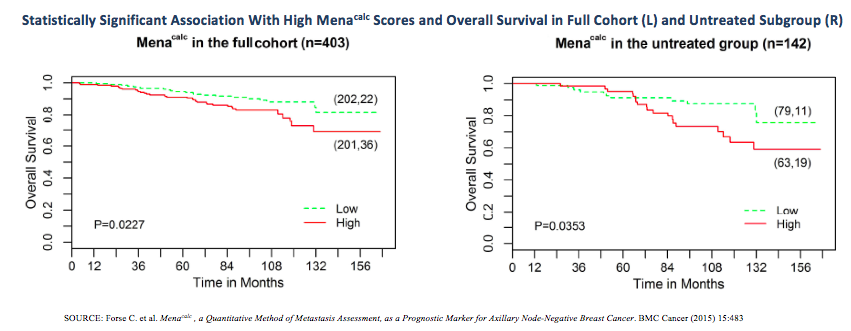
This study, along with data from other unrelated studies of MenaCalc as well as MTST’s MetaSite Breast assay, provides additional support for the company s technology as predictors of breast cancer metastasis and death as well as utility for making more informed treatment decisions.
MTST Receives State Lab License, CLIA Cert Should Be Next. Follows Positive Test Results
In late September MTST announced that they received Massachusetts state licensure for their Boston-based pathology lab. This is the last major step before receiving CLIA certification from CMS. The state license is issued following a survey (i.e. – inspection) by the Massachusetts State Department of Health and allows for the company to begin processing tissue samples.
The state licensure follows on the heels of studies validating the performance and accuracy of MTST’s fully automated MetaSite Breast assay. In late August MTST announced the automated (i.e. – to-be commercialized) MetaSite Breast assay showed greater than 97% analytical precision as compared to results of the Rohan et al study. As a reminder, the Rohan et al study, which included 481 patients with breast cancer, showed a highly statistically significant (95% C.I., p=0.004) association between risk of metastasis and MetaSite score in women with ER-positive/HER2-negative breast cancer. This represented a 2.7x increase in the odds of metastasis for women with a high risk score compared to those with a low risk score. In addition, for every increase of 10 MetaSites, there was a 1.16x increase in the risk of metastasis in this sub-population.
Additional confirmation of the accuracy and performance of the automated assay came in late September when MTST announced topline results from an independent study which again showed that MetaSite score was significantly associated with risk of distant metastasis in women with ER-positive/HER2-negative breast cancer. The data, which also confirmed results from Rohan et al, met its primary endpoint and not only showed MetaSite score was significantly and directly associated with increased risk of distant metastasis for both high versus low MetaSite scores (OR = 3.4; 95%CI = 2.8-4.1; P=0.0002), it also showed statistically significant association of risk of cancer metastasis between low and intermediate scores (OR=3.24; 95%CI = 2.6-3.9; P=0.0006).
Validation of the accuracy of the automated test is a major milestone as this is the test that is expected to be commercialized. This should also bode well for eventual CLIA certification (Kaiser validation study will be used to support CLIA certification) – which the company anticipates could happen in Q1 2016. MTST continues to conduct additional validation studies (including to predict response to chemotherapy) with data from the following various studies expected;
-Kaiser cohort MetaSite replication study: topline data expected Q4 2015. This will be used to support CLIA certification
- Replicate findings of Rohan et al
- Primary endpoint is direct association between risk of distant metastasis and MetaSite score in ER+/HER2- patients
-Kaiser cohort MetaSite/MenaCalc combined: topline data expected Q1 2016
- Define product specs and risk cut-points for combined MetaSite/MenaCalc score as compared to MetaSite score and/or MenaCalc score
- Define the assay or assays to be used in subsequent validation studies
- Primary endpoint is direct assoc. between risk of distant metastasis and MetaSite/MenaCalc score in ER+/HER2-, triple negative and/or HER2+ invasive breast cancer patients
-ECOG 2197 cohort validation study: topline data expected Q1 2016. This is the pivotal clinical validation study for MetaStat in early stage breast cancer
- Compare MetaSite/MenaCalc scores with Oncotype DX’s “recurrence score”
- Primary endpoint is direct assoc. between risk of distant metastasis and MetaSite/MenaCalc score in ER+/HER2-, triple negative and/or HER2+ invasive breast cancer patients .
-Chemo-predictive study: topline data expected Q2 2016.
- Evaluate ability of MenaCal/MetaSite Breast to predict response of adding adjuvant chemotherapy to hormonal therapy in ER+ patients.
- Primary endpoint is direct association between risk classification and benefit from chemotherapy comparing Kaplan-Meier survival curves of treatment with tamoxifen alone versus treatment with combo of tamoxifen and adjuvant chemotherapy for all patients and high, medium and low risk cohorts.
Noteworthy are results of Genomic Health’s Trial Assigning IndividuaLized Options for treatment (Rx), or TAILORx, trial. The study, which includes over 10k patients with node-negative, ER+/HER2- breast cancer, is assessing whether GHDX’s OncoType DX assay can effectively stratify which cases will and will not respond to chemotherapy. Of the 10k plus patients, 16% had a low OncotypeDX recurrence score and were treated with only hormone therapy, 67% had an intermediate score and were randomized to either chemo or hormone therapy and 17% had a high score and were treated with both chemo and hormone therapy. The findings, presented at the European Cancer Congress in late September, found that 99.3% of patients with a low OncotypeDX recurrence score (and therefore were not treated with chemo) were disease-free after five years.
Given the significant physical and emotional side effects (as well as cost) of chemotherapy, being able to effectively identify those patients which can skip chemo is of high value to both practitioners and patients. While OncotypeDX appears to be able to stratify at least a portion of the patients, it’s important to note that 67% (or 2 of 3) patients had an intermediate score which provides no actionable information (i.e. “will or will they not respond to chemo?”).
MTST’s technology, in already completed clinical trials, has demonstrated an “intermediate risk” grouping of approximately 27% (i.e. – much better than OncotypeDX’s). While these have not been chemo-predictive studies, these results may bode well for MetaSite/MenaCalc Breast providing a tighter range of intermediate risk patients, therefore offering a diagnostic that would have utility for a greater portion of the ER+/HER2- breast cancer population and clinicians more actionable information. MTST’s chemo-predictive study (summarized above) should provide much greater insight into how MetaSite/MenaCalc breast stacks up against OncotypeDX in this indication.
Additional Operational Progress
In addition to the recent positive study results using the automated assay, the MTST has made other operational progress. This includes bringing on Dr. Bruce Zetter to the Scientific and Clinical Advisory Board and appointing Dr. Michael Donovan (MD and PhD) as Chief Medical Officer. Both individuals are highly seasoned in cancer diagnostics and related research and should provide invaluable resources to help MTST guide their clinical programs.
Dr. Zetter is the Charles Nowiszewski Professor in the Departments of Cell Biology and Surgery at Harvard Medical School. Per MTST’s press release, he is an internationally recognized leader in cancer research, tumor progression, cancer diagnosis, cancer metastasis, and tumor angiogenesis.
Dr. Donovan had previously been the Chief Medical Officer of Exosome Diagnostics, Inc and Chief Scientific Officer for Aureon Biosciences. Per MTST’s press release, he is board-certified in anatomic and clinical pathology and pediatric pathology with extensive experience in designing and implementing clinical studies. He has spearheaded the utilization of multiplex tissue and fluid-based assays and coupled mathematic applications to produce clinically relevant diagnostic/predictive/prognostic outcome models for a variety of tumor types and disease states. Dr. Donovan also serves as a Professor of Experimental Pathology and Director of the Biorepository and Pathology core at the Icahn School of Medicine at Mt. Sinai, New York City, New York.
MTST has also raised additional capital to help fund the various clinical studies. This includes the sale of $1.2M of non-convertible debt (1yr, 8%) in late July.
Maintaining Buy Recommendation
We have an $11 price target on MTSTD and are maintaining our Buy recommendation. See below for access to our updated report on MTSTD.
READ THE LATEST FULL RESEARCH REPORT HERE
SUBSCRIBE TO ZACKS SMALL CAP RESEARCH to receive our articles and reports emailed directly to you each morning. Please visit our website for additional information on Zacks SCR and to view our disclaimer.