By David Bautz, PhD
OTC:MBVX
Business Update
On October 22, 2015, MabVax Therapeutics Holding, Inc. (OTC:MBVX) held the company’s first investor conference call to provide a corporate update and discuss timelines for the company’s antibody and vaccine programs. Below we provide an overview of the company’s novel antibody discovery platform, lead antibody asset HuMab 5B1, and upcoming milestones.
MabVax’s Novel Antibody Discovery Platform
Monoclonal antibodies comprise many of the top selling therapeutics in the world. Combined global sales of monoclonal antibodies were approximately $78 billion in 2014. There are four different types of antibodies currently in clinical use that differ in the origin of the constant and variable regions:

Developers of monoclonal antibodies have moved to producing more fully human antibodies, as they have the least amount of immunogenicity issues. Fully human antibodies are created through the use of transgenic mice that have human immunoglobulin genes inserted into their genome or through the use of phage display, in which human immunoglobulin genetic sequences are manipulated in vitro to identify an antigen-binding domain of interest. MabVax is exploiting a third means to discover fully human antibodies; from patients immunized with therapeutic cancer vaccines.
MabVax has generated >100 fully human antibody leads from the use of B-cells extracted from patients immunized with proprietary cancer vaccines. This is the only example we know of where fully human monoclonal antibodies targeting cancer are generated from immunized patients. The following graphic gives an overview of MabVax’s antibody discovery platform, which consists of: 1) Dosing patients multiple times with a vaccine containing a target antigen(s) to drive the production of highly useful and protective antibodies; 2) The patients produce multiple antibodies to the target antigen that bind to various epitopes with various affinities; 3) B-cells are collected from the patients and assayed to identify high-affinity antibodies to the target antigen; 4) The genetic sequence of the optimal antibody is cloned into an expression vector and the antibody is produced as a monoclonal through standard cell culture techniques; and 5) The monoclonal antibody is purified and administered to patients as a therapeutic
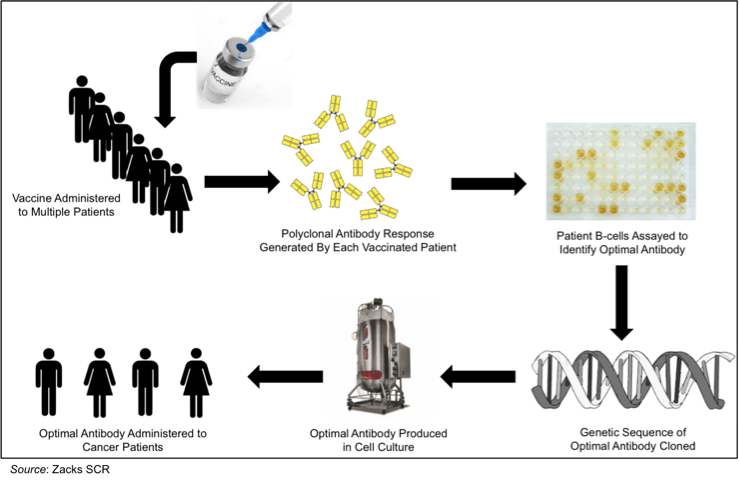
Deriving fully human monoclonal antibodies from vaccinated patients is a novel approach to generating therapeutic antibody candidates and comes with a number of advantages over traditional antibody discovery programs. These advantages include:
1) There is no need to genetically modify a murine derived antibody or perform any type of in vitro affinity maturation, as the patient’s immune system has already performed that work.
2) The self-censoring mechanism of the human immune system prevents that production of “self-harming” antibodies. Thus, any antibodies derived from a vaccinated patient that responds well to the vaccine are less likely to result in unwanted side effects.
3) A “proof-of-concept” experiment has already been performed; a source patient who had a positive clinical outcome provides anecdotal evidence for clinical activity of any derived antibodies.
HuMab 5B1
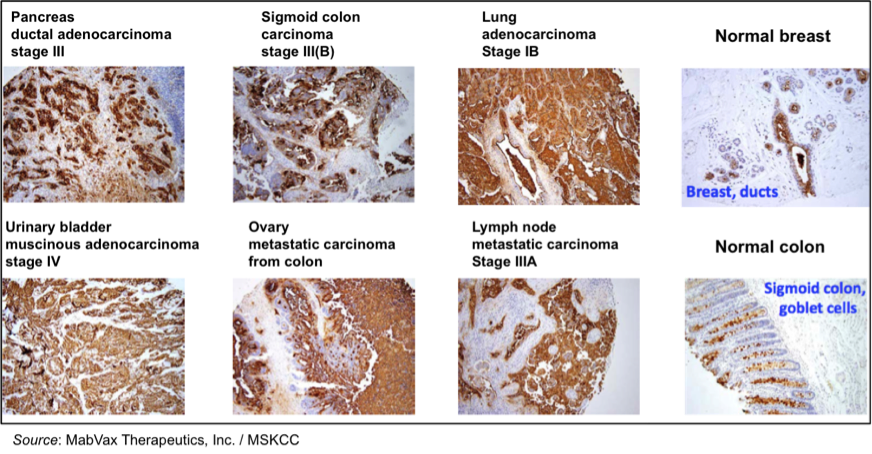
MabVax’s lead antibody candidate is HuMab 5B1, which targets the tumor associated carbohydrate antigen (TACA) sialyl Lewisa (sLea). sLea is over-expressed on a number of different epithelial tumor types including pancreatic, colon, stomach, ovarian, breast, and small-cell lung cancers. The following figure shows significant homogeneity and staining intensity of sLea on different types of cancer cells along with limited staining of normal tissue. The expression of sLea on normal breast, colon, and pancreatic tissue is restricted to cells of the secretory ducts and lumen, which are inaccessible to the immune effector mechanisms.
HuMab 5B1 has demonstrated exceptionally high affinity (Kd = 140 pM) and specificity for sLea. HuMab-5B1 was derived from a patient with Stage IV breast cancer who was originally vaccinated with a sLea vaccine at the end of 2008. A total of seven patients were vaccinated at that time with the sLea vaccine and six of them are still alive today. The patient from whom 5B1 was derived remains disease free to this day, which provides compelling anecdotal evidence for the antibody’s potential efficacy. MabVax is targeting HuMab-5B1 for the treatment of metastatic pancreatic and colorectal cancer, as these two diseases have very low 5-year survival rates and improved therapeutic options are clearly warranted.
HuMab 5B1 Being Developed For Multiple Uses
MabVax is planning to develop HuMab 5B1 as a therapeutic agent, a PET imaging diagnostic agent, a radioimmunotherapy agent (RIA), and an antibody-drug conjugate (ADC).
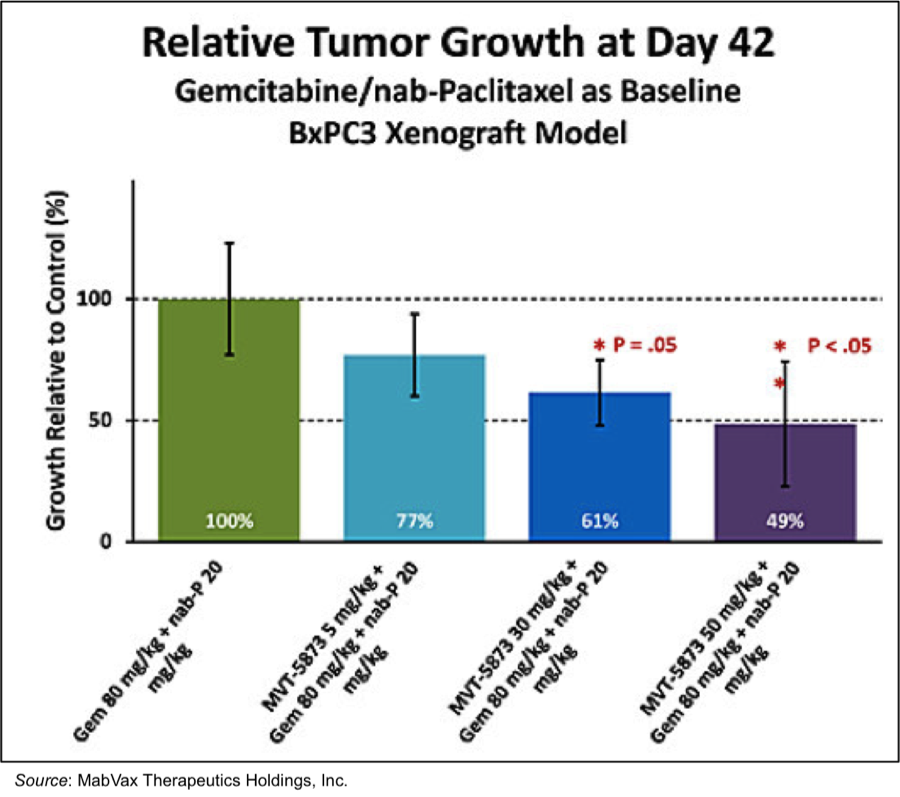
Therapeutic Agent: The standard of care for metastatic pancreatic cancer is a chemotherapy combination of gemcitabine and nab-paclitaxel (Abraxane®). MabVax tested the efficacy of 5B1 as an add-on to gemcitabine and nab-paclitaxel in a BxPC3 xenograft murine model of pancreatic cancer. Results showed that the addition of 5B1 resulted in reduced growth of tumor cells, with up to 50% growth inhibition at the highest dose tested.
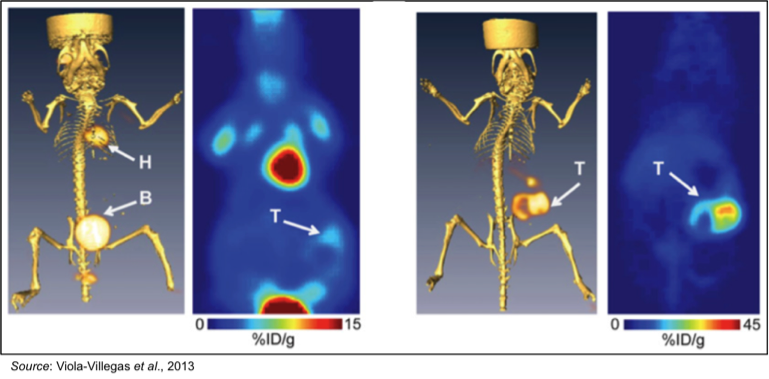
Diagnostic Agent: In order to test the hypothesis that targeting sLea would be a useful imaging tool, HuMAb 5B1 was coupled to the radionuclide 89Zr using a clinically validated linking agent (DFO). 89Zr is known to offer good quality imaging data based on previous pre-clinical and clinical data (Ulmert et al., 2012; Holland et al., 2010). The imaging agent was tested against BxPC3-luc cells (which express the luciferase gene allowing for monitoring of tumor growth by bioluminescence) that were injected directly into the pancreas of immuno-deficient mice. After the tumors had grown for two weeks, all mice received FDG PET (standard cancer imaging agent) and a subset of mice then received HuMab 5B1 PET. The following figure shows combined PET/CT analysis for a representative mouse that received FDG PET (left) and HuMab 5B1 PET (right). The images show that FDG PET has a high degree of background as shown by the intense signal at the heart and bladder and minimal uptake by the tumor. In contrast, the HuMab 5B1 PET image shows very little background and clear uptake by the tumor.
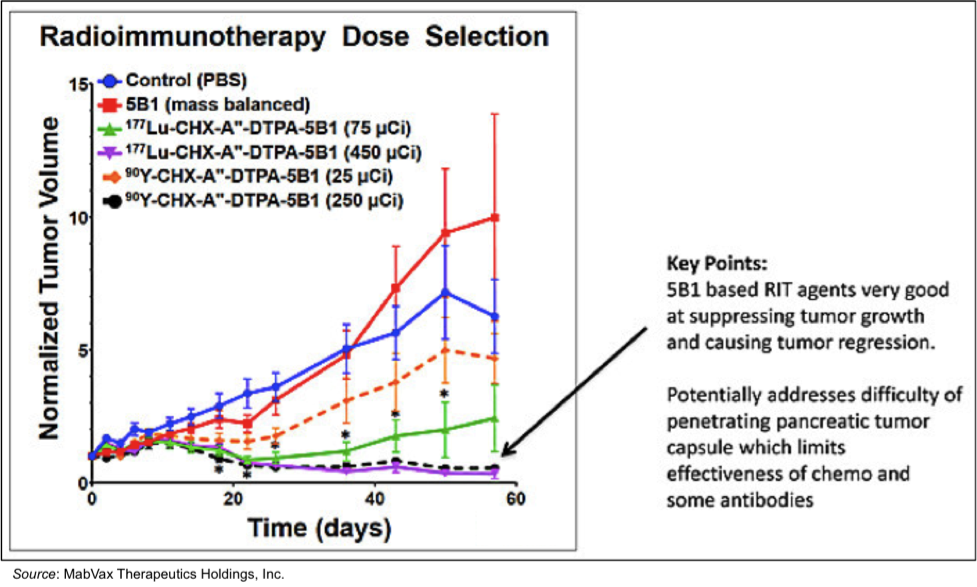
Radioimmunotherapy: Radioimmunotherapy (RIT) refers to the labeling of antibodies with radionuclides (radioactive isotope) that allows for a high dose of radioactivity to be delivered to a tumor while minimizing exposure to normal cells. HuMab 5B1 was tested as a RIT using both 177Lutetium and 90Yttrium. The results showed that treatment with both of the HuMab 5B1-RIT molecules resulted in not just inhibition of tumor growth, but regression in tumor volume. The company believes that an IND could be filed for HuMab 5B1 RIT by the end of 2016.
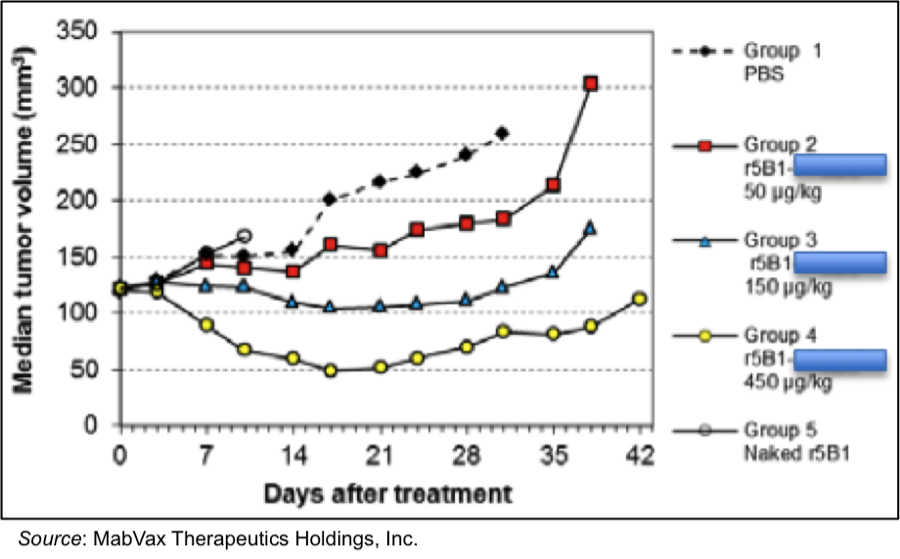
Antibody-Drug Conjugate: Antibody-drug conjugates (ADCs) are monoclonal antibodies that are conjugated to a cytotoxic agent through a stable, chemical linker. Binding between the monoclonal antibody and the cell causes the internalization of the antibody along with the attached cytotoxic agent. Once inside the cell, the cytotoxic agent is released and the cancer cell is killed. MabVax has entered into collaboration with Heidelberg Pharm, a company with its own proprietary linker and toxin technology, and as part of the collaboration Heidelberg has performed initial pre-clinical experiments utilizing HuMab-5B1-toxin ADC candidates. The HuMab-5B1-toxin ADC shows potent in vitro and in vivo activity, as shown by the following figure where a single dose of HuMab-5B1-toxin ADC at varying concentrations limits the growth of BxPC3 xenografts.
Developing HuMab 5B1 as multiple therapeutic and diagnostic agents is a sensible approach to maximizing the value of the asset, and we are particularly encouraged by the early preclinical data regarding the HuMab 5B1 RIT candidates.
Initially Targeting Metastatic Pancreatic and Colorectal Cancer
Pancreatic cancer is responsible for 7% of all cancer deaths in both men and women, making it the fourth leading cause of cancer death in the U.S. (American Cancer Society). There are approximately 49,000 new cases of pancreatic cancer diagnosed each year in the U.S., with approximately 50% of those being metastatic at the time of diagnosis. The 5-year survival rates for patients with pancreatic cancer are dismal (<14%) and are particularly bad for those with metastatic disease (~1%).
Approximately 140,000 new cases of colorectal cancer (CRC) will be diagnosed in the U.S. in 2015 (American Cancer Society), with approximately 20% of those being metastatic. While rates of CRC in those over the age of 50 have been declining, rates in those younger than 50 have been increasing. Five-year survival rates for those diagnosed with metastatic CRC are less than 10%. Clearly, there is an urgent unmet medical need for more effective therapies for patients with metastatic pancreatic and colorectal cancer.
HuMab 5B1 Development Plan
MabVax is planning to file two investigational new drug (IND) applications with the FDA for HuMab 5B1 as a therapeutic agent and a diagnostic agent before the end of 2015. The company then plans on initiating two Phase 1 clinical trials to examine the safety and pharmacokinetics of both HuMab 5B1 products in the first quarter of 2016. We anticipate preliminary results from these studies being available in the second half of 2016. Assuming positive data from each of the Phase 1 studies, we anticipate Phase 2 studies initiating in mid-2017. The company has indicated the possibility exists for partnering 5B1 as a therapeutic after the Phase 1 study, assuming acceptable terms can be established, due to interest exhibited by several larger biopharmaceutical companies based on the positive pre-clinical testing, xenographic animal model experiments, and toxicology results generated thus far.
The company could be in a position to file an IND for HuMab 5B1 RIA by the end of 2016 and initiate a Phase 1 clinical trial in the first quarter of 2017. For the ADC, an IND isn’t likely to be filed until the end of 2017 with a Phase 1 study beginning in 2018.
Vaccine Program
Dr. Philip Livingston, who is the company’s Chief Scientific Officer and former Head of the Laboratory of Tumor Vaccinology at Memorial Sloan-Kettering Cancer Center (MSKCC), has been developing a series of monovalent (targeting a single tumor antigen) cancer vaccines for the last 30 years that target carbohydrate antigens on neuroectodermal and epithelial cancers. MabVax has licensed exclusive rights to vaccines that cover 11 validated target antigens from MSKCC. The license agreement calls for MSKCC to complete all preclinical and Phase 1 clinical trial work at MSKCC’s expense at which point the IND would be transferred to MabVax for continued development.
MabVax has three cancer vaccines under active development targeting recurrent sarcoma, ovarian cancer, and neuroblastoma. We invite investors to review our previous research report for an in-depth overview of the company’s vaccine program. The vaccines targeting recurrent sarcoma and ovarian cancer are currently in proof of concept Phase 2 clinical trials, while the neuroblastoma vaccine has completed an initial Phase 1 trial at MSKCC and a Phase 2 trial could commence in 2016. We anticipate overall survival results from the sarcoma and ovarian cancer trials by early 2017 and the Phase 2 neuroblastoma trial to commence by the end of 2016, however that is contingent upon securing financing for the trial.
Conclusion and Recommendation
MabVax has compiled a considerable amount of pre-clinical data on HuMab 5B1 as a therapeutic and diagnostic agent. The company is planning to file an IND for each indication before the end of 2015 and subsequently initiate Phase 1 clinical trials in the first quarter of 2016. The Phase 1 trial for the therapeutic indication will likely be a safety and pharmacokinetic study involving late-stage cancer patients with multiple types of solid tumors. Data from this study should be available in the second half of 2016, and will be used to guide optimal dosing for a Phase 1b clinical trial later in 2017. The Phase 1 trial for the diagnostic indication will likely enroll up to 30 patients in both the dose escalation and expansion arms of the trial. We estimate it will take approximately one year to fully enroll the trial and obtain all results, however important safety and targeting specificity readouts are likely to come much sooner, perhaps by mid to late-2016. The company is also likely to file an IND for HuMab 5B1 RIA before the end of 2016 and another IND for HuMab 5B1 ADC before the end of 2017. Thus, the company could file four INDs just for HuMab 5B1 over the next 24 months. Combined with the data readouts for the ovarian and sarcoma vaccines by the first part of 2017, and there figures to be a substantial amount of news flow for MabVax over the next 12-18 months.
The company recently completed a public offering by selling 2.5 million shares of common stock at a price of $1.10 per share. Included in the offering were 1.25 million warrants with an exercise price of $1.32 per share that are immediately exercisable and expire in Sep. 2018. Gross proceeds to the company were $2.75 million, which combined with the company’s current cash reserves ($7.1 million as of June 30, 2015) should be enough to fully fund the Phase 1 clinical development of HuMab 5B1.
We have made some slight modifications to our probability-adjusted discounted cash flow model based on the recent financing and the uncertainty regarding the Phase 2 study of the neuroblastoma vaccine. These changes have lowered our price target slightly from $4.50 to $4, however our enthusiasm for the company’s antibody discovery platform has not diminished in any way. Positive news flow from the upcoming clinical trials in 2016 is likely to send the shares much higher, thus we are re-iterating our ‘Buy’ recommendation.
READ THE LATEST FULL RESEARCH REPORT HERE
SUBSCRIBE TO ZACKS SMALL CAP RESEARCH to receive our articles and reports emailed directly to you each morning. Please visit our website for additional information on Zacks SCR and to view our disclaimer.