By David Bautz, PhD
NASDAQ:NBIX
Positive Results from Phase 3 Kinect 3 Trial of NBI-98854 in Tardive Dyskinesia
On October 8, 2015, Neurocrine Biosciences (NASDAQ:NBIX) announced positive results from the Phase 3 Kinect 3 clinical trial of NBI-98854 in tardive dyskinesia (NCT02274558). The Kinect 3 study is a randomized, parallel group, double blind, placebo controlled Phase 3 clinical trial testing NBI-98854 in moderate to severe tardive dyskinesia patients with underlying schizophrenia, schizoaffective disorder, or mood disorder. A total of 234 patients were randomized to receive placebo, 40 mg of NBI-98854, or 80 mg of NBI-98854 once daily for six weeks. The results showed a highly significant change from baseline in the Abnormal Involuntary Movement Scale (AIMS) at Week 6 (p<0.0001). Below we provide a brief overview of tardive dyskinesia, NBI-98854, and the topline results from the Kinect 3 study.
Tardive Dyskinesia and NBI-98854
Tardive dyskinesia (TD) is a disorder that results in involuntary movements of the tongue, lips, face, trunk, and extremities that occur in patients treated with long-term dopaminergic antagonist medications. People with schizophrenia and other neuropsychiatric disorders are particularly vulnerable to developing TD after treatment with conventional neuroleptics, anticholinergics, substances of abuse, and other agents. TD is most common in patients with schizophrenia, schizoaffective disorder, or bipolar disorder who have been treated with antipsychotic medications for a long period of time.
While no large, controlled clinical trials have been conducted, tetrabenazine has shown benefit in managing the symptoms of TD (Leung et al., 2011). Tetrabenazine is an inhibitor of VMAT2, a transporter that serves to package dopamine and other neurotransmitters into vesicles for release into the synapse. The problem with tetrabenazine (sold as Xenazine® in the U.S. by Lundbeck) is that it is a racemate composed of a 1:1 mixutre of enantiomers that is metabolized into four different isomers (+/- α-isomers and +/- β-isomers), with the α-isomers believed to contribute to the drugs efficacy and the β-isomers believed to contribute to the drugs side effects. Tetrabenazine has a number of serious adverse side effects including a “Black Box” warning for depression and suicide risk.
NBI-98854 (L-Valine (2R,3R,11bR)-1,3,4,6,7,11b-hexahydro-9,10-dimethoxy-3-(2-methylpropyl)-2H-benzo(a)quinolizin-2-yl ester) is a prodrug of the (+)-α-isomer of tetrabenazine that was specifically developed for slow metabolism (once a day dosing) and potent VMAT2 inhibition. The drug was previously tested in two Phase 2 studies; Kinect-1 and Kinect-2. The Kinect-1 study did not reach its primary endpoint, which we believe was due to both sub-optimal dosing of patients and the lack of centralized reviewers. However, the Kinect-2 study reported highly statistically significant results with a very clean safety and tolerability profile for the drug.
Kinect 3 Trial Results
Due to the fact that the company is planning on presenting the full data set from the study at future medical conferences and in peer-reviewed publications, not many details about the results were released. However, what was released shows that the trial was very successful, as shown in the following table.
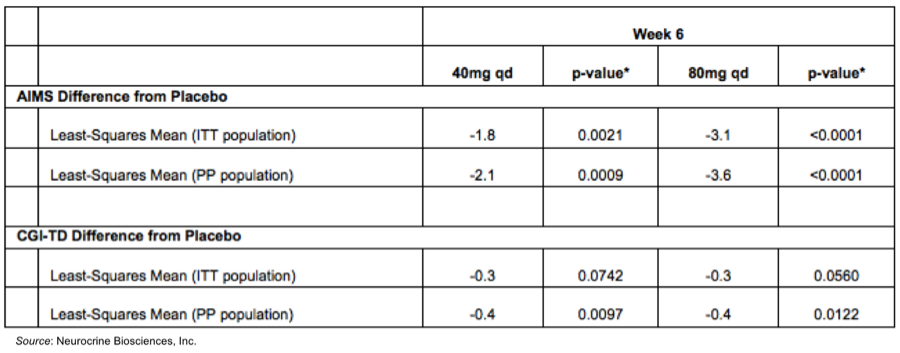
The primary endpoint of the study was the change from baseline in the Abnormal Involuntary Movement Scale (AIMS) at Week 6 as determined by centrally blinded video raters. Secondary endpoints in the study included the Clinical Global Impression of Change (CGI-TD). The AIMS rating at Week 6 was reduced 3.1 points more than placebo, which was a highly significant result (p<0.0001). For comparisons sake, in the Kinect-2 study the results showed the AIMS rating at Week 6 was reduced by 2.4 points more than placebo in the intent to treat (ITT) population and 3.0 points more than placebo in the per protocol (PP) population. The ITT population includes any subject with at least one dose of blinded study drug (active or placebo) and one post-treatment AIMS assessment at week 6, while the PP population excluded any subject randomized to NBI-98854 with levels of drug below the limit of quantitation (i.e., the subject had not ingested the drug). Data not released at this time includes what the reduction in AIMS rating was for placebo treated patients and what the baseline AIMS rating for each group was. However, since the results shown above are the difference from placebo, it is clear that the results in regards to AIMS rating from the Kinect-3 study were superior to the results seen in the Kinect-2 study. The CGI-TD results were not statistically significant for the ITT population, however since that was a secondary endpoint we do not believe this will hinder the approval of the drug.
Teva Pharmaceuticals is developing SD-809, which is a deuterium-modified version of tetrabenazine. In June 2015, Teva announced positive top-line results for SD-809 in the treatment of TD. The primary endpoint of that trial was also the change in AIMS from baseline, however that trial examined results after 12 weeks of treatment. Results showed that patients taking SD-809 had a reduction in AIMS of 3.0 points compared to 1.6 points for those taking placebo, representing a placebo-adjusted reduction of 1.4 points. While impossible to make direct comparisons between results from different clinical trials, the Kinect-3 results showing a placebo-adjusted reduction of 3.1 points look quite good in comparison to the results reported by Teva.
Importantly, the frequency of adverse events in the Kinect-3 trial was similar among all treatment groups and treatment emergent adverse effects were consistent with those of prior studies. Participants in the trial were also assessed for akathisia and parkinsonism and minimal symptoms were present at baseline and there was no worsening during the six-week treatment period. Lastly, clinical hematology, chemistry, and ECG monitoring indicated no emergent safety signals.
The Kinect-3 study, along with the previous efficacy studies of NBI-98854, is designed to complete the clinical efficacy evaluation of the drug in TD. The company is now turning its attention to completing the one year open-label safety studies in TD patients with all data to be included in the company’s New Drug Application (NDA), which we anticipate being filed in 2016.
Phase 1 Tourette Syndrome Study Continues
In addition to TD, Neurocrine is also developing NBI-98854 as a treatment for Tourette syndrome (TS). The company is currently conducting a Phase 1b trial of NBI-988554 in both children and adolescents with TS (NCT02256475). The T-FORCE study is an open-label, multiple ascending dose, two-week study of 36 subjects with TS. The study participants will receive once-daily dosing of NBI-98854 during a two-week treatment period to assess both the safety and tolerability of NBI-98854 in Tourette patients followed by seven days off-drug. The study is taking place at approximately 10 centers in the U.S.
The study is divided into two dosing groups: children (ages 6-11) and adolescents (ages 12-18). Each group is divided into three dosing cohorts of six patients each. Following the initial two weeks of dosing with the first adolescent cohort, an independent review of both safety and pharmacokinetic results will occur prior to escalating the dose level for the second cohort of adolescents. Concurrently, when the second group of adolescents is dosed the first group of children will be administered NBI-98854. Continued dose escalations for both children and adolescents will be contingent upon the pharmacokinetic and safety data from the previous cohort in each age group. Lastly, each patient’s Tourette symptoms will be evaluated weekly using the Yale Global Tic Severity Scale, the Premonitory Urge for Tics Scale, and the Clinical Global Impression in Tourette syndrome Scale. We remind investors that this study is not powered to show efficacy in treating TS, but is rather a pharmacokinetic and pharmacodynamics focused study. Data from the T-FORCE study should be available in the fourth quarter of 2015.
Conclusion and Recommendation
The treatment of TD is a very meaningful market opportunity for Neurocrine. There are an estimated 500,000 TD patients in the U.S. with no real treatment options besides tetrabenazine. For valuation purposes, we assume U.S. approval of NBI-98854 in TD will target roughly 150,000 of the total patients in the U.S. that are moderate-to-severe in disease state. We assume Neurocrine will charge pricing comparable to atypical antipsychotics, or around $15,000 per year. If Neurocrine can capture 33% market share, which we believe is reasonable given the superior characteristics of NBI-98854 vs. generic tetrabenazine, then peak sales estimates are approximately $1.2 billion in this indication in the U.S. alone. We remind investors that NBI-98854 has received breakthrough designation from the U.S. FDA for the treatment of TD. Neurocrine is also pursuing development of NBI-98854 in TS. Phase 1b data are expected in the fourth quarter of 2015. We believe the opportunity for NBI-98854 in TS is another billion-dollar opportunity.
In addition to NBI-98854, Neurocrine is partnered with AbbVie for the development of elagolix as a treatment for endometriosis and uterine fibroids (UF). AbbVie recently announced that it was moving elagolix into a Phase 3 program for the treatment of UF. Earlier in 2015, AbbVie reported positive data from the first Phase 3 elagolix trial in endometriosis along with data from the six-month extension trial showing results consistent with previously reported efficacy and safety findings. Data from the second Phase 3 elagolix trial in endometriosis is expected in the first quarter of 2016, and we believe AbbVie will file an NDA for elagolix in late 2016. Thus, Neurocrine could have two NDAs (one for elagolix, one for NBI-98854) on file with the FDA by the end of 2016!
With the positive results reported from the Kinect-3 study, the good news continues to accumulate for Neurocrine and as such we continue to be very positive about the future of the company. Additional near term catalysts include the Phase 1b clinical data from the T-FORCE trial for NBI-98854 in TS in the fourth quarter of 2015 and the data from the second Phase 3 elagolix trial in endometriosis in the first quarter of 2016. We have increased the probability of approval for NBI-98854 in TD to 80% in our model, and as a result are increasing our price target to $70 and reiterating our ‘Buy’ rating.
READ THE LATEST FULL RESEARCH REPORT HERE
SUBSCRIBE TO ZACKS SMALL CAP RESEARCH to receive our articles and reports emailed directly to you each morning. Please visit our website for additional information on Zacks SCR and to view our disclaimer.