By Grant Zeng, CFA
NASDAQ:NWBO
The Company (NASDAQ:NWBO) presented the updated data from its ongoing Phase I trial of DCVax-Direct for solid tumors at ASCO this Saturday.
Overview of the Phase I Trial
All patients enrolled in the Phase I trial had late stage cancers, with an average of three inoperable tumors. The patients had failed multiple prior therapies and had a poor prognosis.
As of the reporting date at the ASCO, the trial enrolled 40 patients, and 39 were evaluable. Although the patients had multiple inoperable tumors, only 1 tumor was injected with DCVax-Direct. The treatments included only 3 injections in the first 2 weeks (Day 0, 7 and 14), and up to 3 additional injections spaced months apart thereafter (Weeks 8, 16 and 32), over a total period of 8 months.
Patients typically received their first injection about 1-1/2 months after recruitment. Four patients are still in the process of completing the study visits, and data collection is ongoing on all of the patients.
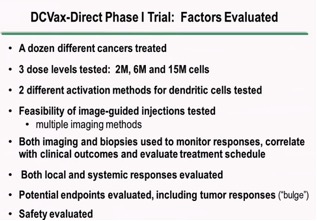
The trial tested three different dose levels of DCVax-Direct, two different methods of activating the dendritic cells that comprise DCVax-Direct, and a dozen different cancers. Findings to date include encouraging survival data and substantial induction of immune checkpoint expression (PDL-1).
Updated Data from the Presentation
Key findings as of the presentation day include the following:
· 27 of 39 patients (69%) are still alive at up to 18 months after first injection.
· With the preferred method of dendritic cell activation, 18 of 21 patients (86%) are still alive.
· The effectiveness of treatment have been observed in diverse cancers, including lung, breast, colorectal, pancreatic, sarcoma, melanoma, neuro-endocrine and other cancers.
· Patient survival correlates with the number of DCVax-Direct injections.
· Patient survival also correlates with stabilization of disease at Week 8 (4th injection visit). Among patients treated with the preferred method of dendritic cell activation, 16 of 19 achieved stable disease (i.e., less than 25% increase in tumor size from baseline) at Week 8.
Findings to date relating to immunological responses include the following:
· Induction of PDL-1 immune checkpoint expression was seen in 64% of evaluable patients (14 of 22) following DCVax-Direct treatment. This suggests that the tumors are putting up defenses against the immune responses induced by DCVax-Direct, and marks these patients as potential candidates for treatment with checkpoint inhibitor therapies.
· An increase in T-cell infiltration into tumors, by functionally active T-cells, was seen following DCVax-Direct treatment.
· Both local effects (in the injected tumor) and systemic effects were observed.
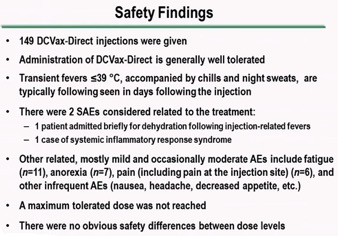
DCVax-Direct was safe and well tolerated in the Phase I trial.
Phase II Trial of DCVax-Direct Planned
Based on the findings from the Phase I trial, the company plans to enhance its Phase II trials in several ways, including:
· Using only the preferred activation method of the DCVax dendritic cells.
· Injecting multiple inoperable tumors at each treatment visit, not just one.
· Providing more frequent treatments and a larger total number of treatments.
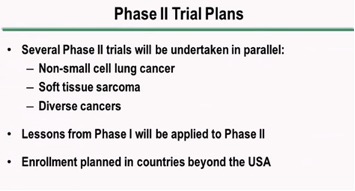
The company plans to pursue Phase II trials in non-small cell lung cancer and sarcoma, as well as a Phase II trial for multiple diverse types of cancers similar to the Phase I study. The company also plans to expand the trial sites to include countries beyond the U.S.
Our Takeaways
We think data from the ASCO presentation are very encouraging. We are especially impressed with these positive results across diverse types of cancers in late stage patients with multiple inoperable tumors who have exhausted other treatment options, and with quite a conservative DCVax-Direct treatment regimen.
We further believe the positive data from the Phase I trial will accelerate the initiation of the planned Phase II trial of DCVax-Direct, which, in addition to the Phase III trial of DCVax-L for brain cancer, will serve as another key value driver the company.
The findings from the Phase I trial also open the door for potential combination therapy of DCVax-Direct with checkpoint inhibitors.
Update on Phase III DCVax®-L Trial
The Phase III trial of DCVax-L for glioblastoma multiforme (GBM) brain cancer is progressing on track. The Phase III trial is enrolling patients at over 50 trial sites in the US and a number of sites in the UK and Germany.
In March 2015, NWBO presented encouraging survival data on 51 Glioblastoma multiforme (GBM) brain cancer patients treated with DCVax®-L at the 2nd Immunotherapy of Cancer (ITOC) Conference in Munich, Germany.
The 51 GBM patients were treated in an Information Arm outside the Company’s Phase III clinical trial because they were not eligible for the trial, due to evidence of early tumor re-growth following 6 weeks of daily radiotherapy and chemotherapy. Overall Survival data is available for all 51 patients; however, MRI images are only available for 46 of the 51 patients. These 46 patients were classified by an independent medical imaging company into 3 groups, as follows. The other 5 patients remained unclassified, due to lack of available images.
The survival to date, for each of these groups of Information Arm patients treated with DCVax-L, is as follows:
· The median OS of the group of 51 Information Arm patients as a whole is 18.3 months. About 30% of the patients (15 of the 51) lived beyond 2 years, and most of these patients (12 of the 15) remain alive.
· The median OS among the 20 rapid-progressors patients is 15.3 months (with patients surviving as long as 37.1 months), compared to expected median OS of 8.3 – 10.8 months with existing treatments, based on published literature on comparable patient populations — a 50% improvement over the expected survival time. Further, one-third of these patients (7 of the 20) lived beyond 18 months – a doubling of the expected survival time with existing treatments.
· The median OS among the 25 indeterminate patients is 21.5 months (with patients surviving as long as 40.7 months), compared to median OS in the general population of newly diagnosed GBM patients of 14.6 months – a 50% improvement over the expected survival time. Further, 9 of these 25 patients remain alive today at more than 24 months, 6 of these 9 patients have exceeded 30 months, and 4 of these 9 patients have reached 35-40+ months.
· 1 pseudo-progressor patient is still alive, with OS of 30.1 months to date.
· The median OS for the 5 unclassified patients is 9.2 months (with patients surviving as long as 30.1 months).
DCVax-L also continues to show an excellent safety profile, with no serious adverse events observed in these Information Arm patients.
We are impressed with these data with all patients treated with DCVax-L are surviving substantially longer than would be expected based on clinical experience reported in the literature.
This survival data, which has been collected by the independent CRO managing the company’s Phase III trial, provides an encouraging insight into the potential results of the DCVax-L treatments for newly diagnosed patients in the Phase III trial.
At the same time, the Phase III trial has reached late stage in patient enrollment. Currently there are more than 60 clinical sites open and operating for the trial across the U.S. and in the U.K., Germany and Canada, with more sites expected to become operational during 2015, particularly in Europe.
The original trial plan involves enrollment of 312 total patients in the trial, and counting 110 “events” of tumor recurrence or patient deaths from among these 312 patients to determine whether the primary endpoint of the trial is met.
NWBO has modified its trial plan so that it will enroll 348 total patients, and will count 248 “events” from among these 348 total patients to determine whether the primary endpoint of the trial is met. So, the number of “events” counted in the statistical analysis will increase from 110 to 248, but the total enrollment in the trial will only increase from 312 to 348.
NWBO anticipates that the Phase III trial will reach its first interim analysis for efficacy during 2015 and anticipates that the Phase III trial will reach its primary endpoint PFS (progression free survival) in 2016, potentially in the spring or summer. According to this schedule, we expect an NDA will be submitted in late 2016 and DCVax-L will be approved in 2H2017.
Balance Sheet Boosted by Recent New Financing
In April 2015, NWBO closed $40 million investment from Woodford investment funds in the UK.
Woodford first invested $25 million in NWBO in November, 2014. On April 2, 2015, Woodford entered into an agreement with the company for a further $40 million investment in two tranches ($11.5 million and $28.5 million). Both of these tranches have been completed in accordance with the agreement. Woodford has also made substantial open market purchases of NWBO shares.
The $40 million investment was done with the purchase of the Company’s common stock at $7.40 per share, for a total of 5,405,405 shares. There are no warrants, pre-emptive rights, or other rights or preferences. There was no investment banker involved in the transaction.
As of March 31, 2015, NWBO had approximately $4 million in cash. With the proceeds from the new investment, the company’s balance sheet has been greatly boosted.
READ THE LATEST FULL RESEARCH REPORT HERE
SUBSCRIBE TO ZACKS SMALL CAP RESEARCH to receive our articles and reports emailed directly to you each morning. Please visit our website for additional information on Zacks SCR and to view our disclaimer.