By David Bautz, PhD
NASDAQ:NVIV
Financial Update
On August 5, 2015, InVivo Therapeutics (NASDAQ:NVIV) reported financial results for the second quarter of 2015 that ended June 30, 2015. As expected, the company did not report any revenues. Net loss totaled $10.4 million and consisted of $2.5 million in R&D and $3.2 million in G&A expense. Included in the net loss was a negative $4.6 million re-valuation of warrant liability.
The company burned $4.2 million during the quarter but also received $4.0 million from the exercise of warrants issued in the company’s May 2014 public offering. Operating burn for the previous four quarters was $2.9, $4.2, $3.2, and $3.6 million, thus it has been fairly consistent over the past year. InVivo exited the quarter with $25.1 million in cash on the books.
Update on Investigational Pilot Study of Neuro-Spinal Scaffold
InVivo is currently conducting a five patient, early feasibility pilot study of the Neuro-Spinal Scaffold (NSS) under an Investigational Device Exemption (IDE) application for the treatment of complete traumatic acute spinal cord injury (SCI). This FDA approved study is intended to capture data on the safety and feasibility of using the NSS along with gathering preliminary evidence of clinical effectiveness. Thus far, there are 12 clinical sites open and three patients have been enrolled in the study and implanted with the NSS.
Patient Updates
Thus far, three patients have been enrolled in the pilot study for the NSS. Below we provide an update on each of the patients.
Patient #1 (Jordan):
The first patient to enroll in the NSS study was involved in a dirt bike accident on October 13, 2014. The injury was classified as AIS-A and graded as complete (total paralysis) at T11 and below. On October 16, 2014, InVivo announced the NSS was successfully implanted in the patient (the surgery took place approximately 8 hours following the accident).
On January 21, 2015 InVivo announced a positive safety update at three months post-injury. At that time the injury was graded as "incomplete" and Jordan was reclassified to AIS-C from AIS-A, with motor, sensory, bowel, and bladder functional improvements compared to baseline.
On May 14, 2015 InVivo announced that between the three-month and six-month assessment Jordan had regained partial function of knee extensors and remained classified as AIS-C with a motor incomplete spinal cord injury.
Patient #2 (Jesi):
The second patient to enroll in the NSS was struck by a car while riding on the back of a motorcycle on January 18, 2015. Her injury was classified as AIS-A impairment and graded as complete at T6 with total paralysis at T8 and below. On January 22, 2015, InVivo announced that the NSS was successfully implanted, however due to the severity of the patient’s injuries the doctors had to wait two days after her accident to perform the surgery.
On March 26, 2015, InVivo announced re-opening of enrollment in the pilot study, signifying success with respect to the safety endpoint at 30-days post-surgery for Jesi.
On May 14, 2015, InVivo announced a positive safety and efficacy update on Jesi at three months post-injury. Despite a return of some sensory and motor function, including appreciable improvement in trunk stability, self-care, mobility, and bowel and bladder function at the three-month post-implant assessment, Jesi remained classified as AIS-A on the impairment scale due to a lack of consistent and profound sensory and motor function at the sacral S4-S5 region.
On July 6, 2015, InVivo announced a six-month post-implant assessment that showed Jesi had marked improvement in sensory function with partial sensation present five dermatome levels lower on the right side compared to the three-month assessment. This translates to regaining partial sensation from the lower ribs to the hip on the right. In addition, Jesi continues to make meaningful progress in activities of daily living.
Patient #3
On June 4, 2015, InVivo announced the third patient was enrolled in the pilot study. The NSS was implanted three and a half days after the patient suffered their injury. Unlike the first two patients, who are in their 20’s, very active on social media, and have waived their HIPAA rights surrounding medical confidentiality, the third patient to enroll is older, didn’t waive his HIPAA rights, and has no interest in social media. Thus, updates for this patient will only be available through press releases from InVivo.
On July 6, 2015, InVivo announced that in the time between implantation and the one-month post-injury assessment, the third patient improved from a complete AIS-A spinal cord injury to an incomplete AIS-B spinal cord injury and that the patient regained sacral sensation with improved bladder function. In addition, there were no reported serious adverse events associated with the NSS.
Once is a Fluke, Twice is a Coincidence, Three Times is a Trend…
To summarize what has been seen thus far in the pilot study of the NSS:
-Patient #1 has gone from AIS-A to AIS-C in one month, which occurs in fewer than 5% of AIS-A patients with a T10-T12 injury.
-Patient #2 remains AIS-A but has seen improvement in trunk stability, self-care, mobility, bowel and bladder function, and has regained partial sensation from the lower ribs to the hip on the right side of her body.
-Patient #3 went from AIS-A to AIS-B in the first month after his accident, which is observed in fewer than 4% of patients with a T4 injury.
-Perhaps most importantly of all, since this is first and foremost a safety study, is that there have been no serious adverse events due to the NSS or the surgical procedure.
Looking at the results thus far, it appears as though a trend is developing in regards to the safety and efficacy of the NSS. InVivo still has two more patients to enroll in the pilot study, which could occur at any time but will most likely happen before the end of 2015. Even though this is only a safety study, it’s hard not to be impressed with the level of efficacy seen thus far with the first three patients.
What's Next?
InVivo will continue to follow all of the patients enrolled in the pilot study for the rest of their lives. With Jordan and Jesi having each completed their six-month assessments, the next update for investors will be the three-month update for Patient #3, which should come at the beginning of September, and the enrollment of Patients #4 and #5, whenever that occurs. We expect the pilot study to wrap up by the end of the year, with 12-month safety assessments of all five patients likely to be completed during the second half of 2016, depending upon enrollment of Patients #4 and #5.
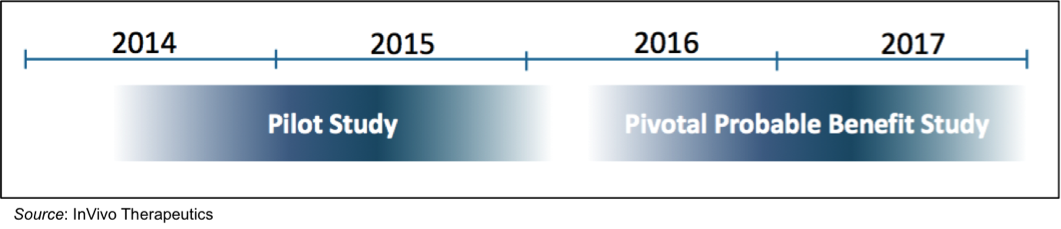
Following successful completion of the pilot study, InVivo expects to conduct a pivotal probable benefit study to obtain FDA approval to commence commercialization under a Humanitarian Device Exemption (HDE). We remind investors that InVivo received a Humanitarian Use Device (HUD) designation for the NSS in April 2013. Some investors have been asking about the potential for InVivo to file for approval after the pilot study through the FDA's Expanded Access (EA) program. We do not think that safety data from five patients will be enough to convince the FDA to allow approval through the EA program and that the company will need to show safety data from more patients, however how many patients won’t be known until the company get further clarification from the FDA. The probably benefit study is likely to commence in 2016, however we won’t have a clear picture of what the endpoints for that study will be until after all data from the pilot study are collected and the company has had a chance to sit down with various KOLs and the FDA to plan the pivotal study.
The Potential For the NSS is Enormous
We believe the NSS is a potential $750 million product just in acute spinal cord injury. We also believe after HDE approval, neurosurgeons will use the device in almost all non-penetrating spinal cord injuries, regardless of things like AIS-A impairment level and injury location. In three months, Jordan (Patient #1) went from complete AIS-A with no motor or sensory function below the belly-button to incomplete AIS-C and the ability to control his bowels/bladder. In two months, Jesi (Patient #2) went from completely paralyzed to being able to move her leg. In one month, Patient #3 went from complete AIS-A to incomplete AIS-B with regained sacral sensation and improved bladder function. We suspect that with additional physical therapy and time, all three patients could progress to AIS-D by the twelve month. That’s incredible!
According to the NSCISC's February 2013 report "Spinal Cord Injury Facts and Figures at a Glance," (i) during the first year, average "cost of care" ranges from $340,787 to $1,044,197, depending on the severity of the injury, (ii) the net present value to maintain a quadriplegic injured at age 25 for life is $4,633,137, and (iii) the NPV to maintain a paraplegic injured at age 25 for life is $2,265,584. Because these costs place a tremendous financial burden on families, insurance providers, and government agencies, and because of the HUD designation, we believe a cost for the NSS of $150,000 is fair (and actually quite conservative) for our financial modeling.
Conclusion
InVivo’s basic market capitalization is approximately $350 million. We think peak sales of the NSS device alone under HUD could reach $750 million. The market for the NSS more than triples in size under a Premarket Approval (PMA) to $2.5 billion. If the company can strike an alliance with a stem cell supplier and figure out how to seed the NSS with neural-spinal stem cells, then the market opens up from approximately 12,000 acute patients per year to some 300,000 chronic patients. That’s a 25-fold increase!
We are continuing to maintain a probability of approval of 33%, even under HUD. The reason for this is that approval will be contingent upon showing safety and probably benefit in a larger number of patients, and while we think that a trend has certainly been established with the first three patients we would like to see additional safety and recovery data before increasing the probability of approval. That being said, the company looks to have gone “3 for 3” with respect to improving function for the first three patients in the pilot study.
With a pivotal probable benefit study beginning in 2016 and commencing in 2017, InVivo could likely apply for approval under HUD in 2018 and receive approval in 2019. We have built a detailed financial model forecasting sales of NSS under both HUD and a full PMA clearance. Using a 15% discount rate we think the shares are worth $24. Accordingly, we recommend the stock for long-term investors. Once all the safety data has been collected for the pilot study, we anticipate raising our odds of success if there continues to be no serious adverse events and similar impressive gains continue to be seen.
READ THE LATEST FULL RESEARCH REPORT HERE
SUBSCRIBE TO ZACKS SMALL CAP RESEARCH to receive our articles and reports emailed directly to you each morning. Please visit our website for additional information on Zacks SCR and to view our disclaimer.