By Brian Marckx, CFA
OBB:PRGB
Full Year 2014 Results: Mostly In-Line With Our Estimates, Services Biz Picking Up Steam…
Protea (OBB:PRGB) filed their 10-K for the full-year ending December 31. While the top-line was slightly softer than our estimate, this was offset by lower OpEx – the net result was operating loss coming in just about dead-on with our forecast. Importantly, the top-line miss was mostly a result of lower than modeled LAESI instrument sales – as opposed to services revenue.
The services business, where we expect the majority of the fuel for long-term revenue growth and expanding margins, has already been a major contributor to top-line growth. While LAESI instrument revenue increased 14% in 2014, services-related revenue (i.e. – “Molecular Information Services”) grew by 154%. And as the services segment commands significantly higher margin as compared to instrument sales, growth of this business as a percentage of total revenue means margins will expand. Services accounted for $199k (16%) of the total $1.2 million in sales in 2013 and $505k (29%) of the total $1.8 million in sales in 2014. We continue to expect to see services revenue grow on both an absolute basis as well as a percentage of total sales.
For 2014 Protea recorded $1.8 million in revenue, up 45% from 2013 but slightly below our $1.9 million estimate. Revenue was comprised of (and compared to in 2013) $743k in LAESI-related sales (+14% from $652k) with both periods consisting of five unit sales, $505k from Molecular Information Services (+154% from $199k), $76k from Research Products (+7% from $373k) and $120k from Grants (+100% from $0).
2014 COGS and operating expenses aggregated to $12.5 million (compared to our $12.7 million estimate), an increase from $11.5 million from 2013 which is mostly related to additional headcount and services expense related to the build-out of the company’s Molecular Information Services business.
Net income and EPS, excluding non-operating items (change in derivative value, loss on asset disposal and gain on sale of subsidiary) were $11.4 million and ($0.17), in-line with our $11.4 million and ($0.17) estimates and compared to $11.1 million loss and ($0.25) in 2013.
The non-cash gain on sale of subsidiary ($1.3 million) recognized on the income statement in Q4 relates to the previously announced (yet not consummated until December) sale of PRGB’s Proteabio Europe subsidiary to AzurRx BioPharma. PRGB generated gross proceeds from the sale of $587k. They also eliminate R&D expenses related to Proteabio Europe (which was ~$1.1 million in 2014) and now have a 33% equity interest in AzurRx.
Cash used in operating activities was $7.3 million in 2014. Protea exited the quarter with $323k in cash and equivalents. They estimate that they will need ~$8.55 million in additional capital (in addition to cash from operations) to maintain operations through the end of the current year.
We have updated our model following the 10-K filing. We are maintaining our Outperform rating. See below for free access to our 27 page report on PRGB.
Protea Launches New Analytics Platform
During a presentation at Biotech Showcase, a premier annual life sciences conference held in San Francisco each January, Protea Biosciences announced the launch of its newest analytics platform. Dubbed, Histology Guided Mass Spec Imaging (HG-MSI), the service combines traditional optical microscopy with mass spec imaging. This allows pathologists to obtain mass spec chemical information from very precise regions within a sample. This precise targeting provides pathologists and researchers the ability to acquire chemical information from sub-populations of cells, offering potentially significant additional chemical information about the larger sample.
The HG-MSI process involves a pathologist reviewing a stained sample which are then then sent to Protea where they are digitized. The pathologist then accesses the digitized slides through Protea’s proprietary ProteaScope web portal. ProteaScope involves the use of a histology-based ultra-high powered microscope to pinpoint very minute morphological areas of interest - once identified, mass spec data can then be obtained from these areas with the use of LAESI or MALDI mass spec.
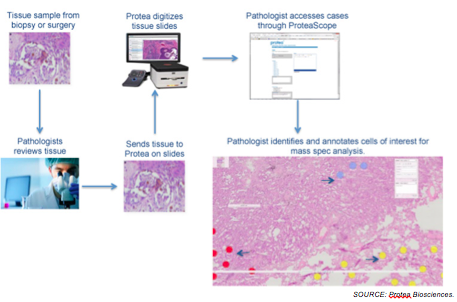
We think HG-MSI, which has already been used in Protea’s collaboration with Memorial Sloan Kettering Cancer Center for profiling of cell sub-populations in lung cancer tissue, may have significant utility in biomarker discovery for oncology, as well as other areas.
As we have noted in our ongoing coverage of Protea, we view their services-related business as an area of particularly high growth potential. Protea's molecular information services offerings is perhaps unmatched in the scope and depth of capabilities related to direct molecular imaging and related analytics. It is the only lab in the world that offers the complementary platforms of LAESI and MALDI under one roof. In addition, mass spectrometry imaging is quickly gaining interest for various applications but requires expensive equipment and highly trained personnel to perform it and analyze the results. As such, MSI is out of reach to most laboratories and research institutions, which offers real opportunities for Protea. With state-of-the-art equipment including LAESI and MALDI mass spectrometers, proprietary MSI software including their ProteaPlot software, and highly trained personnel, Protea believes their molecular information services business has unmatched capabilities in mass spectrometry and MSI. This new HG-MSI workflow platform adds another unique and significant service to the company’s offerings, expanding their capabilities, further separating themselves from the competition and offering another revenue opportunity.
Protea has already scored contract work from cancer research institutions related to biomarker discovery and global biopharmaceutical companies related to preclinical drug development. HG-MSI should also afford even greater interest in Protea’s capabilities from other potential partners. The company has acquired 20+ unique customers since 2013. Protea envisions further contracts from biotechnology / pharmaceutical /universities / government agencies related projects such as biomarker discovery and preclinical drug trials (particularly in areas such as oncology and neurodegenerative diseases - difficult to diagnose diseases with large markets) which could eventually culminate in the development of commercialized products such as novel drugs or diagnostic assays.
READ THE LATEST FULL RESEARCH REPORT HERE
SUBSCRIBE TO ZACKS SMALL CAP RESEARCH to receive our articles and reports emailed directly to you each morning. Please visit our website for additional information on Zacks SCR and to view our disclaimer.