By David Bautz, PhD
OTC:MBVX
Financial Update
On August 10, 2015, MabVax Therapeutics Holdings, Inc. (OTC:MBVX) announced financial results for the second quarter of 2015 and provided a business update. The company reported revenue of $0.14 million, which was recognized from the $1.5 million Phase II Small Business Innovation Research contract from the National Cancer Institute (NCI) for developing HuMab 5B1 as an imaging agent in pancreatic cancer. The company recognizes the revenue from grants received from the National Institutes of Health (NIH) as expenses that directly relatr to the grant are incurred.
Net loss for the second quarter of 2015 was $6.4 million, or $0.29 per share. R&D expenses for the current quarter were $2.3 million while G&A expenses were $4.2 million. The G&A expenses included investor relations expenses related to restricted stock grants to an investor relations firm. Total cash burn for the quarter was approximately $3.9 million. The company exited the second quarter of 2015 with approximately $7.2 million thanks in part to raising $11.6 million through a private placement led by OPKO Health (NYSE:OPKO) and Dr. Philip Frost, CEO and Chairman of OPKO Health. We anticipate this will be sufficient to fund the company through the first quarter of 2016.
Business Update
On August 5, 2015, MabVax published a letter from CEO David Hansen to stockholders. In the letter, Mr. Hansen provided an overview of the company’s antibody pipeline, vaccine pipeline, HuMab 5B1, and upcoming development milestones.
MabVax’s Novel Antibody Discovery Platform
MabVax has generated >100 fully human antibody leads from the use of a novel antibody discovery platform. Instead of using transgenic mice or phage display, MabVax generates fully human antibodies from B-cells extracted from patients immunized with proprietary cancer vaccines. This is the only example we know of where fully human monoclonal antibodies targeting cancer are generated from immunized patients.
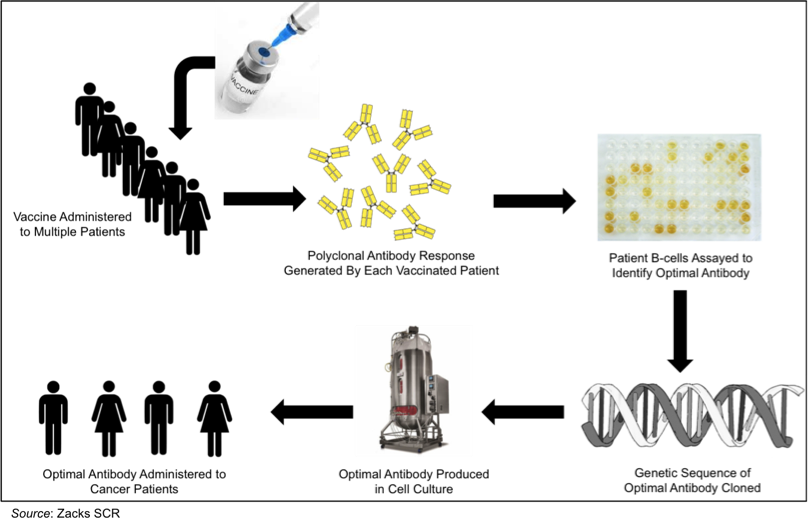
Deriving fully human monoclonal antibodies from vaccinated patients is a novel approach to generating therapeutic antibody candidates and comes with a number of advantages over traditional antibody discovery programs. These advantages include:
1) There is no need to genetically modify a murine derived antibody or perform any type of in vitro affinity maturation, as the patient’s immune system has already performed that work.
2) The self-censoring mechanism of the human immune system prevents that production of “self-harming” antibodies. Thus, any antibodies derived from a vaccinated patient that responds well to the vaccine are less likely to result in unwanted side effects.
3) A “proof-of-concept” experiment has already been performed; a source patient who had a positive clinical outcome provides anecdotal evidence for clinical activity of any derived antibodies.
The lead antibody in MabVax’s pipeline is HuMab-5B1, which has demonstrated exceptionally high affinity (Kd = 140 pM) and specificity for the tumor associated carbohydrate antigen (TACA) sialyl Lewisa (sLea). HuMab-5B1 was derived from a patient with Stage IV breast cancer who was originally vaccinated with a sLea vaccine at the end of 2008. A total of seven patients were vaccinated at that time with the sLea vaccine and six of them are still alive today. The patient from whom 5B1 was derived remains disease free to this day. MabVax is targeting HuMab-5B1 for the treatment of metastatic pancreatic and colorectal cancer, as these two diseases have very low 5-year survival rates and improved therapeutic options are clearly warranted.
HuMab 5B1 is Effective in Pre-Clinical Cancer Models
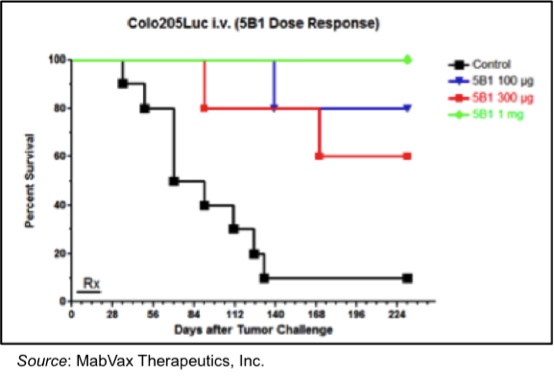
MabVax has tested HuMab 5B1 (MVT-5873) in multiple pre-clinical tumor xenograft models. The first model involved the use of colo205 cells, which are a human colorectal cancer cell line. The following figure shows the effect of treating mice inoculated with colo205-luc cells with MVT-5873 at varying concentrations. Mice were treated twice a week for the first two weeks and then once a week for the next 7 weeks. All mice treated with MVT-5873 at 1 mg per injection survived the experiment.
MabVax to Investigate HuMab 5B1 Effector Mechanisms
On August 6, 2015, MabVax announced a research collaboration with The Rockefeller University’s Laboratory of Molecular Genetics and Immunology, which is headed by Dr. Jeffrey Ravetch. Dr. Ravetch is a leading researcher of antibody-mediated effector responses and how alterations to the antibody constant region impact those responses. Alterations to the amino acid sequence of an antibody’s constant region can have a large impact on how the antibody interacts with other components of the immune system, including various receptors and complement proteins, which can then lead to a varied immunological response. Probable outcomes of this collaboration are to engineer next-generation therapeutics with HuMab 5B1 that have enhanced tumor cell killing capabilities. Examples of Dr. Ravetch’s work can be found on his website.
MVT-5873 Development Plan in Metastatic Cancer
MabVax is planning to file an investigational new drug (IND) application with the FDA for MVT-5873 before the end of 2015 and initiate a Phase 1 clinical trial to examine the safety and pharmacokinetics in a group of patients with different cancer types in the first quarter of 2016. We anticipate preliminary results from this study being available in the second half of 2016.
Following the Phase 1 study, MabVax is planning to initiate a Phase 2 clinical trial that will enroll approximately 150 patients and require two to three years to complete. The program will likely be eligible for Orphan Drug Designation since pancreatic cancer only affects approximately 50,000 individuals each year. The Phase 2 study would likely require $10 million to complete, however the MVT-5873 program has garnered the interest of several larger biopharmaceutical companies based on the positive pre-clinical testing, xenographic animal model experiments, and toxicology results generated thus far and the company would consider partnering after the Phase 1 study is complete if acceptable terms can be established. The robust pipeline of follow-on antibodies already generated means the company can partner MVT-5873 early on as a means of generating non-dilutive capital.
HuMab-5B1 (MVT-2163) as a PET Tracer in Pancreatic Cancer Imaging
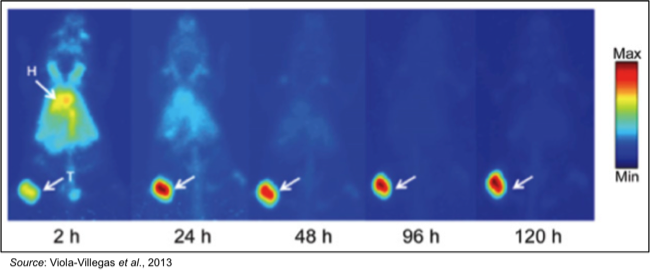
In order to test the hypothesis that targeting sLea would be a useful imaging tool, HuMAb-5B1 (MVT-5873) was coupled to the radionuclide 89Zr using a clinically validated linking agent (DFO). 89Zr is known to offer good quality imaging data based on previous pre-clinical and clinical data (Ulmert et al., 2012; Holland et al., 2010). A small imaging study was then performed with 89Zr-DFO-HuMab-5B1 (MVT-2163) in mice bearing a subcutaneous BxPC3 pancreatic cancer xenograft on the left hind leg. PET imaging showed impressive delineation of the tumor by MVT-2163 with normal tissue binding activity disappearing at 24 hours post injection (Viola-Villegas et al., 2013). The following figure shows high tumor localization at 24 hours, which increases up to 120 hours post injection.
Opportunity and Development Plan for MVT-2163
We believe that MVT-2163 is the only human derived imaging agent currently in development for improving imaging of pancreatic cancer and if proven effective would be welcome by patients and physicians. The opportunity for MVT-2163 is significant in a number of ways since accurately diagnosing, staging, and assessing treatment outcomes in pancreatic cancer, along with accurate determinations on the extent of disease and resectability, are essential to improving care for patients with the disease.
The regulatory pathway for a diagnostic agent is considerably less expensive and time consuming than for a therapeutic agent as it requires less intensive clinical trials. New diagnostic agents must be compared to validated standard diagnostic testing techniques. Initial work is performed in limited Phase 1 and 2 studies with a portion of the validation work coming from comparing published data from the standard technologies to the new product data. This approach can allow for more rapid development and approval of a new diagnostic agent. MabVax is planning to file an IND prior to the end of 2015 and initiate a Phase 1a clinical trial in the first quarter of 2016. We estimate a total of 50 patients will be necessary to get MVT-2163 through Phase 2 trials at a total cost of approximately $5 million.
HuMab 5B1 as an Antibody-Drug Conjugate
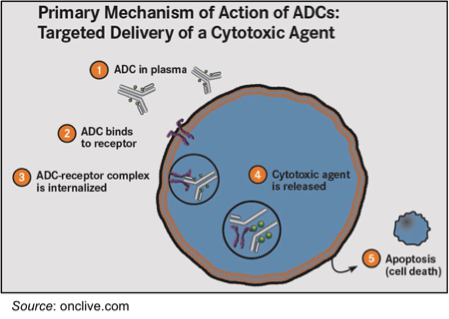
Antibody-drug conjugates (ADC’s) are monoclonal antibodies that are conjugated to a cytotoxic agent through a stable, chemical linker (Ducry et al., 2010). The compounds work through the ability of a monoclonal antibody to delivery a cytotoxic payload to a cancer cell through its specific binding of a tumor antigen (such as sLea for MVT-5873). Binding between the monoclonal antibody and the cell causes the internalization of the antibody along with the attached cytotoxic agent. Once inside the cell, the cytotoxic agent is released and the cancer cell is killed.
 '
The largest challenge in developing additional ADC products is the production of viable linkers that prevent premature off-loading of the cytotoxic agent before the antibody reaches the cancer cell. MabVax has entered into collaboration with Heidelberg Pharm, a company with its own proprietary linker and toxin technology, and as part of the collaboration Heidelberg has performed initial pre-clinical experiments utilizing HuMab-5B1-toxin ADC candidates. Results show the ability to successfully conjugate a linker and toxin to HuMab-5B1 with no apparent loss of binding specificity or affinity between HuMab-5B1 and sLea. This HuMab-5B1-toxin ADC shows potent in vitro and in vivo activity, as shown by the following figure where a single dose of HuMab-5B1-toxin ADC at varying concentrations limits the growth of BxPC3 xenografts.
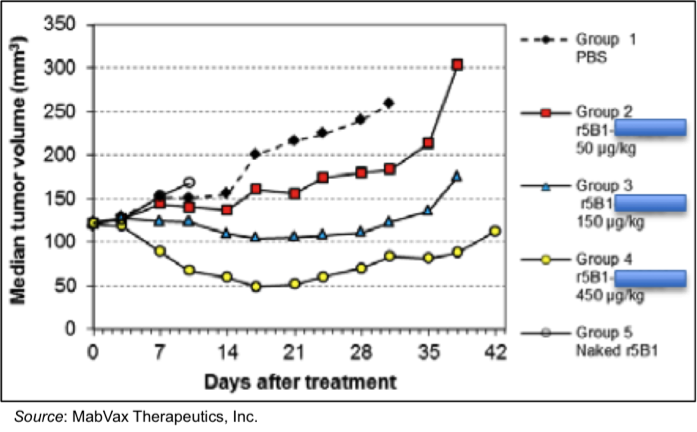
The company plans to continue preclinical testing and select the optimal linker by the end of 2016. In 2017, the company will perform GMP manufacturing of HuMab-5B1-toxin ADC and file an IND such that Phase 1 studies can be initiated.
Vaccine Program
Dr. Philip Livingston, who is the company’s Chief Scientific Officer and former Head of the Laboratory of Tumor Vaccinology at Memorial Sloan-Kettering Cancer Center (MSKCC), has been developing a series of monovalent (targeting a single tumor antigen) cancer vaccines for the last 30 years that target carbohydrate antigens on neuroectodermal and epithelial cancers. MabVax has licensed exclusive rights to vaccines that cover 11 validated target antigens from MSKCC. The license agreement calls for MSKCC to complete all preclinical and Phase 1 clinical trial work at MSKCC’s expense at which point the IND would be transferred to MabVax for continued development.
MabVax has three cancer vaccines under active development targeting recurrent sarcoma, ovarian cancer, and neuroblastoma. We invite investors to review our previous research report for an in-depth overview of the company’s vaccine program. The vaccines targeting recurrent sarcoma and ovarian cancer are currently in proof of concept Phase 2 clinical trials, while the neuroblastoma vaccine has completed an initial Phase 1 trial at MSKCC and a Phase 2 trial should commence in 2016. We anticipate results from the sarcoma and ovarian cancer trials and the Phase 2 neuroblastoma trial to commence in 2016.
Conclusion and Recommendation
MabVax has compiled a considerable amount of pre-clinical data on HuMab 5B1 as a therapeutic and diagnostic agent. The company is planning to file an IND for each indication before the end of 2015 and subsequently initiate Phase 1 clinical trials in the first quarter of 2016. The Phase 1 trial for the therapeutic indication will likely be a safety and pharmacokinetic study involving late-stage cancer patients with multiple types of solid tumors. Data from this study should begin to be available in the second half of 2016, and will be used to guide optimal dosing for a Phase 1b clinical trial later in 2017. The Phase 1 trial for the diagnostic indication will likely enroll up to 30 patients in both the dose escalation and expansion arms of the trial. We estimate it will take approximately one year to fully enroll the trial and obtain all results, however important safety and targeting specificity readouts are likely to come much sooner, perhaps by mid to late-2016.
The company is currently investigating two cancer treatment vaccines in Phase 2 clinical trials for preventing recurrence of sarcoma and ovarian cancer. Both trials are fully enrolled and overall survival data from each of the studies should be available in 2016. In addition, an IND will be filed for the neuroblastoma vaccine in the first half of 2016 with a Phase 2 trial likely to begin shortly thereafter.
Valuation Methodology
We value MabVax using a probability-adjusted discounted cash flow model that takes into account potential future revenues from MVT-5873 as a therapeutic in pancreatic and colorectal cancer, MVT-2163 as a diagnostic in pancreatic cancer, and the cancer treatment vaccines for sarcoma, ovarian cancer, and neuroblastoma. The following table summarizes our valuation model.
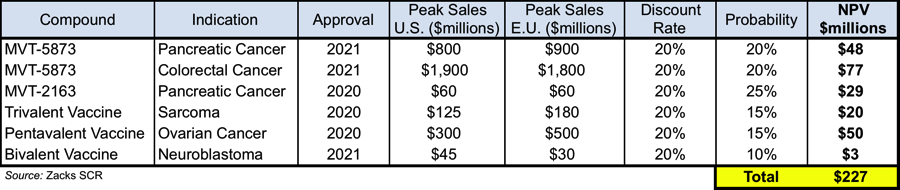
Combining the total sum of parts with the company’s current cash position, the cash that could be brought in from warrants, and estimate capital expenditures gives a net present value for the company of $225 million. Dividing this by the company’s fully diluted share count of 50.3 million shares leads to a fair value of approximately $4.50. We think that investors with a longer investment horizon could be handsomely rewarded as clinical success over the next year leads the share price higher.
READ THE LATEST FULL RESEARCH REPORT HERE
SUBSCRIBE TO ZACKS SMALL CAP RESEARCH to receive our articles and reports emailed directly to you each morning. Please visit our website for additional information on Zacks SCR and to view our disclaimer.