By David Bautz, PhD
NASDAQ:BCLI
Financial Update
On August 13, 2015, BrainStorm Cell Therapeutics (NASDAQ:BCLI) announced financial results for the second quarter of 2015. As expected, the company reported no revenues for the quarter. Net loss was $2.3 million, or $0.12 per share, and was comprised of $1.4 million in R&D expenses and $1.0 million in G&A expenses. Cash burn for the quarter was approximately $2.2 million. The company exited the second quarter with cash and short-term investments of $19.7 million, compared to $8.5 million at the end of 2014. We estimate the company has sufficient capital to fund operations for at least the next year.
As of June 31, 2015 the company had approximately 18.5 million shares outstanding. In addition, there were 0.8 million stock options and 6.5 million warrants for a fully diluted share count of 25.7 million. The warrants have a wide range of exercise prices, however the 3.86 million warrants issued in connection with the raise in January 2015 have an exercise price of $6.50, an expiration date of June 2018, and could potentially bring in gross proceeds of $25 million to the company.
Phase 2 Clinical Trial Fully Enrolled
On August 10, 2015, BrainStorm announced the completion of enrollment of 48 patients in the company’s ongoing, randomized, double blind, placebo controlled Phase 2 clinical trial of NurOwn™ in amyotrophic lateral sclerosis (ALS). Below we provide a review of BrainStorm’s technology, prior clinical data, and an update on the ongoing Phase 2 clinical trial.
Background on BrainStorm
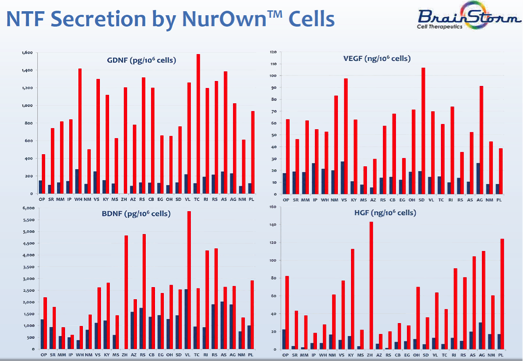
BrainStorm is developing adult stem cells therapies for the treatment of a range of neurodegenerative diseases, including ALS, Autism, Multiple Sclerosis (MS), and Parkinson’s disease (PD). The company has a proprietary process called NurOwn™ that harvests and propagates autologous Mesenchymal Stem Cells (MSC) and then induces their differentiation into neurotrophic factor (NTF) secreting cells, called MSC-NTF. The cells are then returned to the patient at or near the target area for treatment. Because these cells are autologous, there is virtually no risk of rejection or tumor formation. Below is a slide from the company’s January 2015 investor presentation showing the dramatic increase in various neurotrophic factors secreted by NurOwn™ cells (red) compared to normal mesenchymal stem cells (blue).
Brainstorm has demonstrated proof of concept with NurOwn™ in ALS through two early-stage clinical trials. A Phase 1/2 trial testing NurOwn™ in ALS patients was conducted at Hadassah Medical Center in Jerusalem between June 2011 and Dec. 2012. The study met its primary endpoints of safety and tolerability, with no treatment-related adverse events reported in the 12 patients treated with NurOwn™.
The trial consisted of 12 ALS patients classified according to their ALSFRS-r score; six patients who were early stage (ALSFRS-r score > 30) and received intramuscular (IM) injections (at 24 separate sites on the biceps and triceps muscles) and an additional six patients who were progressive stage (ALSFRS-r score of 15-30) and received intrathecal (IT) injections. The “ALS Functional Rating Scale Revised” (ALSFRS-r; Cedarbaum et al., 1999) measures gross motor tasks, fine motor tasks, bulbar functions, and respiratory functions through a scoring system consisting of a series of 12 questions on basic tasks (speech, salivation, swallowing, handwriting, cutting food, dressing and hygiene, turning in bed, walking, climbing stairs, dyspnea, orthopnea, and respiratory insufficiency) that are rated on a five-point scale where 0 = can’t do and 4 = normal ability. The individual items are summed to produce a score of between 0 = worst and 48 = best.
In addition, some clinical improvements were noted in IT-treated patients. There was a slower decline in overall clinical and respiratory function as measured by the ALSFRS-r and forced vial capacity (FVC) score when comparing the three months pre-treatment with the six months following treatment. FVC is the volume of air (measured in liters) that can be forcibly blown out of the lungs after full inspiration. Since most ALS deaths occur due to a decrease in respiratory function, FVC is a useful predictor of clinical outcomes. Results are typically given as a percent of the “predicted value” for patients of similar characteristics (age, height, sex, race, weight). Values close to 100% are the most normal, with anything above 80% often considered normal.
Brainstorm initiated a second proof-of-concept Phase 2a clinical trial at Hadassah Medical Center in January 2013. Fourteen early-stage ALS patients were enrolled into the study and received both IM and IT injections of NurOwn™ cells in three cohorts with increasing doses between February and August 2013. An interim safety summary for the first 12 treated patients was produced two months after the final patient was dosed and it reported one death due to cardiopulmonary arrest, which was confirmed as non-treatment related. In addition, in the three months following the interim safety report, one patient chose to undergo euthanasia and was removed from the study. Thus, two additional patients were enrolled in the trial in late 2013 and dosed in the first quarter 2014, bringing the total number of treated patients to 14. Just as for the Phase 1/2 trial, eligible patients were observed for three months prior to treatment to determine the progressive rate of disease with the patients followed for an additional six months after transplantation.
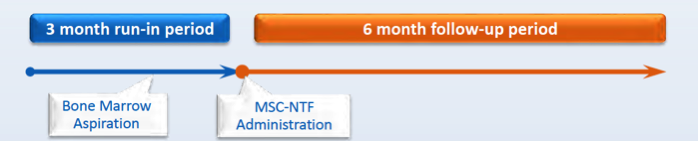
Top-line results were released in early January 2015. The study achieved its primary endpoint of demonstrating that NurOwn™ cells were safe and well tolerated at doses up to 2 million cells per kilogram administered IT and 48 million cells administered IM. In addition, a number of intriguing clinical results were reported in regards to effects on disease progression. For instance, of the 12 patients with at least three months of follow-up, 92% (11/12) achieved an improvement in disease progression for the three-month period following administration of NurOwn™ cells, as measured by the ALSFRS-r or FVC, compared to their trend rates on both measures for the three months run-in period prior to the administration of NurOwn™. For reference, below is a diagram showing the trial design.
Additional data showed that at six months post-treatment there was a statistically significant improvement in the estimated rate of decline in FVC, from -5.1% per month pre-treatment to -1.2% per month post-treatment (two-sided p = 0.036) and a nearly significant improvement in the rate of ALSFRS-r decline, from -1.2 points per month pre-treatment to -0.6 points per month post treatment (two-sided p = 0.052). In the following graphs, β signifies the slope of the lines either before (blue) or after (orange) treatment.
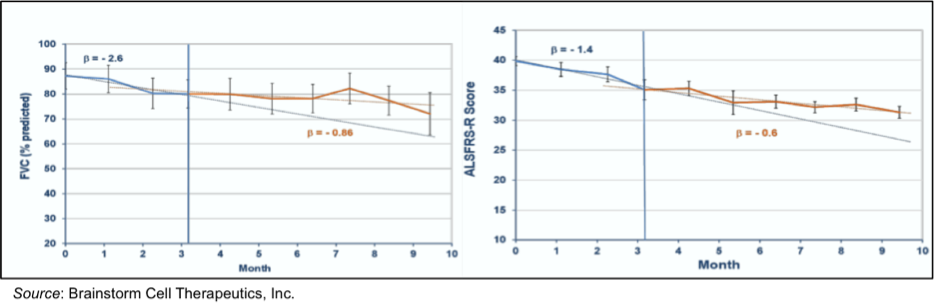
Delving further into the Phase 2a results, 50% of the patients (6/12) had an improvement in the slope of the ALSFRS-r score and 67% (8/12) had an improvement in the slope of the percent-predicted FVC. Three patients had both an improvement in ALSFRS-r and FVC.
In the Phase 2a trial, for ALSFRS-r, administration of NurOwn™ cells slowed the rate of progression by 45% from 1.41 points per month during the three month run-in period to 0.78 points per month for the three months following treatment, and by 57% to 0.60 points per month for the six months following treatment. Results from the Phase 1/2 study, which clearly enrolled a more disease progressed population, the decrease in the rate of decline was an astonishing 82% at six months post treatment.
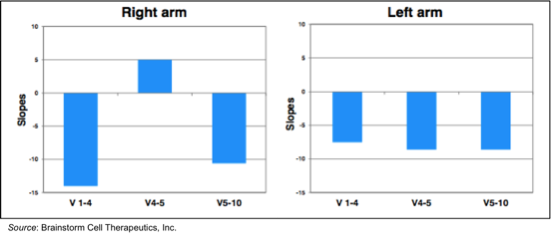
Additional data from the Phase 2a study were local positive effects of intramuscular administration. The following graph shows the results of 3D volumetric analysis using MRI that revealed an improvement in the rate of decline in muscle mass in the right arm, where NurOwn® was administered, through one month post-treatment, as compared to the left arm.
We remind investors that the Phase 2a trial was a single dose study, meaning that each patient received only one round of NurOwn™ treatment by either intramuscular (IM) or intrathecal (IT) administration. At this point it is unknown for how long the cells remain viable once injected, but the company is planning on conducting a multi-dose study to determine if the results seen in the current trial can be extended and/or improved upon.
Putting the Early Stage Data Into Context
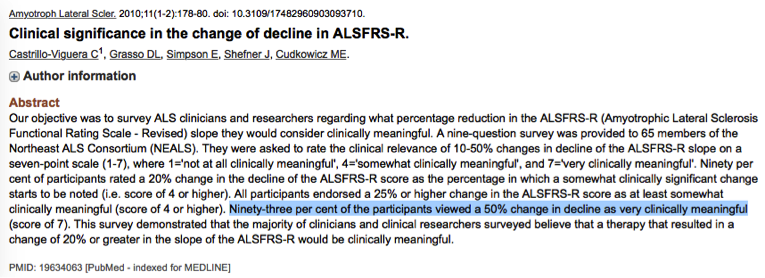
To put these data into perspective, we note that a 2010 survey of ALS clinicians and researchers showed that 93% of participants felt a 50% change in the decline of the ALSFRS-r score would be very clinically meaningful (Castrillo-Viguera et al., 2010).
To give further perspective on the data, we looked at results of placebo patients included in the pooled resource open-access ALS clinical trials database (PROACT). PROACT is a database of over 8,500 ALS patients from 17 Phase 2 and 3 clinical trials with over 8 million longitudinally collected data points. We have combed the PROACT database looking for “what is the average rate of decline” for a standard-of-care ALS patient with a baseline ALS score of around 40 (note the baseline ALSFRS-r score in Brainstorm’s Phase 2a study was 39.9). Of the over 8,500 patients in the database, standard-of-care ALSFRS-r data was available on 531 (note some 7,000 patients were on investigational drugs and another 1,200 patients ALSFRS-r data was not available). The baseline ALSFRS-r score of these 531 patients was 40. Below is a table showing the results of that analysis.
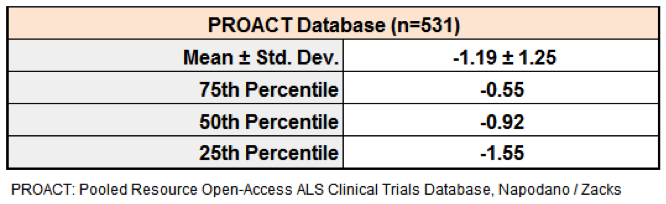
The average decline for 531 ALS patients with a baseline of approximately 40 on ALSFRS-r is 1.19 points per month, with a standard deviation of 1.25 points. The median decline was 0.92 points per month. Both these numbers suggest slower rates of decline than what the three month run-in period for Brainstorm’s Phase 2a showed at a decline of 1.41 points per month. However, we are not surprised that the average patient in the Brainstorm Phase 2a study was declining at a faster rate than the historical controls given that they are enrolling in an early-stage cell therapy program versus the PROACT database that primarily focuses on later-stage therapeutics. Given the large standard deviation of declines, the numbers are not materially different. Thus, the ALSFRS-r data from Brainstorm’s Phase 2a study compares quite favorably with what ALS clinicians would expect to impact patients in a meaningful way. We consider this to be suggestive of a paradigm shift in standard of care.
What These Results May Mean for ALS Patients
We were quite encouraged by the Phase 2a data presented by BrainStorm but realize it may be a bit abstract to discuss slowing rates of progression in ALSFRS-r and FVC. For this reason, we attempted to extrapolate the data seen in the Phase 2a study to get a better sense of how these results could materially impact a patient’s life. We caution that there are a number of limitations to this type of analysis based on the limited amount of data available, the small number of patients that the data was derived from, and the fact that the ALSFRS-r score typically does not show a linear decline. However, we feel the following may help investors think about the possibilities to which this type of data may lead.
The patients entering the Phase 2a trial had an average ALSFRS-r score of 39.9. The lead-in rate of decline was 1.41 points per month, thus after three months the average score of the study subjects was 35.7. The rate of downward progression slowed to 0.78 points per month for the three months post treatment, thus the ALSFRS-r at three months post treatment would be 33.3 for treated patients compared to 31.4 in a theoretical group of patients that did not receive NurOwn™ treatment. At six months the rate of decline had slowed to 0.60 points per month, thus at six months the ALSFRS-r scores would be 27.2, 31.0, and 32.1 for theoretical untreated patients, patients declining at 0.78 points per month, and patients declining at 0.60 points per month, respectively. The following graph shows the theoretical outcome of extrapolating this data for two years.
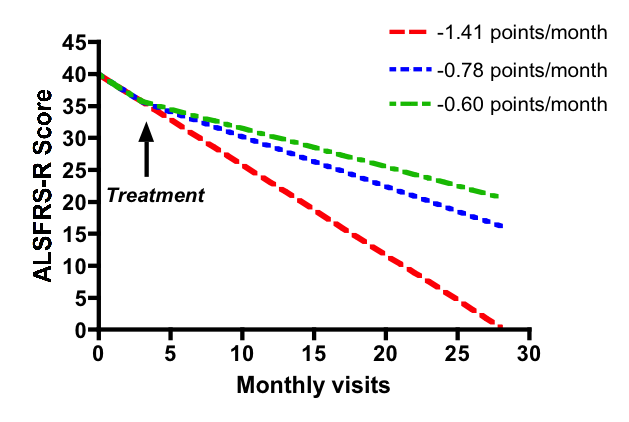
Extrapolating this data all the way out to 25 months post-treatment would give an ALSFRS-r score of approximately 0 (signifying death) for the theoretical untreated patients as opposed to an ALSFRS-r score of 16.2 and 20.7 for patients progressing at a decline of 0.78 and 0.60 points per month, respectively. While it’s difficult to accurately quantify what a patient with an ALSFRS-r score of 16.2 or 20.7 would look like, what is certain is they would still be alive although perhaps needing or very close to needing a wheelchair and/or a ventilator. Regardless, given the fact that the only approved therapeutic for ALS, Sanofi’s Riluzole® (rilutek), improves survival by just two to three months, we believe this analysis shows the potential for a treatment such as NurOwn™ to not just improve survival in these patients but perhaps to delay the need for a wheelchair or assisted breathing by an extended amount of time. Just to reiterate, these data were seen with only a single dose of NurOwn™ cells with some patients getting only intramuscular injections. Thus it will be quite interesting to see if those lines could flatten further in a multi-dose trial focusing on what looks to be the superior intrathecal administration.
Phase 2 Trial in the U.S. is Fully Enrolled
Brainstorm is currently conducting a Phase 2 clinical trial of NurOwn™ for the treatment of ALS in the U.S (NCT02017912). This is a randomized, double blind, placebo controlled trial that will evaluate the safety and efficacy of a single combined IM and IT administration of MSC-NTF cells in early-stage ALS patients. The trial is taking take place at three centers in the U.S. (Massachusetts General Hospital (MGH), University of Massachusetts Memorial Hospital, and the Mayo Clinic) and has enrolled 48 patients randomized 3:1 to receive either NurOwn™ cells (n=36) or placebo (n=12).
Just as with the Phase 2a trial, there is a three-month run-in, followed by treatment and a six-month follow up. The primary endpoint of the study is safety based on the number of patients with adverse events, with secondary endpoints including the change in ALSFRS-r and lung function as measured by vital capacity.
The trial is now fully enrolled, with the final patient set to receive treatment in the fourth quarter. With a six-month follow up, we are estimating that topline data will be available in mid-2016. As a reminder, an independent Data Safety and Monitoring Board is watching the trial and as of February 2015 has noted no issues.
Conclusion
ALS is a rapidly progressing neurodegenerative disease whereby the nerve cells in the brain and spinal cord that control muscle movement degenerate. This rapid degeneration of the motor neurons eventually leads to death, typically in three to five years after patients are first diagnosed. As the motor neurons cease to function properly, they can no longer send signals to the muscle fibers, and thus voluntary muscle action is progressively affected. Eventually, patients in later stages of the disease may become completely paralyzed, which includes losing the ability to control their breathing. In the U.S., approximately 30,000 people are currently living with ALS. The only FDA approved treatment option for ALS is Sanofi’s Riluzole® (rilutek). It cost roughly $50,000 per year and had peak sales less than $100 million.
With top-line data presented from the Phase 2a trial, BrainStorm has successfully demonstrated proof-of-concept for NurOwn™ cells for the treatment of ALS. However, it must be kept in mind that this was a single center study with data only available from 12 patients. This doesn’t necessarily take away from the positive results reported, but means that additional data is necessary before firm conclusions can be drawn about the ability of NurOwn™ treatment to augment the natural progression of ALS. We remain upbeat on the BrainStorm story, and nothing reported thus far has altered our impression of the company or the potential for NurOwn™. We recommend that investors interested in playing the ALS or cell therapy space consider BrainStorm to be a core holding.
From a valuation standpoint, we think BrainStorm shares are highly attractive. The company is well capitalized, with $19.7 million in the bank as of June 30, 2015 thanks to the $13 million raised in January 2015. In terms of timeline, top-line data from the Phase 2 trial should be available around the middle of 2016. We anticipate a Phase 3 trial starting in 2017, NDA filing in 2019, and approval in 2020. Riluzole® costs $50,000 per year and was shown to only extend survival by two to three months. Based on our rudimentary graph above, we believe NurOwn – after one dose – could extend survival by as much as twelve months. Multiple IT doses could push this number even higher. As such, we think $100,000 per treatment is very realistic for NurOwn. We have built a detailed financial model to forecast potential sales of NurOwn in ALS. We believe U.S. penetration could approach 40%, which would put U.S. sales at the $1.6 billion range. With 25% probability of success, we see BrainStorm worth $250 million, or $10 per share.
READ THE LATEST FULL RESEARCH REPORT HERE
SUBSCRIBE TO ZACKS SMALL CAP RESEARCH to receive our articles and reports emailed directly to you each morning. Please visit our website for additional information on Zacks SCR and to view our disclaimer.