By David Bautz, PhD
NASDAQ:TNXP
Financial Update
On August 7, 2015, Tonix (NASDAQ:TNXP) filed form 10-Q with financial results for the second quarter of 2015 that ended June 30, 2015. As expected, the company did not report any revenues. Net loss for the quarter was $11.8 million, or $0.73 per share, and was comprised of $8.9 million in R&D and $2.9 million in G&A expenses. Net cash burn for the quarter was $9.2 million. The company exited the second quarter of 2015 with approximately $48.7 million in cash and cash equivalents. In July 2015, the company closed a public offering of 2.325 million shares sold at $7.50 per share that generated gross proceeds of $20.1 million, thus we estimate that the company will exit the third quarter of 2015 with approximately $57 million. Based on an average cash burn of approximately $10 million per quarter, we estimate the company now has enough cash to last into the first half of 2017.
The company currently has three programs in clinical trials: TNX-102SL in a Phase 3 trial for fibromyalgia; TNX-102SL in a Phase 2 trial for post traumatic stress disorder; and TNX-201 in a Phase 2 trial for treatment of episodic tension type headache. Each of these trials should report data during 2016.
Update on TNX-201
In June 2015, Tonix Pharmaceuticals (TNXP) announced the initiation of a Phase 2 clinical trial of TNX-201 for the treatment of episodic tension-type headache (ETTH). Later in the month the company announced the presentation of preclinical data for TNX-201 showing efficacy in rat pain models. Below we go further into the recently presented data for TNX-201 and what it means for the compound’s potential.
Preclinical Data Elucidates TNX-201 Mechanism of Action
Tonix scientists screened racemic IMH against a large panel of enzymes, receptors, ion channels, and transporters to elucidate the binding target of each of the racemates. The following table shows the binding affinities of both (R)-IMH and (S)-IMH to select receptors expressed in the central nervous system. The data shows that the target of (R)-IMH is the imidazoline-1-receptor (I1-R). In the following table, the lower the value means the greater the binding affinity between the isomer and the target protein.
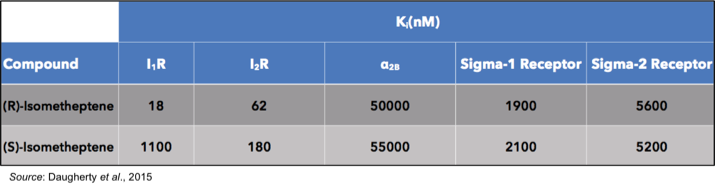
I1-R is a member of a family of cell surface receptors that bind imidazolines, which are a class of heterocyclic compounds that are capable of lowering blood pressure. Most of the imidazolines, such as clonidine, bind to both the α2-adrenergic receptor and I1-R (Ernsberger et al., 1987) resulting in unwanted side effects, particularly drowsiness, dry mouth, and hypotension. The data in the table above shows that (R)-IMH does not bind to the α2-adrenergic receptor with affinity that would be physiologically relevant, meaning that it may not produce some of the aforementioned side effects.
I1-R is found in the brain, kidney, pancreas, and on platelets. It was first cloned in 2000 (Piletz et al., 2000), and a I1-R knockout mouse was recently characterized (Zhang et al., 2013). Important observations of the I1-R knockout mice were that the mice did not differ from wild-type mice in spontaneous locomotion, grip strength, motor coordination, spatial learning, and memory. In addition, there was no difference detected in systolic blood pressure or in the heart rate of conscious mice. Lastly, the pain threshold of I1-R knockout mice was significantly lower than that of wild-type mice using both the hot-plate test and tail-flick test, as shown below.
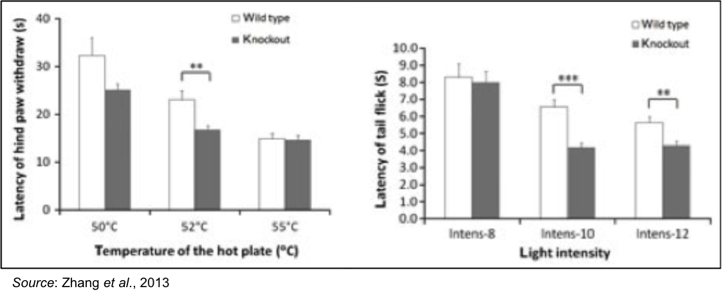
What these data indicate is that I1-R is involved in the sensation of pain. Removing the receptor (such as in the knock-out mice) lowers the pain threshold compared to mice that express I1-R. Thus, since the presence of the receptor is necessary for increased pain tolerance, activation of the receptor (through an agonist such as (R)-IMH) may further increase pain tolerance and create an analgesic effect. Since IMH is already known to provide relief from headaches, the identification of (R)-IMH binding to I1-R coupled with the data showing I1-R is involved in pain perception provides the necessary justification for testing (R)-IMH for the treatment of pain.
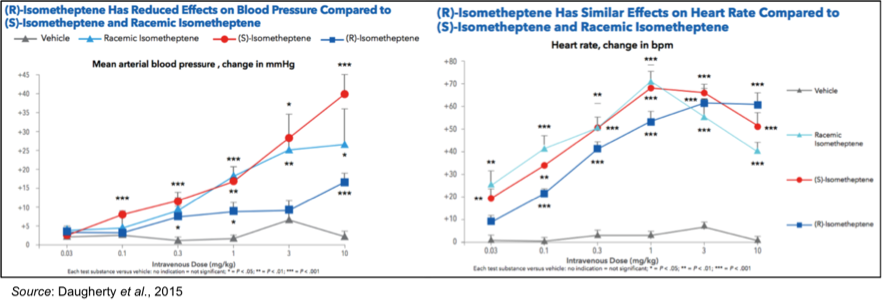
One of the adverse side effects of racemic IMH is a rise in blood pressure. To test which of the racemates of IMH caused this effect, increasing amounts of (R)-IMH, (S)-IMH, and the racemic mixture were administered to rats. Results showed that (S)-IMH and the racemic mixture, but not (R)-IMH, caused an increase in blood pressure. Interestingly, all of the compounds caused an increased heart rate, which based on an average 330-480 bpm for rats was approximately 12-17% for (R)-IMH.
Additional efficacy studies were undertaken in two rat pain models, the chronic migraine model (Oshinsky et al., 2007) and the spontaneous trigeminal allodynia model, which uses rats that are genetically predisposed to episodic pain threshold decreases that respond to pain medications (Oshinsky et al., 2012). In both models, administration of 30 mg/kg (R)-IMH, but not 1 mg/kg (R)-IMH or 30 mg/kg (S)-IMH, resulted in decreased trigeminal sensitivity, with results from the chronic migraine model shown below.
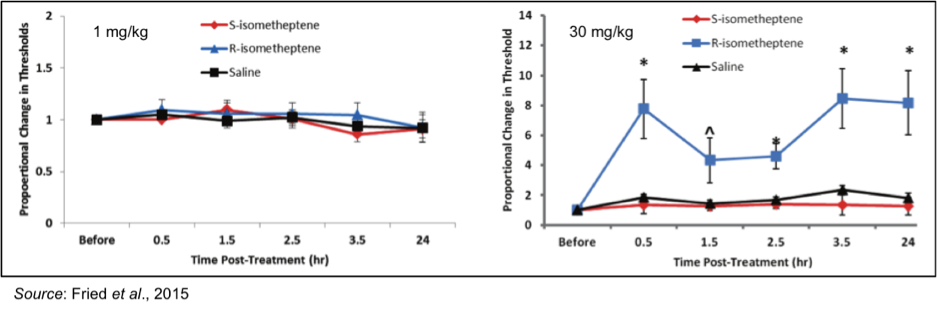
In summary, (R)-IMH is a potent agonist of I1-R, a receptor shown to be associated with pain threshold, thus representing a potential mechanism of action for the analgesic activity of IMH. In addition, the data generated thus far appears to support the notion that binding of (R)-IMH generates the specific downstream mechanisms associated with reduction of pain while (S)-IMH is mostly responsible for the increase in blood pressure. These data provide strong support for testing (R)-IMH as a therapeutic for alleviating ETTH.
TNX-201 Enters the Clinic
Earlier in the year, Tonix announced that they had completed the Phase 1 safety, tolerability, and pharmacokinetic study of TNX-201 with encouraging results. Data from the 45-patient study showed a dose-related increase in TNX-201 plasma levels (Cmax, AUC), with no evidence of isomer inter-conversion and only mild adverse events, none of which were considered drug-related or serious enough to discontinue treatment.
In June 2015, Tonix announced the initiation of a randomized, double blind, placebo controlled, proof-of-concept Phase 2 clinical study of TNX-201 in ETTH (NCT02423408). The study is expected to enroll approximately 200 patients at nine clinical centers in the U.S. Study subjects will be administered 140 mg TNX-201 (4 x 35 mg capsules) or placebo for the treatment of a single TTH. The primary efficacy endpoint is the proportion of subjects pain free at 2 hours post-dose (as recommended by the U.S. Food and Drug Administration). Pain will be assessed utilizing a four-point Numeric Rating Scale, Visual Analog Scale, and binary questionnaire for self-reporting pain. Additional endpoints include the proportion of patients that are pain-free at various time intervals post-dose up to 24 hours, the proportion of patients who utilize rescue medication during the 24-hour post-dose period, and the change from baseline in pain severity at several time intervals post-dose. We anticipate topline results from the study in the first quarter of 2016.
TNX-102SL Update in Fibromyalgia
On June 17, 2015, Tonix announced the FDA has conditionally accepted the trade name Tonmya™ for TNX-102SL for the treatment of fibromyalgia.
In June 2015, Tonix presented additional data from the Phase 2b BESTFIT clinical trial at the European League Against Rheumatism Annual Congress (EULAR 2015). As a reminder, the BESTFIT study was designed to evaluate the safety and efficacy of Tonmya™, 2.8 mg, taken once daily at bedtime, in improving pain, sleep quality, function, and other clinical measures in patients with fibromyalgia. The study enrolled 205 patients randomized 1:1 to Tonmya™ (n=103) or placebo (n=102).
While the study did not hit the primary endpoint of statistical significance in change in average daily pain score at week 12 (P=0.086 by mixed-effect model repeated measure analysis, P=0.172 by jump-to-control, multiple imputation analysis), additional data from BESTFIT showed that Tonmya™ treatment led to significant improvements across a range of symptoms suffered by fibromyalgia patients.
AFFIRM Gets Underway
On May 13, 2015, Tonix announced the initiation of the Phase 3 AFFIRM trial (NCT02436096). The trial is a randomized, double-blind, placebo-controlled 12-week safety and efficacy study that is expected to enroll approximately 500 fibromyalgia patients. The patients will be given either a 2.8 mg Tonmya™ tablet or placebo at bedtime in a 1:1 randomization. The trial is taking place at 35 sites in the U.S. Enrollment is expected to take 12 to 14 months and the entire trial should cost approximately $12 million to run. Enrollment should complete by the summer of 2016 and we anticipate topline results in the second half of 2016.
TNX-102SL Update in Military-Related PTSD
On January 15, 2015, Tonix announced the Phase 2 AtEase study had enrolled its first patient. The AtEase study is a Phase 2 randomized, double-blind, placebo-controlled trial to evaluate the efficacy and safety of TNX-102SL in people with military-related PTSD and related conditions. The three-arm trial is expected to enroll approximately 220 participants, who will be randomized to receive either 2.8 mg or 5.6 mg of TNX-102SL or placebo taken sublingually at bedtime daily for 12 weeks. More information on AtEase can be found on the study’s website or on ClinicalTrials.gov (NCT02277704).
The primary endpoint of the trial is the week eight mean change from baseline in the total CAPS-5 (Clinician-Administered PTSD Scale) score in participants who received 2.8 mg of TNX-102 SL as compared to those who received placebo only. Safety will also be evaluated. The trial will be conducted at approximately 25 U.S. sites. Management plans to use print and radio media to spark military interest in the study, and then hope peer-networking speeds enrollment throughout 2015. We are anticipating data in the first half of 2016.
Valuation and Conclusion
For Tonmya™ in fibromyalgia, we assume approval and launch in 2019, with the drug costing approximately $15 per day. We are assuming Tonix (or its partner) can capture 5% of the market by 2023, with peak sales of close to $775 million. If we apply an 18% discount rate and 40% probability of success to the asset, we arrive at a net present value (NPV) for Tonmya™ in fibromyalgia of approximately $169 million.
For PTSD, a slightly smaller peak sales opportunity of $450 million exists. We believe approval of TNX-102SL in PTSD is approximately one year behind the timelines noted above for fibromyalgia. Thus, our NPV analysis for TNX-102SL in PTSD yields a fair value valuation of approximately $60 million. We believe there is potential for Tonix to receive partial funding of the AtEase study from the U.S. Department of Defense (DOD) not currently factored into our model. Nevertheless, together, we believe TNX-102SL in PTSD and fibromyalgia are worth roughly $230 million in NPV. We remind investors that TNX-102SL is protected by a pharmacokinetic patent that does not expire until 2033 and a composition-of-matter patent that does not expire until 2034.
For TNX-201, we believe the drug has a 20% probability of success and based on peak sales of over $400 million in 2025 its NPV is $67 million. Once we have a look at data from the current Phase 2 study, we will get a better sense of the drug’s efficacy in patients, which will help to refine both our outlook on peak sales and probability of approval.
Summing up our NPV calculations we arrive at a total firm value of approximately $296 million. Tonix exited the second quarter 2015 with $48.7 million in the bank and the company raised gross proceeds of $20.1 million from a public offering in July 2014, thus we estimate the company currently has approximately $66 million in cash and will probably exit the third quarter of 2015 with approximately $57 million. That is enough to fund operations into 2017. We believe the company will require approximately $125 million to fund operations to cash flow positive in 2020. Thus, even with the recent raise we know that Tonix will need to raise additional cash through public offerings or partnering its drugs in 2016. Based on our sum-of-parts NPV analysis, we believe the stock is worth approximately $18 per share today. We believe there are several catalysts on the horizon that can lead to a dramatically higher stock price ahead of that expected need for additional cash in 2017. For example, between now and then, Tonix should report:
- F203 Long-term safety study analysis from BESTFIT in August 2015
- Phase 2 data with TNX-201 in the Q1-2016
- Phase 2 data from AtEase in PTSD with TNX-102SL in the first half of 2016
- Phase 3 data from AFFIRM in fibromyalgia with Tonmya™ in Q4-2016
If the company can raise this $60 million in additional cash at prices in the $10-15 per share range, then the new dilution will be minimal – approximately 5 million shares. Based on the diluted share count of approximately 19.7 million today (assumes only exercisable stock options and warrants in-the-money), we see fair-value at $18 per share. However, if we add in approximately 5 million shares for expected financing activities in 2017 and 2018, we arrive at a more reasonable fair-value target of $14 per share. As such, investors with a longer time horizon can buy Tonix today and see nice returns as we expect clinical progress to drive the shares higher.
READ THE LATEST FULL RESEARCH REPORT HERE
SUBSCRIBE TO ZACKS SMALL CAP RESEARCH to receive our articles and reports emailed directly to you each morning. Please visit our website for additional information on Zacks SCR and to view our disclaimer.