By Anita Dushyanth, PhD
TSX:EDT.TO
OTC:EDTXF
WHAT’S NEW
Financial Update
On August 14, 2015, Spectral Medical, Inc. (TSX:EDT.TO) announced financial results for the second quarter of 2015. All numbers are in Canadian dollars. The company reported $0.8 million in revenue for the quarter, which was in-line with our estimates. Spectral derives income from the sale of proprietary reagents (monoclonal antibodies, recombinant proteins, and calibrators), the Endotoxin Activity Assay (EAA™), and royalty revenues from license arrangements based on a percentage of end user sales of Troponin I. Net loss for the quarter was $2.4 million, or $0.01 per share, and consisted of $3.2 million in operating expenses.
The company exited the second quarter of 2015 with roughly $11 million in cash and cash equivalents. The company shares were sold to Toray Industries, Birch Hill Equity Partners Management Inc. as well as to other investors in mid-2014. Following the private placement, Toray and Birch Hill now own approximately 22.4% and 17.3% of the company, respectively.
Business Update
Spectral is developing the Toraymyxin column for the treatment of severe sepsis. The Toraymyxin column is a polymyxin B loaded absorption column designed to reduce blood endotoxin levels in sepsis patients. Polymyxin B is an antibiotic with very high affinity for endotoxin, a component of the outer membrane of Gram-negative bacteria that is the most potent initiator of the septic response. The Toraymyxin column is approved in both Japan and Europe and has been used to safely treat over 100,000 patients.
The company trades on the Toronto stock exchange (TSX) under the ticker symbol EDT.TO, and on the U.S. OTC market under EDTXF. We initiated coverage of Spectral Medical in January 2015 (see FULL REPORT) with a Hold rating and a $0.75 price target. We have since revised that target to $1.00 per share based on a favorable update from an independent Data Safety and Monitoring Board (DSMB) on the ongoing Phase 3 EUPHRATES clinical trial and the recent securing of additional cash at favorable terms to the company.
...EUPHRATES Continues On Plan…
Spectral initiated the EUPHRATES Phase 3 clinical trial in June 2010 and had 15 sites up and running by the end of 2012. There are currently 50 hospitals eligible to enroll patients in the study throughout Canada and the U.S., thus it could be argued that the trial is taking a very long time to fully enroll. That being said, investors should keep in mind that it is quite difficult to identify septic patients who fit all the inclusion/exclusion criteria. The EUPHRATES trial is screening approximately 125 patients per week, with most patients not qualifying due to not meeting the vasopressor requirements, not having a MODS score > 9, or not having an elevated EAA score. For comparison’s sake, the PROWESS-SHOCK trial that evaluated Eli Lilly’s Xigris® was performed from 2008-2011 in 208 hospitals and screened 27,816 patients in order to enroll 1,697 (6.1% enroll-to-screen rate).
The primary outcome of the EUPHRATES trial is now 28-day all-cause mortality in patients that are in severe septic shock with EAA > 0.6 and a MODS score of > 9. As before, patients must also have at least one organ dysfunction. Since the implementation of the new exclusion criteria (MODS score ≤ 9), the composite mortality rate of the enrolled patients has increased significantly, indicative of the fact that those patients most likely to benefit from treatment with the Toraymyxin column are being properly identified and randomized into the trial.
Spectral released some very good news earlier in March 2015 when an independent Data Safety and Monitoring Board (DSMB) recommended the Phase 3 EUPHRATES clinical trial continue on as planned. The DSMB also agreed that an interim analysis be performed on the patients randomized since the last protocol amendment to include EAA > 0.6 and a MODS score of > 9. Spectral management plans to perform that analysis on these amended protocol patients enrolled through the end of the third quarter 2015. Based on the current calculated enrollment rate of one patient every 4.2 days, we estimate that approximately 116 patients will be included in this interim analysis and that it will be completed by the end of 2015.
In April, 2015, the FDA accepted the company’s plan for a rolling Pre Market Approval (PMA) submission, which consists of four separate modules. This process allows for the timely review of the various modules and has the potential to significantly reduce the time to commercialization. The first three modules include physical, chemical and safety testing data, as well as requisite manufacturing information. The fourth and final module provides clinical data. The company has completed the first three modules. The first module was submitted in June 2015. Management plans to submit the second module during Q3 2015. The final module will be submitted to the FDA once the clinical data from the EUPHRATES trial is available. Meanwhile, as recommended by the DSMB, Spectral plans to perform an interim analysis during Q3 of this year, with 90+ patients. Based on the analysis of the clinical data, the company will be able to recalculate the sample size needed to obtain statistical significance. Spectral will then submit an amended statistical analysis plan (SAP) to the FDA.
As of August 13, 2015, 363 patients have been enrolled into the EUPHRATES trial, 93 of whom have been randomized according to the revised protocol in April 2014. The pace of enrollment is approximately one patient every 4.2 days. The screen to enroll rate is ~1.35%. The trial is being conducted at a total of 42 hospitals (32 in the U.S. and 10 in Canada).
The company has developed a working prototype of its proprietary hemoperfusion/RRT (renal replacement therapies) pump. It is specifically designed to simplify the treatment for patients with septic shock and is intended for use in the intensive care unit under the direction of the intensive care doctor and nurse. The pump was introduced to a select group of critical care clinicians and nephrologists at the CRRT conference held in San Diego in February 2015. Management expects to secure CE mark, Health Canada and FDA 510K licensing and clearances by the end of Q1 2016.
…Handicapping the Interim Analysis...
Previously, we had conservatively estimated a 50% mortality rate for placebo treated patients and performed a power analysis based on a final enrollment of 110 patients for the interim analysis. That analysis led us to believe that there would only be a 40% probability of success for the interim analysis based on mortality rates of 50% and a 37.5% in the placebo and treated cohorts, respectively. The 12.5% absolute risk reduction was based on a Japanese study of the Toraymyxin column where the mortality rates for column-treated and placebo groups were 34.5% and 47%, respectively (Iwagami et al., 2014).
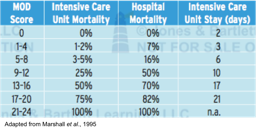
Having previously presented our conservative scenario analysis, below we present an additional, less conservative estimation of the mortality rate for the control group of patients and the likelihood of success at the interim analysis in the fourth quarter of 2015. The following references lend some support to a higher mortality rate for patients with a MOD score > 9:
Marshall et al., 1995: This paper originally described the MODS score and found the following correlations with intensive care unit (ICU) and hospital mortality.
Hebert et al., 1993: This study examined organ failure on day 1 of admittance to the ICU for 154 consecutive patients with sepsis syndrome. The results showed 30-day mortality of 20% in patients with less than 3 organ system failures and 70% in patients with 3 or more organ system failures.
Marshall, 2001: The number of failing organ systems is correlated to mortality for patients in the ICU as follows:
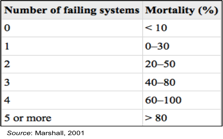
Averaging the mortality rates together for patients with MOD scores from 9-20 (we have decided to exclude patients with a MOD score >20 as they are unlikely to have mean arterial pressure of >65mm Hg, which is an exclusion criteria for the trial) for both the ICU and hospital gives a composite mortality of 59%. We also estimate that patients entering the trial would average 3 failing organ systems, which gives an average mortality rate of 60%.
In order for the interim analysis to result in stopping the trial, a different statistical threshold must be achieved due to the effect of repeated significance tests on accumulating data (Armitage et al., 1969). The O’Brien-Fleming approach (O’Brien et al., 1979) is typically used for interim analyses, as it allows for the final significance level to be near the overall significance level. For example, if Spectral used a significance level of 0.005 at the interim analysis that would result in a significance level at the final analysis of 0.048, which is quite close to the 0.05 value required to show significance.
Using a 60% mortality rate for the control group, a total of 116 patients randomized 1:1, and an alpha level of 0.005, a power analysis reveals the following (all calculations performed with G*Power 3.1.9.2):
1) A 28% mortality rate for the toraymyxin-treated group would give 80% power to the study. This would imply a composite mortality rate of 44% for all patients in the study, a 32% absolute risk reduction in mortality, and a 53% relative risk reduction in mortality. We consider this a very aggressive assumption.
2) A 40% mortality rate for the toraymyxin-treated group (representing a 20% absolute risk reduction and 33% relative risk reduction) would make the trial 30% powered. We consider this to be a far more realistic assumption.
Even with our “far more realistic” assumption for the control group, we feel it would be highly unlikely for the trial to be stopped early during the interim analysis given the current rate of patient enrollment into the trial as the difference in mortality rates necessary for stopping the trial is quite large. The graph below shows the statistical power assumptions for the following variables: placebo = 60%, column = 40%, p<0.005.
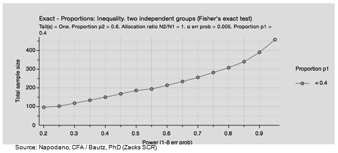
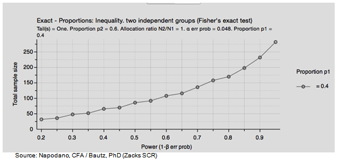
As investors can see, with around 116 patients, the trial is only 30% powered to succeed. However, when we adjust the assumptions to assume enrollment of 175 patients (which should take place mid 2016) and a p<0.048, we see that the statistical power is now ~ 80%.
…But Long-Term We Like the Concept…
Regardless of when it happens with the interim analysis, we believe the company has the right strategy with EUPHRATES given the amended protocol and previous clinical data supporting safety and efficacy of the Toraymyxin column. We are more confident in the outcome of a fully-enrolled trial, which we estimate would be approximately 175 patients with estimated mortality rates of 60% and 40% for control and treated groups, respectively. Under this scenario, we believe the trial would be fully enrolled in mid-2016 with data expected in late 2016. We continue to believe that a positive outcome to the EUPHRATES trial would cause a significant revaluation of the shares, as there are no FDA approved treatment options for sepsis and the sepsis market in the U.S. is a greater than $3 billion opportunity.
We feel that there will be ample opportunity for investors to take a position in Spectral during the year as more information is gathered in regards to the EUPHRATES trial. We recommend that investors get familiar with the Spectral story, and follow the updates when the interim analysis is performed later this year. Being familiar with the Spectral story will allow investors to invest astutely on the results of the interim analysis. If the results show that the trial did not reach necessary statistical separation with 116 patients (or however many are enrolled by the end of the third quarter), the shares may sell-off. However, because this is what we expect we would use this as a buying opportunity to invest in the name ahead of the full analysis in late 2016. On the contrary, if the interim analysis does show statistical separation in favor of the Toraymyxin column, we believe the shares are headed for a major revaluation – potentially in the order of ten-fold, and investors should immediately buy the news in anticipation of a significant run in the shares.
…Valuing Spectral Medical…
We are currently taking a conservative approach and modeling for the EUPHRATES trial to conclude in mid-2016. This timeframe is certainly subject to change; particularly if the interim analysis reveals more information about when the trial is likely to conclude. We understand our model is different from what Spectral management is currently guiding, as the current guidance is indicating that the Toraymyxin column could be approved as early as the first half of 2016. Instead, we model for the Toraymyxin column to be approved in 2017 and launched in 2018.
We forecast that each treatment will cost $21,000 ($10,000/column x 2 columns per patient + $200/EAA test x 5 EAA tests per patient). As of now, we are projecting peak market share of 25% in a target population of 175,000 septic patients per year to occur in 2024, with corresponding peak revenues of $1.2 billion. Given the limited treatment options available for sepsis patients and the lack of many viable sepsis treatments in late stage development, we feel that this is a fully realizable potential. However, based on our uncertainty surrounding whether the EUPHRATES results will be positive, coupled with the uncertainty regarding the timeline for the trial, we are utilizing a large discount rate and probability adjustment to derive a net present value for the company.
We assign a 25% discount rate to account for the uncertainties we have discussed, we forecast free cash flow to be 60% of gross revenues, and we assign a 50% probability of the EUPHRATES trial being successful. This gives us a net present value for the company of approximately $198 million. Spectral currently has a fully diluted share count of 191 million shares, which leads to a fair value of approximately $1.00 per share. Risk and visibility keep us at a ‘Hold’ rating, both of which are clearly “fixable” as the story progresses and more information is released later in 2015.
READ THE LATEST FULL RESEARCH REPORT HERE
SUBSCRIBE TO ZACKS SMALL CAP RESEARCH to receive our articles and reports emailed directly to you each morning. Please visit our website for additional information on Zacks SCR and to view our disclaimer.