By: David Bautz, PhD
OTC:RESX
Financial Update
On Augst 12, 2015, RestorGenex Corp. (OTC:RESX) announced financial results for the second quarter of 2015. As expected, the company did not report any revenues. Net loss for the quarter was $4.0 million, or $0.21 per share, and was comprised of $1.1 million in R&D expenses, $1.9 million of G&A expenses, and $1.0 million of additional expenses, which were mostly related to a severance package with the company’s former Chief Scientific Officer.
The company had approximately $16.5 million in cash and cash equivalents at the end of the second quarter of 2015. Total burn for the first quarter was approximately $2.7 million and the company did not raise any money during this time period. There are approximately 18.6 million shares currently outstanding, along with approximately 3.6 million stock options and approximately 4.5 million warrants. The majority of the warrants have an exercise price of $4.80 (range $2.00-$4.80) and could potentially provide an additional $20 million if all of them are exercised.
RES-529 Synergizes With Other Treatments in Prostate Cancer Xenograft Model
On June 23, 2015, RestorGenex announced that Claudio Festuccia presented in vitro and in vivo data on RES-529 at the XXVth National Congress of the Italian Society of Uro-Oncology (SIUrO) in Rome, Italy. The data showed that RES-529 synergized with hormone therapeutics in a prostate cancer xenograft model using 22rv1 cells. This builds upon previous data showing RES-529 synergized with chemotherapy and radiation in prostate cancer and also inhibited angiogenesis and glioma tumor growth.
Background on RES-529
RES-529 (8-(1-Hydroxy-ethyl)-2-methoxy-3-(4-methoxy-benzyloxy)-benzo[c]chromen-6-one) is a derivative of a nonsteroidal estrogen antagonist that maintains antiproliferative activity while retaining no ability to inhibit binding to the estrogen receptor. This drug is a derivative of 3-hydroxy dibenzo[b,d]pyran-6-one, which was previously described to share structural similarities with the potent anti-angiogenic and antitumor compound 2-methoxyestradiol, and to exhibit selective antiproliferative activity for endothelial cells (Schmidt et al., 2003).
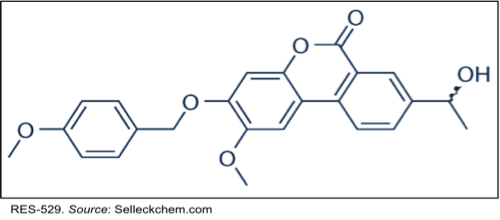
RES-529 is an inhibitor of both the mTORC1 and mTORC2 complexes, which are involved in the phosphatidylinositol 3-kinase (PI3K) signaling pathway. The inhibition of both mTORC1 and mTORC2 has a number of implications, including in both ophthalmology and oncology:
Ophthalmology
Lewis et al., 2009: RES-529 is reported to have a long ocular half-life, and because it is an inhibitor of the AKT/mTOR pathway that controls a number of cellular processes, it was investigated what the effect of RES-529 treatment would be on sub-retinal scar formation and photoreceptor survival induced by retinal detachment. Results showed that a single injection of RES-529 can significantly reduce photoreceptor cell death, the amount of intraretinal proliferation, and the number and size of sub-retinal scars, indicating that it may be useful for treating proliferative diseases associated with retinal detachment surgery and ensuing photoreceptor cell death.
Oncology
Xue et al., 2008: This study first showed that RES-529 is an inhibitor of both mTORC1 and mTORC2. The compound was shown to inhibit tumor growth, angiogenesis, and reduced vascular permeability in an in vivo model of glioblastoma. Like rapamycin, RES-529 showed the ability to normalize tumor vasculature; however, in addition the compound blocked phosphorylation of AKT on serine 473, consistent with blocking mTORC2 activity.
Diaz et al., 2009: This study evaluated the hypothesis that RES-529 would enhance the effect of radiotherapy (RT) in an in vivo model of prostate cancer, as the AKT pathway is known to be involved in radio-resistance. The results showed that RES-529 potentiates the effect of RT via inhibition of AKT phosphorylation, but also through other cancer-related pathways involving MMP-2, MMP-9, and vascular endothelial growth factor (VEGF) that reduced proliferation rates and promoted apoptosis.
Gravina et al., 2011: The aim of this study was to evaluate the use of RES-529 in association with docetaxol (DTX) and cisplatin (CP) for the treatment of hormone-refractory prostate cancer. Results showed that RES-529 synergized with both DTX and CP, with the greatest results seen when prostate cancer cells were treated sequentially with either DTX or CP followed by RES-529. In addition, in vivo treatment with a combination of RES-529 and DTX or CP increased the percentage of complete responders and reduced the number of mice with tumor progression.
Gravina et al., 2014: This study aimed to identify the molecular mechanisms through which RES-529 exerts its radio-sensitizing properties in a panel of prostate cancer models. Results showed that RES-529 downregulated proteins associated with DNA double-strand break repair. In addition, treatment with RES-529 promoted pro-apoptotic and autophagic events.
RES-529 Synergizes with Anti-Androgen Therapy in 22rv1 Prostate Cancer Cells
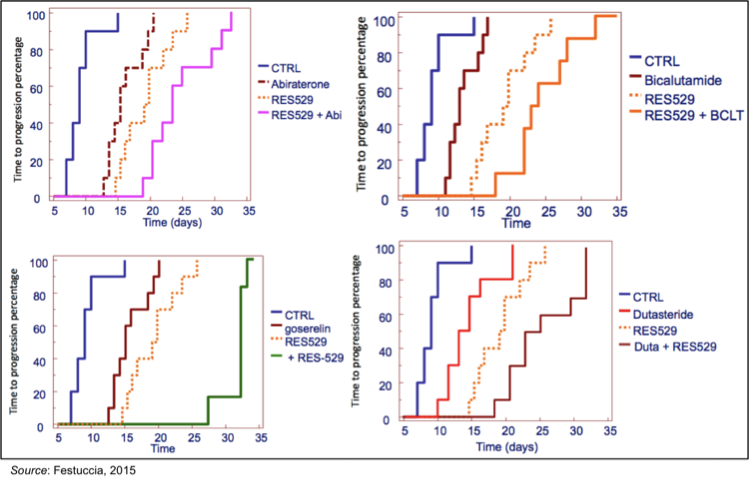
The 22rv1 prostate cancer cell line was derived from the human prostate cancer xenograft CWR22R after castration-induced regression and relapse of the parental cell line (Sramkoski et al., 1999). RES-529 was tested both as a single-agent and in combination with the anti-androgen bicalutamide, the 17-alpha hydroxyl inhibitor abiraterone, and the 5-alpha reductase inhibitors goserelin and dutasteride. The following figure shows how treatment with RES-529 in combination with each of the other treatments was superior to either therapy as a single agent in preventing progression of 22rv1 tumors.
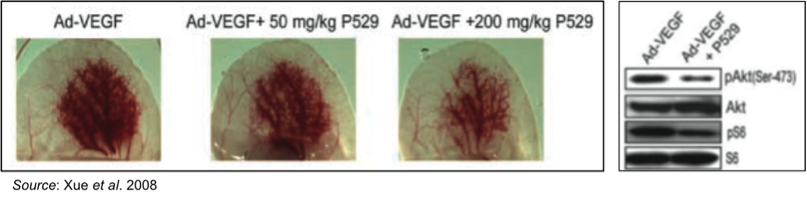
The results show that RES-529 inhibits angiogenesis in a dose dependent manner, and it also inhibited phosphorylation of AKT at serine 473 (pAktSer-473) and phosphorylation of ribosomal protein S6 kinase (pS6), indicative of an inhibition of both mTORC1 (lack of pS6) and mTORC2 (lack of pAktS473).
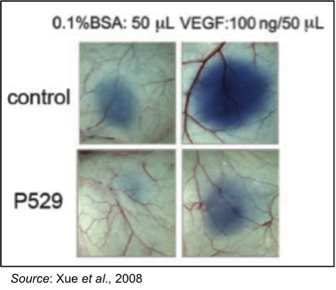
In addition to affecting angiogenesis, RES-529 appears to affect vascular permeability, which is the capacity of a blood vessel wall to allow for the flow of small molecules in and out of the vessel. Increased VEGF would be expected to increase vascular permeability, and when this occurs in the presence of a tumor it allows for increased nutrient uptake and growth. Thus, a treatment that decreases vascular permeability would be expected to decrease the amount of nutrients available to a tumor, thus inhibiting growth. The following figure shows the result of RES-529 in the Miles assay, which measures vascular permeability through the retention of a blue dye in the vasculature. The assay was performed with either a control protein (bovine serum albumin, BSA) or VEGF to show increased permeability with VEGF treatment. Addition of RES-529 (P529 in the figure) results in greatly decreased staining, indicating that RES-529 is directly reducing VEGF-driven vascular permeability.
RES-529 Inhibits Glioma Tumor Growth
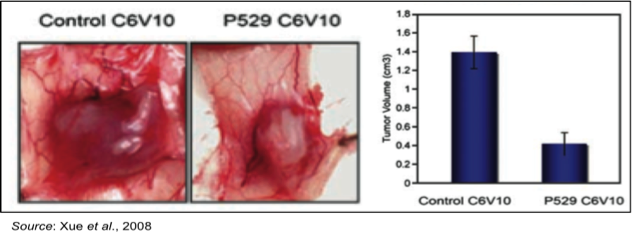
RES-529 was tested as a potential cancer therapeutic with experiments involving the C6 rat glioma cell line (Benda et al., 1968). For these studies, the C6 variant C6V10, which is transfected with exogenous mouse VEGF (Benjamin et al., 1997), was utilized as it has previously been found to have a more accurate vascular pathology representative of high-grade glioblastoma, including glomeruloid vessels, which are not commonly found in mouse tumors. Nude mice were pre-treated for one week with 200 mg/kg RES-529 before C6V10 cells were injected subcutaneously, with treatment continuing for 21 days. The following figure shows that tumors from mice treated with RES-529 (P529 in the figure) grew an average of 70% less than control tumors.
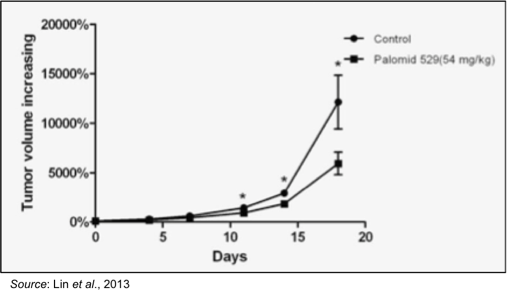
An effective GBM treatment needs to be capable of crossing the blood-brain barrier (BBB), which is an impediment to a number of potential therapeutics. The BBB is formed by the brain micro-vasculure endothelial cells. These cells contain tight junctions and require substances to use tightly regulated influx transporters (such as GLUT1 for glucose) to gain access to the brain. Substances that do not have such transporters can only gain access to the brain through passive diffusion, and this is highly dependent on the lipophilicity of the compound (Muldoon et al., 2007). Even substances that cross the BBB may not accumulate in the brain thanks to a set of ATP-binding cassette (ABC) drug efflux transporters, particularly ABCB1 and ABCG2, two efflux transporters known to limit the accumulation of lipophilic anti-cancer agents and small molecule inhibitors (Agarwal et al., 2010). Results with RES-529 show that the compound does not interact with ABCB1 or ABCG2 and that those efflux transporters do not restrict the brain penetration of RES-529 (Lin et al., 2013). This was exhibited by treating mice harboring intracranial GBM tumors with RES-529 (Palomid 529), which significantly inhibited tumor growth compared to control mice, as shown in the following figure
RES-529 Development Plans
RestorGenex is planning to develop RES-529 as a treatment for both wet AMD and GBM. The company plans on finalizing the CMC work of the active pharmaceutical ingredient (API) so that final IND-enabling studies can be performed in 2015. This will enable the filing of the IND for both indications in the first half of 2016.
- For wet AMD, two Phase 1 clinical trials have been performed with RES-529. In the first company-sponsored study (Protocol P52901), fifteen patients were injected intravitreally with varying doses of RES-529 from 0.004 mg up to 0.5 mg. In the second study (Protocol 11-EI-0066), sponsored by the National Eye Institute, five patients refractory to anti-VEGF treatment were dosed with subconjunctival injections of 2 mg once a month for three months (Dalal et al., 2013). Both studies showed RES-529 to be well tolerated with no serious adverse events. For the next step in development as a treatment for wet AMD, a Phase 1/2 clinical trial will be performed in 2016 to assess the safety, tolerability, and clinical efficacy of RES-529. In addition, the maximum tolerated dose will be established for subconjuctival administration.
- For GBM, a Phase 1/2 clinical trial will be performed in 2016 to assess the maximum tolerated dose in GBM patients along with early efficacy signals. The company also has plans to initiate clinical trials in other oncology indications, most likely prostate, lung cancer, and breast cancer, using the maximum tolerated dose established in the GBM trial.
With Phase 1/2 trials set to begin in 2016, we estimate that Phase 3 studies would not begin in either indication until 2018, with an NDA filing likely in 2020 and commercial launch in 2021.
Additional Upside From RES-440: A First in Class “Soft” Anti-Androgen
RestorGenex is developing RES-440, which is a carboxylic acid ester of hydroxyflutamide, as a treatment for acne and is engineered to be the first topical anti-androgen that is rapidly deactivated by hydrolytic enzymes near the site of application to a single inactive metabolite. The company refers to this as a “soft” anti-androgen. The approach has the advantage of sparing internal, androgen sensitive tissues, thus potentially resulting in fewer side effects. The expected major metabolite of RES-440 has no detectable androgen-receptor affinity or ability to interfere with the androgenic effects of endogenous androgens.
The Syrian Golden Hamster model has long been validated as a model for topical anti-androgens as the animals have flank glands that are highly sensitive to androgen stimulation. The sebaceous gland flank organ spots are visible as a dark raised spot on each flank. Application of anti-androgenic compounds will cause the glands to diminish in size. The advantage of this model is that one gland can be treated with the test compound and the other compound with a control.
Topical doses of RES-440 from 10 to 300 µg/day were administered to male Golden Syrian Hamsters. In addition to monitoring the untreated flank organ size for systemic effects, androgen-sensitive tissues collected at the end of the experiment were weighed and compared to vehicle-treated intact animals and castrated controls. The results of the Golden Syrian Hamster study with RES-440 are shown below.
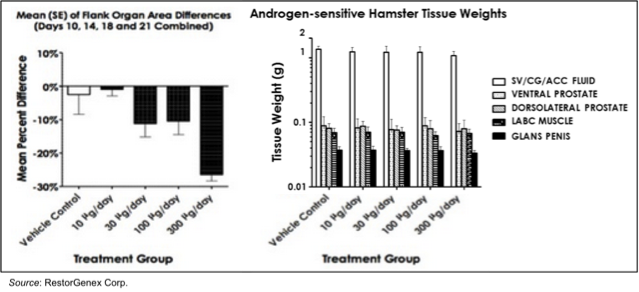
The above left figure shows the result of treating the hind flank glands with the indicated amount of RES-440 once-daily for 21 days. The data show that the gland treated with 300 μg per day was almost 30% smaller than the flank treated with vehicle control. In addition, there did not appear to be any affect on various androgen sensitive tissues, as shown by the above right figure. Taken together, these data indicate that RES-440 has potent anti-androgenic activity that is locally contained and does not result in systemic effects.
…RES-440 development plan…
RES-440 has a number of advantages over currently available acne therapeutics including a short half-life, an inactive metabolite (to avoid systemic side effects), a melting point very near body temperature making it possible to penetrate into the pilosebaceous unit, and its stable at skin pH.
RestorGenex is planning to complete preclinical and toxicology studies to enable an Investigational New Drug (IND) application to be filed in 2016. The company will then initiate Phase 1/2 clinical trials to study the safety and efficacy of RES-440. Differin® was approved with a single 12-week study involving 653 patients, thus RestorGenex could potentially be ready to perform a Phase 3 study in 2017 and file the U.S. NDA in 2018. If all goes well, RES-440 could be ready for commercial launch in 2019.
Conclusion
RestorGenex currently has a market cap of approximately $25 million. The company currently has approximately $16 million in cash and cash equivalents as of June 30, 2014. We see this as plenty of capital to get the requisite IND enabling studies completed in 2015 as well as initiate the Phase 1/2 clinical trials, which we estimate will begin in the first half of 2016. For example, cash burn in the second quarter 2015 was only $2.7 million.
Currently, RES-529 and RES-440 are being valued at approximately $9 million, which is a perplexingly low valuation seeing as those compounds are targeting three multi-billion dollar indications in wet AMD, GBM, and acne. As evidenced by the recent launch of Regeneron’s Eylea®, a successful wet AMD treatment can generate revenues in excess of $1 billion shortly after approval. With the limited treatment options for GBM, a successful therapeutic could also potentially generate over $1 billion in peak revenues, as Temodar® did before losing patent protection. Lastly, a differentiated acne therapeutic, RES-440, is a potential $450 million opportunity. The extremely low valuation for RestorGenex is most likely due to clinical trials not beginning until next year, but for investors with a long time horizon, the current stock price represents a nice opportunity to pick up shares in the company at a significant discount to our fair value, which we peg at $6.50. While an investment in an early stage biotechnology company is very high risk, with multiple high revenue opportunities an investment in RestorGenex has an enormous potential return.
READ THE LATEST FULL RESEARCH REPORT HERE
SUBSCRIBE TO ZACKS SMALL CAP RESEARCH to receive our articles and reports emailed directly to you each morning. Please visit our website for additional information on Zacks SCR and to view our disclaimer.