By Steven Ralston, CFA
TXS:SNS.V
OTC:CLICF
Select Sands (TSX:SNS.V) (OTC:CLICF) is an early-stage frac sand (oil & gas proppant) company engaged in the exploration and development of a 520-acre prospective frac sand property (Sandtown) located in northeast Arkansas. In October 2014, the company entered into a binding Letter of Agreement (LOA) for an option to acquire a 100% undivided right, title and interest. An addendum to the agreement allows Select Sand to test mine a 10-acre parcel before the final payment is made on or before April 25, 2016.
The prospective industrial/frac sand property is being fast-tracked for development. Yesterday, October 19th, Select Sands announced that test production has started at Sandtown. Management contracted Explosive Contractors Inc. of Hollister Missouri to extract the first test silica sand from the starter pit and anticipates approximately 2,000 tons out of the 5,600 tons of extracted silica sand will be processed (crushed and screened). The first finished product is expected to be delivered to potential customers in the industrial (glass-making, foundry and building) and/or energy (hydraulic fracturing and well cementing) markets in November 2015. A processing plant operator has been identified in the area that can produce finished silica products, (especially finer-mesh, high-purity white sand) on a toll basis, whereby the sand will be processed for a volume-based fee.
Management is utilizing a two-stage production model consisting of contract mining and toll processing. At the outset, contract agreements are being utilized to mine and process the sandstone resource at Sandtown, thereby proceeding with the development of the mine and generating cash flow without the need of directly investing capital in the purchase of mining or processing equipment. Larger scale production is expected to begin in the first half of 2016.
Management envisions larger scale test mining and toll processing to begin in the first half of 2016, possibly as early as the first quarter. Depending on market conditions, management plans to build a wash plant on site, possibly in early 2016, with the intent of trucking the washed sand to Batesville for further processing (drying and sieving) at a contract plant before being loaded into railcars or trucks for delivery to the Eagle Ford and Permian Basins. Ultimately, management envisions construction of processing facilities (crushing and screening plant, wet classification plant, grinding plant and product drying and storage facilities) on site at Sandtown.
The cyclical oil & gas industry appears to be presenting an investment opportunity. Oil prices declined from roughly $105 per barrel in June 2014 to a low of about $45 in the first quarter of 2015 until rebounding to the low $60’s during the summer and then declining to below $40 in mid-August. Currently, light crude (NYMEX) is trading in the high $40’s. This significant volatility is fertile ground for promising prospects and potentially oversized gains.
The domestic oil and gas business is currently in the midst of a production renaissance, primarily due to the improved horizontal drilling and fracking technologies that permit the economic development of tight oil & gas plays. Many oil and gas wells were drilled in 2014 but not completed. We expect these drilled-but-uncompleted-wells (DUCs) create a significant backlog of frac sand demand. Though the precise timing is hard to predict, it is not inconceivable that there may be a convergence of demand for frac sand from both DUCs and a reacceleration of drilling activity simultaneously. We are optimistic about the prospects for continued and growing extraction of oil and gas from shale formations.
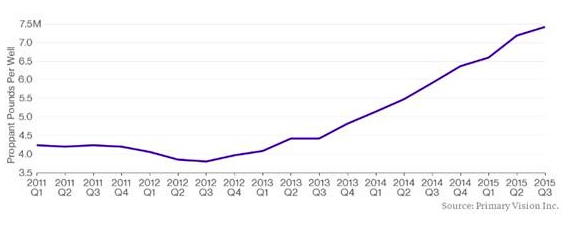
The most recent data indicates that the amount of frac sand being used per well continues to increase. According to Primary Vision, the average hydraulic fracturing job now utilizes almost 7.5 million pounds of proppant per well. Oil and gas companies are testing and using high intensity completion methods in order to boost cumulative oil production. In addition, new enhanced completion methods require more sand both from increased volumes of sand per stage and more stages per well. Also, finer-mesh silica is in higher demand for these advanced completion techniques.
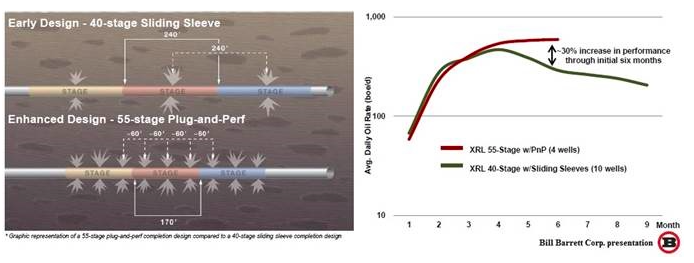
One advanced completion design shared by Bill Barrett Corporation (BBG) exemplifies the trend. In a recent investor presentation, Bill Barrett explained the improved production profile of utilizing a 55-stage plug-and-perf enhanced design (that requires more than 1,000 lbs. of sand per foot) versus an earlier 40-stage sliding sleeve design (that consumes less than 1,000 lbs. of sand per foot). The 55-stage plug-and-perf completion technique is providing significantly improved initial production rates and shallow production declines thereafter which together exceed traditional anticipated production curve results.
The frac sand group has exhibited high beta relative the industry and high alpha relative to the market as a whole for those fundamental reasons. High alpha is illustrated by Emerge Energy Services (EMES), Hi Crush Partners LP (HCLP) and U.S. Silica (SLCA) rallying 786%, 312% and 305%, respectively, between May 2013 and their peaks in August/September 2014. Their high beta relative to the oil patch is exemplified by Emerge Energy Services having declined 95% (from above $130 to below $7) during the recent downturn in oil prices while Hi-Crush and US Silica have dropped 89% and 77%, respectively. However, after these significant price declines over the last 14 months, the frac sand stocks provide leveraged exposure to the improvement of oil prices.
Managements of mineral production and exploration companies create value through evaluating, acquiring, exploring and/or developing mining properties. In the case of Select Sands, management’s strategy is to increase shareholder value by fast-pacing the development of the Sandtown silica project in northern Arkansas. As an exploration company, we believe it would be inappropriate to value Select Sands on an earnings, cash flow or book value basis, which would not adequately capture the value of the company’s resource base. Since the company has advanced to a milestone point in the exploration phase that the resources have been estimated to a degree of certainty, we are comfortable in utilizing a resource-based valuation model.
Our calculation of share value of attributable reserves and resources is based on the ascertained value of the estimated resources in the northern 200 acres of the Sandtown property plus balance sheet adjustments for working capital, PPE (property, plant and equipment) and marketable securities. The value of the property is determined by adjusting the value of current resources for the expected recovery rate, mining/processing costs, anticipated financing costs, etc. The reserves/resources are assigned a confidence factor that attempts to take into account the risks of each project, such as the locality of the deposits, the assurance level of the reserves/resources, various technical mining/production risks, etc. Estimated prices of frac sand and industrial sand are utilized. Based on our calculation of share value of attributable resources (see table below), our target for the common stock of Select Sands is US$0.92 for CLICF and CDN$1.16 for SNS.V.
READ THE LATEST FULL RESEARCH REPORT HERE
SUBSCRIBE TO ZACKS SMALL CAP RESEARCH to receive our articles and reports emailed directly to you each morning. Please visit our website for additional information on Zacks SCR and to view our disclaimer.