By Grant Zeng, CFA
NASDAQ:THLD
Last week at the annual meeting of the American Association for Cancer Research (AACR) held in Philadelphia and on its Analyst and Investor Day held in New York City, Threshold (NASDAQ:THLD) presented both preclinical and clinical data, which support the initiation of Phase II clinical trials of its recently acquired cancer candidate TH-4000.
The Background of TH-4000
In September, 2014, Threshold licensed TH-4000 (formerly known as PR610 or Hypoxin) from the University of Auckland of New Zealand.
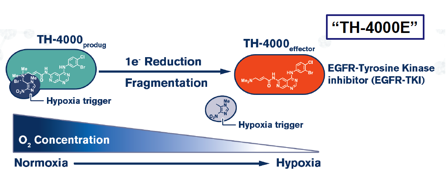
TH-4000 is a hypoxia-targeted epidermal growth factor receptor (EGFR) tyrosine-kinase inhibitor (TKI). In hypoxic tumors, TH-4000 will selectively release a potent, picomolar, irreversible EGFR-TKI.
TH-4000 is a small molecule prodrug that releases the potent EGFR-TKI via reductases under hypoxic conditions which exist in most cancer cells. When TH-4000 enters the tumor cells, it diffuses to the hypoxic zone, in which the TH-4000 effector (TH-4000E) is selectively activated and blocks hypoxia-induced EGFR signaling and tumor cell survival.
EGFR signaling is involved in the growth and spread of certain tumor types including non-small cell lung cancer (NSCLC) and head and neck cancer (H&N). Clinical studies indicate that mutant EGFR-positive NSCLC with wild-type EGFR present (heterozygous) is associated with reduced response rates, progression free survival and overall survival outcomes on conventional EGFR-TKIs. In H&N cancer, wild-type EGFR signaling drives tumor growth. Both types of tumors are known to be hypoxic; thus, hypoxia-induced activation of wild-type EGFR signaling may be a mechanism of current EGFR-TKI resistance.
Preclinical Studies of TH-4000 for Cancers
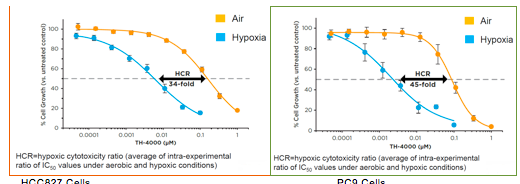
At the AACR meeting, Threshold presented that in both PC9 and HCC827 NSCLC cell lines, TH-4000 shows hypoxia-selective anti-proliferative activity.
In both HCC827 (homozygous mutant EGFR) and the PC9 (heterozygous WT/Mutant EGFR) xenograft model of NSCLC, TH-4000 was more active than the conventional EGFR-TKI erlotinib, but this difference was more significant in the PC9 model. A single dose of TH-4000 (equivalent to 20 mg/m2 in humans) showed prolonged prodrug residency and EGFR shutdown in tumor tissue for a week.
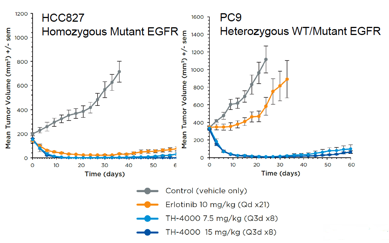
In addition, while treatment with erlotinib alone resulted in only modest benefit, treatment with TH-4000, resulted in 9/9 complete responses, suggesting an ability to prevent or overcome resistance to TKI treatment. Furthermore, the PC9 model was determined to be only 8% hypoxic, suggesting that the complete responses observed with TH-4000 were due to the ability of TH-4000, once hypoxia-activated, to diffuse into the surrounding normoxic tumor tissue.
Preclinical data presented also demonstrated that TH-4000 is highly active against WT EGFR-driven tumors, whereas approved EGFR-TKIs are substantially less active. It is believed the 'masked' design of TH-4000 allows WT EGFR signaling in tumor tissue to be targeted via hypoxia while sparing normal tissue signaling in the skin and GI tract, providing a potential therapeutic window.
Certain tumor types are addicted to EGFR signaling and current EGFR-TKI therapies are ineffective in shutting down that signaling due to dose-limiting toxicities of rash and diarrhea. Therefore, a molecularly-targeted, hypoxia-activated irreversible EGFR-TKI such as TH-4000 may deliver greater efficacy with fewer side effects than currently available treatments.
Phase I Clinical Studies of TH-4000 for Cancers
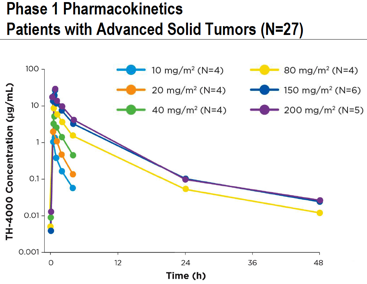
Threshold also presented data from a previous Phase I clinical trial of patients with advanced solid tumors.
The completed Phase I trial enrolled 27 patients with advanced solid tumors. TH-4000 was administered as a 1-hour weekly intravenous infusion.
The maximum tolerated dose of TH-4000 was established at 150 mg/m2. The most common treatment-related adverse events were dose-dependent and included rash, QT prolongation, nausea, infusion reaction, vomiting, diarrhea and fatigue.
Two Phase II Clinical Trials Will be Initiated in 2015
Both preclinical and Phase I clinical data presented at AACR and at the Analyst and Investor Day support further clinical development of TH-4000 in patients with tumors that are not candidates for conventional EGFR-TKI therapy.
Based on the data, Threshold expects to initiate two Phase II proof-of-concept studies:
- in patients with EGFR-positive, T790M-negative non-small cell lung cancer (NSCLC) after conventional EGFR-TKI therapy has failed
- and in patients with head and neck cancer in 2015.
The primary objective is overall response rate. Secondary objectives include safety and tolerability, PK and pharmacodynamic relationships, duration of response, PFS and OS.
We believe both indications represent significant unmet medical needs. The license of TH-4000 is a natural expansion of the Company’s clinical pipeline, which diversify its clinical risks in our view.
Balance Sheet Boosted by Recent Financing
As of December 31, 2014, Threshold had $58.6 million in cash, cash equivalents and marketable securities with no debt outstanding.
In February 2015, THLD completed an underwritten offering of 8,300,000 shares of its common stock together with accompanying warrants to purchase an aggregate of 8,300,000 shares of common stock.
The combined offering price of each share of common stock and accompanying warrant was $3.62. The net proceeds to Threshold from this offering are expected to be approximately $28.2 million.
All of the shares and accompanying warrants in the offering are sold by Threshold. The initial per share exercise price of the warrants is $10.86, subject to adjustment upon certain events. The warrants may be exercised at any time six months after the date of issuance and up to the fifth anniversary from the date of issuance.
The new financing immediately boosted the company’s balance sheet.
Threshold has a collaboration agreement with Merck KGaA worth total of $550 million in terms of upfront and milestone payments. To date Threshold has received upfront and milestone payments of $110 million. The Company can earn additional potential milestone payments of up to $440 million, comprised of $100 million in development and regulatory milestones and $340 million in sales-based milestones.
We welcome this non-dilutive financing which benefits all of its shareholders. We estimate current cash balance combined with the potential payment from Merck KGaA could last into 2017 when the Company’s EVOFOSFAMIDE could be approved for soft tissue sarcoma.
Valuation Very Attractive
We maintain our Buy rating for Threshold (THLD) shares and reiterate our 12-month price target of $9.50.
Threshold is a late development stage biopharmaceutical company focused on developing and commercializing hypoxia based therapeutics for cancer treatment based on its prodrug platform technology.
The Company’s lead drug candidate is EVOFOSFAMIDE, a prodrug which can be taken by cancer cells and released in the microenvironment of tumor hypoxia. Evofosfamide is in a series of clinical trials targeting a variety of cancer indications either alone or in combination with other cancer therapeutics. The most advanced are two ongoing Phase III clinical trials for soft tissue sarcoma and for pancreatic cancer, respectively.
Both Phase III trials have completed the target enrollment. An interim efficacy and safety analysis for soft tissue sarcoma trial has concluded and suggests the trial continue to its natural conclusion. Overall survival data for the Phase III soft tissue sarcoma are expected to be available in 1Q16. We estimate EVOFOSFAMIDE could be approved by the FDA in late 2016 or early 2017.
Data for the Phase III trial of EVOFOSFAMIDE in combination with gemcitabine in pancreatic cancer patients is expected to be available in 2016.
In addition to the two Phase III trials, Evofosfamide is in more than 10 Phase I/II clinical trials targeting different cancer indications.
Threshold has a collaboration agreement with Merck KGaA to co-develop EVOFOSFAMIDE worth total of $550 million in terms of upfront and milestone payments. This agreement is a major de-risk factor for Threshold in our view. This non-dilutive financing not only boosts Threshold’s balance sheet, but more importantly validates its technology and clinical programs.
In addition to EVOFOSFAMIDE, Threshold is also developing TH-4000 for cancers, which naturally expand its clinical pipeline.
In terms of valuation, we think Threshold shares are undervalued at current market price. Currently, Threshold shares are trading at about $4.00 per share, which values Threshold at $285 million in terms of market cap based on 71 million outstanding shares. We think this is a discount compared to its peers. Threshold is a late development stage company with its lead candidate EVOFOSFAMIDE to be approved in as early as in late 2016. According to our financial model, we estimate Threshold will become profitable in fiscal 2018 with EPS of $0.24 based on $105 million in revenue. Revenue will grow to $165 million in 2019 with an EPS of $0.79. We think it’s appropriate to use 30 x P/E multiple to valuate Threshold. If we use 30 x P/E ratio and EPS of $0.79 for 2019, discounted at 25% for 4 years, we come up with our price target of $9.50 per share. Our price target values Threshold at $675 million in market cap which we think is appropriate.
But keep in mind the risks associated with our price target. We assume that EVOFOSFAMIDE will be approved by the FDA in late 2016 or early 2017. There are still some clinical and regulatory hurdles to overcome by Threshold. If EVOFOSFAMIDE fails to be approved or is delayed for approval by the FDA, the share price could drop dramatically.
Even if EVOFOSFAMIDE is approved by the FDA, there is still commercialization risk for Threshold since the Company has no experience in product commercialization.
Another risk we would like to remind investors is that the broad market fluctuation also has impact on the Company’s share price. But overall we think Threshold is a risk/award opportunity for investors with a long term investment horizon.
READ THE LATEST FULL RESEARCH REPORT HERE
SUBSCRIBE TO ZACKS SMALL CAP RESEARCH to receive our articles and reports emailed directly to you each morning. Please visit our website for additional information on Zacks SCR and to view our disclaimer.