By David Bautz, PhD
NASDAQ:TNXP
Financial Update
On November 9, 2015, Tonix Pharmaceuticals Holding Corp. (NASDAQ:TNXP) reported financial results for the third quarter of 2015 and provided a business update. As expected, the company did not report any revenues. Net loss for the quarter was $13.3 million, or $0.72 per share, and was comprised of $10.3 million in R&D and $3.0 million in G&A expenses. Net cash burn for the quarter was $12.2 million. The company exited the second quarter of 2015 with approximately $55.0 million in cash, cash equivalents, and marketable securities. In July 2015, the company closed a public offering of 2.325 million shares sold at $7.50 per share that generated gross proceeds of $20.1 million. Based on an average cash burn of approximately $10 million per quarter, we estimate the company now has enough cash to last into the first part of 2017.
Business Update
Tonix is a clinical stage pharmaceutical company developing treatments for disorders that affect the central nervous system. The company’s lead product candidate, Tonmya™ (cyclobenzaprine HCl sublingual tablets, 2.8 mg) is in Phase 3 clinical development as a potential treatment for fibromyalgia. TNX-102SL, the same proprietary product candidate as Tonmya™, is in Phase 2 clinical development for the treatment of post-traumatic stress disorder (PTSD). The company’s second product candidate, TNX-201 (dexisometheptene mucate), is in Phase 2 clinical development for the treatment of episodic tension-type headache (ETTH). Below we provide an overview of each of the clinical programs.
Update on Tonmya™/TNX-102 SL
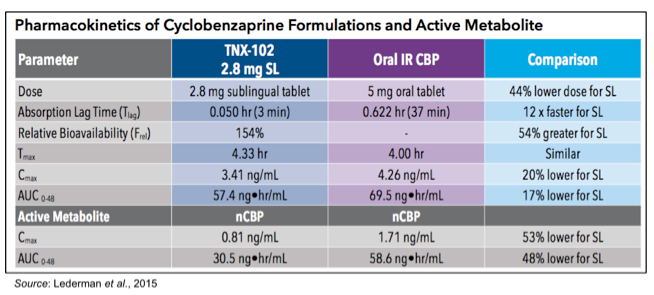
On June 17, 2015, Tonix announced the FDA has conditionally accepted the trade name Tonmya™ for TNX-102SL for the treatment of fibromyalgia. TNX-102 SL is a proprietary eutectic sublingual tablet formulation of low-dose cyclobenzaprine HCl (2.8 mg) that is designed for rapid absorption and long-term bedtime use. A comparison of TNX-102 SL and oral cyclobenzaprine pharmacokinetics is shown below.
Tonmya™ for the Treatment of Fibromyalgia
Tonix had previously tested Tonyma™ in the Phase 2b BESTFIT study (NCT01903265). This was a randomized, double blind, placebo controlled study that was designed to evaluate the efficacy of Tonyma™ taken daily at bedtime in improving pain, sleep quality, and other clinical measures of fibromyalgia. A total of 205 patients were randomized to receive Tonmya™ (n = 103) or placebo (n = 102) for 12 weeks. Top-line results were reported in September 2014 and showed that in the pre-specified secondary outcome measurement for a 30% pain responder analysis, Tonmya™ resulted in a response rate that was statistically significantly higher than placebo (p = 0.033). Other statistically significant improvements included the Patient Global Impression of Change (p = 0.025) and the Fibromyalgia Impact Questionnaire-Revised (p = 0.014).
The company recently announced the presentation of additional results from the BESTFIT study in three posters at the 2015 ACR/AHRP Annual Meeting. Among the most important new findings being presented is that the patients who reported the greatest improvements in sleep quality were the most likely to experience pain relief, and that the group treated with Tonmya™ was approximately twice as likely as placebo-treated patients to be in the top third of reported sleep quality improvements.
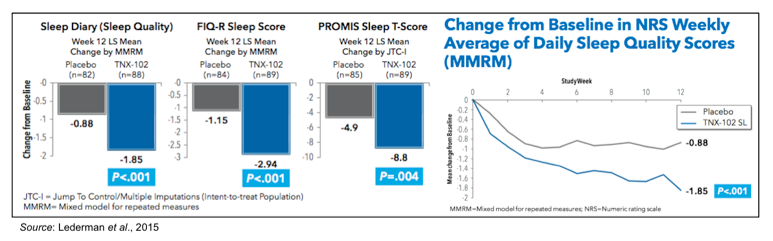
Improvement in Sleep Quality Correlates With Improvement in Pain: Treatment with Tonmya™ resulted in significant improvements in all measures of sleep quality, including the Patient Reported Outcomes Measurement Information System (PROMIS) sleep instrument (P=0.004), the daily sleep diary (P<0.001), and the Fibromyalgia Impact Questionnaire-Revised (FIQ-R) sleep item (P<0.001). Importantly, the improvements in sleep quality were observed early after initiating Tonmya™ treatment, and generally preceded improvements in other outcome measures.
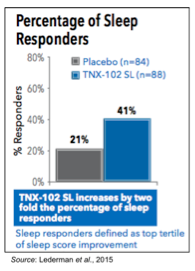
In addition, treatment with Tonmya™ increased the number of sleep responders by two-fold, with sleep responders defined as those in the top third of sleep score improvement. For this analysis, 172 patients were evaluable, with 88 treated with Tonmya™ and 84 treated with placebo. The following graph shows that 41% (36/88) of the Tonmya™ treated patients were in the top tertile of sleep improvement score, compared to 21% (18/84) of the placebo treated patients. Of the 42 patients in the top tertile who experienced at least a 30% improvement in pain from baseline, 28 (67%) were in the Tonmya™ treated group while 14 (33%) were in the placebo treated group.
Additional analyses were performed to examine the relationship between sleep quality and several standard measures of fibromyalgia. The three sleep quality measurements shown above (Sleep Diary, FIQ-R Sleep Score, and PROMIS Sleep T-Score) all showed a statistically significant correlation with each of the following fibromyalgia and pain outcomes: PGIC Favorable Response, FIQ-R Total Score, and the 30% Responder Rate for Pain. This is depicted in the following figure, where R represents the Pearson correlation coefficient (which ranges from -1 to 1, with 0 = no correlation, 1 = total positive correlation, and -1 = total negative correlation; the p values associated with each correlation coefficient show the statistical significance of the correlation).
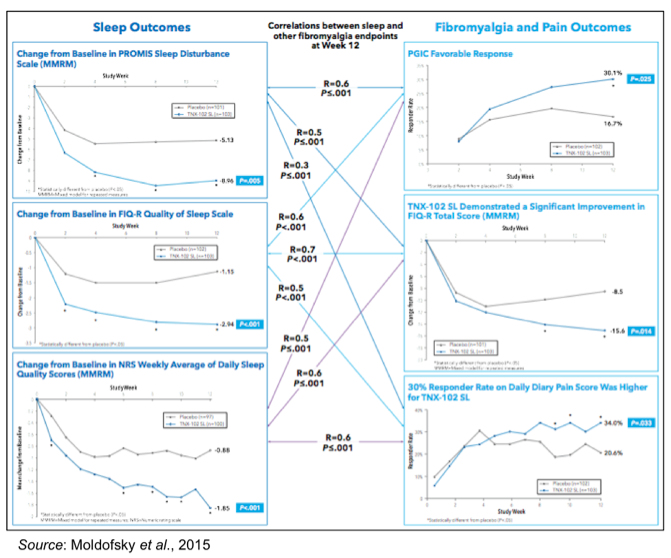
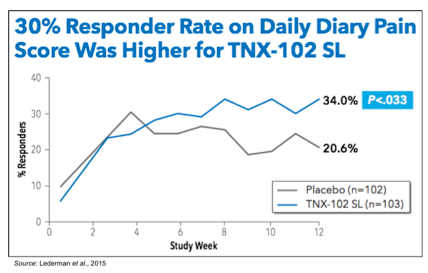
30% Responder Analysis: Analysis of patients who reported a 30% improvement in their pain scores showed that Tonmya™ had a statistically significant effect on pain compared to placebo (34.0% vs. 20.6%; P = 0.033). What this data means is that 34% of patients taking Tonmya™ and 20.6% of patients taking placebo reported at least a 30% in improvement in pain score. As an example, if pain is rated on a numeric rating scale of 0 to 10, with 10 being the highest, a patient with a baseline pain score of 6 that is reduced to 4 at the end of the treatment period would have experienced a ~33% reduction in pain. This patient would count towards the primary endpoint. However, a patient with a baseline of 8 reduced to 6 at the end of the study would only have seen a 25% reduction in pain and thus not counted as a responder towards the primary endpoint. The following figure shows that the 30% responder rate began to separate between active and placebo-treated patients around week 6, with the separation continuing through the end of the 12-week treatment period.
AFFIRM Trial Continues
On May 13, 2015, Tonix announced the initiation of the Phase 3 AFFIRM trial (NCT02436096). The trial is a randomized, double-blind, placebo-controlled 12-week safety and efficacy study that is expected to enroll approximately 500 fibromyalgia patients. The patients will be given either a 2.8 mg Tonmya™ tablet or placebo at bedtime in a 1:1 randomization. The trial is taking place at 35 sites in the U.S. Enrollment is expected to take 12 to 14 months and we anticipate topline results in the third quarter of 2016. Based on inputting the 30% responder data from BESTFIT (~34% for TNX-102SL and 21% for the placebo) into our powering-calculator, we believe AFFIRM is approximately 90% powered to succeed (P<0.05). We also expect the company to initiate a second Phase 3 clinical trial of Tonmya™ in fibromyalgia in the second quarter of 2016.
Tonix elected to use the 30% responder analysis for the planned Phase 3 trial because this endpoint demonstrated a statistically significant separation from the placebo group in the Phase 2b BESTFIT study. As a point of reference, Cypress Bio conducted two Phase 3 studies with milnacipran HCl using a 30% responder analysis. The placebo groups in the first and second study came in at ~16% and ~19%, respectively. The milnacipran HCl groups came in at ~25% and ~27%, respectively. We believe TNX-102SL compares favorably to Savella®, a drug that posted sales of approximately $105 million in 2014.
Additional data to be generated in 2015 or 2016 for the preparation of the NDA includes a prospective multi-dose pharmacokinetic study, a safety and tolerability study comparing Tonmya™ to cyclobenzaprine, and standard non-clinical toxicology work. We believe the most likely scenario is filing an NDA in 2018, after successful completion of two Phase 3 clinical trials, and approval in 2019. Tonix has filed patent applications around Tonmya™ that aim to protect the drug to 2034.
Valuing Tonmya™ in Fibromyalgia
Based on the generic market, the target population for Tonix with Tonmya™ is over 2 million patients. We think that the sublingual formulation clearly contains meaningful advantages over the generic oral formulation of low dose cyclobenzaprine. These include rapid absorption and minimal next-day residual effects ideal for a bedtime dose, and avoidance of first pass metabolism and build-up of norcyclobenzaprine ideal for chronic dosing.
For valuation purposes, our model conservatively estimates that an NDA will be filed in 2018 after completion of two Phase 3 studies; the AFFIRM trial and the trial that will initiate in the second quarter of 2016. This would lead to approval and first sales in 2019. Of the 5 million Americans with fibromyalgia (NIAMS/NIH, November 2014), approximately 50% are diagnosed, which represents approximately 2.5 million U.S. adults. Of those diagnosed, 85% receive treatment (Robinson et al., 2012), thus making the target population approximately 2.1 million individuals in 2015. We estimate peak market share of 5%, which represents approximately 125,000 patients and close to $775 million in peak sales. With an 18% discount rate, a 40% probability of approval, 65% operating margin, and 30% tax rate, the net present value of Tonmya™ for fibromyalgia is approximately $169 million.
TNX-102SL for the Treatment of Military-Related PTSD
On January 15, 2015, Tonix announced the Phase 2 AtEase study had enrolled its first patient. The AtEase study is a Phase 2 randomized, double-blind, placebo-controlled trial to evaluate the efficacy and safety of TNX-102SL in people with military-related post-traumatic stress disorder (PTSD) and related conditions. The three-arm trial is expected to enroll approximately 220 participants, who will be randomized to receive either 2.8 mg or 5.6 mg of TNX-102SL or placebo taken sublingually at bedtime daily for 12 weeks. More information on AtEase can be found on the study’s website or on ClinicalTrials.gov (NCT02277704).
The primary endpoint of the trial is the week eight mean change from baseline in the total CAPS-5 (Clinician-Administered PTSD Scale) score in participants who received 2.8 mg of TNX-102 SL as compared to those who received placebo only. Safety will also be evaluated. The trial is being conducted at approximately 25 U.S. sites. Management plans to use print and radio media to spark military interest in the study, and then hope peer-networking speeds enrollment throughout 2015. We are anticipating data in the second quarter of 2016.
There is enormous overlap between fibromyalgia and PTSD. According to Tonix, 50% of the fibromyalgia or PTSD patient population meets the criteria for the other disorder. Plus, the manifestations and treatment paradigms are similar, and include disturbed sleep and painkiller abuse and addition. Roughly 3.5% of the U.S. adult population suffers from PTSD. The numbers are shockingly high for U.S. military service personnel, a population with high incidence of suicide and opioid addiction. It’s a sad and growing problem, and there have been no new approved medications for PTSD in over a decade.
Tonix’ Phase 2 program will focus specifically on PTSD associated with military / combat service. Although management has narrowed the PTSD population, eliminating things like car accidents and sexual assault, the homogenous population should lead to improved data collection. Plus, the growing attention of the U.S. government in this area should eventually lead to grants or additional funding in the future. It’s an astute development plan in our view. If the AtEase trial is successful, we believe Tonix will move forward with two Phase 3 registration programs later in 2016.
The U.S. PTSD population is estimated at 8 million in size. We believe approximately 25% of these cases are associated with military service, about half of which seek medical treatment for the disease. This puts the U.S. military-associated PTSD population at around 1 million. Assuming similar pricing ($15 per day) and market penetration (roughly 5%) as noted above for fibromyalgia, we believe TNX-102SL peak sales in PTSD are around $450 million in 2026.
The biggest change between our fibromyalgia model and our PTSD model is our probability of approval. We are using only 15% for this indication given the historic difficulty in treating PTSD patients and the earlier-stage nature of the program. After all, the BESTFIT data give us a very good look at what to expect from AFFIRM. With AtEase, Tonix is still attempting to generate this type of proof-of-concept data that will help design registration programs for TNX-102SL in PTSD. The historical success rate of a Phase 2 program in this type of indication is approximately 15%. We do not believe it is prudent to assume any better at this stage. As such, we believe the current value for TNX-102SL in PTSD is $60 million.
Update on TNX-201
Tonix is developing TNX-201 for the treatment of episodic tension-type headache (ETTH). TNX-201 (dexisometheptene mucate) is an improved formulation of isometheptene (6-methylamino-2-methylheptene, IMH), which has been utilized to treat headaches for greater than 50 years. For an in-depth background on TNX-201, including an overview of preclinical efficacy data, please see our previous report.
TNX-201 Enters the Clinic
Earlier in the year, Tonix announced that they had completed the Phase 1 safety, tolerability, and pharmacokinetic study of TNX-201 with encouraging results. Data from the 45-patient study showed a dose-related increase in TNX-201 plasma levels (Cmax, AUC), with no evidence of isomer inter-conversion and only mild adverse events, none of which were considered drug-related or serious enough to discontinue treatment.
In June 2015, Tonix announced the initiation of a randomized, double blind, placebo controlled, proof-of-concept Phase 2 clinical study of TNX-201 in ETTH (NCT02423408). The study is expected to enroll approximately 200 patients at nine clinical centers in the U.S. Study subjects will be administered 140 mg TNX-201 (4 x 35 mg capsules) or placebo for the treatment of a single TTH. The primary efficacy endpoint is the proportion of subjects pain free at 2 hours post-dose (as recommended by the U.S. Food and Drug Administration). Pain will be assessed utilizing a four-point Numeric Rating Scale, Visual Analog Scale, and binary questionnaire for self-reporting pain. Additional endpoints include the proportion of patients that are pain-free at various time intervals post-dose up to 24 hours, the proportion of patients who utilize rescue medication during the 24-hour post-dose period, and the change from baseline in pain severity at several time intervals post-dose. We anticipate topline results from the study in the first quarter of 2016.
Robust Intellectual Property Portfolio for TNX-201
Tonix has an extensive patent portfolio for TNX-201. The intellectual property relates to IMH isomers and includes patent applications directed to a purified isomer of IMH, pharmaceutical compositions containing IMH, IMH formulations, methods for modulating headache, and other CNS conditions and treating CNS conditions utilizing IMH isomers, and methods of manufacturing IMH isomers. The IMH technology patent portfolio includes U.S. Patent Application No. 14/158,735 as well as U.S. Provisional Patent Application No. 61/953,715. If U.S. and non-U.S. patents claiming priority from those applications issue, those patents would expire in 2034, excluding any patent term adjustments or extensions.
Valuing TNX-201
The potential market for TNX-201 is quite large as approximately 75 million Americans suffer from TTH each year. We believe the majority can be treated with OTC medications, however there were still close to 10 million prescriptions for headache medications in the U.S in 2013. We estimate that approximately 70% of these are for ETTH. The 3.5 million prescriptions for butalbital combination products are the initial low-hanging fruit for Tonix, with opportunity to take away market from prescription NSAIDs and Triptan products offering significant upside. At peak, 2.5 million prescriptions were written for IMH containing products in the late 1990s.
If we assume the average headache sufferer has about one episode per week (50/year), and we price TNX-201 comparable to migraine drugs Cambia® ($35 per pill) and Treximet® ($40 per pill), with 10% market share of the active prescription seekers, we estimate TNX-201 will have peak sales of approximately $440 million. Data from the current Phase 2 study should be available in the first quarter of 2016 and we estimate two registration programs will take place in 2016 and 2017 with an NDA filing in 2019 and approval in 2020. We assume peak sales in 2025. The net present value of the franchise is $67 million based on a 20% probability of approval and 65% operating margins.
Valuation and Conclusion
For Tonmya™ in fibromyalgia, we assume approval and launch in 2019, with the drug costing approximately $15 per day. We are assuming Tonix (or its partner) can capture 5% of the market by 2023, with peak sales of close to $775 million. If we apply an 18% discount rate and 40% probability of success to the asset, we arrive at a net present value (NPV) for Tonmya™ in fibromyalgia of approximately $169 million.
For PTSD, a slightly smaller peak sales opportunity of $450 million exists. We believe approval of TNX-102SL in PTSD is approximately one year behind the timelines noted above for fibromyalgia. Thus, our NPV analysis for TNX-102SL in PTSD yields a fair value valuation of approximately $60 million, thus we believe TNX-102SL in PTSD and fibromyalgia is worth roughly $230 million in NPV. We remind investors that TNX-102SL is protected by a pharmacokinetic patent that does not expire until 2033 and a composition-of-matter patent that does not expire until 2034.
For TNX-201, we believe the drug has a 20% probability of success and based on peak sales of over $400 million in 2025 its NPV is $67 million. Once we have a look at data from the current Phase 2 study, we will get a better sense of the drug’s efficacy in patients, which will help to refine both our outlook on peak sales and probability of approval.
Summing up our NPV calculations we arrive at a total firm value of approximately $296 million. Tonix exited the third quarter 2015 with $55.0 million in the bank, which we believe is enough to fund operations into 2017. We believe the company will require approximately $125 million to fund operations to cash flow positive in 2020. Thus, even with the recent raise we know that Tonix will need to raise additional cash through public offerings or partnering its drugs in 2016. Based on our sum-of-parts NPV analysis, we believe the stock is worth approximately $18 per share today. We believe there are several catalysts on the horizon that can lead to a dramatically higher stock price ahead of that expected need for additional cash in 2017. For example, between now and then, Tonix should report:
- Phase 2 data with TNX-201 in the first quarter of 2016
- Phase 2 data from AtEase in PTSD with TNX-102SL in the second quarter of 2016
- Phase 3 data from AFFIRM in fibromyalgia with Tonmya™ in the third quarter of 2016
If the company can raise this $60 million in additional cash at prices in the $10-15 per share range, then the new dilution will be minimal – approximately 5 million shares. Based on the diluted share count of approximately 19.7 million today (assumes only exercisable stock options and warrants in-the-money), we see fair-value at $18 per share. However, if we add in approximately 5 million shares for expected financing activities in 2017 and 2018, we arrive at a more reasonable fair-value target of $14 per share. As such, investors with a longer time horizon can buy Tonix today and see nice returns as we expect clinical progress to drive the shares higher.
READ THE LATEST FULL RESEARCH REPORT HERE
SUBSCRIBE TO ZACKS SMALL CAP RESEARCH to receive our articles and reports emailed directly to you each morning. Please visit our website for additional information on Zacks SCR and to view our disclaimer.