By David Bautz, PhD
Financial Update
NASDAQ:NBIX
On July 29, 2015, Neurocrine Biosciences, Inc. (NASDAQ:NBIX) reported financial results for the second quarter of 2015. The company did not report any revenue during the quarter. Operating expenses totaled $25.3 million and consisted of $18.7 million in R&D and $6.6 million in G&A expenses. This compares with R&D and G&A expenses of $10.2 million and $4.2 million, respectively, for the same time period in 2014. The increase in R&D expenses was mainly driven by the VMAT2 Phase 3 clinical program, while the increase in G&A expenses was driven by both an increase in share-based compensation as well as external costs related to market research, licensing, and professional services.
Net loss for the quarter totaled $24.0 million, or $0.28 per share, compared with $13.4 million, or $0.18 per share, for the second quarter of 2014. The company exited the second quarter of 2015 with approximately $503.7 million in cash and investments. We remind investors that in February 2015 the company closed a very successful public offering whereby approximately 7.99 million shares of common stock were sold at $36.00 per share resulting in roughly $270 million in cash. Management expects to end 2015 with approximately $450 million in cash and investments. We believe the current cash balance is sufficient to fund all operating activities to commercialization of NBI-98854.
NBI-98854 (VMAT-2) Update
The Phase 3 Kinect 3 (NCT02274558) study of NBI-98854 for the treatment of tardive dyskinesia (TD) continues on plan, with top-line data expected in the fourth quarter 2015. As a reminder, the trial opened for enrollment in October 2014, with a target of 240 patients with moderate to severe TD and an underlying diagnosis of mood disorder, schizophrenia, or schizoaffective disorder. The Phase 3 trial is a randomized, parallel-group, double-blind, placebo-controlled study assessing either 40 mg or 80 mg of NBI-98854 dosed once daily against placebo.
The primary endpoint for the Kinect 3 study is change from baseline in the Abnormal Involuntary Movement Score (AIMS) as measured by blinded central raters, just as was done in Neurocrine’s previous and successful Kinect 2 study (see our analysis of Kinect 2 here) at six weeks. During the second quarter conference call, management indicated that the final patients first visit is scheduled for the first week of August 2015, with the final visit likely to occur toward the end of September. Topline data would then be released approximately 4-6 weeks later. As a reminder, patients completing Kinect 3 will be eligible to enroll in an open-label, 48-week, long-term safety assessment study called Kinect 4, where all study subjects will be randomized in a blinded fashion to either 40 mg or 80 mg NBI-98854.
The Kinect 3 study, along with the previous efficacy studies of NBI-98854, is designed to complete the clinical efficacy evaluation of the drug in TD. Alongside the Kinect 3 pivotal trial and open-label Kinect 4 assessment, Neurocrine is planning to perform additional Phase 1 work that includes a QTc study, a study involving patients with renal impairment, and another drug interaction study. Assuming the Kinect 3 study is successful, we believe the company will be in position to file the NDA in TD in 2016.
FDA Awards Breakthrough Therapy Designation in TD
As a reminder, on October 30, 2014, Neurocrine announced that the U.S. Food and Drug Administration (FDA) has granted Breakthrough Therapy Designation for NBI-98854 in TD. The breakthrough therapy designation is granted for a drug that is intended to treat a serious or life-threatening disease or condition and preliminary clinical evidence indicates that the drug may demonstrate substantial improvement on clinically significant endpoints over available therapies. The FDA had previously granted Fast Track status to NBI-98854 for tardive dyskinesia. Breakthrough therapy designation is quite similar to the Fast Track designation in that both programs are designed to expedite the development and review of drugs, which includes the following:
- Increased number of meetings with the FDA throughout the development of the drug,
- Maintaining an interactive dialogue with the FDA regarding drug development to ensure the sponsor is obtaining the proper nonclinical and clinical data necessary for approval expeditiously,
- Working with the FDA to ensure the clinical trials are being run as efficiently as possible,
- Rolling review and priority review.
Phase 1 Tourette Syndrome Study
On October 2, 2014, Neurocrine announced the initiation of a Phase 1b clinical trial called T-FORCE (NCT02256475) of NBI-98854 in both children and adolescents with Tourette syndrome (TS). The T-FORCE study is an open-label, multiple ascending dose, two-week study of 36 subjects with TS. The study participants will receive once-daily dosing of NBI-98854 during a two-week treatment period to assess both the safety and tolerability of NBI-98854 in Tourette patients followed by seven days off-drug. The study is taking place at approximately 10 centers in the U.S.
The study is divided into two dosing groups: children (ages 6-11) and adolescents (ages 12-18). Each group is divided into three dosing cohorts of six patients each. Following the initial two weeks of dosing with the first adolescent cohort, an independent review of both safety and pharmacokinetic results will occur prior to escalating the dose level for the second cohort of adolescents. Concurrently, when the second group of adolescents is dosed the first group of children will be administered NBI-98854. Continued dose escalations for both children and adolescents will be contingent upon the pharmacokinetic and safety data from the previous cohort in each age group. Lastly, each patient’s Tourette symptoms will be evaluated weekly using the Yale Global Tic Severity Scale, the Premonitory Urge for Tics Scale, and the Clinical Global Impression in Tourette syndrome Scale. We remind investors that this study is not powered to show efficacy in treating TS, but is rather a pharmacokinetic and pharmacodynamics focused study. Data from the T-FORCE study should be available in the fourth quarter of 2015.
Partnership with Mitsubishi Tanabe
On March 31, 2015, Neurocrine entered into an exclusive collaboration and licensing agreement for the development and commercialization of NBI-98854 in Japan and other select Asian markets with Mitsubishi Tanabe Pharma Corporation. Under the terms of the agreement, Neurocrine received an initial payment of $30 million and is eligible to receive up to $85 million in additional milestone payments associated with the development and commercialization of NBI-98854 in Asia. Upon commercialization, Neurocrine will also receive royalties on product sales from select territories in Asia.
Neurocrine will also support Mitsubishi Tanabe's clinical efforts in developing NBI-98854 for patients suffering from the chorea associated with Huntington's disease and TD. This may (management is still looking into this) include conducting a Phase 3 study in the U.S. in patients with chorea associated with Huntington's disease. Neurocrine will pay for this study, which they estimate will cost roughly $12 million to complete, if necessary. Management plans to use the $30 million upfront payment to fully fund this trial if requested by Mitsubishi Tanabe. At this point, we believe it is prudent to assume they have to do the study, and believe that management likely believes that will be the case and this is why they only recognized $19.8 million of the $30 million upfront payment in the first quarter 2015 financial results.
Teva Acquisition of Auspex Validates the Market
In March 2015, Teva Pharmaceuticals and Auspex Pharmaceuticals announced that they had entered into a definitive merger agreement under which Teva would acquire Auspex at $101.00 per share in cash, representing total consideration of approximately $3.2 billion in enterprise value. Auspex lead pipeline candidate, SD-809, is a deuterium substituted version of tetrabenazine that recently completed a positive Phase 3 trial for chorea associated with Huntington’s disease, and is in Phase 3 for TD and Phase 2 for TS.
Neurocrine’s NBI-98854 is also an improved version of tetrabenazine. The drug is the primary active metabolite in the (+)-alpha isomer (valbenazine). We think Neurocrine’s valbenazine may have some safety advantages over SD-809, but will likely be priced significantly less for the tardive dyskinesia market than what we suspect Teva will ask for the drug in Huntington’s chorea. As such, we think NBI-98854 will win the market share game, and if Auspex is worth $3.2 billion based largely on SD-809, then Neurocrine’s NBI-98854 should be worth a similar amount post the Phase 3 data coming this fall.
Elagolix Update
On January 8, 2015, AbbVie Inc. reported positive top-line data from a Phase 3 trial evaluating the safety and efficacy of elagolix in the treatment of endometriosis in premenopausal women. Violet Petal (NCT01620528) was a 24-week, multinational, randomized, double-blind, placebo-controlled study designed to evaluate the safety and efficacy of elagolix in 872 women, age 18 to 49, with moderate-to-severe endometriosis-associated pain. The trial was conducted at approximately 160 sites in the United States, Puerto Rico and Canada.
According to the AbbVie press release, results from the Phase 3 trial, dubbed Violet Petal (NCT01620528), show that after three and six months of treatment, both doses of elagolix (150 mg once daily and 200 mg twice daily) met the study's co-primary endpoints (p<0.001) of reducing scores of non-menstrual pelvic pain (NMPP) and menstrual pain (or dysmenorrhea), associated with endometriosis as measured by the Daily Assessment of Endometriosis Pain scale. If you’re scoring at home, that’s eight total endpoints that all hit statistical significance.
Unfortunately, no actual figures on efficacy were reported in the press release, protecting the data we suspect from competitors' eyes and so that AbbVie can present full results at a medical meeting later this year. However, a brief summary of the safety data and adverse event profile was presented in the release. According to AbbVie, the observed safety profile of elagolix in this Phase 3 trial was consistent with observations from prior studies (which we discuss below). The most common adverse events (AEs) were hot flush, headache, nausea and fatigue. Adverse events, particularly hot flush, were dose-dependent. No DXA scan data was presented in the press release, only the mention that bone mineral density (BMD) loss was dose-dependent and the 150 mg results were similar to the results for the 150 mg cohort seen in the previous Phase 2b studies (< 0.5% change).
During Abbvie’s second quarter 2015 conference call, management indicated that they had seen data from the six-month extension trial of the Violet Petal study and “the results were consistent with the previously reported efficacy and safety findings.” This is very encouraging news, as it likely indicates that the drug’s efficacy does not wane over time and that no additional safety issues are likely with extended use of the compound.
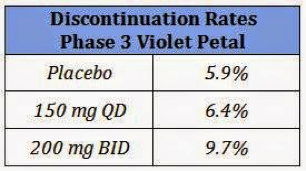
Discontinuation rates specifically due to AEs for the Violet Petal trial are presented below:
A second Phase 3 trial, Solstice (NCT01931670), is ongoing. This study is similar in design to the Violet Petal study and will assess 788 women, age 18 to 49, with moderate to severe endometriosis-associated pain at more than 200 sites globally. Data from Solstice is expected in the first quarter of 2016. We continue to believe that elagolix is roughly a one billion drug in the U.S. based on the following key pieces of information and market dynamics:
- AbbVie is a pioneer and market leader in GnRH agonists with Lupron for the treatment of hormone-responsive cancers such as prostate cancer or breast cancer.
-We believe that AbbVie will look to replace Lupron in the Ob/Gyn market with elagolix thanks to superior efficacy and tolerability, as well as patent protection.
- Prevalence of endometriosis at around 10% of the general female population between the ages of 18 and 49. This is roughly 10 million women in the U.S.
-25% of these women are asymptomatic.
-In 2009, Datamonitor cited 7.5 million women in the U.S. suffer from clinically significant endometriosis.
- Neurocrine notes that 75% of endometriosis sufferers have symptoms defined as moderate or severe.
-Data from IMS Health suggests that 10-20% of all oral contraceptive prescriptions are written off-label for endometriosis,
-Ob/Gyn's prescribe NSAIDs and opioids off-label to approximately 25% of their endometriosis patients.
- Approximately 400,000 hysterectomies per year are attributed to endometriosis.
-We suspect that another 300-400,000 women are to the point that they are failing these other medications and nearing a hysterectomy (essentially pulling forward one year all the women that are heading towards a hysterectomy next year).
- As such, we believe there are approximately 750,000 women in the U.S. that are ideal potential candidates for elagolix. We think it is realistic for AbbVie to penetrate 30% of this market.
- We believe that elagolix will launch competitively priced with branded neurological or fibromyalgia pain medications such as Cymbalta or Lyrica, or around $12-15 per day.
- We believe a typical course of treatment will include eight months on therapy.
-Multiplying all this through, we arrive at a peak U.S. opportunity for elagolix in endometriosis of $825 million (750k patients x 30% penetration x $15 per day x 245 days).
Uterine Fibroid Data Expected in the Third Quarter of 2015
We remind investors that AbbVie is also evaluating elagolix in women with uterine fibroids (UF). AbbVie is conducting a Phase 2b clinical trial (NCT01817530) evaluating the change in menstrual blood loss of 520 women, age 18-51, with heavy menstrual bleeding associated with uterine fibroids. Management described this as an “add back” study because women in the study will also be receiving low dose oral contraceptives. The goal of the study is to find the right balance of dosing between elagolix and oral contraceptives, while mitigating the loss of bone mineral density. Data on this study is expected in the third quarter of 2015. The doses for the trial have not been disclosed, but Neurocrine describes them as a broad range with previous work done in Phase 1 and Phase 2a programs.
Also, we think this is an important step forward for AbbVie and Neurocrine because development of elagolix outside the U.S. will probably focus on uterine fibroids. The opportunity in uterine fibroids may be as large as in endometriosis. As such, globally, we think elagolix is a blockbuster drug, with peak sales that could eclipse $2.5 billion if the drug is approved for both endometriosis and uterine fibroids.
NBI-77860 Update
On January 16, 2015, Neurocrine Bio announced that NBI-77860, the company’s proprietary corticotropin releasing factor 1 (CRF-1) receptor antagonist, has been granted orphan drug status by the U.S. FDA for the treatment of congenital adrenal hyperplasia (CAH). CRF is a peptide released directly from the hypothalamus in the central nervous system into a discrete network of blood vessels where it functions via specific G-Protein Coupled Receptors on cells in the anterior pituitary gland to regulate the release of pituitary hormones. One such hormone is adrenocorticotropic hormone (ACTH), the primary role of which is the stimulation of synthesis and release of adrenal steroids including cortisol.
In late 2014, Neurocrine announced it had successfully completed the 1501 study in adult females with classic CAH. This was a small, single-dose pilot study designed to show that a single dose of NBI-77860 results in a pharmacokinetic/pharmacodynamic effect on key biomarkers of interest. The study was not designed as an efficacy trial, and management obviously received no information about chronic repeated dose exposure or what happens in children with CAH, which ultimately are the target population, but they were very pleased with what they saw with respect to the biomarker levels. Management has also confirmed with the U.S. FDA that these biomarkers are indeed the appropriate endpoints for this stage of clinical development. A full description of the study results and related data was presented at the Endocrine Society's 97th Annual Meeting in San Diego on March 5, 2015.
Specifically, eight study participants visited the investigative site for three separate overnight visits consisting of bedtime dosing with placebo or one of two active doses of NBI-77860. Each of the visits was separated by a three-week washout period. Key biomarker measurements included ACTH, 17-hydroxyprogesterone (17-OHP), androgen, and cortisol levels collected in the morning after dosing. Data from this initial single dose exploratory study demonstrated a robust decrease in ACTH and 17-OHP.
On June 8, 2015, the company surprisingly announced that it had suspended clinical studies of NBI-77860 out of an abundance of caution due to certain preclinical findings that the company discovered that were not observed in previous animal studies. During the second quarter conference call, management indicated that the preclinical finding was from a juvenile toxicology study done to support the use of NBI-77860 in an adolescent population. This was the first juvenile toxicology study done with NBI-77860; all prior toxicology studies were done in adult models since that had been the target population. At this point management is not saying much other than they don’t know yet whether the findings were due to the target, the species tested, or the molecule itself. The company is working with the FDA to sort through the issue, and at this point the worst-case scenario is that NBI-77860 is not advanced further. However, the company stated that there are multiple follow-on molecules available to take the place of NBI-77860 if needed and those molecules are being advanced into additional studies.
Neurocrine had planned to initiate a second repeat dose study with NBI-77860 in adolescent females. The 1401 study was to be a Phase 1/2 open-label, sequential cohort, single ascending dose pharmacokinetic/pharmacodynamic study assessing three doses of NBI-77860. The fifteen adolescent females with classic CAH would be split into three cohorts and each would receive one dose of NBI-77860 at bedtime. Biomarker measurements including ACTH, 17-OHP, androgen, and cortisol levels were to be collected the morning after dosing. We are uncertain when or if this study will be conducted.
What’s so surprising about the partial clinical hold is that NBI-77860 is a drug that the company has studied extensively under its previous collaboration with Glaxo looking at the potential role for CRF-1 antagonists in the treatment of depression and anxiety. Although no meaningful efficacy was seen with the drug in anti-depression studies, Neurocrine amassed significant exposure data with the drug showing excellent safety and tolerability.
As noted above, Neurocrine has been granted Orphan Drug status for NBI-77860 for the treatment of CAH. The company believes the U.S. CAH population is between 20,000 and 30,000 individuals. However, this number would encompass all CAH patients including both male and female from young to old. In the Phase 1 pilot study noted above the company enrolled only adult female CAH patients. In the Phase 1/2 1401 study that is currently on hold, the company was targeting fifteen adolescent females with classic CAH. Ultimately the target population for the company may be around 10,000 patients in the U.S. We hope to learn more about the preclinical findings that lead to the clinical hold and whether the company will be able to get NBI-777860 into the clinic later this year. Given the potential for strong pricing and limited competition, we believe NBI-77860 could have peak sales in the billion-dollar range (5,000 patients x $200,000 per year), however given the uncertainty surrounding future development we have excluded the compound from our financial model.
Recent Hires Set Neurocrine Up For Commercial Success
In June 2015, Neurocrine announced the hiring of Eric Benevich as Chief Commercial Officer. Mr. Benevich was most recently at Avanir Pharmaceuticals as Vice President of Marketing where he was responsible for NUEDEXTA® and commercialization of their CNS pipeline. He has over twenty years of previous experience in the pharmaceutical industry with Peninsula Pharmaceuticals, Amgen, and AstraZeneca in the sales and marketing of drugs such as Enbrel®, Epogen® and Prilosec®. His marketing expertise coupled with his experience and track record with prior CNS therapies will be vital to the company with the anticipated NDA filing and commercial launch of NBI-98854 for TD.
In May 2014, the company announced the hiring of Dr. Bill Aurora as Vice President, Medical Affairs. Prior to joining Neurocrine, Dr. Aurora was Vice President, Global Center for Scientific Affairs at Merck. Prior to Merck, he spent twelve years at Amgen most recently as the Vice President of Global Scientific Affairs where he lead the Regional Medical Liaisons, Medical Communications, Medical Information, Medical Writing, and Scientific Affairs Training and Development groups across therapeutic areas and geographies. Dr. Aurora has also held positions at Novartis and Bristol Myers Squibb. His experience in medical affairs and high regard among psychiatric and neurological physicians will be quite valuable for Neurocrine as the company moves NBI-98854 toward commercialization.
Conclusion: Valuation and Recommendation
Neurocrine had a fantastic first half of 2015. On the clinical side, AbbVie reported positive data from the first Phase 3 elagolix trial in January 2015 and then followed that up by recently announcing data from the six-month extension trial that showed results consistent with the previously reported efficacy and safety findings. On the financial side, the company raised $270+ million in cash in February 2015 at $36 per share, and the shares have since risen to near $51.
The momentum may well continue, as AbbVie is expected to report data for elagolix from the Phase 2b uterine fibroid trial in the third quarter of 2015. Data from the second Phase 3 elagolix trial in endometriosis is expected in the first quarter of 2016. We expect that AbbVie will be in position to file the New Drug Application (NDA) on elagolix in late 2016. Our model assumes commercial launch for endometriosis in the U.S. in early 2018.
Neurocrine’s management is guiding for data from the Phase 3 Kinect 3 study to be available in the fourth quarter of 2015. In parallel, the company is conducting the open-label study Kinect 4, as well as some Phase 1 safety and drug-drug interaction studies. We continue to believe that the company will file the NDA on NBI-98854 for TD during the second half of 2016.
The treatment of TD is a meaningful market opportunity for Neurocrine. There are an estimated 500,000 TD patients in the U.S. with no real treatment options besides tetrabenazine. For valuation purposes, we assume U.S. approval of NBI-98854 in TD will target roughly 150,000 of the total patients in the U.S. that are moderate-to-severe in disease state. We assume Neurocrine will charge pricing comparable to atypical antipsychotics, or around $15,000 per year. If Neurocrine can capture 33% market share, which we believe is reasonable given the superior characteristics of NBI-98854 (valbenazine) vs. generic tetrabenazine, then peak sales estimates are approximately $1.0 billion in this indication in the U.S. alone. We remind investors that NBI-98854 has received breakthrough designation from the U.S. FDA for the treatment of TD. Neurocrine is also pursuing development of NBI-98854 in TS. Phase 1b data are expected in the fourth quarter of 2015. We believe the opportunity for NBI-98854 in TS is another billion-dollar opportunity.
We continue to be positive on the Neurocrine story. Near term catalysts over the next six months include the Phase 2b uterine fibroid data for elagolix, the Phase 3 Kinect 3 data for NBI-98854 in TD, and Phase 1b clinical data from the T-FORCE trial for NBI-98854 in TS. Our current sum-of-parts valuation model gives a fair-value of $57 per share. Given Teva’s acquisition of Auspex for a potential competitor to NBI-98854 and elagolix looking like a blockbuster for Abbvie, we would not be surprised to see Neurocrine acquired at some point in the future.
READ THE LATEST FULL RESEARCH REPORT HERE
SUBSCRIBE TO ZACKS SMALL CAP RESEARCH to receive our articles and reports emailed directly to you each morning. Please visit our website for additional information on Zacks SCR and to view our disclaimer.