By Nisha Hirani, MD and David Bautz, PhD
Financial Review & Business Update
OBB:TTNP
On August 13, 2015, Titan Pharmaceuticals, Inc. (OBB:TTNP) reported financial results for the second quarter of 2015. The company reported total revenues of approximately $0.8 million, compared with revenue of approximately $0.9 million in the second quarter of 2014. Second quarter 2015 and 2014 revenues consisted entirely of license revenue and reflect the amortization of the upfront license fee received from development and commercialization partner Braeburn Pharmaceuticals in December 2012. This was in-line with our expectations.
Operating expenses for the second quarter 2015 totaled $1.9 million, compared with approximately $1.5 million in the same quarter in 2014, and were in-line with expectations. The increase of approximately was driven due to higher research and development expenses totaling approximately $1.1 million, compared with approximately $0.7 million in the second quarter of 2014. This increase was associated with external and internal development expenses related to the support of Titan's Probuphine® and ProNeura-ropinirole product development programs in addition to other R&D expenses. General and administrative expenses for the second quarter of 2015 and 2014 were approximately $0.8 million and approximately $0.7 million, respectively. Both R&D and G&A expenses were in-line with our expectations. We remind investors that the majority of the costs associated with the current clinical program are borne by Braeburn Pharmaceuticals, as per the terms of the amended license agreement.
Net other expenses for the second quarter of 2015 were approximately $1.2 million, compared with approximately $0.3 million for the same period in 2014, and consisted primarily of non-cash losses on changes in the fair value of warrants. Net loss for the second quarter 2015 was approximately $2.3 million, or approximately $0.02 per share, compared with approximately $0.8 million, or approximately $0.01 per share in the same quarter in 2014.
Titan exited the second quarter of 2015 with approximately $11.5 million in cash. Net cash burn in the quarter totaled $2 million, and was consistent with the cash burn in the first quarter 2015. We believe that these funds are sufficient to support Titan’s planned operations into the fourth quarter of 2016. By that time, we expect U.S. approval of Probuphine, which will net Titan a $15.0 million milestone payment from Braeburn. We also believe that potential licenses outside the U.S. could occur in 2016, thus bringing in more non-dilutive cash to the company. All-in-all, we believe Titan is currently in a strong financial position, especially with the possibility of receiving the $15.0 million milestone payment from Braeburn.
Positive Probuphine Phase 3 Data
On June 8, 2015, Titan reported positive topline results from a confirmatory Phase 3 study with Probuphine in subjects with opioid addiction. This is the third positive Phase 3 trial for the company since 2011. As a reminder, Titan completed two previous Phase 3 trials on the drug showing both superiority to placebo implants and non-inferiority to sublingual buprenorphine/naloxone for the treatment of opioid addiction (1stP3, 2ndP3). The company filed for U.S. approval in October 2012, and along with commercialization partner, Braeburn Pharmaceuticals, was granted priority review by the agency in January 2013. In March 2013, the FDA's Psychopharmacologic Drugs Advisory Committee (PDAC) voted to recommend approval of the product; however, the FDA issued a complete response letter (CRL) in April 2013, seeking additional data on the use of the product in patients stable on lower doses of sublingual buprenorphine/naloxone than previously tested in the first two Phase 3 clinical trials. We believe the positive Phase 3 data released this morning by the company clears the way for a re-filing of the U.S. New Drug Application (NDA) in the next several months.
Titan Goes 3-for-3 in Phase 3
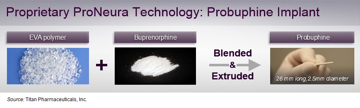
The positive topline data from the third Phase 3 trial released in June 2015 only further strengthens the company’s claim that Probuphine is a safe and highly effective product for the treatment of opioid addiction. Probuphine is an ethylene-vinyl acetate (EVA) polymer that has been designed to elute buprenorphine over a controlled period of time. The product is extruded into rods roughly the size of a matchstick and implant in the arms of opioid addictions.
The confirmatory Phase 3 trial (PRO-814) was designed to show that patients currently taking ≤ 8 mg sublingual buprenorphine/naloxone and stable in their absence can be transitioned to Probuphine and maintain absence in a safe and effective manner. The study was a randomized, double blind, double dummy design that enrolled 177 patients into two parallel treatment arms. Patients were randomized to receive either four Probuphine implants, or to continue the daily sublingual buprenorphine therapy. The patients were treated for six months, and the primary analysis was a non-inferiority comparison of responders in the two arms.
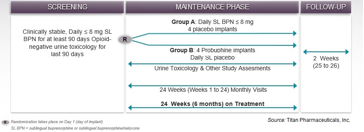
In the trial, a responder was defined as having at least four out of six months free of illicit opioids based on urine testing and subject self-report. Analyses conducted according to the pre-planned Statistical Analysis Plan indicated response rates of 96.4% for the Probuphine arm and 87.6% for the sublingual buprenorphine/naloxone arm. The two-sided 95% confidence interval (0.009, 0.167) of the treatment difference (Probuphine - sublingual buprenorphine/naloxone) was well within the pre-defined successful margin for non-inferiority. In fact, sequential analysis showed that Probuphine was clinically superior to sublingual buprenorphine/naloxone (p < 0.05).

No additional data was provided in the press release, as Titan plans to present the full data from the PRO-814 at a medical conference in the near future. However, on the June conference call Titan did note that one patient had an adverse event and needed to have the implant removed. We are not overly concerned with an adverse event rate of +0.6% (1 out of 173 patients that received implants). We note that there was no diversion (authorized implant removal) during the trial, consistent with what has been seen throughout the entire clinical program with Probuphine.
As noted above, based on the positive data we expect that Titan and Braeburn will be in position to re-file the NDA during the third quarter 2015. Titan and Braeburn have previously been working on completing the necessary CMC work required to re-file over the past year. We are expecting a six-month review, which should put the new action date in the first half of 2016. We are expecting approval at that time. Approval earns Titan a $15.0 million milestone from Braeburn, and we believe that this will help fund the rest of the developmental programs.
Titan Continues to Look Ex-U.S.
With the U.S. confirmatory Phase 3 study now complete and Braeburn preparing the re-filing of the NDA, Titan can turn is attention to areas outside the U.S. with Probuphine. In fact, management has already begun the process of engaging with key opinion leaders and regulatory consultants outside the U.S. in areas where Probuphine may be an attractive product. Furthermore, management expects to have some meetings scheduled before the end of the year with at least two or three different local health authorities in Europe. These talks are taking place on a country-by-country basis and it is too early to say at this point whether or not any of these countries will recognize the U.S. FDA approval as clearance for sale. However, management did state that countries that use buprenorphine stand out, such as Australia, France, Germany, U.K., Italy and some Scandinavian and Asian countries, and that there is early interest in these markets. We suspect that Titan may need to conduct new clinical studies prior to filing. Nevertheless, it is also possible that Titan secures development and commercialization agreements on a country or regional basis before U.S. approval. This is positive new for shareholders because any deal for development or commercialization of Probuphine outside of the Braeburn territory could come with upfront cash.
Potential ProNeura Expansion to Parkinson’s Disease
It’s also worth mentioning that Titan continues to look for additional product opportunities, and to expand the use of its ProNeura platform. More specifically, Titan continues to aggressively pursue its ProNeura Parkinson’s Disease program. In support of the Parkinson’s indication, Titan received a notice of allowance from the U.S. Patent and Trademark Office for a patent application covering the sustained release of dopamine agonists utilizing the ProNeura technology in June 2014. The patent, titled “Implantable Polymeric Device for Sustained Release of a Dopamine Agonist”, provides intellectual property protection of the program for Parkinson’s disease and is expected to have an expiration date of at least 2024. In addition to the U.S., Titan has similar issued patents in Europe, Japan, Australia, Canada, South Korea, Mexico, New Zealand, South Africa, and Hong Kong, while prosecution of patent applications continues in the U.S., Israel, India, and China.
Titan plans to complete non-clinical studies to enable timely submission of the IND in the first half of 2016, and commence a Phase 1 proof-of-concept safety and efficacy clinical study in the second half of 2016, following potential approval of Probuphine. The product is similar to Probuphine, only instead of the EVA rods eluting buprenorphine, they are eluting ropinirole. Ropinirole was previously sold as Requip by GlaxoSmithKline for the treatment of Parkinson’s disease and Restless Leg Syndrome (RLS). GlaxoSmithKline posted peak sales of Requip XL, and extended release formulation of ropinirole, of $250 million in 2010. The goal of the ProNeura formulation is to slowly release, at continuous levels, ropinirole through the process of dissolution. Titan has conducted initial non-clinical studies with long-term delivery of dopamine agonists demonstrating the potential of this product in the treatment of Parkinson’s disease in non-clinical models of the disease and has commenced work on optimizing an implant formulation of ropinirole. This work, along with input from key scientific and regulatory advisors, is helping Titan plan the non-clinical studies and an appropriate proof-of-concept clinical study.
On June 17, 2015, Titan presented nonclinical data in the form of a poster titled "Continuous Delivery of Ropinirole by Subdermal ProNeura™ Implants," at the 19th International Congress of Parkinson's Disease and Movement Disorders. The dose-escalating study in Parkinsonian primates showed that motor function could be improved with no onset of dyskinesias (involuntary movements), following the continuous, non-fluctuating release of ropinirole with the ProNeura platform. Management stated that there were no observed signs of irritation, inflammation or fibrotic capsule formation at the site of implantation, with continuous, non-fluctuating release of ropinirole being observed for a period of several months following implantation. We believe that these early stage results of ProNeura with ropinirole are encouraging, and although it is still quite early, we are interested in watching the story unfold and seeing if the ProNeura-ropinirole product can indeed provide continuous, non-fluctuating therapeutic drug levels for several months from one treatment in human trials.
With Titan aggressively advancing its development plans for ProNeura-ropinirole product for Parkinson's disease, we believe that the company is on target to submit briefing material to the FDA in the fourth quarter to support a pre-IND meeting. We believe that Titan intends to begin clinical work on ProNeura in PD in the second half of 2016, following completion of nonclinical safety and pharmacology studies and the filing of the IND application with the FDA. We believe this product – especially if Probuphine gets approved – could bring significant value to shareholders through the signing of a development and commercialization partnership. As of yet, our financial model assumes no contribution from a ProNeura-PD candidate, so this represents upside to our fair value target.
Conclusion
We continue to remain optimistic regarding the Titan Pharma story, and are looking forward to seeing the NDA go back under priority review by the end of 2015, with a potential new PDUFA date for the first half of 2016. We would also like to point out that Titan has also made progress in evaluating additional compounds that can be delivered in the ProNeura implant, and the company expects to add another product to the development pipeline in the next few months. We are looking forward to learning more about this product in the upcoming quarters. With both late- and early-stage programs utilizing the ProNeura platform under way, we still see the shares worth $1.50 right now, with upside to the $2.00 level upon approval in 2016. Our model has very little contribution from ProNeura in Parkinson’s disease at this point or in value for Probuphine outside the U.S. We believe this presents additional upside to our financial model.
READ THE LATEST FULL RESEARCH REPORT HERE
SUBSCRIBE TO ZACKS SMALL CAP RESEARCH to receive our articles and reports emailed directly to you each morning. Please visit our website for additional information on Zacks SCR and to view our disclaimer.