By David Bautz, PhD and Nisha Hirani, MD
NASDAQ:EPRS
Financial Review & Business Update
On August 12, 2015, Epirus Biopharmaceuticals, Inc. (NASDAQ:EPRS) filed form 10-Q with financial results for the second quarter of 2015 and also provided a business update. Revenues for the first quarter were negligible at $45,000. Net loss for the second quarter of 2015 was $15.3 million, or $0.65 per share, as compared to a net loss of $9.9 million for the second quarter of 2014.
Operating expenses for the second quarter 2015 were significantly above our expectations. Research and Development expenses were $8.3 million for the second quarter of 2015 compared to $2.6 million for the second quarter of 2014, an increase of $5.7 million. Management stated that the increase was due to greater development expenses, including headcount, related to BOW015 and BOW050, as well as a one-time $1.8 million commitment charge for commercial batches of BOW015 included in the settlement agreement with Reliance Life Sciences (RLS Settlement Agreement), which was finalized in April 2015. General and Administrative expenses were $6.8 million for the second quarter of 2015 compared to $6.4 million for the second quarter of 2014, an increase of $0.4 million. The increase was primarily due to increased headcount and also reflects a one-time fee of $2.2 million related to the RLS Settlement Agreement, partially offset by decreased consulting and professional fees incurred in the second quarter of 2014. Epirus exited the second quarter of 2015 with approximately $58.3 million in cash and cash equivalents.
Recent Epirus Headlines
On May 14, 2015, Epirus and mAbxience, a biopharmaceutical company and wholly-owned subsidiary of CHEMO Group specialized in research, development, and manufacturing of biosimilars, entered into a development and future distribution deal for EPIRUS' lead program, BOW015 (infliximab, reference biologic Remicade®), for Latin American markets, including Argentina, Chile, Ecuador, Paraguay, Uruguay and Venezuela. mAbxience will be responsible for regulatory submissions, using BOW015's existing data package, and future commercialization in select Latin American markets.
On June 10, 2015, Epirus presented new BOW015 data at the European League Against Rheumatism Annual Congress (EULAR 2015) from its Phase 1 study in healthy volunteers and its Phase 3 trial in active rheumatoid arthritis patients. EPIRUS has been building up the data package for BOW015, and the new data reinforces the analytical, pharmacokinetic, safety, and efficacy profile for BOW015, further demonstrating the similarity between BOWO15 and infliximab.
Epirus Enters into Collaboration with PolPharma
On July 14, 2015, Epirus Biopharmaceuticals (EPRS) announced the signing of a multi-product, multi-nation, profit-sharing collaboration with PolPharma Group, a privately held generic pharmaceutical company headquartered in Poland. Below we give an overview of PolPharma group, the partnership deal, and what the deal means for Epirus and its shareholders.
Brief Background on Epirus’ Assets
Epirus is a biopharmaceutical company developing, manufacturing, and commercializing biosimilar therapeutics in various jurisdictions worldwide. Biosimilars are highly similar, though not exact, versions of approved biological drug products. Epirus currently has three biosimilar compounds in clinical development that are utilized to treat a range of inflammatory conditions, most notably rheumatoid arthritis (RA): BOW015 (Remicade™ biosimilar), BOW050 (Humira™ biosimilar), and BOW070 (Actemra™ biosimilar).
Both BOW015 and BOW050 target tumor necrosis factor alpha (TNF-α), and can potentially be utilized to treat not just RA, but a number of other inflammatory conditions including Crohn’s disease, ulcerative colitis, and psoriasis. Actemra™ has a differentiated mechanism of action compared to both Remicade™ and Humira™ in that the drug targets the interleukin-6 receptor (IL6r) and prevents the binding of IL6 and the initiation of pro-inflammatory signaling cascades due to that interaction. As we’ve previously stated, from a strategic point of view we believe that Epirus has decided to go after a full compliment of RA biosimilar therapeutics with the idea being that Epirus should not decide which is the best treatment option for an RA patient, but rather that choice should be made by the health care provider and the patient together, with Epirus then offering a range of treatment options for patients with RA.
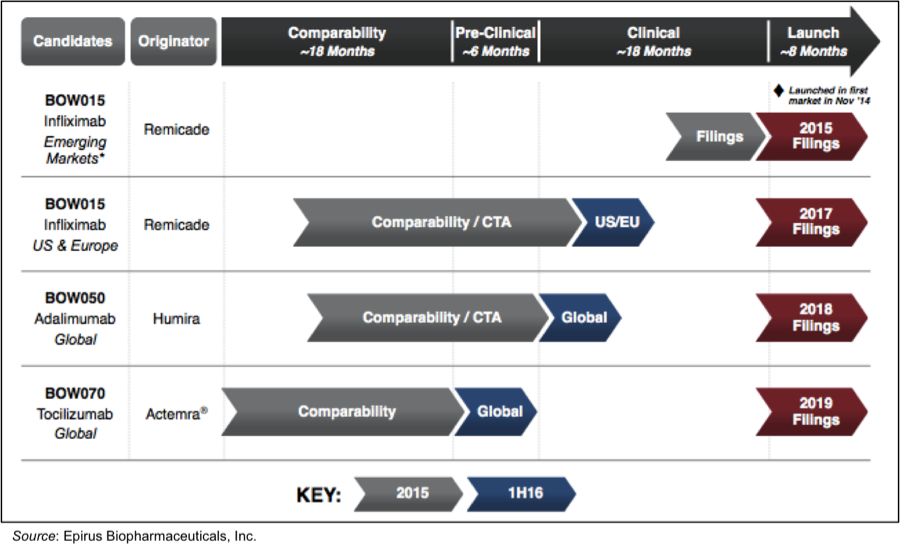
BOW015 launched in India under the name Infimab™ in December 2014, which was a full quarter ahead of schedule. Thus, we believe that the timelines shown above for each of the pipeline products are quite reasonable. Epirus is still planning on initiating a global Phase 3 clinical study in the fourth quarter of 2015 or first quarter of 2016 for BOW015 that will be used to support regulatory filings in the U.S. and E.U. in 2017. For BOW050, Epirus is planning to initiate clinical trials in the second half of 2016, which would most likely lead to a regulatory filing in 2018 and approval in 2019. BOW070 is still in the very early stages of development, thus we do not anticipate clinical trials to initiate until at least 2017, with regulatory filings in 2019 and approval in 2020.
Details of the Partnership Deal with PolPharma
The PolPharma Group is among the top 20 generic drug manufacturers in the world with sales of approximately $1 billion per year. The company’s portfolio consists of approximately 600 products, with an additional 200 products under development. Included in the portfolio are generic medications for RA patients, thus the company is quite familiar with the RA market. Over 7,000 individuals are employed by PolPharma, including over 1,700 sales people worldwide.
Epirus has previously stated the desire for a partnership in Europe that included retaining the rights to select countries in order to develop a direct commercialization footprint in the region. The partnership deal signed with PolPharma provides just such an arrangement, as the two companies will share in the development and commercialization costs for Epirus’ pipeline in a majority of the E.U., the Middle East, Turkey, and Russia in a 51% PolPharma/49% Epirus split. Epirus retains the rights to the pipeline products in Switzerland, Norway, Austria, Belgium, Denmark, Finland, Luxembourg, the Netherlands, and Sweden. Importantly, Epirus also retains the rights to North America and we expect the company to enter into an additional partnership for commercialization in that region.
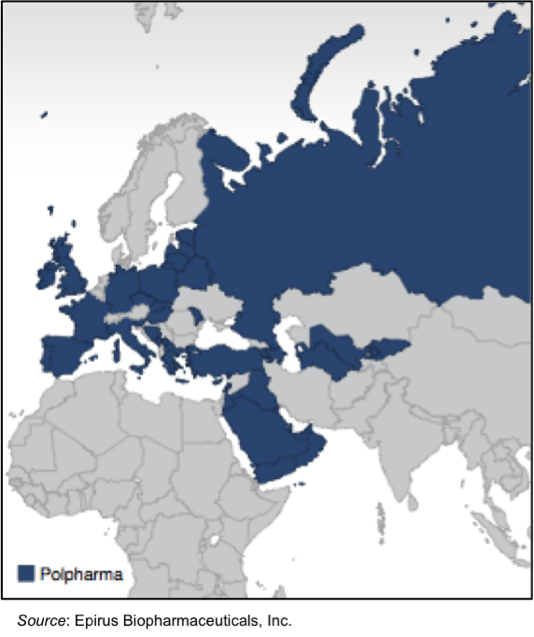
Epirus will lead the global product development and clinical programs and both companies will jointly fund clinical development and collaborate on regulatory filings in the specified territories. Epirus will also be responsible for process development, scale-up, and manufacturing, with Polpharma Group overseeing commercialization across the territories. All told, PolPharma is expected to contribute approximately $30 million toward clinical development costs as well as to cover product launch costs across all three programs. A joint management board will be established to oversee the collaboration.
Market Expansion is Still Key to the Epirus Strategy in Emerging Markets
The launch of Infimab™ in India was a significant milestone for Epirus as it exhibited the fact that the company is capable of working with commercialization partners to get a product to market as well as providing the company with a small amount of non-dilutive capital. It should also provide a real-world example of the potential for market expansion in emerging markets. Already the company has indicated that rheumatologists in India are quite open to prescribing a biosimilar for their patients, and commercial partner Sun Pharma (which acquired Ranbaxy in March 2015) intends to collect data on the prescribing patterns of physicians as well as the number of new patients that initiate RA biologic treatment for the first time with Infimab™.
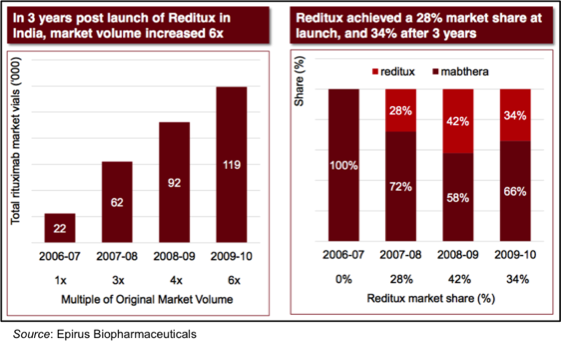
As we indicated in our Initiation Report, Epirus’ strategy in the accessible markets is predicated on market expansion. As an example of the potential for this, Reditux®, a non-comparable biologic version of rituximab, was launched in India in 2007. Following the launch, and a subsequent 40% drop in price, the market expanded 6-fold, with Reditux® taking 34% of the expanded market, as shown in the following figure. Reditux® was also launched by Ranbaxy. We intend to keep a close eye on the number of patients that Epirus is able to reach with Infimab™ to determine what effect the launch of Infimab™ is having on the number of treated patients in India.
Conclusion and Recommendation
We have been positive on Epirus’ story since we first initiated coverage in December 2014, and the announcement of the partnership with PolPharma is further proof of why we believe Epirus represents a compelling investment opportunity, particularly with the stock trading near $5. Since initiating coverage, two additional events have occurred that we believe significantly de-risk an investment in Epirus:
- The FDA approved the first biosimilar in the U.S. with Novartis’ Zarxio™. Zarxio™ was approved for all labeled indications of the reference product, Amgen’s Neupogen™. While we are still uncertain as to how the FDA will treat a monoclonal antibody such as BOW015 with a reference product that is approved for multiple disparate indications (in the case of Remicade™ it is approved for RA, ulcerative colitis, Crohn’s disease, psoriasis, psoriatic arthritis, and ankylosing spondylitis), the fact remains that: A) the approval of a biosimilar in the U.S. is significantly de-risked now that there is a clear regulatory pathway; and B) the possibility for a full label approval for BOW015 means that the market potential has increased substantially. This was clearly “better” news than we anticipated.
- Epirus raised a significant amount of money through a public offering, with gross proceeds to the company of approximately $52.8 million, and net proceeds of $48.2 million. The company reported $58.3 million in cash at the end of the second quarter of 2015. This money will be necessary to execute the next part of Epirus’ strategy, which is to initiate a global Phase 3 clinical trial of BOW015 in RA patients to support a regulatory filing in the U.S. and E.U. The company estimates that the trial will cost approximately $50 million. The partnership with PolPharma calls for a total of $30 million in support for clinical development costs and we believe that approximately $5 million of that money will be utilized to support the upcoming Phase 3 trial of BOW015.
Recently, we made adjustments to our discounted cash flow model based upon the partnership agreement between PolPharma and Epirus that calls for a 51/49 split of development costs and eventual operating profits in the named regions. These adjustments resulted in the net present value of BOW015 increasing to $259 million from $178 million with slight upward adjustments for BOW050 and BOW070. Based on these adjustments, we are maintaining our recently increased price target of $15 and are reiterating our ‘Buy’ rating.
READ THE LATEST FULL RESEARCH REPORT HERE
SUBSCRIBE TO ZACKS SMALL CAP RESEARCH to receive our articles and reports emailed directly to you each morning. Please visit our website for additional information on Zacks SCR and to view our disclaimer.