By Grant Zeng, CFA
OBB:SNGX
In February, 2015, Soligenix (OBB:SNGX) presented new preclinical study data that demonstrated the efficacy and safety of its heat-stabilized ricin toxin vaccine (RiVax™) in a non-human primate (NHP) lethal aerosolized ricin exposure model. The data was presented in a poster session at the American Society of Microbiology (ASM) Biodefense and Emerging Diseases Research meeting held in Washington, DC.
In the preclinical study, 12 animals were vaccinated with RiVax™ and 6 animals were given an injection of placebo. Each animal received 3 intramuscular injections, administered at time 0, 30 days and 60 days.
RiVax™ was well tolerated with no evidence of elevated heart rate, respiration or temperature. All RiVax™-vaccinated animals generated neutralizing antibodies after the third injection. To fully test the efficacy of the vaccine, all animals were exposed to an aerosol of ricin toxin 3-5 times the amount that is known to result in death of untreated animals. All RiVax™-vaccinated animals survived exposure, while all unvaccinated control animals died within 40 hours, demonstrating a statistically significant improvement in survival. Moreover, the lungs of the RiVax™-vaccinated animals did not demonstrate any signs of irreversible damage, unlike those of the unvaccinated control animals.
[endif]
RiVax™ is developed using the company’s proprietary ricin toxin vaccine, in conjunction with its heat stabilization technology, ThermoVax™, as a heat-stable biodefense vaccine.
Previous studies with RiVax™ have demonstrated significantly enhanced thermostability indicating that cold chain storage will potentially not be required for this vaccine, enabling it to be stored and distributed at room temperature.
This particular study is a critical step along the path of establishing efficacy under the FDA 'animal rule' which dictates that efficacy in animals must be ascertained in cases where a drug or vaccine cannot be ethically tested for efficacy in humans.
Soligenix plans to further conduct human safety and immunogenicity trials along with advanced manufacturing of RiVax.
The National Institute of Allergy and Infectious Diseases (NIAID) awarded grants to Soligenix for the development of the vaccine for potential counter terrorism measures. Currently, there are no approved methods to prevent the toxic effects of ricin poisoning which results in tissue necrosis, organ damage and death within days of exposure. If subsequent studies are successful, RiVaxTM could be added to the US Strategic National Stockpile and potentially dispensed if ricin is used as a biological weapon in a terrorist attack.
SGX943 and SGX101 may be a solution for Melioidosis
A recent news release from the US Centers for Disease Control and Prevention (CDC) on inquiry into melioidosis illness at Tulane National Research Center (TNPRC) has raised the visibility and awareness of melioidosis among healthcare professionals and the general public.
The ongoing inquiry was initiated in November 2014, when two non-human primates in the breeding colony at the TNPRC became ill and one was euthanized. The CDC has since identified Burkholderia Pseudomallei as the causative agent. Burkholderia Pseudomallei (Bps) is the bacteria which causes the illness of melioidosis.
Even more serious than the primate infection, during the investigation, one woman investigator fell ill with unspecific symptoms. Blood test results indicated a presence of antibodies in the blood indicating some exposure to Burkholderia Pseudomallei. At this point, it is still too early to determine whether exposure was related to this recent visit to the center or whether the sick individual’s travel history may have provided an opportunity for exposure.
Although the CDC indicated that at this time, there is no known public health threat, this event raises the concern about a possible outbreak of melioidosis in the US, which could be a threat to the public health.
Bps is also considered a top five priority in the most recent Public Health Emergency Medical Countermeasure Enterprise (PHEMCE) Strategy document. Therefore, in this article, I would like to revisit some background information about the this disease and review some treatment options under research, especially biotech company Soligenix (SNGX)’s programs, which may provide therapeutic solution to this disease.
The Background of Melioidosis
Melioidosis, sometimes called Whitmore's disease, is an infectious disease caused by the Gram-negative bacterium Burkholderia pseudomallei. Melioidosis can infect both humans and animals. It is endemic in parts of Southeast Asia and Northern Australia. The bacteria are often found in contaminated water and soil in the above regions and spread to humans and animals through inhalation, inoculation and direct contact with the contaminated source.
Melioidosis is of great public health importance in endemic areas. There are two forms of melioidosis: acute and chronic. Typical signs and symptoms may include pain in chest, bones, or joints; cough; skin infections, lung nodules and pneumonia. Once a melioidosis is diagnosed, the disease can be treated with the use of appropriate antibiotics.
The treatment of melioidosis is usually divided into two stages, an intravenous antibiotic therapy (high-intensity phase) for 10 to 14 days followed by a 3-6 months of oral antibiotic therapy (eradication phase) to prevent recurrence.
During the intravenous intensive phase, ceftazidime is the current drug of choice for treatment of acute melioidosis. Combination therapy with ceftazidime, meropenem and imipenem is also used for the acute treatment.
During the eradication phase, treatment with co-trimoxazole and doxycycline is recommended to be used for 12 to 20 weeks to reduce the rate of recurrence.
Current Challenges for Melioidosis Treatment
Treatment with the above antibiotics can reduce mortality rate to 10% for uncomplicated cases, but still up to 80% for cases with bacteraemia or severe sepsis while mortality rate could exceed 90% without appropriate treatment. This means that treatment with antibiotics is insufficient.
Also, very often, delayed treatment by antibiotics is ineffective.
Another major problem for antibiotic treatment of melioidosis is the resistance, especially for the long term treatment of melioidosis.
Currently there are no vaccines are approved for the prevention of melioidosis.
Considering the risk of potential outbreak and great threat as a biologic weapon, new prevention and/or treatment options must be developed for melioidosis.
Soligenix Has Two Distinctive Programs for Melioidosis: SGX943 and SGX101.
SGX943, which is being developed to treat infections and tissue damages, belongs to a new class of compounds called Innate Defense Regulators (IDRs).
SGX943 provide a novel approach to the control of infection and tissue damage via highly selective binding to an intracellular adaptor protein, sequestosome-1, also known as p62, which has a pivotal function in signal transduction during activation and control of the innate defense system. Sequestosome is a recently identified target for modulation of innate defenses and is expressed in most cell types.
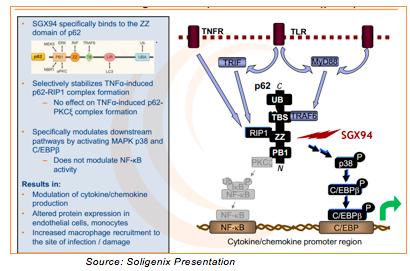
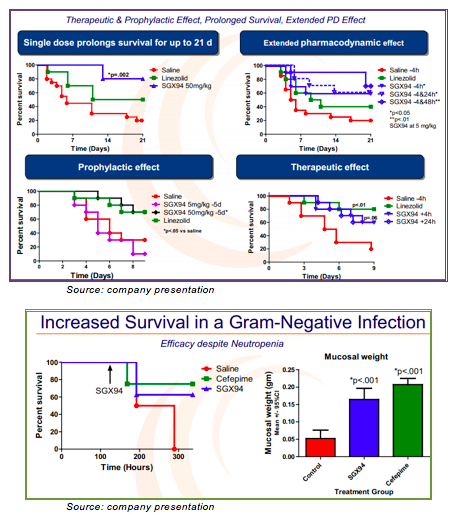
SGX943 has no direct antibiotic activity but modulate host responses, increasing survival after infections with a broad range of bacterial Gram-negative and Gram-positive pathogens including both antibiotic sensitive and resistant strains, as well as accelerating resolution of tissue damage following exposure to a variety of agents including bacterial pathogens, trauma and chemo- or radiation-therapy.
Since SGX943 targets the host (and not the pathogen), it does not engender resistance and are active against resistant pathogens. In vitro data indicate that the endothelium plays a significant role in SGX94 activity and animal studies show that SGX943 selectively promotes monocyte and macrophage recruitment to disease sites and accelerate resolution of disease.
In Feb 2015 at the ASM Biodefense and Emerging Infectious Diseases Meeting, Soligenix presented preclinical animal data showing that SGX943 is efficacious in Gram-positive methicillin resistant Staphylococcus aureus (MRSA) infection as well as with other Gram-negative pathogens infection.
Soligenix also presented preclinical animal data showing that SGX943, either alone or in combination with antibiotic Doxycycline, was effective to increase survival after Bps infection.
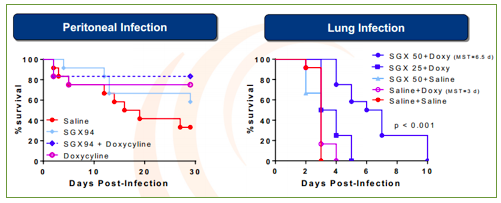
The company plans to optimize dosing regimens for SGX943 in combination with antibiotic for the intranasal pneumonic model and to demonstrate efficacy in aerosol model of infection including large animal model proof of concept. The route of delivery for biodefense applications will also be optimized this year including self-administered injection (IM/SC) or oral tablet. The company also plans to identify responding cell population/ biomarker to enable further dose optimization and facilitate the use of the Animal Rule. The Animal Rule provides that under certain circumstances, where it is unethical or not feasible to conduct human efficacy studies, the FDA may grant marketing approval based on adequate and well-controlled animal studies when the results of those studies establish that the drug is reasonably likely to produce clinical benefit in humans. Demonstration of the product's safety in humans is still required.
In addition to SGX943, Soligenix is also developing SGX101 for melioidosis. SGX101 is a monoclonal antibody (Mab) or monoclonal antibody cocktail developed by Soligenix with collaboration with Intrexon Corporation (XON) as a passive immunotherapy. Passive immunotherapy utilizes antibodies in the same manner a host-derived antibody would be used, targeting and labeling foreign entities and infected cells. SGX101 is intended as a human Mab therapy directed at host cells infected with Bp. SGX101 may also be utilized in conjunction with available antibiotic therapy.
Either SGX943 or SGX101, if successful, may be extended to other difficult to treat bacterial infections. In particular, the IDR approach could be directly translated to other infections. In the case of SGX101, the product would be specific to Bp and perhaps Bm infection but the process whereby the product was identified could be generalized to other difficult to treat infections with intracellular bacteria.
With these two distinctive anti-melioidosis programs, Soligenix is emerging as a key player in this specific field.
There is still Room for Further Price Appreciation
We maintain an Outperform rating for Soligenix and keep our 12-month price target of $5.50 per share. We believe there is still enough room for further price appreciation.
Soligenix becomes a late development stage biotech company through the acquisition of SGX301, a Phase III candidate for CTLC. Soligenix is focused on cancer/cancer supportive care and GI disorders, two large pharmaceutical markets both in the US and around the world. Soligenix also develops vaccines/oral therapeutics for biodefense.
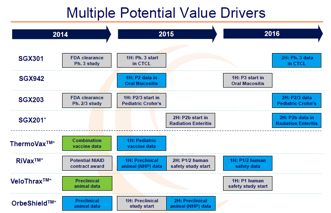
In addition to SGX301, Soligenix has built a diversified pipeline using three proprietary platform technologies: the SGX942 platform, the oral BDP platform and the ThermoVax platform. We are especially optimistic about its lead drug candidate SGX942 for the treatment of mucositis. SGX942 is currently under a Phase II study. Results will be available in 1H15, which, if positive, would be a significant de-risking event for Soligenix. SGX942 has a new mechanism of action and will command a significant market share of the oral mucositis market if approved in our view.
The Company’s oral BDP has the potential to target multiple GI disorders such as Crohn’s disease, radiation enteritis and GVHD as well as ARS.
Soligenix’s vaccines and biodefense therapeutics are being developed under specific FDA regulatory guidelines called the “Animal Rule.” We think the “Animal Rule” means a lot for Soligenix, because this can accelerate the development of the ricin and anthrax vaccines as well as OrbeShield. Once approved by the FDA, Soligenix will have the opportunity to negotiate a stock-pile contract with the US government. These stock-pile or procurement contracts have been very lucrative for other companies supplying similar drugs to the US government and will provide significant cash flow to Soligenix.
Based on our analysis, we think Soligenix shares are undervalued at current market price. Currently shares of Soligenix are trading at around $1.60 per share, which values the Company at $38 million in market cap based on 24 million outstanding shares. This deeply undervalues Soligenix shares in our view.
Our price target of $5.50 is arrived at by using 45 x P/E ratio, multiplied by an EPS of $0.30 in 2018, discounted at 25% for 4 years.
Most small biotech companies of development stage are valued from $50 million to $1 billion depending on how advanced the pipeline is and which indications the company is targeting. Soligenix has one Phase III candidate, two Phase II programs, and two more programs will move to Phase II/III study in 2015. Soligenix has multiple catalysts in the next 6 to 12 month or so.
Our price target of $5.50 per share values Soligenix at $132 million in market cap which we think is very conservative.
READ THE LATEST FULL RESEARCH REPORT HERE
SUBSCRIBE TO ZACKS SMALL CAP RESEARCH to receive our articles and reports emailed directly to you each morning. Please visit our website for additional information on Zacks SCR and to view our disclaimer.