By Brian Marckx, CFA
OTC:VIVMF
Q3 2015 Revenue Preannouncement: Revenue Jumps ~8x Over Q2 As Initial Roll-Out Gains Real Traction…
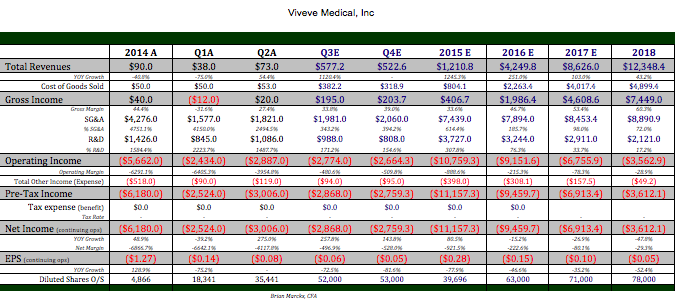
Viveve Medical (OTC:VIVMF) preannounced expected Q3 revenue which, at $580k, is almost 8 times that of the $73k generated in Q2. The 12 consoles sold in the quarter represent almost 60% of the total installed base of 21 units. The game plan remains to rapidly grow the installed base over at least the next 18 – 24 months with a major focus towards detailing to key opinion leaders, endorsements from which can have substantial influence on practitioners’ purchasing decisions. A growing installed base should be followed by multiplying leverage in the revenue model as Viveve benefits from steepening sales of higher margin treatment tips (i.e. – consumables). VIVMF sold 312 treatment tips in Q3 – using a crude, back-of-the-envelope calculation – this represents utilization of about 5 treatments per console per month (this will likely be somewhat variable due to, among other things, timing of sales versus usage). We note that this is well ahead of our forecasted 3 treatments per console per month.
Importantly, revenue is being driven by pull-through demand with little or no distributor stocking contributing to sales in the quarter. The $580k in revenue is well ahead of our estimated $145k – we were looking for just 4 consoles and 72 treatment tips being sold in the quarter. As we noted in our Q2 update, the underperformance of unit placements up to that point as compared to expectations prompted us to make significant downward revisions to our current year placement rates and consumables sales, and resultant revenue estimates (including moving Q3 revenue estimate down from $535k – which would have ended up being fairly close to actual). Given the big beat on the Q3 top-line, it appears we may have been too hasty in moving our estimates down and have again revised our model – this time moving revenue back up, although taking a somewhat cautious approach.
However, we think it is clear that the aggressive onboarding of third party distribution over the last several months, which most recently included partners for Turkey and Azerbaijan, expanding VIVMF’s reach to 45 countries (28 of which still require gaining regulatory approvals), is paying dividends and should bode well for further unit placement and revenue growth.
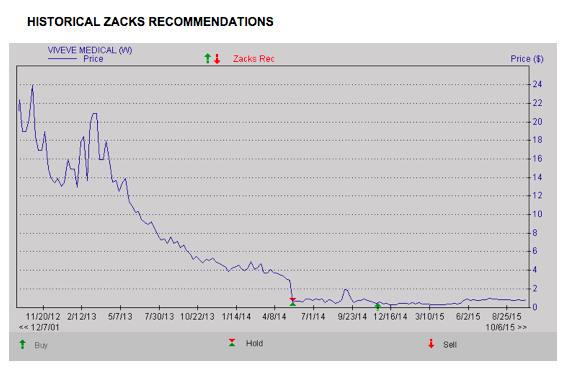
The upward revisions to our model following the Q3 revenue preannouncement have resulted in our per share valuation moving from $1.10 to $1.35. We are maintaining our Buy recommendation. See below for access to our Investor Note on VIVMF which includes our valuation methodology.
Valuation / Recommendation
We think it is relevant to look at Thermage, Inc.'s (Thermage was acquired by Valeant Pharmaceuticals in early 2014) ThermaCool system as a rough guide on which to base a forecast for the roll-out and economics of the Viveve System. The Viveve System is based on the same technology as the ThermaCool system, which launched in late 2002 for the treatment of wrinkles and skin tightening on the face and other parts of the body. The ThermaCool revenue model is also similar to that of the Viveve System - essentially to build a sufficient installed base of consoles which will then feed an ever-growing revenue stream of consumables. The consumables are also very similar and include a treatment tip, return pad, coolant and other small accessories.
The potential market size for skin tightening is many multiples larger than that for vaginal tightening. According to ISAPS there were 309k facelift procedures and 56k surgical vaginal rejuvenation procedures performed in 2011. Using these as rough proxies for the respective U.S. markets for non-invasive skin tightening and vaginal tightening, implies the former is 5x - 6x the size of the latter.
Another difference related to the end-user markets, which we account for in our financial projections, is that the availability of facial and body non-invasive skin tightening is almost certainly much more common knowledge than it is for non-invasive vaginal tightening. Also, while there is little embarrassment associated with inquiring about addressing facial wrinkles, uptake of cosmetic vaginal procedures has been hampered as a result. We think these differences will be reflected in a more moderate adoption curve of the Viveve System as compared to that of ThermaCool.
In addition to selling to a significantly larger target market, Thermage has had the benefit of a highly scaled distribution platform. Their distribution as of the end of 2006 (ThermaCool's fourth year on the market), the earliest period in which we were able to find this information, included sales through 29 distributors in 70 countries and a direct sales force in the U.S.
In the first full year on the market (i.e. - 2003) 587 ThermaCool consoles and 40k treatment tips (including the other consumables) were sold. Thermage notes in their filings that each treatment tip represents approximately one treated patient. Thermage averaged annual sales of over 500 consoles and almost 100k per-patient consumables during the first six years following ThermaCool launch and had an installed base of approximately 525k consoles at the end of that period (i.e. - 2008). Their total installed base at the end of 2012, which includes complementary products acquired since 2009, was approximately 9,300 units.

In terms of pricing and utilization, Thermage averaged approximately $30k per console and $300 of consumables per-patient during the first six years. Utilization per console averaged approximately 5x per month over the same period.

Our Financial Model Assumptions…
So while certain differences in Thermage's product, target market, competitive landscape and early distribution capabilities may not provide a specific template for what to expect with the roll-out of the Viveve System, we think it is a useful gauge, at least in terms of illustrating the potential demand for the technology (which is essentially the same), pricing and utilization in the respective end-user markets.
We currently model a unit placement rate of about four per month for the remainder of 2015 and estimate utilization at 2x – 3x per month.
Assuming positive clinical data from the OUS sham-controlled study in early 2016 and additional distribution reach, we think the placement rate will accelerate and model (perhaps conservatively) 90 units sold in 2016 with utilization ticking up to 3x per month.
Entry into the U.S. market could come in 2018 and, coupled with a greater marketing push, expanded OUS distribution and additional clinical data to support sales, we think it is reasonable that Viveve could increase the unit placement rate by approximately 15 - 20 consoles per year from 2016 to 2024. This results in a total installed base of almost 1,700 units after ten years on the market, which compares to ~9,300 units with Thermage's products over roughly the same period of time. Again we account for the much more moderate roll-out with the Viveve System and much smaller market as compared to Thermage. We also think that a reasonable case would be made that our forecasted unit placement rate is conservative, particularly given that competition in Thermage's target market is much more intense and widespread than that of Viveve's.
We model utilization to improve with greater awareness of the benefits of non-invasive vaginal tightening and, potentially with a generation of women that may feel less embarrassed about broaching the subject of vaginal laxity with their physician. Our modeled utilization improves from 2x - 3x per month to just over 5x per month at year 2024.
Relative to pricing, we again may be erring on the side of conservatism. While list price of the Viveve console is $60k and per-patient consumables are estimated to sell for approximately $600, we use initial pricing of $30k and $350, respectively. This more closely mirrors Thermage's legacy pricing over the first six years - although inflation and less competition in the vaginal tightening space may imply that these estimates are on the low end.
DCF Values VIVMF at $1.35/share
We use a 10-year DCF model to value VIVMF. Using the inputs discussed above, we have revenue growing from $1.2M in 2015 to $12.3M in 2018 and to approximately $71M in 2025 (for reference, Thermage's sales were $50M+ at second year after ThermaCool launch). We use estimated gross margins for both the consoles and consumables that are similar to those of ThermaCool.
Other key inputs to our DCF include a 10.5% discount rate and 2% terminal growth rate. Based on our DCF model, VIVMF is valued at approximately $1.35/share. This is adjusted from $1.10/share from our previous update as a result of the revenue beat expected in Q3 and related upward revisions to our forecasted revenue. Our outlook and financial estimates are subject to change based on progress with expansion of distribution, results of clinical trial data and regulatory approvals, among other events. We are maintaining our Buy recommendation.
READ THE LATEST FULL RESEARCH REPORT HERE
SUBSCRIBE TO ZACKS SMALL CAP RESEARCH to receive our articles and reports emailed directly to you each morning. Please visit our website for additional information on Zacks SCR and to view our disclaimer.