By Brian Marckx, CFA
NYSE:VNRX
Pancreatic Panel Shows 92% Sensitivity @ 90% Specificity: Study Published in Clinical Epigenetics. Pancreatic Cancer Panel May Be Next Product Introduction, Could It Become The New “Gold Standard”???….
This morning (Oct 12) VolitionRx (NYSE:VNRX) announced that results of their pancreatic cancer pilot study were published in the online version of Clinical Epigenetics. The study included 59 individuals; 25 with stage IIa or stage IIb pancreatic cancer (i.e. early-stage, operable cancers), 24 healthy subjects and 10 with other pancreatic non-cancer disorders (i.e. benign pancreatic disease). Blood samples were taken from patients prior to being treated at Skane University Hospital in Lund, Sweden. Healthy samples came from a local blood bank.
In January VNRX announced interim results which showed a five-assay NuQ panel correctly identified 21 of the 25 cancer cases (84% sensitivity) at a 90% specificity among the healthy subjects (i.e. - two false positives). This panel was also able to distinguish 18 of the pancreatic cancer cases from healthy individuals or those with other pancreatic non-cancer disorders with a 72% sensitivity at 90% specificity (three false positive results; one from healthy group and two from benign group).
As we noted in January, we characterized the interim results as highly encouraging given the impressive accuracy seen with the interim data. However, we are even more inspired with the results of the full data set which included, in addition to the initial five-assay panel, a four-NuQ assay panel in combination with a generic CA19-9 ELISA test. Carbohydrate antigen 19-9 (CA 19-9) is considered the current gold-standard diagnostic for pancreatic cancer testing and is used as a benchmark for comparing novel pancreatic cancer diagnostics. This is despite it not being particularly accurate – with reported sensitivity/specificity of 79%/82%.
But when four of the five NuQ assays in the original panel (the least incrementally additive assay was excluded) were combined with CA 19-9, VNRX was able to achieve higher accuracy as compared to both their initial five-assay panel as well as to CA 19-9. This four NuQ panel plus CA 19-9 achieved 92% sensitivity using a 90% specificity (identified 23 of 25 cancer cases) on discriminating cancer versus healthy subjects as well as versus healthy and benign subjects. This is significantly higher than CA 19-9 alone. The table below illustrates the superiority of the four NuQ panel plus CA 19-9 as compared to CA 19-9 alone, the four NuQ assay panel alone and the original five NuQ assay panel. In addition to the high accuracy of the four NuQ panel plus CA 19-9, it is also noteworthy that all of the three false positives were from the benign group, with none coming from the healthy group (i.e. – 100% specificity versus healthy group).
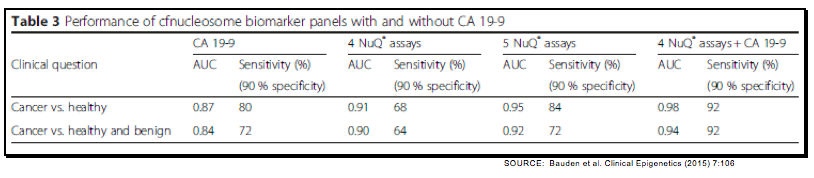
Despite CA 19-9’s high risk of false negative results and the American Society of Clinical Oncology discouraging its use, it remains the gold standard for diagnosis of pancreatic cancer. However, its main use has mostly been relegated to determine whether a tumor is secreting carbohydrate antigen 19-9 and to monitor the level following treatment. The results of this small pilot study suggest NuQ assays in combination with CA 19-9 could have more than high enough accuracy as a clinical pancreatic cancer diagnostic and would be the only test able to identify early stage pancreatic cancer with relatively very high sensitivity.
Diagnosis of pancreatic cancer is almost always a death sentence given that no tests currently on the market can reliably identify early-stage pancreatic cancer. Currently only about 6% of people diagnosed with pancreatic cancer survive five years or more. The USPSTF has a grade D recommendation on pancreatic cancer screening, recommending "against routine screening for pancreatic cancer in asymptomatic adults using abdominal palpitation, ultrasonography, or serological markers." The USPSTF notes that they "found no evidence that screening for pancreatic cancer is effective in reducing mortality. There is a potential for significant harm due to the very low prevalence of pancreatic cancer, limited accuracy of available screening tests, the invasive nature of diagnostic tests, and the poor outcomes of treatment. As a result, the USPSTF concluded that the harms of screening for pancreatic cancer exceed any potential benefits."
As such a test that could identify pancreatic cancer at an early stage may allow for more effective clinical intervention and vastly improve mortality rates. If VNRX can demonstrate similar results of this pilot study in larger trials, we think eventual FDA approval would be almost a given and believe it is reasonable that this panel could one day become the new gold standard for pancreatic cancer diagnosis. Importantly, CA 19-9 is a generic ELISA test so it is easily available with no intellectual property protection and, therefore, can be freely combined and commercialized in a VNRX panel.
Next steps likely include at least one more small clinical study which, assuming positive results, will be followed by one or more much larger (500+ subjects) studies. We expect to hear more about VNRX’s specific plans in the coming weeks or months but we think it is not unreasonable that larger, pivotal pancreatic cancer studies could be completed sometime next year. If results are confirmed, we expect pancreatic cancer will be VNRX’s second (after colorectal cancer) assay commercialized, which could potentially happen by late 2016 or 1H 2017. We note that we do not yet include contribution from a pancreatic cancer assay in our model (or our related valuation) but expect to do so if high accuracy of the panel is maintained over the course of additional clinical trials. And if it is, we expect this will provide another inflection point opportunity for the stock price.
READ THE LATEST FULL RESEARCH REPORT HERE
SUBSCRIBE TO ZACKS SMALL CAP RESEARCH to receive our articles and reports emailed directly to you each morning. Please visit our website for additional information on Zacks SCR and to view our disclaimer.