By Brian Marckx, CFA
NYSE:VNRX
First Assay Receives CE Mark, Launch of Initial Panel Still Expected in 2016:
This morning (Sept 22) VolitionRx (NYSE:VNRX) announced that their assay, dubbed NuQ X001S, received CE Marking. This is the company's first assay to receive the European regulatory stamp of approval. While this news was not unanticipated given that management had guided towards expectations that CE Mark of the initial assay(s) would come before current year-end, it is an important milestone nonetheless as this is another substantive step towards initial launch in Europe.
The game plan for initial commercial introduction continues to be that VNRX will launch a panel of assays - likely made up of 4 to 6 tests - following requisite CE Marking of those additional assays. The company recently acquired several Tecans (i.e. - robots) to accelerate analysis of the various studies that are ongoing in colorectal and other cancers - data from which continues to show the NuQ technology is demonstrating excellent sensitivity (including results announced earlier in September - discussed below). We expect a fairly regular flow of additional clinical data over the next several months, which should provide additional insight into the accuracy and potential utility (and demand) of the technology. VNRX is still guiding to launch the initial panel - for colorectal cancer - sometime in 2016.
Add'l Study Data Confirms High Accuracy of NuQ in Detection of Colon Cancer, Even at Early Stages:
Earlier this month (Sept 9) VNRX reported additional compelling data from their 4,800-patient retrospective colon cancer study. The presentation supports previous data that found the NuQ technology has better than 80% sensitivity at 78% specificity with high accuracy at all stages of the disease, including Stage I (i.e. earliest) - this further helps validate the competitiveness of the technology compared to already commercialized blood-based cancer tests. The most recent announcement, which came slightly earlier than expected (we had anticipated this coming sometime in October), provides additional significant support of the utility of the technology in identifying those patients with pre-cancer and cancer.
As a reminder, last year (Sept and Oct 2014) VNRX announced initial data on 938 patients from this 4,800-patient study which showed a three-test NuQ panel was able to detect 84% of colorectal cancers (60% of polyps) at 78% specificity (this prompted initiation of a stand-alone study for adenomas). Of the 59 colorectal cancer cases identified by colonoscopy, the NuQ panel was able to detect 50 (85%). Importantly the test showed high accuracy at all stages of cancer (table below from VNRX's PR). Given that colorectal cancer is more effectively treated and has a much higher survival rate if found early, the ability of a diagnostic to detect the disease at the earliest stages is critical to maximize chances for patient long-term survival.
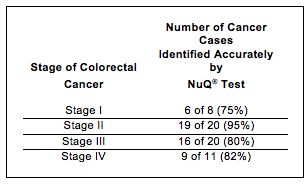
In addition to high accuracy, the NuQ panel was able to differentiate between types of cancer - something that the technology had also demonstrated in the past. Of the 59 colorectal cancers presented last October, 35 were colon and 24 rectal - and the NuQ panel was able to differentiate between the majority of colorectal cancers as being either colon or rectal cancers.
The data announced about two weeks ago further supports the high accuracy of the technology. While last year's data was from a three assay panel on the first 938 patients, the most recent data (table below) was from a four test panel and included the entire 4,800 sample base. The data showed 81% sensitivity at 78% specificity and importantly, this level of accuracy was consistent with all stages of cancer (i.e. - the high accuracy and utility of the test is not stage-dependent). Furthermore, the panel detected 63% of polyps (slightly higher than the 938-sample set), including 67% of high risk adenomas. The high accuracy, particularly with early stage and pre-cancers, is particularly impressive and should almost certainly provide a very formidable competitive profile against other blood-based tests, such as Epigneomics' Epi proColon.
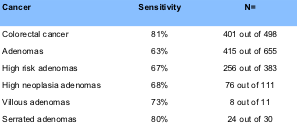
And while we think this level of accuracy is more than good enough to have utility as a cancer diagnostic and draw commercial demand (as a gauge Epigneomics' Epi proColon showed sensitivity of 79% and specificity of 68% in its pivotal trial versus FIT), accuracy of the NuQ panel could improve even further. VNRX can run as many as 20 different assays per sample and expects to analyze this 4,800 set with as many as 11 assays - data from which VNRX expects to announce in Q1 2016. As each assay has the potential to provide additional information, combining additional assays into the panel could improve overall accuracy. Once the optimal combination is found, VNRX will then use that as its initial panel to bring to market (expected to be a panel of 4 to 6 assays).
Additional data from this retrospective study as well as other studies, including the 14k prospective colon cancer study (initial data on 2,500 samples expected early 2016) and dedicated 800-patient pre-cancerous colorectal study, will provide even more insight into the potential for NuQ in colon cancer. And, as reminder, the technology is being studied in other cancers including (dedicated studies for) lung, ovarian and pancreatic and is in a 4,200-patient study assessing NuQ in 27 of the most prevalent cancers.
We are maintaining our Buy recommendation and $6.50/price target. We think additional and ongoing positive clinical data, including the near-term release of results from the retrospective and prospective colorectal cancer studies, should further benefit appreciation of the share price towards our target.
READ THE LATEST FULL RESEARCH REPORT HERE
SUBSCRIBE TO ZACKS SMALL CAP RESEARCH to receive our articles and reports emailed directly to you each morning. Please visit our website for additional information on Zacks SCR and to view our disclaimer.