By Brian Marckx, CFA
NYSE:VNRX
Q3 Results:
VNRX (NYSE:VNRX) announced financial results for the third quarter ending Sept 30 and provided an operational update. As the company remains in the (late) development stage there continues to be no revenue. Q3 OpEx jumped fairly considerably from Q2. The majority of the $400k+ q-o-q increase in G&A relates to higher stock-based compensation while the ~$500k jump in R&D is from trial-related expenses including the purchase of antibodies and other supplies and ingredients for assay production. We think OpEx will continue to be somewhat variable going forward, which in the near-term may be highly influenced activities related to the various European clinical studies.
OpEx was $3.0 million, compared to our $2.2 million estimate. Net income and EPS were ($2.9) million and ($0.16), compared to our ($2.2) million and ($0.12) estimates.
Cash used in operating activities was $2.5 million for the quarter and $6.7 million through the first nine months. We expect this to increase going forward with the ramp-up in ongoing studies, the recent commencement of others, regulatory submission activities and pre-launch (Europe) preparations. VNRX exited Q3 with $6.9 million in cash. We expect a capital raise will be in the cards in the next several months – an assumption which had already been incorporated into our model and valuation.
Operational Update: Update on timelines for readout of retro & prosp studies, pancreatic looks very promising..
Some prior timelines for the various near-term study readouts have slipped slightly but management is still guiding for the initial colorectal panel to launch sometime next year. Importantly, VNRX hit several significant milestones since they reported Q2 earnings including the first CE Mark of a colorectal cancer assay, grant of a key U.S. patent, release of additional promising data from the retrospective study and very compelling data in pancreatic cancer – so compelling was the data (which included a publication) in fact that VNRX now expects pancreatic cancer to be the second commercialized indication following colorectal.
Add’l Colorectal Data:
Hvidore Retrospective: in Sept VNRX reported additional positive interim data. The presentation supports earlier data that found the NuQ technology has better than 80% sensitivity at 78% specificity with high accuracy at all stages of the disease, including Stage I (i.e. earliest) – we discuss more fully below. While VNRX had previously guided for full data from 4,800-patient retrospective colorectal cancer study to be released in Q4 of this year, comments on the Q3 call indicate this might be pushed back to Q1 or Q2 of next year. The full data will be run with ten or more assays – which will help to narrow towards an initial panel consisting of ~4 – 6 assays.
Hvidore Prospective: the timeline for release of the initial data from the 14,000 sample prospective colorectal cancer study may have also slipped a bit – VNRX had hoped this to be a Q1 2016 event – which may still hold, although it sounds as this may be more likely to happen in Q2. 2,500 samples have already been run and VNRX will finish another 2,500. Initial data announcement may include the first batch or both, depending on timing of analysis. Expect analysis to speed up once retro study is fully sampled as add’l Tecans can be dedicated to this study
Pre-Cancerous Colorectal Study: a subset of the 938-patient data from the retrospective study which was announced last year included patients with precancerous lesions, or adenomas. NuQ was able to detect 60% of these lesions. This prompted VNRX to initiate an 800-patient study, which will also be conducted at Hvidore Hospital, for the detection of precancerous polyps. VNRX will likely include additional assays in this study in order to try and further improve on accuracy. The study commenced in Q2. Timelines for look at the first data is uncertain but potentially by current year-end or early 2016. Results could provide a better indication of the power of NuQ for adenomas, which if left untreated or removed, can eventually become cancerous. The current thinking is that an adenoma assay/panel could be layered into a colorectal cancer assay or as a stand-alone product. As precancerous polyps have proven difficult to detect, relatively high accuracy in this indication could be a meaningful differentiator compared to other colon cancer tests such as Cologuard and Epi proColon. Epi proColon (Epigenomics) showed sensitivity of just 20% with small polyps and Cologuard 42% with precancerous lesions
27-Cancers Study: VNRX had previously announced the initiation of an expected 4,000 sample study looking at the 20 most prevalent cancers at the U of Bonn. More recently the company announced that this has now been expanded to include 4,200 samples and 27 of the most prevalent cancers. Two of the four Tecans are dedicated to this study. VNRX had previously said that they hoped to have the first of the data may be available in Q1 of next year, although that timeline may have slipped some. Nonetheless, the study has the potential to produce an enormous amount of data given the number of assays that may be included as well as the diverse sample set. It is still a question mark as to how the output will applied, although if the data supports it, a home-run would be eventual development of an assay/panel that could detect and differentiate between several cancer types
CE Mark / European Commercialization: NuQ X001S is the first assay to receive CE Mark, which happened in September. Despite some delay in expected release of data from the Hvidore studies, VNRX continues to expect that the initial panel will be approved and launch sometime in 2016. The gameplan is to develop an initial assay around the early data from the 4,800-sample colorectal cancer study. Additional data will shape decision-making on follow-on assays – the initial panel may include four to six assays
Follow-ons…: VNRX will then look to strengthen both the clinical support for their technology as well as the performance. Follow-on data from the two large Hvidore studies should provide support for both – as noted, additional data should be available fairly quickly. The data should help drive development of new and higher performing assays on a regular basis and, combined into panels, can further enhance performance, providing opportunity for the next iteration of CE Marked products. Providers and payers are also interested in seeing as much data as possible to make informed use and reimbursement decisions – so a regular flow of positive trial data will be key to maximizing initial chances of success in the marketplace
Commercialization: VNRX does not expect to launch into Europe until they have more supporting data and the full panel CE Marked – which they think can happen in 2016 – we think it’s more likely a 2H event than in 1H. They recently brought on two consulting firms to guide the European commercialization strategy which includes advice on market selection, reimbursement expectations, distribution, etc.
More follow-ons…: with the plethora of data expected to come out of the various studies, VNRX hopes to further enhance the performance of their tests and bring further iterations of cancer panels through CE Marking. Clearly the initial focus is colorectal cancer but pancreatic, lung and others could potentially follow in short-order. And possibly, eventually a multi-cancer panel
Pancreatic now looks like it will be the second indication.
Our Comments: Epigenomics has had a tough go of it in Europe with their IVD Epi proColon colon cancer blood test. While the test has been available since 2012 product revenue from Europe amounted to roughly $1 million in all of 2014. They cite a difficult reimbursement environment and high barriers to get into the government level screening programs. Part of the difficulty is most likely pricing - as Cameron noted on the Q2 call, the government programs are tight-fisted and to be competitive pricing needs to be near the EUR 20 – 30 range (~$20 - $30). And if Epigenomics can’t or won’t come in near there, then it is reasonable they may not qualify. VNRX indicated that they believe they can meet that price point and maintain reasonable margins. They brought on the two consulting firms (one focused on the U.K. and the other the rest of Europe) to help navigate the intricacies and difficulties – one potentially major one being reimbursement – of the European market. VNRX may also have an advantage in accuracy – the data to-date has suggested NuQ may have superior accuracy as compared to the 79% sensitivity / 68% specificity Epi proColon demonstrated in their PMA-supporting studies. As more data is announced, it should provide greater insight.
We think it is reasonable to expect revenue from Europe will not be overly significant in the first year of launch, particularly if initial commercialization does not happen until late in the year. This could improve with further penetration throughout Europe and also depend on reimbursement and inclusion in government screening programs.
U.S. Pathway: initial U.S. introduction is expected to be in the form of licensing rights to the technology to CLIA certified labs to develop LDT tests. Concurrent with that VNRX would work to bring an FDA approved test to market. This is a similar strategy that Epigenomics has followed with their Epi proColon technology.
VNRX has brought on another consultant to guide them in their U.S. plans. Timelines include LDT licensing sometime in 2016. Relative to the FDA approval process – VNRX’s hopes to support a PMA filing with data from the ongoing studies (prospective and retrospective most likely) and then potentially supplement that with a “bridging” study – essentially additional samples from more ethnicities to more represent the broader U.S. population. This, however, is not yet definitive and something that we expect we will hear more about as more info is available. Timelines for an eventual FDA approved product are highly uncertain right now as there still needs to be clarification from FDA on what they will require to support a filing. And, of course, then the data will have to be good enough to support approval. We think a very optimistic scenario would be that VNRX may soon have much of the data they may eventually need (from the Danish studies) and be able to supplement with a quick-moving bridge study – and maybe file sometime in 2H 2016 with approval by 1H 2017. A more realistic scenario might be to expect typical FDA-related delays (in study design feedback, data review, approval decisions, etc), possibly a 6 – 12 month bridging study and a PMA filing maybe sometime in mid-to-late 2017 and approval in 2018. But, again, we expect we’ll hear more when VNRX knows more which will hopefully provide some more clarity about potential timelines. Key to maximize the revenue potential of the technology will be to successfully bring an FDA approved product to market.
Our Comments: while LDT’s offer the opportunity to get the tests into the market, generate earlier revenue and build some front-end awareness about the technology (although the tests will likely be marketed under another brand), they may hold only a fraction of the revenue potential that a PMA approved product would. Marketing claims are much more restrictive with LDT’s and availability, depending on the labs’ reach (and marketing efforts), may also be less broad based than an FDA approved product. Licensing means VNRX may have little to control over how much effort the labs dedicate to marketing the tests. Epigenomics licenses their technology to Quest and ARUP in the U.S. and generates ~$200k (or less) in annual sales royalties – the reason they cite for the meager sales is the labs are waiting for the FDA approved kits. But it may also be that these large labs will not dedicate much in the way of marketing support.
VNRX, wisely in our opinion, brought in outside expertise to guide the LDT process (along with FDA pathway). Lab selection (i.e. – those that may be more likely to dedicate resources towards it) may be part of this as well as seeking areas where reimbursement may be more favorable.
OVERVIEW of ONGOING / PLANNED STUDIES:
Pancreatic Panel Shows 92% Sensitivity @ 90% Specificity: Study Published in Clinical Epigenetics. Pancreatic Cancer Panel May Be Next Product Introduction, Could It Become The New “Gold Standard”???….
In mid-October VNRX announced that results of their pancreatic cancer pilot study were published in the online version of Clinical Epigenetics. The study included 59 individuals; 25 with stage IIa or stage IIb pancreatic cancer (i.e. early-stage, operable cancers), 24 healthy subjects and 10 with other pancreatic non-cancer disorders (i.e. benign pancreatic disease). Blood samples were taken from patients prior to being treated at Skane University Hospital in Lund, Sweden. Healthy samples came from a local blood bank.
In January VNRX announced interim results which showed a five-assay NuQ panel correctly identified 21 of the 25 cancer cases (84% sensitivity) at a 90% specificity among the healthy subjects (i.e. - two false positives). This panel was also able to distinguish 18 of the pancreatic cancer cases from healthy individuals or those with other pancreatic non-cancer disorders with a 72% sensitivity at 90% specificity (three false positive results; one from healthy group and two from benign group).
As we noted in January, we characterized the interim results as highly encouraging given the impressive accuracy seen with the interim data. However, we are even more inspired with the results of the full data set which included, in addition to the initial five-assay panel, a four-NuQ assay panel in combination with a generic CA19-9 ELISA test. Carbohydrate antigen 19-9 (CA 19-9) is considered the current gold-standard diagnostic for pancreatic cancer testing and is used as a benchmark for comparing novel pancreatic cancer diagnostics. This is despite it not being particularly accurate – with reported sensitivity/specificity of 79%/82%.
But when four of the five NuQ assays in the original panel (the least incrementally additive assay was excluded) were combined with CA 19-9, VNRX was able to achieve higher accuracy as compared to both their initial five-assay panel as well as to CA 19-9. This four NuQ panel plus CA 19-9 achieved 92% sensitivity using a 90% specificity (identified 23 of 25 cancer cases) on discriminating cancer versus healthy subjects as well as versus healthy and benign subjects. This is significantly higher than CA 19-9 alone. The table below illustrates the superiority of the four NuQ panel plus CA 19-9 as compared to CA 19-9 alone, the four NuQ assay panel alone and the original five NuQ assay panel. In addition to the high accuracy of the four NuQ panel plus CA 19-9, it is also noteworthy that all of the three false positives were from the benign group, with none coming from the healthy group (i.e. – 100% specificity versus healthy group).
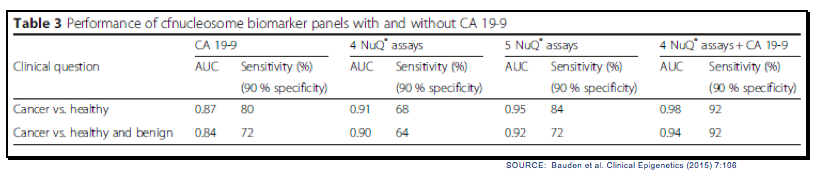
Despite CA 19-9’s high risk of false negative results and the American Society of Clinical Oncology discouraging its use, it remains the gold standard for diagnosis of pancreatic cancer. However, its main use has mostly been relegated to determine whether a tumor is secreting carbohydrate antigen 19-9 and to monitor the level following treatment. The results of this small pilot study suggest NuQ assays in combination with CA 19-9 could have more than high enough accuracy as a clinical pancreatic cancer diagnostic and would be the only test able to identify early stage pancreatic cancer with relatively very high sensitivity.
And additional data, from a separate study, further supported the findings of high accuracy of NuQ in detection of pancreatic cancer. Later in October VNRX announced that NuQ was able to correctly detect 19 of 20 (95% sensitivity) pancreatic cancers with an 84% specificity in patients from their 4,800-sample retrospective colorectal cancer study (while it is a colorectal cancer study, it also picked up patients with other cancers, including 20 with pancreatic cancer). Two NuQ assays along with carcino-embryonic antigen (CEA) test were used in the analysis.
Diagnosis of pancreatic cancer is almost always a death sentence given that no tests currently on the market can reliably identify early-stage pancreatic cancer. Currently only about 6% of people diagnosed with pancreatic cancer survive five years or more. The USPSTF has a grade D recommendation on pancreatic cancer screening, recommending "against routine screening for pancreatic cancer in asymptomatic adults using abdominal palpitation, ultrasonography, or serological markers." The USPSTF notes that they "found no evidence that screening for pancreatic cancer is effective in reducing mortality. There is a potential for significant harm due to the very low prevalence of pancreatic cancer, limited accuracy of available screening tests, the invasive nature of diagnostic tests, and the poor outcomes of treatment. As a result, the USPSTF concluded that the harms of screening for pancreatic cancer exceed any potential benefits."
As such a test that could identify pancreatic cancer at an early stage may allow for more effective clinical intervention and vastly improve mortality rates. If VNRX can demonstrate similar results of this pilot study in larger trials, we think eventual FDA approval would be almost a given and believe it is reasonable that this panel could one day become the new gold standard for pancreatic cancer diagnosis. Importantly, CA 19-9 is a generic ELISA test so it is easily available with no intellectual property protection and, therefore, can be freely combined and commercialized in a VNRX panel.
Next steps may include one or more small clinical studies or potentially going straight to one or more much larger (500+ subjects) studies. We expect to hear more about VNRX’s specific plans in the coming weeks or months but we think it is not unreasonable that larger, pivotal pancreatic cancer studies could be completed sometime next year. If results are confirmed, we expect pancreatic cancer will be VNRX’s second (after colorectal cancer) assay commercialized, which could potentially happen by late 2016 or 1H 2017. We note that we do not yet include contribution from a pancreatic cancer assay in our model (or our related valuation) but expect to do so if high accuracy of the panel is maintained over the course of additional clinical trials. And if it is, we expect this will provide another inflection point opportunity for the stock price.
New Trial in Ovarian Cancer
VolitionRx recently initiated its first study in ovarian cancer. This is also VNRX’s first study focused solely on an Asian population and the first study that will analyze both blood and tissue. The small pilot study is expected to include blood and tissue samples from 40 patients (20 with cancer, 20 healthy) and is being done in collaboration with Singapore General Hospital. Researchers will be blinded to the samples which will be analyzed with the NuQ assays. Success with the pilot study would likely mean that VNRX will move to larger ovarian cancer studies.
Lung Cancer Study Initiated
Adding to the now fairly long laundry list of cancer studies is a lung cancer study which VNRX announced in December 2014 was in the planning phase. This follows positive data from a pilot study, announced in November of that year. 46 individuals were included in the pilot study, including 21 with non-small cell lung cancer, 12 with COPD and 13 healthy subjects. Both sputum and blood samples were tested. With sputum, NuQ was able to detect 18 of the 21 (85%) lung cancer cases with no false positives for healthy individuals. In addition, NuQ was able to differentiate between lung cancer and COPD.
With blood samples, NuQ identified 76% (16 of 21) patients with lung cancer with only one false positive (1 of 13) of a healthy individual. With blood, NuQ was also able to differentiate between lung cancer and COPD. While this was just a small pilot study, VNRX hopes to confirm the results in a larger trial, which will be performed at the University Hospital of Bonn.
Multi-Cancer Study
U of Bonn is also conducting VNRX’s large 4,200-patient prospective cancer study (includes 27 of the most prevalent cancers at various disease stages) – this lung cancer study will be run as a separate trial in conjunction with the 27-cancer study. Only blood (not sputum) will be used in this confirmatory lung cancer study. Approximately 600 blood samples (~ 400 lung cancer patients, ~100 benign lung disease patients, ~100 healthy patients) will be evaluated in the lung cancer study.
The first of the data from this multi-cancer study may be available in Q1 of next year. The study has the potential to produce an enormous amount of data given the number of assays that may be included as well as the diverse sample set. Two of the four Tecans will be dedicated to the study analysis. It is still a question mark as to how the output will applied, although if the data supports it, a home-run would be eventual development of an assay/panel that could detect and differentiate between several cancer types.
Hvidore Colorectal Cancer Studies: Add'l Study Data Confirms High Accuracy of NuQ in Detection of Colon Cancer, Even at Early Stages
In September VNRX reported additional compelling data from their 4,800-patient retrospective colon cancer study. The presentation supports earlier data that found the NuQ technology has better than 80% sensitivity at 78% specificity with high accuracy at all stages of the disease, including Stage I (i.e. earliest) - this further helps validate the competitiveness of the technology compared to already commercialized blood-based cancer tests. The September announcement provides additional significant support of the utility of the technology in identifying those patients with pre-cancer and cancer.
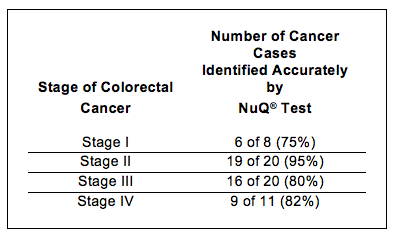
As a reminder, last year (Sept and Oct 2014) VNRX announced initial data on 938 patients from this 4,800-patient study which showed a three-test NuQ panel was able to detect 84% of colorectal cancers (60% of polyps) at 78% specificity (this prompted initiation of a stand-alone study for adenomas). Of the 59 colorectal cancer cases identified by colonoscopy, the NuQ panel was able to detect 50 (85%). Importantly the test showed high accuracy at all stages of cancer (table below from VNRX's PR). Given that colorectal cancer is more effectively treated and has a much higher survival rate if found early, the ability of a diagnostic to detect the disease at the earliest stages is critical to maximize chances for patient long-term survival.
In addition to high accuracy, the NuQ panel was able to differentiate between types of cancer - something that the technology had also demonstrated in the past. Of the 59 colorectal cancers presented last October, 35 were colon and 24 rectal - and the NuQ panel was able to differentiate between the majority of colorectal cancers as being either colon or rectal cancers.
The most recent data further supports the high accuracy of the technology. While last year's data was from a three assay panel on the first 938 patients, the data announced in September 2015 was from a four test panel and included the entire 4,800 sample base. The data showed 81% sensitivity at 78% specificity and importantly, this level of accuracy was consistent with all stages of cancer (i.e. - the high accuracy and utility of the test is not stage-dependent). Furthermore, the panel detected 63% of polyps (slightly higher than the 938-sample set), including 67% of high risk adenomas. The high accuracy, particularly with early stage and pre-cancers, is particularly impressive and should almost certainly provide a very formidable competitive profile against other blood-based tests, such as Epigneomics' Epi proColon.
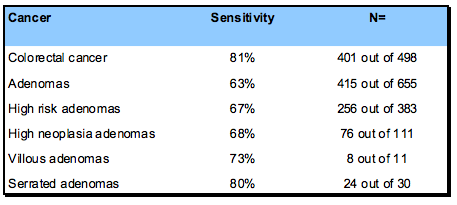
And while we think this level of accuracy is more than good enough to have utility as a cancer diagnostic and draw commercial demand (as a gauge Epigneomics' Epi proColon showed sensitivity of 79% and specificity of 68% in its pivotal trial versus FIT), accuracy of the NuQ panel could improve even further. VNRX can run as many as 20 different assays per sample and expects to analyze this 4,800 set with as many as 11 assays - data from which VNRX expects to announce in 1H 2016. As each assay has the potential to provide additional information, combining additional assays into the panel could improve overall accuracy. Once the optimal combination is found, VNRX will then use that as its initial panel to bring to market (expected to be a panel of 4 to 6 assays).
Additional data from this retrospective study as well as other studies, including the 14k prospective colon cancer study (initial data on 2,500 samples expected 1H 2016) and dedicated 800-patient pre-cancerous colorectal study, will provide even more insight into the potential for NuQ in colon cancer.
Pre-Cancerous Colorectal Study
A subset of the 938-patient data from the retrospective study which was announced last year included patients with precancerous lesions, or adenomas. NuQ was able to detect 60% of these lesions. This prompted VNRX to initiate an 800-patient study, which will also be conducted at Hvidore Hospital, for the detection of precancerous polyps. VNRX will likely include additional assays in this study in order to try and further improve on accuracy. The study commenced in Q2 2015. Timelines for look at the first data is uncertain but potentially by current year-end or early 2016. Results could provide a better indication of the power of NuQ for adenomas, which if left untreated or removed, can eventually become cancerous. The current thinking is that an adenoma assay/panel could be layered into a colorectal cancer assay or as a stand-alone product. As precancerous polyps have proven difficult to detect, relatively high accuracy in this indication could be a meaningful differentiator compared to other colon cancer tests such as Cologuard and Epi proColon. Epi proColon (Epigenomics) showed sensitivity of just 20% with small polyps and Cologuard 42% with precancerous lesions.
VNRX Looking at Prostate Cancer
VNRX continues to expand the potential indications for its NuQ technology and in early October 2014 announced a collaboration with the high profile MD Anderson Cancer Center at the University of Texas to study the company's technology in the detection of prostate cancer. The retrospective study will assess the NuQ technology in differentiating between anaplastic prostate cancer, a very aggressive form, and castration-resistant prostate cancer, a less aggressive form. The ability to differentiate between the two is important in clinical practice as it can dictate the most appropriate treatment regimen.
OUTLOOK / VALUATION / RECOMMENDATION
We continue to model launch in Europe in 2H 2016. With studies ongoing in several other cancer types, including pancreatic and breast, among several others, subsequent CE Marking in other cancers could potentially come in fairly short order – as noted, we think pancreatic could emerge as a very formidable indication if larger studies confirm the early highly encouraging data. We also expect VNRX will look to continually enhance the performance of their commercialized panels. Ongoing study data will also be used to support reimbursement.
Relative to the U.S. market, we think VNRX’s current game-plan – that is, to initially tap the LDT channel via licensing agreement(s) with established CLIA lab(s), makes a lot of sense. Not only is this an earlier revenue opportunity in the U.S. as the company continues to pursue FDA approval, it also provides additional and valuable clinical experience and awareness benefits.
In terms of the road towards eventual FDA approval – which is the ultimate quest and one which we think could rapidly steepen VNRX’s revenue curve – this could be a years-long process and require U.S.-based clinical studies. If, however, FDA discussions reveal that a bridge study complementing data from already ongoing studies is sufficient, it’s possible the PMA pathway could be more abbreviated.
In terms of the accuracy hurdle that a PMA filing may have to clear - one yardstick that may be relevant to look at is that an FDA advisory panel recently recommended PMA approval of Epigneomics' Epi proColon colorectal cancer test which in a pivotal trial versus FIT showed sensitivity of 79% and specificity of 68%. This compares to VNRX's interim data (n = 938) from the Danish retrospective study, which showed the three-panel NuQ tests were able to detect 84% of colorectal cancers (60% of polyps) at 78% specificity. Epi proColon has also shown relatively low sensitivity (20%) in precancerous polyps – which is another potential indication that NuQ could demonstrate superior accuracy.
Valuation Remains Attractive…
Based on our DCF model which goes out to year 2025 and uses a 9.5% discount rate (based on CAPM) and 2% terminal growth rate, VNRX is valued at $6.28/share (which we round to $6.50). Our model and assumptions will be updated if appropriate based on news flow which could also influence valuation. We will be eagerly awaiting additional clinical data in several cancers which, assuming positive, could prompt upward revisions to our modeled revenue and related valuation. For example, as we noted, we have yet to model any contribution from a potential pancreatic cancer panel but will likely do so if high accuracy of the diagnostic is maintained in subsequent studies.
As it is now, we value VNRX at $6.50/share. We feel the current market price ($3.75) remains cheaper than warranted and undervalues the company. We recommend accumulating the stock up towards our $6.50 price target. We think additional and ongoing positive clinical data, including the near-term release of results from the retrospective and prospective colorectal cancer studies, should further benefit appreciation of the share price towards our target. We are maintaining our Buy rating.
See below for access to our updated report on VNRX.
READ THE LATEST FULL RESEARCH REPORT HERE
SUBSCRIBE TO ZACKS SMALL CAP RESEARCH to receive our articles and reports emailed directly to you each morning. Please visit our website for additional information on Zacks SCR and to view our disclaimer.