By Grant Zeng, CFA
NYSE:CANF
We are upgrading Can-Fite Biopharma Ltd. (NYSE:CANF) shares to Buy from previous Neutral. Our new 12-month price target is $7.50 per share. Our call is based on the multiple achievements the company has made in the past 6 months and the compelling valuation.
For those who are not familiar with Can-Fite, the company is a biopharmaceutical company focused on the development of orally available small molecule therapeutic products for the treatment of autoimmune-inflammatory, oncological, and ophthalmic diseases. The company has three lead candidate products: CF101, CF102, and CF602.
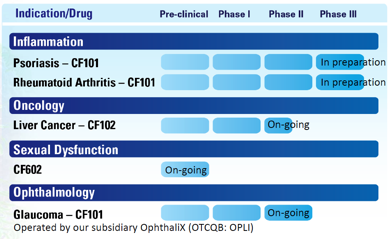
Can-Fite is developing CF101 for rheumatoid arthritis (RA), psoriasis and glaucoma. The company recently completed a Phase IIb study of CF101 for the treatment of RA and will be initiating a Phase III clinical trial in RA later in 2015. A Phase II/III trial of CF101 for psoriasis was also completed recently and the company plans to move forward with a Phase III trial in 2016. A Phase II trial of CF101 for the treatment of glaucoma is ongoing.
Can-Fite is currently evaluating CF102 in a Phase II study in hepatocellular carcinoma (HCC) patients. CF602 is in pre-clinical development as a treatment for sexual dysfunction.
All of the company’s products target the A3 Adenosine Receptor (A3AR), which is overexpressed in a number of cancer cells as well as the peripheral blood mononuclear cells (PBMCs) of patients with various inflammatory conditions including rheumatoid arthritis, psoriasis, and Crohn’s disease. However, the A3AR is expressed in very low levels in normal tissue, thus making it a compelling target for pharmaceutical intervention as the receptor affects pathological and normal cells differently. While specific A3AR agonists, such as CF101 and CF102, and allosteric modulators, such as CF602, appear to inhibit growth and induce apoptosis of cancer and inflammatory cells, normal cells are refractory, or unresponsive to the effects of these drugs. To date, the A3AR agonists have had a positive safety profile as a result of this differential effect.
Strong Balance Sheet
As of June 30, 2015, Can-Fite had cash and cash equivalents of $7.75 million.
In September, 2015, the company closed a registered direct offering with institutional investors for gross proceeds of $9 million. In connection with the offering, the Company issued 2,068,966 registered American Depository Shares (ADSs) of Can-Fite at a purchase price of $4.35 per ADS in a registered direct offering. Additionally, for each ADS purchased by investors, the investors received an unregistered warrant to purchase one-half of an ADS. The warrants have an exercise price of $5.25 per ADS, shall be exercisable six months following the issuance date and will expire five and one-half years from the issuance date.
Further in October, 2015, the same institutional investors who participated in September’s round have invested again in Can-Fite's registered direct offering. This time, Can-Fite will issue 1,109,196 registered American Depository Shares (ADSs) of Can-Fite at a purchase price of $4.35 per ADS in a registered direct offering. Additionally, for each ADS purchased by investors, the investors will receive an unregistered warrant to purchase 40% of an ADS. The warrants have an exercise price of $5.25 per ADS, shall be exercisable six months following the issuance date and will expire five and one-half years from the issuance date. Can-Fite received gross proceeds of approximately $4.8 million.
These two new financings not only boost Can-Fite’s balance sheet immediately, but further validate its technology and clinical programs.
Current cash at hand can carry the company’s operations into mid-2017 according to our financial model.
Attractive Valuation
Can-Fite is a late stage development biopharmaceutical company focused on the development of orally available small molecule therapeutic products for the treatment of autoimmune-inflammatory, oncological, and ophthalmic diseases. The company has three lead candidates in each category: CF101 for autoimmune disease (RA and Psoriasis), CF102 for liver cancer, and CF602 for glaucoma.
The most advanced candidate is CF101. Can-Fite has completed a couple of Phase II studies of CF101 for RA with the most recent one achieving statistically significance based on the A3AR expression level as enrollment criteria. The company plans to initiate a Phase III trial of CF101 for RA late this year using the same enrollment criteria.
For psoriasis, Can-Fite also completed a Phase II and a Phase II/III study of CF101. The Phase II study achieved statistically significant results, but the Phase II/III failed its initial primary endpoint (PASI75 in 12 weeks). However, further analysis indicated that CF101 achieved multiple statistically significant results (PASI50, 75, 90, 100 in 32 weeks). We think the cumulative and linear improvement in CF101's efficacy over a longer period of time is a very significant finding for Can-Fite and the psoriasis treatment market. Based on the new data and the favorable safe profile, Can-Fite intends to continue the development of CF101 for the treatment of psoriasis and has initiated work on the design of the next advanced–stage clinical trial protocol.
We are especially encouraged by the fact that CF101 has the potential as a first-line systemic therapy for patients with moderate-severe psoriasis and for patients who do not want to be treated with the current systemic drugs due to safety issues. Currently there is no universally accepted first-line systemic therapy for patients diagnosed with psoriasis, and therefore CF101, an orally bioavailable drug with an excellent safety profile can be positioned for this unmet need.
For CF102, Can-Fite is conducting a global Phase II trial as a second line treatment for advanced HCC in subjects with Child-Pugh B cirrhosis who failed Nexavar (sorafenib) as a first line treatment. Top line data from this Phase II trial are expected to be available in mid-2016. Can-Fite’s strategy to test CF102 in HCC patients who are Child-Pugh B and have failed sorafenib is very risky, however it is warranted based on the positive preclinical data and Phase I/II data showing the drug to be both safe and effective in that cohort. The reward could be immense if the strategy pays off, as there is no current treatment option for advanced liver cancer patients.
Can Fite is also developing CF101 for glaucoma with a Phase II trial ongoing.
The big change since our previous report comes from the company’s Phase II/III trial of CF101 for psoriasis. Initial results failed the primary endpoint (PASI75 in 12 weeks). However, further analysis of the data indicated that CF101 achieved multiple positive results including PASI50, 75, 90, and 100 in 32 weeks. Moreover, the PASI 90 subset analysis further suggests a higher and significant (p=0.026) CF101 response rate of 26.9% among patients previously untreated with systemic psoriasis therapy compared to patients pre-treated with systemic drugs. Based on the new data, we believe CF101 has the increased probability to succeed in the newly planned advanced Phase III trial which will begin in early 2016.
Based on the new updates, we think current market price does not reflect the intrinsic value of Can-Fite anymore.
For RA, we estimate the company will initiate the Phase III trial in late 2015, file an NDA in 2017, and receive approval in late 2018 or early 2019. For psoriasis, we estimate the company will initiate the Phase III trial in early 2016, file an NDA in late 2017 or early 2018, and get approval in late 2018 or early 2019.
For CF102, we estimate that upon completion of the Phase II trial a Phase III trial will be initiated in 2017, with an NDA filing in 2019 and approval in 2020. There is a very slim chance that the data from the Phase II trial will be good enough to request approval, however we do not see this as likely enough to include in our model.
Based on our long term financial model, Can-Fite will achieve profitability in 2010 with earnings of $0.77 per ADS based on total revenue of $85 million. We believe a P/E multiple of 35 x is appropriate for the valuation of the company. Based on this relative valuation metric, we come up with a new price target of $7.5 per ADS using 25% discount rate for 5 years. Our price target values the company at $105 million based on 14 million ADS outstanding. This is still conservative in our view.
But keep in mind the risks. Our valuation assumes the final approval of the company’s three lead clinical programs including RA, psoriasis and liver cancer. Any clinical/regulatory failure or delay will have a significant negative impact on the company’s shares. Cash burn is also on our close watch list. As the company moves its clinical programs into advanced stage, R&D expenses will soar. Current cash balance can only last into 2017. The company will need to tap the capital market for further financing before it become cash flow positive in 2020. Any equity related financing will dilute existing shareholder base and will have negative impact on share price. But overall, the company has a favorable risk/award profile for investors with a long term investment horizon.
READ THE LATEST FULL RESEARCH REPORT HERE
SUBSCRIBE TO ZACKS SMALL CAP RESEARCH to receive our articles and reports emailed directly to you each morning. Please visit our website for additional information on Zacks SCR and to view our disclaimer.