By Brian Marckx, CFA
NASDAQ:AEMD
Fiscal Q3 2016 Financials, Operational Update
Aethlon Medical (NASDAQ:AEMD) reported financial results for their third quarter 2016 and provided an operational update. Financial results were largely in-line with our numbers with revenue coming in very close to our forecast and operating expense somewhat lower than our estimate. Most of the beat on OpEx we attribute to anticipated versus actual timing of rate of enrollment in the two small U.S.-based clinical studies as well as rolling off of some costs in the ESI segment. We have made only minor changes to our model following Q3 results, with the majority of our near-term revenue coming from the remainder of the DARPA contract and operating expense estimates reflecting anticipation of accelerating activity in the U.S. HCV and cancer studies as well as some incremental spend on more recent endeavors in both the Hemopurifier-related and ESI segments.
Successes on the operational front over the last few months have included acceptance of the manuscript of the DETECT (Diagnosing and Evaluating Traumatic Encephalopathy Using Clinical Tests) study, finalizing training of investigators conducting the U.S. feasibility study, additional clinical experience with the TauSome CTE assay including use in a new NIH-funded study, approval to conduct an Indian-based study with Hemopurifier in Dengue virus and validation of Hemopurifier in the in vitro capture of Chikungunya virus.
Q3 revenue was $301k, compared to our $332k estimate, and consisted of $297k of DARPA grants ($297k estimate) and $4k ($35k estimate) from the Battelle subcontract. The DARPA revenue relates to the 27th milestone – see our Appendix for the description. In September 2015 AEMD announced that they were awarded year 5 of the DARPA contract which is the final year and will pay up to $581k if all the requisite milestones are met.
Q3 OpEx was $1.4M, about 9% lower than our $1.5M estimate – the difference which we attribute to longer than expected draw out of enrollment for the two U.S. clinical studies. Management indicated on the call that enrollment in the HCV study, with the principal and two sub-principal investigators now fully trained, should begin to accelerate. We continue to expect operating expenses to trend higher as a result of increased clinical trial activities related to the U.S. HCV and cancer studies. And with other new irons in the fire, including potentially broadening the targets that Hemopurifier may have utility for – particularly additional pandemic and bioterror threats and latent viral pathogens, we could see some other incremental spend. These are investments that could expand the scope of applications for Hemopurifier and, if fully validated, will almost certainly increase shareholder value of AEMD.
Net loss and EPS were $1.2M and ($0.16), compared to our $1.3M and ($0.17) estimates. AEMD exited the quarter with $3.3M in cash, down from $4.2M at the end of Q2. Management expects the cash balance to be sufficient to fund operations through the end of fiscal 2016 (ending 3/31/2016) and into the beginning fiscal 2017.
Operational Update:
CTE: As a reminder, Aethlon’s majority-owned subsidiary Exosome Sciences (ESI) has collaborated with Boston University’s CTE Center for the development of a blood-based diagnostic that would be able to identify CTE in living individuals. ESI has used what they learned in how to isolate certain brain-specific biomarkers to evaluate blood samples collected by participants (former NFL players and a control group) enrolled in BU's DETECT study. In April 2015 investigators presented initial findings of DETECT at the annual Traumatic Brain Injury Conference held in Washington, DC. Results were from 78 former NFL players and 16 controls and showed that the NFL players had significantly higher levels of tausome (tau) in their blood than those of the controls. Tau levels were also correlated to performance on memory tests, with higher tau levels corresponding to poorer test performance. The study is the first on CTE funded by the NIH. Aethlon submitted a manuscript of the study in 2015 and announced with Q3 earnings (2/4/16) that it had been accepted for publication. On the Q3 call management noted that there is extensive data related to their CTE diagnostic (TauSome) in the manuscript, particularly in two categories; the ability to monitor TauSome levels in former NFL players compared to control (i.e. known healthy subjects) and correlation of TauSome levels with cognitive decline.
Cancer: A potential application in cancer received arguably additional support in an article titled, "Extracellular Vesicles: Emerging Target for Cancer Therapy" published in the April 2014 issue of the journal, Trends in Molecular Medicine. The article, written by researchers at Harvard Medical School, Massachusetts General Hospital and University of Oxford explores evidence that extracellular vesicles (i.e. - exosomes) play a key role in cancer development and progression and suppression of immune response. As such, extracellular vesicles (EVs) have increasingly become targets for anticancer therapy. This coincides with AEMD's cancer research and how Hemopurifier, via the removal of circulating cancer-secreted exosomes, could have utility in the treatment of cancer.
The authors also believe that EVs may also increase the body's resistance to cancer drugs and hinder their effectiveness. They further note that, while early evidence suggests that inhibition of EV biogenesis may have beneficial effects in the treatment of cancer, that a challenge has been to find therapies that can specifically target cancer related EVs without affecting normal cell function. The researchers specifically reference Hemopurifier as a potential therapy to overcome these challenges, noting that with the use of Hemopurifier "it might be possible to specifically capture tumour cell-derived EVs on an antibody-coated matrix during extracorporeal dialysis. For example, in human epidermal growth factor receptor-2 (HER-2) overexpressing breast cancer, where HER-2-expressing EVs have been shown to interfere with therapy and are associated with tumour aggressiveness, anti-HER-2 antibodies could be used to remove HER-2-expressing EVs from circulation with the aim of improving therapeutic outcome. In principal, this approach could be tailored for other tumour types, as long as the tumour cell-derived EVs are enriched for tumour-specific proteins. However, whether the level and duration of EV depletion after ADAPT (i.e. - Hemopurifier) therapy would be sufficient to achieve a clinically relevant outcome remains to be determined."
The authors note that their current understanding of EVs role in cancer development and progression is still in the relatively early stages and is based on data from in vitro experiments. Their acknowledgement of Hemopurifier as potentially having utility in the treatment of cancer is also largely based on the supposition that removal of circulating EVs may be beneficial in interrupting the development and spread of tumors - which is still just a theory at this point. Nonetheless, we think this research does add meaningful credibility to Hemopurifier's potential role in cancer suppression and adds additional support to AEMD's research which indicates the same.
Cancer Study Update: As a reminder, in April 2015 AMED announced that they entered an agreement with UC, Irvine to conduct an investigator-initiated study with various cancer types including breast, colorectal lung, head and neck and others. Targeted enrollment is five patients in each of nine cancer types (45 patients total) including breast adenocarcinoma, colorectal, gastric and gastroesophageal, pancreatic, cholangiocarcinoma, lung, head and neck, melanoma and ovarian adenocarcinoma. The proposed study protocol, Plasma Exosome Concentration in Cancer Patients Undergoing Treatment”, will monitor changes in circulating exosome levels and their association with cancer treatment and response to treatment. In May 2015 AEMD announced that UC, Irvine Medical Center approved an IRB to commence the study. AEMD noted on the Q2 call that this study has commenced and has now enrolled three patients so far. No specifics on enrollment were provided on the Q3 call but clearly enrollment has not been particularly fast moving.
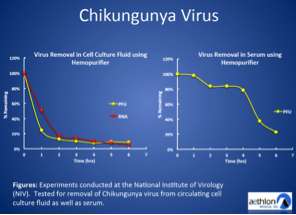
Infectious Diseases: AEMD has recently made a more dedicated efforts towards advancing additional collaborations for Hemopurifier in cancer and infectious diseases. As a reminder, Hemopurifier has shown potential utility in HCV, HIV, Ebola, other pandemic diseases, bioterror applications, cancer and other areas. AEMD is clearly focused on deepening and broadening the potential applications that their device may have utility for. In June 2015 the company announced an agreement with the India’s National Institute of Virology to commence testing of Hemopurifier for treatment of Chikungunya. On the Q3 call (2/3/16) AEMD announced that NIV has validated the rapid capture (charts below) of Chikungunya virus in vitro with small scale versions of Hemopurifier.
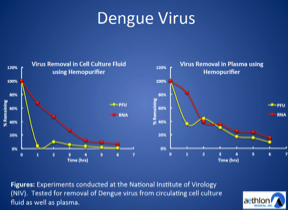
Dengue: AEMD received IRB approval from MAX Healthcare to conduct a clinical treatment study with Hemopurifier in individuals infected with Dengue virus at MAX Super Specialty Hospital in India. Hemopurifier, in in vitro studies conducted by NIV (India) has shown ability remove Dengue virus
On the Q2 call AEMD announced that they initiated a research project with the National Center for Biodefense and Infectious Diseases to investigate the use of Hemopurifier in Venezuelan equine encephalitis. AEMD has had a relationship with the National Center for Biodefense and Infectious Diseases for over ten years and this latest announcement appears to be further progress towards working with the center for applications of AEMD’s technology in addressing biological threats.
U.S. Feasibility Study: In 2015 Dr. Ronal Ralph was brought on as the new principal investigator. AEMD since brought on two sub-principal investigators and announced on the Q3 call that all three have now been trained and indicated enrollment should now accelerate. Progression of the study has been drawn out longer than initially anticipated – but the hope is that now enrollment will proceed.
As a reminder, this is a safety study being conducted at DaVita Medical Center Dialysis in Houston with target enrollment of 10 HCV-infected patients who are already undergoing dialysis. Patients will receive Hemopurifier treatment three times per week for two weeks. This is primarily a safety study but secondary outcomes including quantity of captured viral copies and change in viral load will also be measured. Results which were initially expected to be used solely for support of FDA approval to conduct larger pivotal studies in HCV as well as potentially other diseases such as HIV and cancer, are now expected to be used to move into clinical studies for other viruses and pandemic threats.
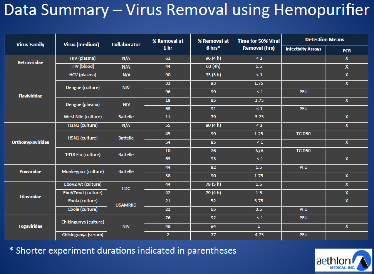
Once this HCV feasibility study is completed, and assuming positive results, this is expected to form the basis to move into U.S.-based studies for potential end-use type indications in areas such as latent viral pathogens and pandemic type diseases. Zika virus has recently become a significant concern, not only in areas where it is traditionally found such as S. America and equatorial regions of Africa and Asia, but now also in parts of the U.S. The World Health Organization just declared the Zika virus outbreak an international public health emergency. Zika is one of the pandemic-type threats that could be on a short-list of targets for Hemopurifier. The device has already been validated in in clinical studies in a number of targets including Ebola, HIV and HCV and in vitro studies in Chikungunya, Dengue virus, multiple strengths of Ebola virus, H1N1 swine flu, H5N1 bird flu virus, the reconstructed Spanish flu of 1918 virus and West Nile virus. Zika could be next and clinical studies in the U.S. in some of these targets or others could be on the horizon in the near-term. And, given the severity of these viruses and lack of effective treatments, it is conceivable Hemopurifier could a fast-track candidate. This is something we expect to hear more about from AEMD in upcoming conference calls.
Aethlon ADAPT
In early November 2015 the company announced a new initiative at the IN3 Medical Device 360 Summit Conference in San Francisco called Aethlon ADAPT. ADAPT, is an acronym for the company’s technology and stands for Adaptive Dialysis-like Affinity Platform Technology. The Aethlon ADAPT initiative is focused on partnering with organizations in development of other affinity bio-filtration devices to address other diseases, which is a program that will run parallel to AEMD’s individual efforts. We view this as a way to de-risk (at least from a financial standpoint) and, potentially accelerate, development of their technology in a broader spectrum of diseases and applications.
See below for access to our coverage of AEMD.
READ THE LATEST FULL RESEARCH REPORT HERE
SUBSCRIBE TO ZACKS SMALL CAP RESEARCH to receive our articles and reports emailed directly to you each morning. Please visit our website for additional information on Zacks SCR and to view our disclaimer.