By Brian Marckx, CFA
NASDAQ:AEMD
U.S. Feasibility Study Progressing
In 2015 Dr. Ronal Ralph was brought on as the new principal investigator. Aethlon (NASDAQ:AEMD) since brought on two sub-principal investigators. While progression of the study has been drawn out longer than initially anticipated, in late March AEMD announced that a patient had completed a six-treatment protocol of Hemopurifier therapy. Then in early May the company announced that a second patient completed the treatment protocol and third has been enrolled and commenced treatment. AEMD also noted that they have a cGMP manufacturing system operational which is manufacturing Hemopurifier devices for this study.
As a reminder, this is a safety study being conducted at DaVita Medical Center Dialysis in Houston with target enrollment of 10 HCV-infected patients who are already undergoing dialysis. Patients will receive Hemopurifier treatment three times per week for two weeks. This is primarily a safety study but secondary outcomes including quantity of captured viral copies and change in viral load will also be measured. Results which were initially expected to be used solely for support of FDA approval to conduct larger pivotal studies in HCV as well as potentially other diseases such as HIV and cancer, are now expected to be used to move into clinical studies for other viruses and pandemic threats.
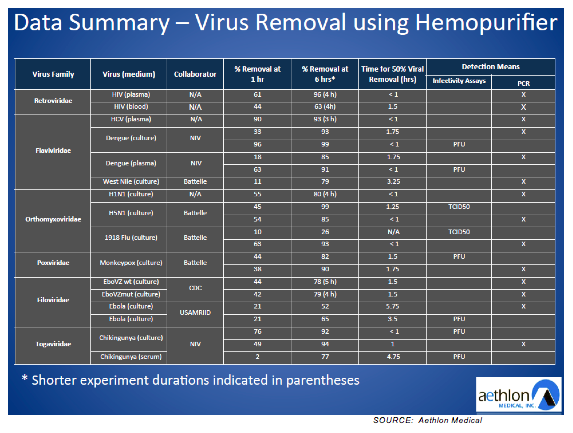
Once this HCV feasibility study is completed, and assuming positive results, this is expected to form the basis to move into U.S.-based studies for potential end-use type indications in areas such as latent viral pathogens and pandemic type diseases. Zika virus has recently become a significant concern, not only in areas where it is traditionally found such as S. America and equatorial regions of Africa and Asia, but now also in parts of the U.S. The World Health Organization just declared the Zika virus outbreak an international public health emergency. Zika is one of the pandemic-type threats that could be on a short-list of targets for Hemopurifier. The device has already been validated in in clinical studies in a number of targets including Ebola, HIV and HCV and in vitro studies in Chikungunya, Dengue virus, multiple strengths of Ebola virus, H1N1 swine flu, H5N1 bird flu virus, the reconstructed Spanish flu of 1918 virus and West Nile virus. Zika could be next and clinical studies in the U.S. in some of these targets or others could be on the horizon in the near-term. And, given the severity of these viruses and lack of effective treatments, it is conceivable Hemopurifier could a fast-track candidate. This is something we expect to hear more about from AEMD in upcoming conference calls.
ESI Broadens Access to ELLSA Platform
Following compelling initial results of the CTE study (detailed below) as well as in identifying HIV via isolation of urinary exosomes and subsequent analysis, AEMD announced that they will begin production of their ELLSA diagnostic platform and look to collaborate with other institutions interested in pursuing diagnostics related to disease-specific exosomes.
CTE Study Published Online in Journal of Alzheimer’s Disease
As a reminder, Aethlon’s majority-owned subsidiary Exosome Sciences (ESI) has collaborated with Boston University’s CTE Center for the development of a blood-based diagnostic that would be able to identify CTE in living individuals. ESI has used what they learned in how to isolate certain brain-specific biomarkers to evaluate blood/plasma samples collected by participants (former NFL players and a control group) enrolled in BU's DETECT study. The study is the first on CTE funded by the NIH.
In April 2015 investigators presented initial findings of DETECT at the annual Traumatic Brain Injury Conference held in Washington, DC. Results were from 78 former NFL players and 16 controls and showed that the NFL players had significantly higher levels of tausome (tau) in their blood/plasma than those of the controls. Tau levels were also correlated to performance on cognition tests, with higher tau levels corresponding to poorer test performance.
Aethlon submitted a manuscript of the study in 2015, which was published in the online version of the Journal of Alzheimer’s Disease earlier this month. Inclusion criteria for the NFL group included age 40-69, a minimum of 12 years of tackle football including a minimum of 2 years in NFL at position associated with extensive head impacts and a self-report of having symptoms associated with CTE including changes in cognition, behavior and mood. Inclusion criteria for control included male age 40-69, minimum of 4 years in non-contact sports including 2 at college level or higher.
The publication provided additional details of the results which included (all charts and graphics[if !supportFootnotes][1][endif]);
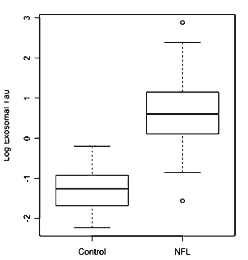
- Total plasma exosomes did not differ between the NFL and control groups and NFL did have significantly higher (p<0.0001) plasma exosomal tau (results in figure below are unadjusted for age)
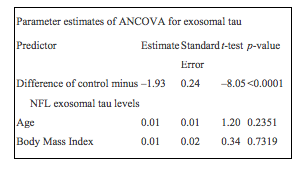
- Plasma exosome levels were still statistically significantly higher (p<0.0001) in the NFL group than in control after adjusting for age and body mass (BMI)
- The diagnostic demonstrated 82% sensitivity with 100% specificity, 100% positive predictive value and 53% negative predictive value. In other words, all of the elevated tau results came from NFL players, although not all NFL players showed elevated tau levels
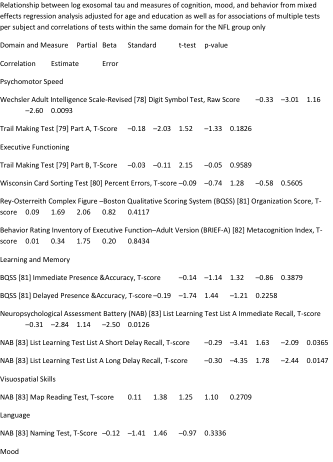
- In the NFL cohort, tau levels were statistically significantly inversely correlated to performance on cognition tests (Wechsler Adult Intelligence Scale Digital Symbol and Neuropsychological Assessment Battery List Learning)
- While exosomal tau was statistically correlated to cognition, it was not correlated to any of the mood or behavioral measures
Key Takeaways:
- ESI’s CTE diagnostic demonstrated
- exosome tau was significantly higher in NFL players than in control
- exosome tau was significantly correlated to performance on cognition tests. Higher levels of tau correlated to poorer test performance on memory and psychomotor speed tests
- Exosome tau was not correlated to mood or behavior measures
- Highest levels of tau were found only in NFL players although not all NFL players had high levels of tau
- Confirmation that the diagnostic can accurately identify individuals with CTE would require neuropathological examination of the brain
Relative to the lack of association between tau levels and mood/behavior test results, the investigators noted that there is evidence suggesting tau is a better indicator of cognitive function than it is of mood/behavior and that CTE-related cognitive functionality impairments have been reported to be more prevalent in later stage of the disease as compared to mood/behavior changes. In addition, they note “It is possible that the mood and behavioral features may have multiple potential etiologies, in addition to CTE-associated tau degeneration, whereas the cognitive changes are more consistently due to the tau degeneration.”
Relative to the fact that not all NFL players had high levels of tau – the investigators indicated that this was not a surprise as it should be expected that not all NFL players, even those in the study (i.e. – which have at least some symptoms), would have CTE.
While the investigators concluded that these findings suggest exosomal tau in plasma may be an accurate biomarker for CTE, additional research needs to be done. They note some limitations of the study including that;
- confirmation of association between exosome tau and CTE would require a neuropathological exam
- the study did not include markers for where the tau originated so there was not complete confidence that these were all brain-derived exosomes (tau is also present in other areas of the body besides the brain)
- and if these were brain-derived exosomes, the study was also not powered to differentiate between where in the brain they came from (i.e. – neuronal vs, non-neuronal, which may have implications)
- small sample size of the study (particularly control)
- lack of an additional biomarker for CTE
Additional research is moving forward which includes a new $16M NIH funded study focused on detecting and diagnosing CTE in living individuals which ESI and their CTE diagnostic is part of. This and other studies should provide additional data points and provide more insight into the potential future utility of the diagnostic for CTE – and potentially other conditions such as Alzheimer’s disease.
READ THE FULL RESEARCH REPORT HERE
SUBSCRIBE TO ZACKS SMALL CAP RESEARCH to receive our articles and reports emailed directly to you each morning. Please visit our website for additional information on Zacks SCR and to view our disclaimer.