David Bautz, PhD
NYSE:APHB
Business Update
AmpliPhi Biosciences Corp. (NYSE:APHB) is developing bacteriophage therapeutics for the treatment of bacterial infections. The company’s pipeline consists of treatments that specifically target infections caused by
Staphylococcus aureus (AB-SA01),
Pseudomonas aeruginosa (AB-PA01), and
Clostridium difficile (AB-CD01). AmpliPhi has recently announced a number of updates for both AB-SA01 and AB-CD01, which are summarized below.
Bacteriophages
Bacteriophages are viruses that infect, replicate in, and kill bacterial cells while not harming eukaryotic cells. This exclusivity is vital to their use in combating infectious diseases, and their unique mechanism of action compared to traditional antibiotics means they can be used in place of or in conjunction with those therapies.
While bacteriophages have been known for over 100 years, up until now their use as anti-infectious agents has been restricted to limited geographic regions (mainly Eastern Europe and Russia). This is due to the rise of antibiotics during the middle part of the 20th century that proved to be cheap, plentiful, and effective therapeutics. However, the rise of antibiotic resistant organisms has resulted in a clear need for alternative treatment options, specifically for ones that no longer respond to once effective antibiotic therapies.
Bacteriophage therapies potentially hold a number of advantages over antibiotics, including:
- Multiple modes of application
- Less severe side effects
- Localized and highly specific effect
- Very low doses
- Can treat antibiotic-resistant strains
- Unique mechanism of action makes resistance less likely
AB-SA01 Update
AB-SA01 is being developed for the treatment of
Staphylococcus aureus infections, including methicillin-resistant
S. aureus (MRSA) infections. It contains three phage constituents that target greater than 96.7% of
S. aureus isolates from a global diversity panel.
AB-SA01 in Chronic Rhinosinusitis.
On November 19, 2015, AmpliPhi announced a clinical trial research agreement has been entered into with the University of Adelaide for the purpose of conducting a Phase 1 clinical trial of AB-SA01. The study is titled “A Phase 1 Investigator Initiated Study to Evaluate the Safety, Tolerability and Preliminary Effectiveness of AB-SA01 in Patients with Chronic Rhinosinusitis Associated with Staphylococcus aureus infection”.
The trial is being conducted at the Queen Elizabeth Hospital, Adelaide, Australia and AmpliPhi is supplying the bacteriophage drug product for the clinical study. In addition, AmpliPhi is providing scientific input, protocol recommendation, and assisting the study’s principal investigator with data management support. The trial is expected to enroll nine patients who suffer from chronic rhinosinusitis (CRS) and are also positive for S. aureus by nasal swab. Since this is a Phase 1 study, the primary endpoint is safety, however the company will also be collecting anecdotal evidence about how bacteriophage treatment affects the patients symptoms.
As part of the standard of care these patients flush their sinuses twice a day with a sterile saline solution. The trial involves the addition of different concentrations of bacteriophage to the saline solution that the patients use to flush out their sinuses. Cohort 1 was dosed with 108 phage/mL in sterile saline twice daily for one week. Cohort 2 was dosed with 108 phage/mL in sterile saline twice daily for two weeks. Cohort 3 is currently being dosed with 109 phage/mL in sterile saline twice daily for two weeks.
On September 20, 2016, the company provided an update on the Phase 1 trial. Thus far, seven patients have completed dosing and the final two patients should be enrolled into the trial very soon. The preliminary safety results from the first seven patients show that AB-SA01 was well tolerated as there was no change in body temperature following treatment and no difference in blood panels before or after treatment. In addition, no drug-related serious adverse events were reported.
Importantly, the company announced that eradication of S. aureus infection was seen in two out of three patients in Cohort 2. None of the patients in Cohort 1 experienced eradication of S. aureus. Patients in both Cohorts 1 and 2 reported improvements in symptoms on days 0, 7, and 14 by Visual Analog Scale (VAS) and Sino-Nasal Outcome Test (SNOT-22) score.
These preliminary results are very encouraging, and with eradication seen with low-dose phage treatment for 14 days, it stands to reason that very similar results should be seen in Cohort 3 as they are receiving high-dose phage for 14 days. We anticipated bacteriophage treatment being safe and well-tolerated, as bacteriophages are ubiquitous in the environment and people are constantly exposed to them, but it is encouraging to see administration of bacteriophage does not result in any unanticipated safety signals. We anticipate full results from this study before the end of 2016.
AB-SA01 for Wound Care
In addition to treating CRS, AmpliPhi is also developing AB-SA01 in collaboration with the U.S. Army as a topical treatment for wound infections. On September 13, 2016, AmpliPhi announced topline results from a Phase 1 clinical trial designed to test the safety and tolerability of AB-SA01 administered topically to the skin. A total of 12 healthy adult volunteers were dosed in two cohorts of six participants each, with each volunteer receiving either low-dose (1x10⁸ PFU/mL) or high-dose (1x10⁹ PFU/mL) of AB-SA01 on the forearm under an occlusive bandage. Placebo was administered to the opposite forearm, thus allowing each participant to serve as his or her own control. AB-SA01 and placebo were administered daily for three consecutive days. Results showed that AB-SA01 was well-tolerated and that no drug-related serious adverse events were reported. This study was required before a trial involving wounds infected with S. aureus could get underway, and we are glad to see that it was completed successfully with no unanticipated safety signals arising.
AB-CD01 Update
AB-CD01 is under development for the treatment of Clostridium difficile infections. C. difficile is a gram-positive, spore-forming bacterium that is best known for causing antibiotic-associated diarrhea. According to the U.S. CDC, It is estimated to cause upwards of 300,000 infections and 30,000 deaths every year in the U.S.
There are only three antibiotics that are utilized for the treatment of C. difficile infections, thus there is a need for more treatment options as relapse rates are very high. Approximately 20% of patients will have a relapse infection, and once a patient has had one recurrence the chance of having another recurrence rises to 65%.
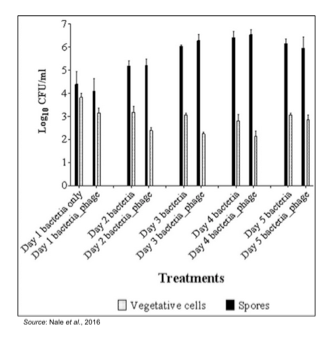
On September 12, 2016, AmpliPhi announced the publication of data from a preclinical study in both in vitro and in vivo models of C. difficile infection (Nale et al., 2016). For the in vitro studies, a 4-phage cocktail was added to pre-established biofilms of C. difficile and live cells were quantified following treatment. The following chart shows an approximately 0.5-1.0 log reduction in vegetative cells for 1-4 day old biofilms, however there did not appear to be an effect on spore formation.
For the
in vivo studies, the researchers used the
Galleria mellonella larvae model, which has been used previously to study phage therapy for
P. aeruginosa (
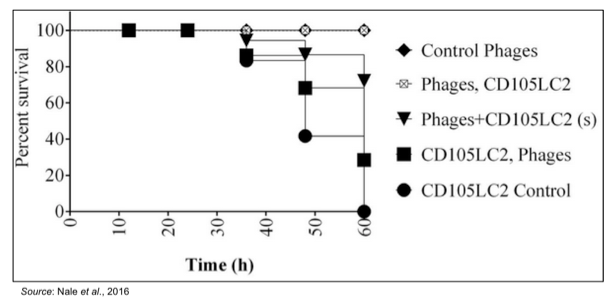
Beeton et al., 2015). The following graph shows the impact of phage treatment on the larvae when phage was administered two hours before the bacterial inoculation (phages, CD105LC2), concurrently with bacterial inoculation (Phages+CD105LC2), or two hours following bacterial inoculation (CD105LC2, phages). Control groups included larvae given phage only (control phages) and those that received bacteria only (CD105L2 control). Results showed that 100% of larvae died within 60 hours following administration of
C. difficile alone, while 100% of larvae administered phage two hours prior to bacterial inoculation survived the experiment.
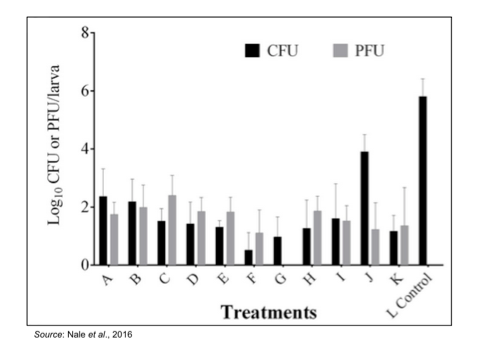
The phage cocktail was also tested in combination with vancomycin. The following graph shows the recovery of phage (PFU) and bacteria (CFU) following various combinations of those agents administered either prophylactically or following bacterial inoculation. Compared to larvae administered only bacteria (L), the most effective combination of agents that resulted in the lowest number of bacteria recovered was phage and vancomycin administered two hours prior to bacterial inoculation (F). These results show that phage treatment could potentially be used as an adjunct to vancomycin treatment to help prevent relapse.
Conclusion
The preliminary results announced for AB-SA01 in the Phase 1 study in patients with CRS are very encouraging, particularly since AB-SA01 was able to safely eradicate
S. aureus in two patients that were refractory to antibiotic treatment. We look forward to the full results from the study later in 2016, which we believe is likely to show similar results in Cohort 3 that were seen in Cohort 2.
We have constructed a probability adjusted discounted cash flow model that takes into account the potential market for treating CRS patients with AB-SA01, cystic fibrosis patients with AB-PA01, as well as the amount of capital that will be required to get the first product to market. Our current valuation for AmpliPhi is $11/share, and we continue to remain positive on the AmpliPhi story and believe that bacteriophage therapy has tremendous potential as a treatment for serious and life-threatening bacterial infections.
For a free copy of the full research report, please email scrinvestors@zacks.com with APHB as the subject.
SUBSCRIBE TO ZACKS SMALL CAP RESEARCH to receive our articles and reports emailed directly to you each morning. Please visit our website for additional information on Zacks SCR and to view our disclaimer.