By David Bautz, PhD
NYSE:APHB
Financial Update
On May 12, 2016, AmpliPhi Biosciences Corp. (NYSE:APHB) announced financial results for the first quarter of 2016. The company reported $0.1 million in revenue, which was received in relation to sublicensing agreements from the company’s former gene therapy program. The net loss for the first quarter was $4.8 million, or $0.88 per share, and included $2.0 million in R&D expenses and $2.6 million in G&A expenses. The company burned $3.2 million in cash in the first quarter and has approximately $6.2 million in cash and cash equivalents as of Mar. 31, 2016. We believe this is sufficient to fund operations into the third quarter of 2016.
Subsequent to the end of the first quarter, AmpliPhi announced that the company converted all 7.5 million outstanding shares of Series B convertible preferred stock into approximately 1.5 million shares of common stock. The move came after more than 2/3rd of the holders of the Series B preferred stock elected for the conversion, which was in accordance with the company’s articles of incorporation. As part of the conversion, AmpliPhi issued to the preferred stockholders who elected to convert approximately 0.9 million additional shares of common stock in exchange for waving certain rights contained in the articles of incorporation. In addition, the exercise price of warrants that were originally issued in June 2013 was reduced from $7.00 per share to $4.05 per share and the expiration date was extended from June 2018 to March 2021. In exchange for the common shares and the amendments for the warrants, the former holders of the Series B preferred stock agreed to waive their right to receive approximately $2.2 million in aggregate cash payments that they would have been entitled to from accrued dividends. As of May 6, 2016 AmpliPhi has approximately 8.2 million shares of common stock outstanding and when factoring in stock options and warrants, a fully diluted share count of approximately 10.5 million.
We’re glad to see that the company has cleaned up its capital structure, which we believe will make it easier to raise additional capital, as any questions surrounding the company’s capital structure have been resolved.
Business Update
AmpliPhi is focused on the discovery, development, and commercialization of bacteriophage treatments for bacterial infections. Bacteriophages are viruses that infect, replicate in, and kill bacterial cells while not harming eukaryotic cells. This exclusivity is vital to their use in combating infectious diseases, and their unique mechanism of action compared to traditional antibiotics means they can be used in place of or in conjunction with those therapies.
While bacteriophages have been known for over 100 years, up until now their use as anti-infectious agents has been restricted to limited geographic regions (mainly Eastern Europe and Russia). This is due to the rise of antibiotics during the middle part of the 20th century that proved to be cheap, plentiful, and effective therapeutics. However, the rise of antibiotic resistant organisms has resulted in a clear need for alternative treatment options, specifically for ones that no longer respond to once effective antibiotic therapies.
Bacteriophage therapies potentially hold a number of advantages over antibiotics, including:
- Multiple modes of application
- Less severe side effects
- Localized and highly specific effect
- Very low doses
- Can treat antibiotic-resistant strains
- Unique mechanism of action makes resistance less likely
AB-SA01 Update
AB-SA01 is being developed for the treatment of Staphylococcus aureus infections, including methicillin-resistant S. aureus (MRSA) infections. It contains three phage constituents that target greater than 96.7% of S. aureus isolates from a global diversity panel.
On November 19, 2015, AmpliPhi announced a clinical trial research agreement has been entered into with the University of Adelaide for the purpose of conducting a Phase 1 clinical trial of AB-SA01. The study is titled “A Phase 1 Investigator Initiated Study to Evaluate the Safety, Tolerability and Preliminary Effectiveness of AB-SA01 in Patients with Chronic Rhinosinusitis Associated with Staphylococcus aureus infection”.
The trial is being conducted at the Queen Elizabeth Hospital, Adelaide, Australia and AmpliPhi is supplying the bacteriophage drug product for the clinical study. In addition, AmpliPhi is providing scientific input, protocol recommendation, and assisting the study’s principal investigator with data management support. The trial is expected to enroll nine patients who suffer from chronic rhinosinusitis and are also positive for S. aureus by nasal swab. Since this is a Phase 1 study, the primary endpoint is safety, however the company will also be collecting anecdotal evidence about how bacteriophage treatment affects the patients symptoms. As part of the standard of care these patients flush their sinuses twice a day with a sterile saline solution. The trial involves the addition of different concentrations of bacteriophage to the saline solution that the patients use to flush out their sinuses. Cohort 1 will be dosed with 108 phage/mL in sterile saline twice daily for one week. Cohort 2 will be dosed with 108 phage/mL in sterile saline twice daily for two weeks. Cohort 3 will be dosed with 109 phage/mL in sterile saline twice daily for two weeks. The first cohort of patients has been successfully treated, and the first patient from Cohort 2 has also been dosed. We anticipate the trial will conclude in mid-2016.
The treatment of chronic rhinosinusitis is one development pathway that the company is currently taking for AB-SA01, as the company’s collaboration with the U.S. Army is continuing for the development of a topical treatment for wound infections. The company is first planning to conduct a study that will involve the use of AB-SA01 on intact skin of healthy volunteers, as the FDA is interested in whether there will be any type of allergic reaction to the bacteriophage. We anticipate this study completing by mid-2016 and topline data available in the third quarter of 2016.
AB-PA01 Update
On April 12, 2016, AmpliPhi Biosciences Corp. (APHB) presented data on AB-PA01 showing both in vitro and in vivo activity against 87.8% of Pseudomonas Aeruginosa clinical isolates from a global population of cystic fibrosis (CF) patients. AB-PA01 was active against both multi-drug resistant and sensitive strains of P. aeruginosa and the data presents a strong rationale for moving the drug into clinical testing in CF patients.
Background On Cystic Fibrosis
Cystic Fibrosis (CF) is an autosomal recessive genetic disorder that affects close to 30,000 individuals in the U.S. and a total of 70,000 people worldwide. The hallmark of CF is a thick, sticky mucus build up in various organs throughout the body. Typically, mucus is a slippery, water substance produced by tissues that line organs and body cavities, such as the lungs and nose. However, due to abnormal sodium and chloride transport in the lungs, pancreas, liver, and digestive tract, patients suffering from CF have mucus that is thick and sticky and leads to blockages of the airways in the lungs and ducts in the pancreas (Boucher, 2004). The name refers to the characteristic scarring (fibrosis) and cyst formation seen in the pancreas.
CF is caused by a mutation in the cystic fibrosis transmembrane conductance regulator (CFTR), a gene found on chromosome #7. The typical protein produced by the CFTR gene contains 1,480 amino acids, however in 70% of CF patients worldwide, and 90% of patients in the U.S., there is a loss of the amino acid phenylalanine at the 508th position on the protein (Bobadilla et al., 2002). This mutation, termed ΔF508 (Δ meaning deletion), causes the protein to fold improperly thus resulting in its degradation.
The CFTR protein is a chloride ion channel that is involved in creating sweat, digestive juices, and mucus. When the protein is either not present or not functioning properly, there is a buildup of chloride ions inside the cells in the airway. While no one knows exactly how this leads to a buildup of thick mucus, one theory suggests that the malfunctioning CFTR protein leads to a paradoxical increase in sodium and chloride uptake, which in turn leads to increased water reabsorption, creating dehydrated and thick mucus.
The most serious complication associated with the disease is difficulty in breathing due to recurrent lung infections.
Lung disease in patients with CF results from airway blockage and resulting inflammation. The build up of mucus is an ideal environment for bacteria to grow, and the inflammation and repeated infections result in injury and structural changes to the lungs. Early stages of the disease are characterized by excessive coughing, phlegm production, and shortness of breath. These symptoms are exacerbated when the overgrowth of bacteria leads to pneumonia. Staphylococcus aureus, Haemophilus influenza, and Pseudomonas aeruginosa are the three most common organisms that cause lung infections in CF patients.
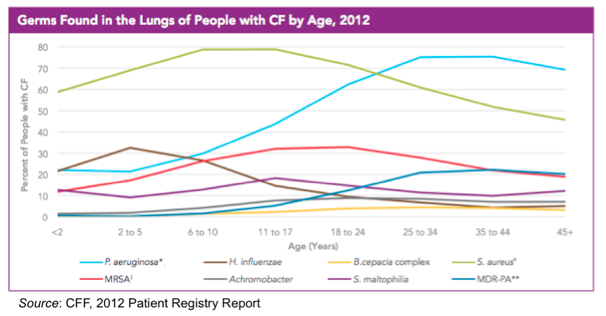
The lungs of CF patients are colonized by bacteria starting at a very young age. The combination of bacterial growth and thick mucus leads to the production of bacterial microenvironments known as biofilms, which are an aggregate of microorganisms in which cells stick to each other and are embedded within a self-produced matrix of extracellular polymeric substance. Biofilms are difficult both for the immune system and for antibiotics to penetrate, thus leading to reduced treatment efficacy. Early in life, S. aureus and H. influenzae are the most common bacterial strains found in CF patients lungs. However, by the age of 18, 70% of CF patients will harbor P. aeruginosa (CFF 2012 Patient Registry Report). The spread of bacteria between CF patients is so common that they are routinely isolated from one another in a healthcare setting.
AB-PA01 is Active Against Multiple P. aeruginosa Isolates
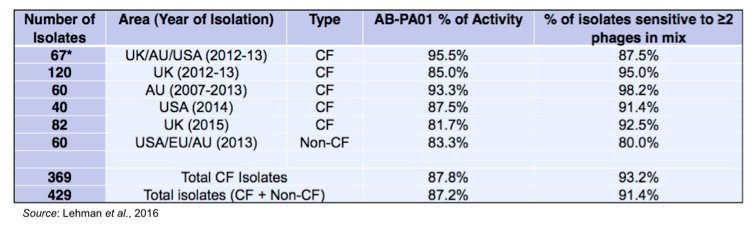
AB-PA01 is a mixture of four bacteriophages that specifically target P. aeruginosa. To develop this product, AmpliPhi created a global “diversity” panel of relevant P. aeruginosa clinical isolates from CF clinics around the globe. Clinical isolates are bacteria cultured from infected patients. This diversity panel was screened against the company’s bacteriophage library that was isolated and characterized according to their proprietary discovery and development platform. The bacteriophage mix was selected to exhibit a high degree of “complementation,” defined as the number of bacteria targeted by more than one bacteriophage in the product. High complementation is an important factor in preventing bacteria from developing resistance to bacteriophage products.
To test the activity of AB-PA01, 108 PFU/mL was spotted onto different strains of P. aeurigonsa cultures. Each strain was considered sensitive if more than 20 plaques (areas of bacterial cell death) were observed. The following table shows the percentage of P. aeruginosa isolates that were sensitive to treatment with AB-PA01. Complementation was shown by the high percentage of P. aeruginosa isolates that were sensitive to two or more of the phages in AB-PA01.
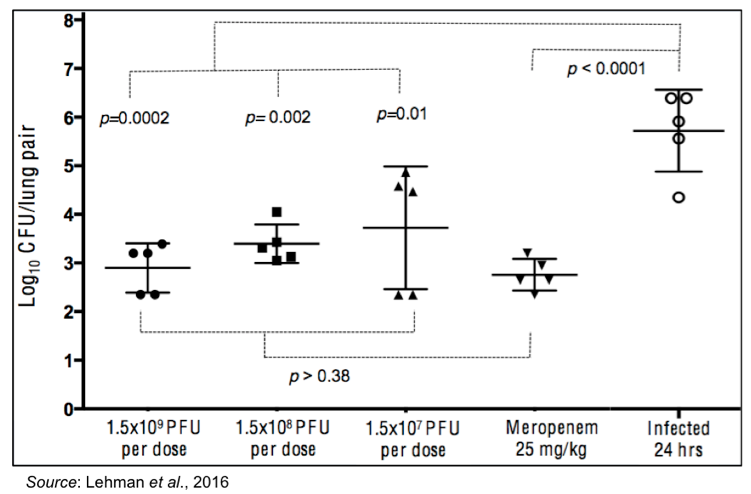
The in vivo activity of AB-PA01 was tested in immunocompetent CD-1 mice infected with 6.26 log10 CFU of P. aeruginosa. Two hours after infecting the mice, three different doses of AB-PA01 (7.5x10⁹/mL, 7.5x10⁸/mL, or 7.5x10⁷/mL) were administered intranasally to three different dosage groups (n=5). A second dose of phage was administered four hours later. Meropenem, a broad spectrum antibiotic, was administered to a fourth group of animals subcutaneously two and six hours post infection, while a fifth group of animals received phage diluent as a control. The mice were euthanized 24 hours after infection and the CFU/lung pair was determined. The following graph shows that all three doses of phage resulted in a statistically significant decrease in bacterial load compared to the control group. There was also a dose response seen with higher doses of AB-PA01 resulting in decreased bacterial load. Lastly, AB-PA01 showed similar efficacy to meropenem.
AmpliPhi is developing AB-PA01 in collaboration with the Royal Brompton Hospital in London, England. The company is continuing formulation work on AB-PA01 through the rest of 2016, and we anticipate a Clinical Trial Application (CTA) being submitted to the Medicines and Healthcare Products Regulatory Authority (MHRA) in the UK in the first half of 2017, with the first clinical trial likely to commence shortly thereafter. The MHRA has agreed with the company’s plans to conduct a first-in-man dose ranging clinical trial in CF patients, thus bypassing the need to test AB-PA01 first in healthy volunteers.
AmpliPhi Cancels ECC With Intrexon
On April 14, 2016, AmpliPhi announced that it had provided written notice to Intrexon Corp (XON) to cancel the Exclusive Channel Collaboration (ECC) between the two companies. The ECC agreement was directed towards the research, development, and commercialization of the company’s P. aeruginosa and Clostridium difficile programs. AmpliPhi decided to terminate the agreement due to the belief that meaningful progress had not been made under the collaboration program and the desire to avoid any further fiduciary responsibility under the agreement. In addition, this allows the company to pursue collaborations for genetic modification of phage products with other companies.
Conclusion
We are glad to see that the Phase 1 study of AB-SA01 is proceeding as planned and, as expected, there have been no safety signals thus far after dosing of the first cohort of patients. While primarily a safety study, the company will also be able to obtain some anecdotal evidence about patient outcomes, and we will be quite interested to examine the data when it is released in the second half of 2016.
The data presented by AmpliPhi on AB-PA01 are very encouraging in both the activity toward such a high percentage of clinical isolates of P. aeruginosa as well as in vivo activity that matches the effects of a broad spectrum antibiotic. There are approximately 30,000 patients with CF in the U.S. and another 40,000 in the rest of the world. With 70% of CF adults harboring P. aeruginosa infections, most of which are resistant to antibiotics due to the development of biofilms or acquired resistance, this represents a sizeable market opportunity for the company. We anticipate Phase 1 dose-ranging studies beginning in CF patients in 2017.
We have made slight modifications to our probability adjusted discounted cash flow model that takes into account the potential market for treating chronic rhinosinusitis patients with AB-SA01, CF patients with AB-PA01, as well as the amount of capital that will be required to get the first product to market. Our current valuation for AmpliPhi is $11/share, and we continue to remain positive on the AmpliPhi story and believe that bacteriophage therapy has tremendous potential as a treatment for serious and life-threatening bacterial infections.
READ THE FULL RESEARCH REPORT HERE
SUBSCRIBE TO ZACKS SMALL CAP RESEARCH to receive our articles and reports emailed directly to you each morning. Please visit our website for additional information on Zacks SCR and to view our disclaimer.