By
David Bautz, PhD
NYSE:APHB
Business Update
AmpliPhi Biosciences Corp. (NYSE:APHB) is developing bacteriophage therapeutics for the treatment of bacterial infections. The company’s pipeline consists of treatments that specifically target infections caused by Staphylococcus aureus (AB-SA01), Pseudomonas aeruginosa (AB-PA01), and Clostridium difficile (AB-CD01).
Favorable Topline Results for AB-SA01
On October 25, 2016, AmpliPhi announced favorable topline results from the Phase 1 clinical trial evaluating the safety and tolerability of AB-SA01 in patients suffering from chronic rhinosinusitis (CRS). The trial enrolled nine patients who suffer from CRS and are also positive for S. aureus by nasal swab. The primary endpoint of the study was safety, however the company also collected anecdotal evidence about how bacteriophage treatment affected the patients’ symptoms.
As part of the standard of care these patients flush their sinuses twice a day with a sterile saline solution. The trial involved the addition of different concentrations of bacteriophage to the saline solution that the patients use to flush out their sinuses. Cohort 1 was dosed with 108 phage/mL in sterile saline twice daily for one week. Cohort 2 was dosed with 108 phage/mL in sterile saline twice daily for two weeks. Cohort 3 was dosed with 109 phage/mL in sterile saline twice daily for two weeks.
The Safety Monitoring Committee determined that there were no drug-related serious adverse events and that AB-SA01 was well tolerated by all nine patients in the study. In addition, the company disclosed that the eradication of S. aureus was achieved in two of three patients in Cohort 2 and zero of three patients in Cohort 1. Patients in both Cohorts 1 and 2 reported improvements in symptoms, as measured on days 0, 7, and 14 by Visual Analog Scale and Sino-Nasal Outcome Test. In Cohort 2, there were improvements noted in endoscopic video examination using the Lund Kennedy Score, which quantifies the pathologic states of the nose and paranasal sinuses by focusing on the presence of polyps, discharge, edema, scarring, or crusting (Lund et al., 1995).
It is encouraging that improvements were seen in endoscopic examinations, particularly since those were performed on day 14, or as soon as treatment ended. A previous study of a P. aeruginosa bacteriophage in patients with chronic otitis showed that the bacteriophage was still active in some patients up to 42 days after administration (Wright et al., 2009). Thus, we believe that future studies would likely include a longer follow up time to allow for full examination of a potential therapeutic effect exerted by bacteriophage treatment, which was not done in this Phase 1 study as the primary outcome was safety.
In addition to treating CRS, AmpliPhi is also developing AB-SA01 in collaboration with the U.S. Army as a topical treatment for wound infections. On September 13, 2016, AmpliPhi announced topline results from a Phase 1 clinical trial designed to test the safety and tolerability of AB-SA01 administered topically to the skin. A total of 12 healthy adult volunteers were dosed in two cohorts of six participants each, with each volunteer receiving either low-dose (1x10⁸ PFU/mL) or high-dose (1x10⁹ PFU/mL) of AB-SA01 on the forearm under an occlusive bandage. Placebo was administered to the opposite forearm, thus allowing each participant to serve as his or her own control. AB-SA01 and placebo were administered daily for three consecutive days. Results showed that AB-SA01 was well-tolerated and that no drug-related serious adverse events were reported. This study was required before a trial involving wounds infected with S. aureus could get underway, and we are glad to see that it was completed successfully with no unanticipated safety signals arising.
AB-CD01
AB-CD01 is under development for the treatment of Clostridium difficile infections. C. difficile is a gram-positive, spore-forming bacterium that is best known for causing antibiotic-associated diarrhea. According to the U.S. CDC, It is estimated to cause upwards of 300,000 infections and 30,000 deaths every year in the U.S.
There are only three antibiotics that are utilized for the treatment of C. difficile infections, thus there is a need for more treatment options as relapse rates are very high. Approximately 20% of patients will have a relapse infection, and once a patient has had one recurrence the chance of having another recurrence rises to 65%.
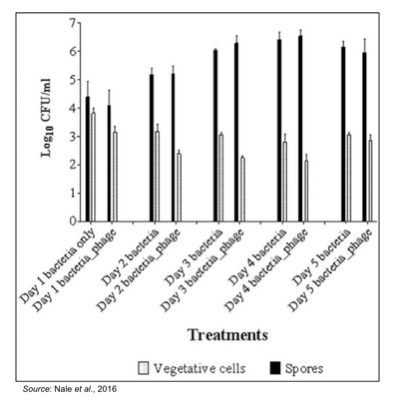
On September 12, 2016, AmpliPhi announced the publication of data from a preclinical study in both in vitro and in vivo models of C. difficile infection (Nale et al., 2016). For the in vitro studies, a 4-phage cocktail was added to pre-established biofilms of C. difficile and live cells were quantified following treatment. The following chart shows an approximately 0.5-1.0 log reduction in vegetative cells for 1-4 day old biofilms, however there did not appear to be an effect on spore formation.
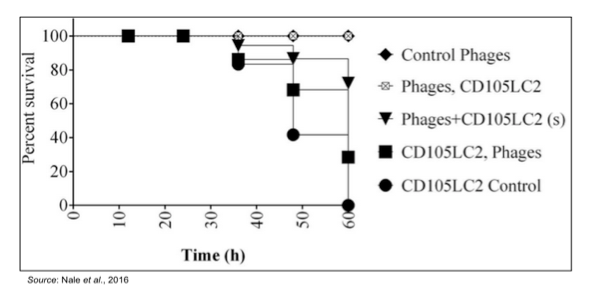
For the in vivo studies, the researchers used the Galleria mellonella larvae model, which has been used previously to study phage therapy for P. aeruginosa (Beeton et al., 2015). The following graph shows the impact of phage treatment on the larvae when phage was administered two hours before the bacterial inoculation (phages, CD105LC2), concurrently with bacterial inoculation (Phages+CD105LC2), or two hours following bacterial inoculation (CD105LC2, phages). Control groups included larvae given phage only (control phages) and those that received bacteria only (CD105L2 control). Results showed that 100% of larvae died within 60 hours following administration of C. difficile alone, while 100% of larvae administered phage two hours prior to bacterial inoculation survived the experiment.
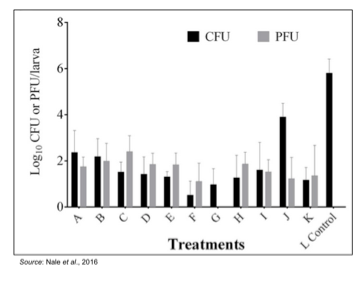
The phage cocktail was also tested in combination with vancomycin. The following graph shows the recovery of phage (PFU) and bacteria (CFU) following various combinations of those agents administered either prophylactically or following bacterial inoculation. Compared to larvae administered only bacteria (L), the most effective combination of agents that resulted in the lowest number of bacteria recovered was phage and vancomycin administered two hours prior to bacterial inoculation (F). These results show that phage treatment could potentially be used as an adjunct to vancomycin treatment to help prevent relapse.
Financial Update
On November 10, 2016, AmpliPhi Biosciences Corp. (APHB) announced financial results for the third quarter of 2016. The company reported $0.03 million in revenue, which was received in relation to sublicensing agreements from the company’s former gene therapy program. The net loss for the third quarter was $3.6 million, or $0.32 per share, and included $1.7 million in R&D expenses and $1.8 million in G&A expenses. Total cash burn for the third quarter of 2016 was $3.2 million, which is in line with the previous two quarters.
The company exited the third quarter of 2016 with approximately $4.0 million in cash and cash equivalents. Subsequent to the end of the quarter, the company received a $0.9 million tax incentive payment from the Australian tax authority, which is based on eligible expenses for R&D activities incurred by the company’s Australian subsidiary in 2015. AmpliPhi will record the payment in the fourth quarter of 2016 as a reduction in R&D expenses. The company also raised net proceeds of $3.8 million from a public offering. We estimate that the company currently has sufficient capital to fund operations to the end of the first quarter of 2017.
During the second quarter of 2016, AmpliPhi announced that the company converted all 7.5 million outstanding shares of Series B convertible preferred stock into approximately 1.5 million shares of common stock. The move came after more than 2/3rd of the holders of the Series B preferred stock elected for the conversion, which was in accordance with the company’s articles of incorporation. On November 14, 2016, AmpliPhi announced a settlement of its pending lawsuit with NRM VII Holdings I, LLC, which related to the conversion of the Series B convertible preferred stock. The settlement calls for NRM to dismiss with prejudice the lawsuit and AmpliPhi’s insurance carrier will pay $2 million to NRM. Approximately $914,000 of that payment is due to accrued dividends that were payable to NRM upon conversion of the Series B convertible preferred stock and AmpliPhi has agreed to repay the insurance carrier in installment payments.
As of November 10, 2016 AmpliPhi had approximately 11.1 million shares of common stock outstanding and when factoring in stock options and warrants, a fully diluted share count of approximately 14.3 million.
Conclusion
Thus far, the results seen for AB-SA01 are quite encouraging, as the safety of the drug has been firmly established through two different Phase 1 trials. In addition, the eradication of S. aureus infections from two patients in Cohort 2 of the CRS study is promising, particularly since these are patients who were refractory to antibiotic treatment. The full results from the CRS study should be announced before the end of 2016, and we believe there is a good chance that similar results will be seen with Cohort 3 patients.
We have constructed a probability adjusted discounted cash flow model that takes into account the potential market for treating CRS patients with AB-SA01, cystic fibrosis patients with AB-PA01, as well as the amount of capital that will be required to get the first product to market. After taking into consideration the shares of common stock and warrants offered in the recent public offering, our current valuation for AmpliPhi is $6/share, and we continue to remain positive on the AmpliPhi story and believe that bacteriophage therapy has tremendous potential as a treatment for serious and life-threatening bacterial infections.
For a free copy of the full research report, please email scrinvestors@zacks.com with APHB as the subject.
SUBSCRIBE TO ZACKS SMALL CAP RESEARCH to receive our articles and reports emailed directly to you each morning. Please visit our website for additional information on Zacks SCR and to view our disclaimer.