By
David Bautz, PhD
NASDAQ:ARLZ
Financial Update
On August 9, 2016, Aralez Pharmaceuticals, Inc. (NASDAQ:ARLZ) reported financial results for the second quarter of 2016. The financial results for the corresponding periods in 2015 are those of Pozen, Inc., the predecessor to Aralez.
Total revenues for the second quarter of 2016 were $12.6 million, and consisted of $5.2 million in royalties from the sale of Vimovo® and $7.4 million in product sales. The $5.2 million in royalty revenue was the same as the second quarter of 2015. For the six months ending June 30, 2016, royalty revenues were $9.7 million, compared to $9.6 million for the corresponding period in 2015. The increase was due to an increase in the royalty rate (10%) due to the company from sales of Vimovo® by AstraZeneca, which was offset by a decrease in royalties from Horizon Pharma due to lower net pricing. We anticipate a similar level of revenues from both product sales and Vimovo® royalties for both Q3 and Q4 of 2016.
Total operating expenses for the second quarter were $29.7 million, and consisted of $3.4 million in cost of goods sold, $2.1 million in amortization, $22.7 million in SG&A expenses, and $1.5 million in R&D expenses. The $22.7 million in SG&A was an increase of $4.5 million over the same time period in 2015, primarily driven by $6.2 million in commercialization costs incurred in the U.S., $4.7 million of expenses related to the company’s Canadian operation, and $3 million of additional expenses related to the company’s global corporate structure. The $1.5 million in R&D expenses was a decrease of $0.8 million from the same time period in 2015, the result of additional expenses incurred during 2015 for YOSPRALA®.
Interest expense and other income/expense for the quarter was $0.9 million and consisted of $0.6 million in interest expense, due to the issuance of $75 million in principal of the 2.5% senior secured convertible notes in February 2016, and $0.3 million in other expenses related to a $0.5 million loss on foreign exchange partially offset by a $0.2 million decrease in the fair value of the warrants liability.
As of June 30, 2016, Aralez had cash and cash equivalents of $93 million. In addition, the company has access to a $200 million line of credit to fund future acquisitions.
Business Update
YOSPRALA®
On March 28, 2016, Aralez announced that the U.S. Food and Drug Administration (FDA) accepted the company’s new drug application (NDA) for YOSPRALA® for the secondary prevention of cardiovascular disease in patients at-risk for aspirin-related gastric ulcers. The Prescription Drug User Fee Act (PDUFA) goal date for a decision is September 14, 2016.
As a reminder, the NDA for YOSPRALA® was originally filed in March 2013. On August 25, 2014, Pozen received a complete response letter (CRL) from the FDA, noting that deficiencies were found during an inspection of the facility that manufactures the active ingredient of YOSPRALA®. The supplier responded to the FDA and on June 30, 2014 the NDA was resubmitted. On December 17, 2014, Pozen received a second CRL, which contained identical wording to the first CRL. On December 28, 2015, Pozen announced that the NDA would move forward with a new supplier of the active pharmaceutical ingredient (API) for YOSPRALA®. During the first quarter, Aralez worked with the new supplier in preparation for a planned inspection by the FDA. There were no deficiencies noted during this inspection. Thus, we believe this will resolve the deficiencies noted in the previous CRLs and we anticipate YOSPRALA® being approved on or before the PDUFA date.
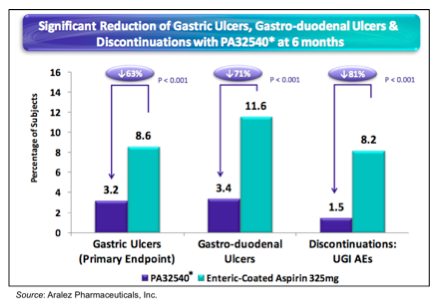
YOSPRALA® is composed of a delayed-release aspirin and an immediate-release omeprazole intended for the secondary prevention of heart attack and stroke. For patients who have suffered a heart attack or stroke, taking daily aspirin has been shown to help prevent the occurrence a second heart attack or stroke. In the U.S., there are approximately 26 million secondary prevention patients, with approximately 70% of them taking daily aspirin. In addition, approximately 40% of prescribing physicians recommend that their patients take some form of gastric acid reducer. The reason for this is that daily use of nonsteroidal anti-inflammatory drugs (NSAIDs), such as aspirin, is associated with an increased risk of developing gastric ulcers, thus the addition of an agent that decreases stomach acid production, such as the proton pump inhibitor (PPI) omeprazole, is intended to decrease the chance for the development of ulcers. Pozen has previously shown that patients taking YOSPRALA® develop significantly fewer gastric ulcers than patients taking enteric-coated aspirin after six months of treatment (Whellan et al., 2014).
In April 2016, the U.S. Preventive Services Task Force (USPTF) stated that people in their 50’s with risk factors for cardiovascular disease (i.e., high blood pressure, high cholesterol, or a history of smoking) may benefit from taking daily aspirin for at least a decade. This is in addition to guidelines published in the Journal of the American College of Cardiology that includes the use of aspirin in every instance of Dual Antiplatelet therapy (DAPT). Aralez is poised to benefit from these guidelines and the increasing awareness of the cardioprotective aspects of daily aspirin.
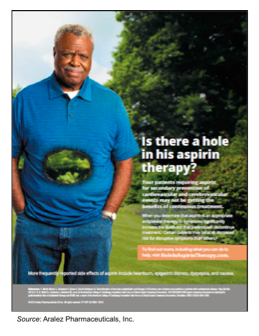
Aralez has developed an educational campaign titled “Hole in Aspirin Therapy” that will feature such things as advertisements in medical journals (example shown below). The company is hoping to raise awareness of the gastrointestinal side effects of aspirin therapy (i.e., bleeding), which can lead to non-adherence and discontinuation of treatment. YOSPRALA® is designed to decrease the chances for these side effects. Discontinuing daily aspirin is reported to increase the risk of major cardiovascular events by three fold, thus avoiding the major reason for discontinuation of treatment could have a profound impact on patient healthcare outcomes.
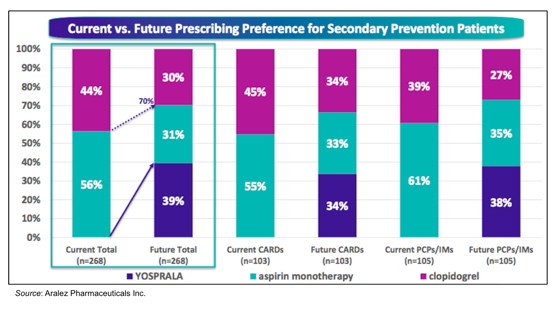
To gain better insight into how YOSPRALA® may be received by physicians, Aralez conducted a survey with cardiologists (CARDs), primary care physicians (PCPs), and internal medicine (IMs) specialists about their prescribing preferences for secondary prevention patients. The following graphic shows the breakdown of patients on either aspirin monotherapy or clopidogrel (Plavix®) and how the surveyed physicians might utilize YOSPRALA® once it is approved. The results show that those physicians would prescribe YOSPRALA® for up to 39% of their secondary prevention patients, representing a sizeable market opportunity for Aralez and indicative of the fact that YOSPRALA® could gain appreciable market share following approval.
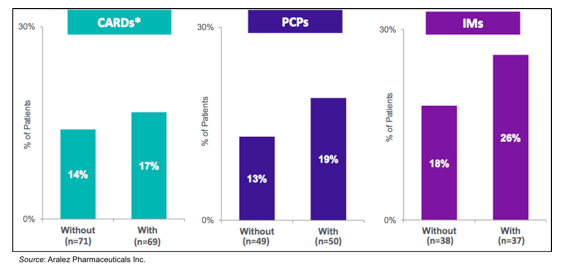
In addition, Aralez’s market research indicates that educational initiatives can help to drive physician support of YOSPRALA®. The following figure shows that physicians intend to use YOSPRALA® in approximately 14-18% of their aspirin/proton pump inhibitor patients without educational initiatives, but this increases to approximately 17-26% for physicians that are supplied with educational materials.
Aralez has indicated that upon FDA approval, the company will launch YOSPRALA® with approximately 110 sales representatives (25 of which are already employed to promote Fibricor®). The company has put in 85 contingent offers (formal offers will follow FDA approval of YOSPRALA®) with sales representatives that have worked with the Aralez management team in the past. The 110 person sales team will allow the company to reach 29% of secondary prevention specialists, or approximately 15,000 physicians. The company will likely expand this sales force to approximately 300 individuals that will reach 40% of the defined market, or close to 35,000 physicians.
Aralez will file for approval of YOSPRALA® in Europe in the fourth quarter of 2016, however the company has not indicated whether the rights to the drug will be licensed or if the company will promote it in that region. In addition, the company will file for approval of YOSPRALA® in Canada in the first half of 2017.
Fibricor®
Fibricor® is a unique formulation of fenofibric acid and is indicated as an adjunctive therapy to diet for the treatment of severe hypertriglyceridemia (triglycerides ≥ 500 mg/dL), to reduce elevated LDL cholesterol, total cholesterol, triglycerides, apolipoprotein B (Apo B), and to increase HDL cholesterol. Fenofibrate was originally sold by Abbott Labs (now AbbVie Pharmaceuticals) as TriCor, with peak sales in excess of $1 billion. AbbVie brought a blockbuster next-generation product, Trilipix (fenofibric acid) to the market as a follow-on to TriCor, but now 80% of the market for fenofibrate and fenofibric acid is generic. As a reminder, Tribute acquired Fibricor® from Sun Pharma in May 2015. Tribute paid $10 million for the rights to the product, which included $5 million upfront, $2 million due in November 2015, and $3 million due in May 2016. Fibricor® had U.S. net sales of $2 million in 2015 with no promotion. Aralez has assembled a 25 person sales team to promote Fibricor® to approximately 3,500 cardiologists and primary care physicians and began promoting the drug in April 2016. Thus far, this has resulted in an 88% increase in new prescriptions in covered geographies for the first 13 weeks following the promotional launch compared to the 13 weeks preceding the launch.
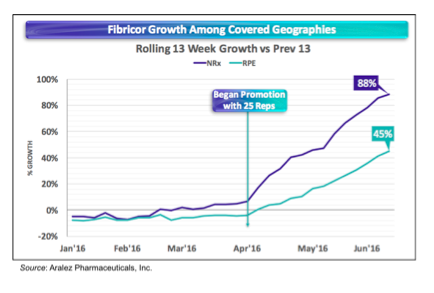
One of the key aspects in launching Fibricor® will be to begin to build relationships ahead of the launch of YOSPRALA®. In addition, the company’s commercialization strategy is designed to educate healthcare practitioners on the benefits of Fibricor® and how to maximize effectiveness through prescribing practices. Lastly, the company is planning to utilize a new copay program to leverage affordability of both the branded drug and the authorized generic. Following approval of YOSPRALA®, Aralez intends to promote the two drugs together in order to help drive U.S. sales of Fibricor®.
Conclusion and Valuation
We have built a detailed financial model for Aralez that takes into account potential future revenues from YOSPRALA®, product revenues, and royalty income for Vimovo®.
For YOSPRALA®, we continue to anticipate approval of the drug in the fourth quarter of 2016, leading to minimal revenues this year. For 2017 and 2018 we have slightly modified our model to more conservatively estimate YOSPRALA® uptake, which now calls for revenues of $30 and $80 million in 2017 and 2018, respectively, with the total continuing to rise to a peak of $225 million in 2022. However, these numbers will be entirely dependent on YOSPRALA® uptake and prescription growth and will likely be modified further in the future.
Our model calls for gross margins to be near 80% in 2016 and slowly rise to the mid-to-upper 80’s by 2020. We model for operating expenses in 2016 of approximately $146 million, which includes $124.2 million in GAAP G&A expenses and $8.9 million in GAAP R&D expenses, both of which are in line with the company’s guidance. Additionally, the G&A expenses include approximately $12 million in stock-based compensation, $15 million in merger-related expenses, and $11 million in excise tax payments. Operating expenses will decrease slightly in 2017 before rising in 2018 due to expansion of the sales force promoting YOSPRALA®.
Our valuation is based on an enterprise value (EV)/revenues multiple of 5.0x on projected 2020 revenues using a 15% discount rate. The slight modifications to the model have resulted in a small decrease in fair value to $9.50 per share. We note that additional upside to this valuation is possible from the company attaining approval for YOSPRALA® in Canada and the E.U., rapid uptake of YOSPRALA® following its launch, better than anticipated sales of products from the company’s portfolio, and of course any accretive deals, at least one of which we anticipate occurring before the end of 2016.
READ THE FULL RESEARCH REPORT HERE
SUBSCRIBE TO ZACKS SMALL CAP RESEARCH to receive our articles and reports emailed directly to you each morning. Please visit our website for additional information on Zacks SCR and to view our disclaimer.