By Anita Dushyanth, PhD
OTC:AYTU
On September 1, 2016 Aytu Bioscience Inc. (OTC:AYTU) reported financial results for the year ending June 30, 2016.
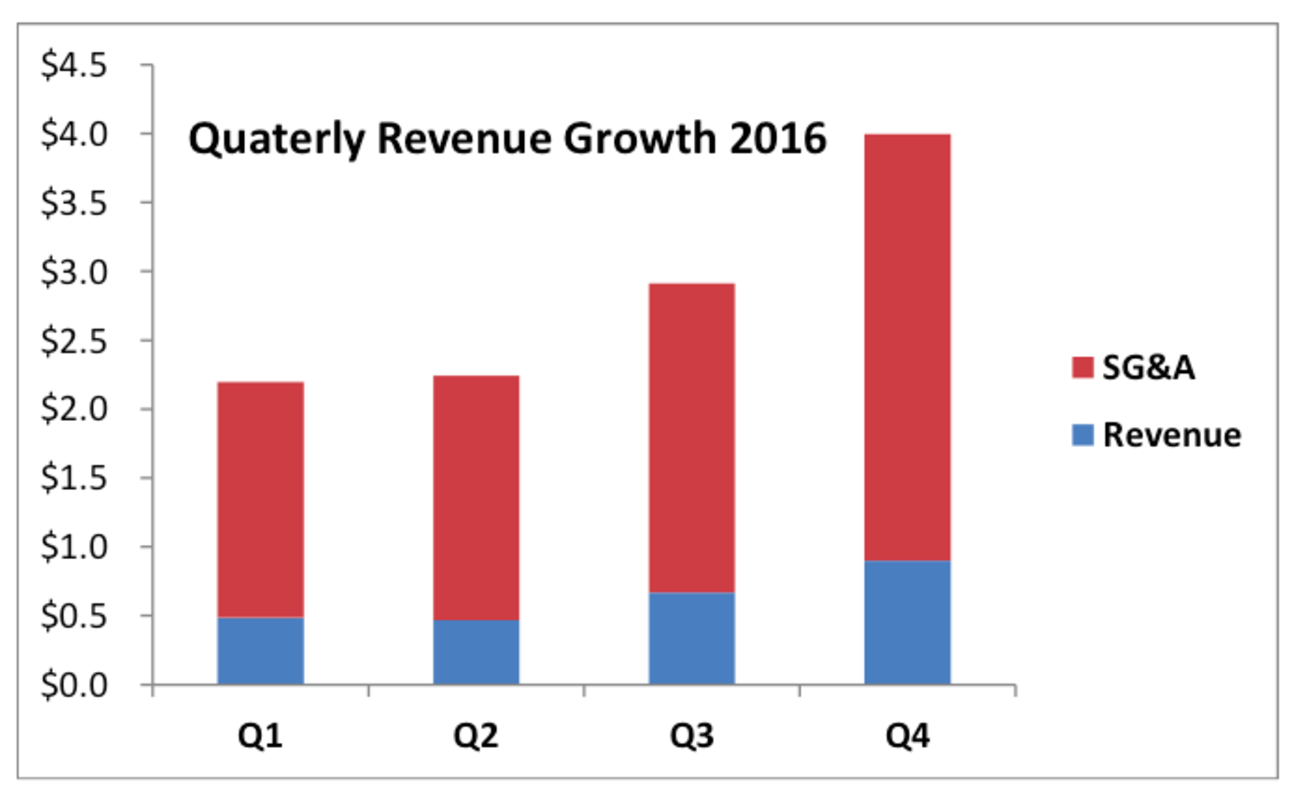
The total revenue (product and service) during 2016 was $2.1 million, which was very close to our estimates. Annual 2016 revenue increased 10-fold from the prior year. Significant contribution to the revenue was from the sale of ProstaScint. Since there is a certain degree of seasonality associated with Primsol and it was introduced only from Q2 2016 onwards, the revenue contribution was low. Natesto’s revenue was not reported as it was launched only by the end of July 2016.
Acerus Pharmaceuticals Corporation (TSX: ASP) terminated the agreement relating to the commercialization of Natesto in the U.S. and Mexico with Endo Ventures Bermuda Limited (an affiliate of Endo International plc) (NASDAQ: ENDP) on June 30, 2016. In April 2016 Aytu acquired the exclusive rights from Acerus Pharmaceuticals to market Natesto in the U.S. Aytu paid $2 million at signing, and will pay the remaining $6 million in September 2016 and January 2017. Additionally, Aytu is expected to pay up to $37.5 million based on the achievement of certain sales milestones. Further, Aytu is expected to make royalty payments of 25% on net sales. Acerus will be continuing to supervise manufacturing of Natesto. In the initial months after launch, Acerus will be working closely with Aytu to ensure a smooth transition of Natesto from Endo.
The reasons we think management found potential in Natesto, after assessing all opportunities and challenges in the evolving TRT market, are listed below.
- The U.S. testosterone replacement therapy (TRT) market generated ~$2 billion in annual sales in 2013 and sales are expected to double by 2018.
- There is a lot of capacity in Aytu’s urology-centric sales force and therefore Natesto is a nice addition to the portfolio.
- Natesto was not Endo’s prioritized product and consequently Natesto under performed generating only $1.2 million in revenue in the past year as per Acerus’ 2015 annual report.
Natesto’s promotional labeling requirements are largely expected to remain the same as when marketed by Endo. We think Natesto has the following advantages over other TRT drugs:
- It is the first FDA approved, patented, nasally-administered TRT product for men with Low-T.
- It requires 2-3x dosing per day which mimics the natural diurnal testosterone cycle in men.
- It is easy and convenient to use. It offers a non-messy, no-touch application.
- Unlike Axiron (Eli Lilly) and AndroGel (AbbVie), its two leading TRT competitors, Natesto’s label does not contain a black-box warning against transference risk.
- Natesto has demonstrated significant improvements in erectile function, intercourse satisfaction, orgasmic function, sexual desire, overall satisfaction and positive mood when compared to baseline.
In 2000, the first topical gel was introduced and according to IMS, it accounted for ~73% of the total prescriptions in the TRT market. As per IMS, the total number of prescriptions written within the TRT market increased three times (to about three million prescriptions) between 2000 and 2008. However, the gel market growth slowed down in 2013 due in large part to formulary changes, patients switching from gels to injectables and non-availability of newer therapies.
Aytu had beefed up its marketing and sales team to launch Natesto.in the U.S. in late July 2016. Management has not appointed sales personnel to focus their marketing efforts solely on Natesto. We believe that they have an adequate sales force who are familiar with marketing TRT products. Additionally, they have existing relationships with prescribing physicians that should help optimize Natesto’s potential sales in this market.
Aytu’s urology sales force (about 40 reps) is promoting Natesto to the highest TRT prescribing physicians, urologists, endocrinologists and few primary care physicians totaling about 5500 specialists in metropolitan areas. We believe this focused messaging will help in driving adoption of Natesto. Management is planning to prioritize the sales of Natesto to the untapped urologist audience (where other TRT drugs have not been targeting). The initial sales strategy is to approach dissatisfied patients (using other TRT therapies), followed by those using injectable drugs and then new patients. We think Aytu is making strong headway in the commercialization efforts of Natesto.
Although management did not provide any guidance on what to expect in revenue from Natesto in the coming quarters, they hinted that they have seen a growing demand for this product among physicians and specialists. Mr. Josh Disbrow, Aytu’s CEO, mentioned on the call that based on the feedback he received from the sales reps, the main pushback from the community in adopting this drug was the inertia. The physicians were not necessarily married to any particular product but were unaware of Natesto’s existence. The sales team is on an aggressive campaign to promote Natesto and management said that Natesto sales seemed to be picking up since launch due to three factors:
1- Natesto mimics the natural diurnal rhythm of testosterone
2- The exceptionally positive response received from patients to the reimbursement help with the copay card
3- The drug has no risk of transference or black box warnings.
While Angrogel sells for around $400, Natesto sells for ~$250. As far as reimbursement is concerned, majority of reimbursement plans cover Natesto currently. However, Aytu provides co-pay assistance ($25 for up to 12 refills). In the initial weeks after launch, it seemed that Natesto sales doubled from the second to the fourth week. While many patients had insurance coverage and did not require the copay assistance, there were others who did, as it was apparent from the high number of copay redemptions.
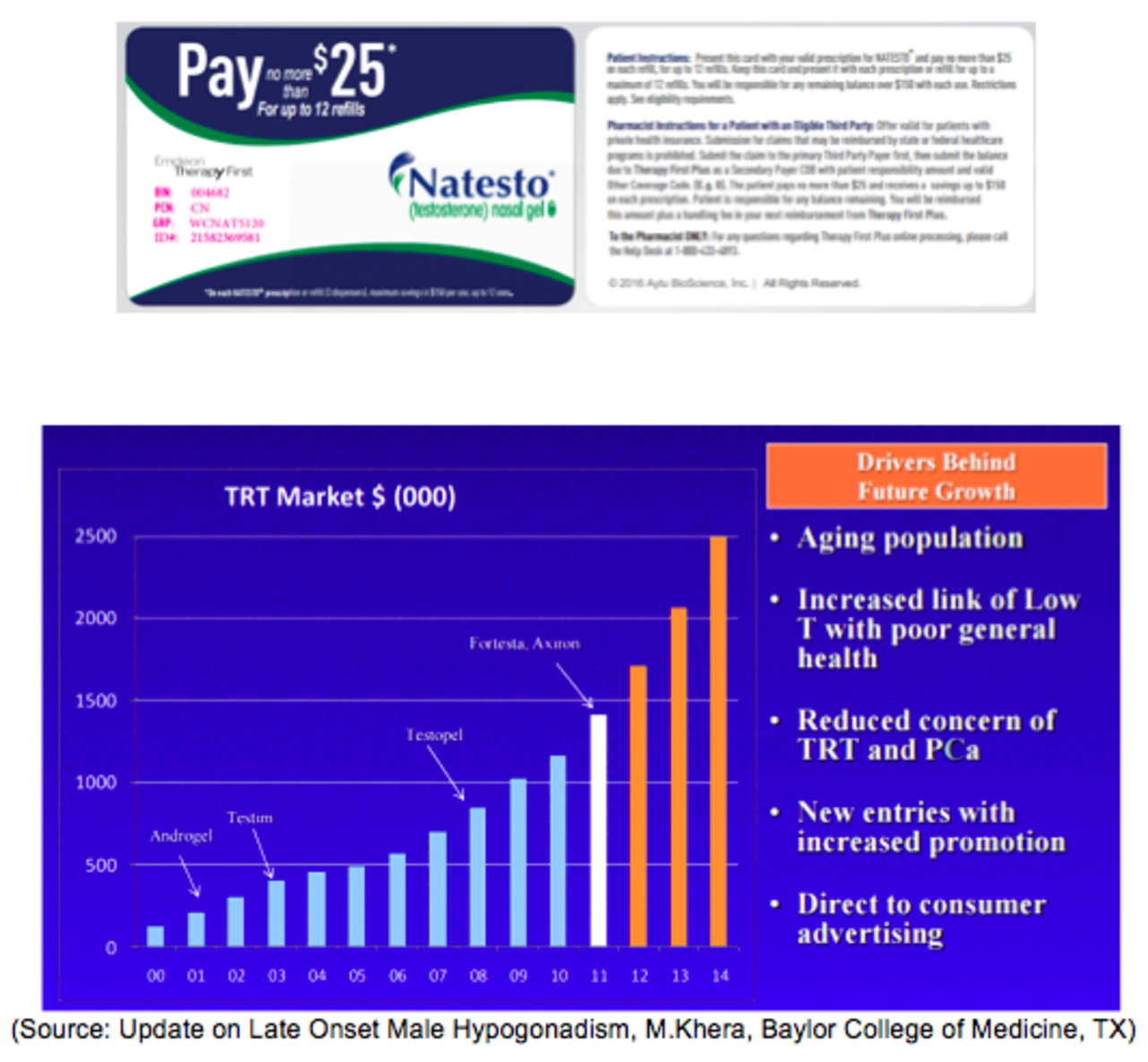
Based on the guidance management has given, we are not expecting an immediate revenue increase in Q1 2017 as the firm will not have sufficient time within the launch of Natesto to make a serious impact. However, we do expect sequential but modest growth in commercial sales in the coming year. We think Natesto sales will gain traction and follow an upward growth trend in the subsequent quarters following Q2 2017. Natesto has a shelf life of three years and the inventory is stocked well to meet a full year’s expected demand. Management expects to gain 5% market penetration sometime in the out years. Also tilling the soil for Aytu’s growth could be the overall uptick in the TRT market segment that has shown a 5.5% CAGR in the past year.
R&D expenses came in at around $6 million, and were higher than expected as the company switched ProstaScint to a new manufacturer. The company signaled on the earnings call held on September 1, 2016 that R&D expenses would decrease by ~$5 million in fiscal 2017 as compared to fiscal 2016 due to two reasons: the cost of transferring the manufacturing of Prostascint to another vendor is complete and therefore there is no further expenditure associated with this issue. Management has decided that it will pay more attention to the other products on their urology portfolio that are already FDA approved and generating revenue rather than pursuing further clinical development of Zertane. Mr. Josh Disbrow further reiterated on the call that they are steering away from draining resources into Zertane that is still in clinical development stages. Hence, there are no more clinical costs associated with the development of Zertane in the coming year. We, therefore, expect R&D costs to be lower in fiscal 2017 than in 2016. G&A costs came in close to $9 million. The firm expects that the costs associated with the increase in professional staffing as well as business development related activities will be following an upward trend. The firm noted on the earnings call that they are looking into establishing their foothold in the urology market and will probably expand their sales force depending on demand.
The firm reported using $10.7 million cash for operations and exited the quarter with cash and cash equivalents of ~$8 million.
Subsequent to the fiscal year end, in order to meet the requirements for uplisting shares to NASDAQ, Aytu underwent a 1 for 12 reverse stock split that became effective on July 1, 2016. The reverse stock split was approved by the company's stockholders and board of directors during the annual meeting held in May 2016. Following the reverse split, the number of outstanding shares is approximately 3.7 million.
In the beginning of June 2016 the firm began patient enrollment and dosing at Princess Margaret Cancer Centre in Canada for their three-arm, open label prostate cancer study. The study is being led by Dr. Antonio Finelli in collaboration with Hybridyne Imaging Technologies to investigate the efficacy of Hybridyne's ProxiScan compact gamma cameras to detect local prostate cancer using ProstaScint. Currently the study has enrolled twenty of the sixty total patients. Patient enrollment is expected to be completed by end of calendar 2016 (Q2 2017).
In January 2016 the MiOXSYS system received CE Mark and by June 2016 the company entered into agreements with five leading European specialty medical distributors to commercialize the system. The European commercial network includes Tani Medikal in Turkey, TECOmedical in Switzerland and Germany, Parallabs in the U.K. and France, THP Medical Products in Austria, and Durviz S.L. in Spain. Aytu anticipates expanding its ex-U.S. distribution channel to ramp up commercial sales in CE Mark territories. Although management has not disclosed specific sales numbers of the MioXSYS system, there seems to be considerable interest as five distributors have quickly signed contracts. Aytu is also focused on expanding their footprint by signing additional distribution agreements in various global regions focusing on the urology market.
Aytu also published clinical findings using MiOXSYS in the journal, Fertility and Sterility. The company expects to gain potential FDA clearance for MiOXSYS under the 510(k) de novo process. Conversations are ongoing with the regulatory authority to finalize the study protocol. Aytu expects to begin patient enrollment by the end of calendar year 2016. The cost associated with conducting this trial is expected to be around $0.5 million.
In the past year, the firm added pharmaceutical industry veterans, John Donofrio, Jr. and Gary Cantrell (bio detailed below) to its board of directors. All board members have impressive credentials and we believe the recent addition has strengthened the management team immensely. They have the necessary financial and commercial experience in the pharmaceutical industry to carry Aytu through its business operations.
Bio
Mr. Donofrio is the Chief Financial Officer and Head of North American Business Development for Merz North America, or Merz, since August 2013. Over his 24-year career in pharmaceuticals he has a broad range of experience in consolidated financial reporting, international accounting and internal controls, budget and forecast planning, mergers and acquisitions, business development and other strategic and financial areas. Mr. Donofrio has been instrumental in Merz North America's growth; sales and profits have more than doubled since he joined the company. Previously, he served as interim CFO and vice president of Stiefel Global Finance, U.S. specialty business and Puerto Rico, for Stiefel, a GlaxoSmithKline plc. company (GSK). He was also the senior finance partner for the U.S. specialty business units of GSK. Mr. Donofrio holds a degree in accounting from North Carolina State University.
Mr. Cantrell's thirty years' experience in the life sciences industry ranges from clinical experience as a respiratory therapist to his current executive-level consulting role with Mayne Pharma (MYX.AX), as business development executive focused on acquiring branded prescription assets for Mayne Pharma's U.S. specialty brands division. Prior to forming his professional consultancy, Mr. Cantrell served as CEO of Yasoo Health Inc., a global specialty nutritional company from 2007 to 2015, highlighted by the sale of its majority asset, AquADEKs, to Actavis in March 2015. He was also president of the Catevo Group, a North Carolina-based healthcare consulting firm, and executive vice president, sales and marketing at TEAMM Pharmaceuticals, an Accentia Biopharmaceuticals company. Mr. Cantrell started his pharmaceutical career at GSK, where he held multiple senior management positions in sales, marketing and business development over a period of 22 years. He has served as an advisor or board member of several emerging life science companies including his role as a board member at Flexible Stenting Solutions, Inc., which was sold to Cordis, while a division of Johnson & Johnson in March 2013. Mr. Cantrell is a graduate of Wichita State University.
Valuation
Achieving major business milestones thus far is a sure demonstration of Aytu’s successful management team. We expect the firm to keep up their forward strides leading to expansion of their business.
Management believes that as revenue ramps up it will help offset the OpEx in the coming year. In July 2016, Aytu entered into a $10.5 million stock purchase agreement with Lincoln Park Capital. The new source of funds helped strengthen the balance sheet. Additionally, the availability of financial resources provides flexibility to continue operations into Q2 2017. Although operating burn is less than $10 million per year, Aytu thinks it has sufficient funds to finance clinical trial involving MiOXSYS system in the U.S. as well as support commercial development of its products. Aytu is actively looking for additional urology asset purchases and expects to add other complementary products in urology. Management is of the opinion that they will be able to raise additional funding as need arises to support the firm’s growth through 2017 and 2018.
We are keeping a close watch on Aytu’s events in the second half of 2016 as the company executes its goals of up listing to a U.S. premier stock exchange and ramping up sales of their three products in urology.
We have updated our financial model to reflect annual 2016 financial results. We have modified OpEx slightly as per management’s guidance (explained in the above paragraphs). At this time, we do not consider the added value from the potential launch of Zertane as this product was shelved. With the existing commercial stage products, we value AYTU at $7.70 per share, which is an upside to the current trading price. Our financial model, assumptions and consequently valuation are subject to change depending on relevant news.
For a free copy of the full research report, please email scrinvestors@zacks.com with AYTU as the subject.
SUBSCRIBE TO ZACKS SMALL CAP RESEARCH to receive our articles and reports emailed directly to you each morning. Please visit our website for additional information on Zacks SCR and to view our disclaimer.