By David Bautz, PhD
NASDAQ:BCLI
Financial Update
On March 10, 2016, BrainStorm Cell Therapeutics (NASDAQ:BCLI) announced financial results for the fourth quarter and full year 2015. As expected, the company reported no revenues for the quarter or the year. Net loss for the fourth quarter of 2015 was $1.4 million, or $0.08 per share, and was comprised of $0.8 million of R&D expenses and $0.6 million of G&A expenses. For the full year 2015, the company had a net loss of $8.5 million, or $0.46 per share, and was comprised of $4.9 million in R&D expenses and $3.6 million in G&A expenses. The company exited 2015 with cash and short-term investments of $15.9 million. We estimate that this is sufficient to fund operations for at least the next 12 months.
As of March 4, 2016 the company had approximately 18.7 million shares outstanding. In addition, there were 1.0 million stock options and 6.5 million warrants for a fully diluted share count of 26.1 million. The warrants have a wide range of exercise prices, however the 3.86 million warrants issued in connection with the raise in January 2015 have an exercise price of $6.50, an expiration date of June 2018, and could potentially bring in gross proceeds of $25 million to the company.
On November 30, 2015, BrainStorm announced the receipt of an additional grant of $735,000 from Israel’s Office of the Chief Scientist (OCS). This grant is the second this year for the company, and brings the total awarded by OCS in 2015 to approximately $1.8 million. Since 2007, the OCS has supported BrainStorm with grants totaling $5.6 million to support the development of NurOwn™. The company will pay mid-single digit royalties to the OCS based on sales of NurOwn™ up to a total of the cumulative amount of OCS grants received plus accumulated interest.
NurOwn™ Data in ALS Published in JAMA Neurology
On January 11, 2016, BrainStorm announced the publication of a peer-reviewed paper in the journal JAMA Neurology describing results from BrainStorm’s Phase 1/2 and Phase 2a clinical trials of NurOwn™ in ALS patients. The paper can be found here. Getting the clinical trial data published in a prestigious journal such as JAMA Neurology (Impact Factor = 7.348 in 2015) was a very important milestone for the company.
As a brief reminder, BrainStorm previously conducted a Phase 1/2 and a Phase 2a clinical trial of NurOwn™, both of which took place at Hadassah Medical Center between June 2011 and October 2014. All patients in the trials had a three-month run-in period, were treated with NurOwn™, and then evaluated during a six-month follow-up time. The Phase 1/2 trial consisted of 12 patients (six patients received NurOwn™ intramuscularly [IM] while six patients received NurOwn™ intrathecally [IT]) and the study met its primary endpoints of safety and tolerability, with no treatment-related adverse events reported. The Phase 2a study consisted of 14 patients that received both IM and IT injections of NurOwn™. Topline results from the Phase 2a study were released in January 2015, and the study achieved its primary endpoint of demonstrating that NurOwn™ cells were safe and well tolerated at doses up to 2 million cells per kilogram administered IT and 24 million cells administered IM.
As discussed in the press release announcing the publication, the results from the two clinical trials demonstrated indications of clinically meaningful benefits in those patients that received IT injections of NurOwn™. This was shown by a change in the rate of decline in the “ALS Functional Rating Scale Revised” (ALSFRS-r; Cedarbaum et al., 1999) as well as the forced vial capacity (FVC) in the pretreatment versus posttreatment periods. The results are shown below.
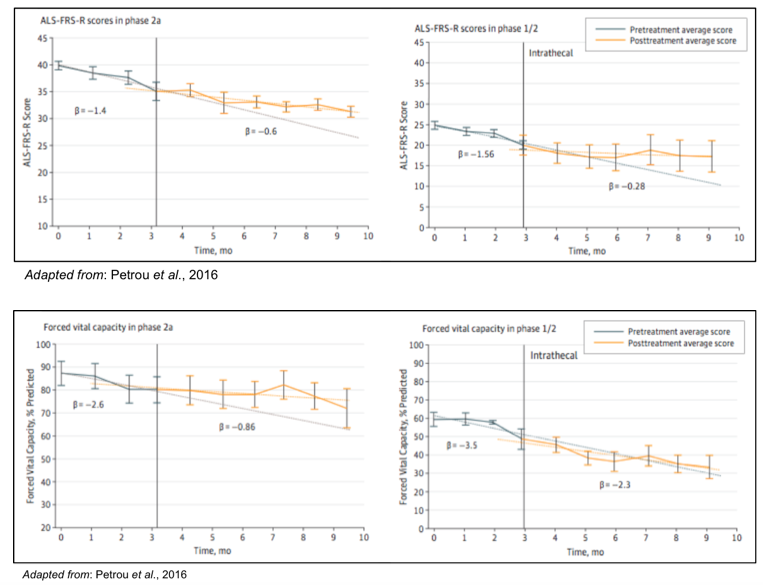
In the paper, BrainStorm indicated that a patient who demonstrated a posttreatment improvement in the slope of at least 25% for either ALSFRS-r or FVC compared to the run-in period was considered a “responder”. The reason that BrainStorm classified these patients as such is based on a 2010 survey of ALS clinicians and researchers that showed all participants in the survey believed a decline of 25% or more in the change in ALSFRS-r was at least somewhat clinically meaningful (Castrillo-Viguera et al., 2010). According to this definition, 87% of the patients injected IT with NurOwn™ were considered responders, which is a very encouraging number. These data provide a nice foundation from which to support the company’s planned multi-dose Phase 2 clinical trial, which will get underway later in 2016.
Phase 2 Clinical Trial Fully Enrolled
Brainstorm is currently conducting a Phase 2 clinical trial of NurOwn™ for the treatment of ALS in the U.S (NCT02017912). This is a randomized, double blind, placebo controlled trial that will evaluate the safety and efficacy of a single combined IM and IT administration of MSC-NTF cells in early-stage ALS patients. The trial is taking place at three centers in the U.S. (Massachusetts General Hospital (MGH), University of Massachusetts Memorial Hospital, and the Mayo Clinic) and has enrolled 48 patients randomized 3:1 to receive either NurOwn™ cells (n=36) or placebo (n=12).
Just as with the Phase 2a trial, there is a three-month run-in, followed by treatment and a six-month follow up. The primary endpoint of the study is safety based on the number of patients with adverse events, with secondary endpoints including the change in ALSFRS-r and lung function as measured by vital capacity.
The trial is now fully enrolled and all patients have completed treatment. With a six-month follow up, we are estimating that topline data will be available in mid-2016. An independent Data Safety and Monitoring Board (DSMB) is watching the trial and in February 2015 noted no issues. The DSMB conducted its second pre-planned safety review in November 2015 and again recommended that the study continue as planned with no safety issues noted.
Multi-dose Trial Set to Get Underway Later in 2016
On January 11, 2016, BrainStorm announced that the company will be conducting a multi-dose trial of NurOwn™ in ALS patients. The trial will be taking place at Hadassah Medical Center in Israel and will be used to provide guidance for a Phase 3 program for NurOwn™. We anticipate 24 patients to enroll in the trial, who will be treated with three doses of NurOwn™ spaced out every two months to explore the safety and efficacy of multi-dose administration. The company is currently awaiting approval for the trial by the Ministry of Health, and we anticipate that this will occur shortly such that the trial can get underway in the second half of 2016.
Customized Bioreactor for NurOwn™ Production
On December 1, 2015, BrainStorm announced significant progress has been made in regards to developing a novel bioreactor for industrial-scale manufacture of NurOwn™ cells. BrainStorm is working with Octane Biotech, Inc., a Canadian company that focuses on clinical systems for cell and tissue therapy, which has collaborations with a number of leading healthcare companies and academic centers. The collaboration between BrainStorm and Octane has resulted in the production of a NurOwn™-specific cassette that is employed as a disposable cartridge within Octane’s Cocoon™ platform along with a dedicated software program to track the NurOwn™ process. Octane’s Cocoon™ platform integrates multiple steps of cell manipulation in a single-use disposable cassette allowing for substantial upscaling of cell manufacturing capabilities, all under GMP conditions. Work will continue to refine the cassettes that will ultimately be used to manufacture NurOwn™ cells.
Conclusion
ALS is a rapidly progressing neurodegenerative disease whereby the nerve cells in the brain and spinal cord that control muscle movement degenerate. This rapid degeneration of the motor neurons eventually leads to death, typically in three to five years after patients are first diagnosed. As the motor neurons cease to function properly, they can no longer send signals to the muscle fibers, and thus voluntary muscle action is progressively affected. Eventually, patients in later stages of the disease may become completely paralyzed, which includes losing the ability to control their breathing. In the U.S., approximately 30,000 people are currently living with ALS. The only FDA approved treatment option for ALS is Sanofi’s Riluzole® (rilutek). It cost roughly $50,000 per year and had peak sales less than $100 million.
With the publication of data from the company’s initial trials of NurOwn™ in ALS patients, BrainStorm has successfully demonstrated proof-of-concept for NurOwn™ cells for the treatment of ALS. However, it must be kept in mind that these were primarily safety studies and did not contain a control arm. This doesn’t necessarily take away from the positive results reported, but means that additional data is necessary before firm conclusions can be drawn about the ability of NurOwn™ treatment to augment the natural progression of ALS.
We remain upbeat on the BrainStorm story, and nothing reported thus far has altered our impression of the company or the potential for NurOwn™. We recommend that investors interested in playing the ALS or cell therapy space consider BrainStorm to be a core holding.
From a valuation standpoint, we think BrainStorm shares are highly attractive. The company is well capitalized, with $15.9 million in the bank as of December 31, 2015. In terms of timeline, top-line data from the Phase 2 trial should be available before the end of the second quarter of 2016. We anticipate a Phase 3 trial starting in 2017, NDA filing in 2019, and approval in 2020. Riluzole® costs $50,000 per year and was shown to only extend survival by two to three months. We believe NurOwn™ has the potential to extend patient survival by much more than that, particularly with multiple doses. Thus, we think $100,000 per treatment is very realistic for NurOwn™. We have built a detailed financial model to forecast potential sales of NurOwn™ in ALS. We believe U.S. penetration could approach 40%, which would put U.S. sales at the $1.6 billion range. With 25% probability of success, we see BrainStorm worth $250 million, or $10 per share and we continue to rate the stock a ‘Buy’.
READ THE FULL RESEARCH REPORT HERE
SUBSCRIBE TO ZACKS SMALL CAP RESEARCH to receive our articles and reports emailed directly to you each morning. Please visit our website for additional information on Zacks SCR and to view our disclaimer.