By
David Bautz, PhD
NASDAQ:BVXVPositive Preliminary Safety Data for M-001 in Phase 2b Trial
On November 29, 2016, Biondvax Pharmaceuticals, Ltd. (NASDAQ:BVXV)
announced positive preliminary safety results from the Phase 2b clinical trial currently being conducted with M-001, the company’s universal influenza vaccine candidate. Since the data is still blinded, the distribution of adverse events amongst the total of 219 participants who completed the study in the control and experimental groups is unknown. However, only three moderate adverse events were considered to be possibly or probably related to treatment and no treatment-related serious adverse events were reported.
The BVX-007 trial is a Phase 2b clinical trial with 219 adults (age 18-60) who have completed the study. It is designed to evaluate the safety and immunogenicity of M-001 when used as a primer to the H5N1 avian influenza vaccine. The H5N1 avian influenza vaccine was given once, at a sub-optimal dose, in order to test whether M-001 can enhance its immunogenicity. If successful, this trial could show the dose sparing potential of M-001, which in the case of a pandemic situation could allow for the available doses of pandemic vaccine to be administered to more subjects. The trial is being funded through a grant from the European Union and is being conducted in conjunction with the
European UNISEC Consortium. On September 21, 2016, the company
announced that the last participant in the trial has completed their final visit and we anticipate results from this trial to be reported near the end of the first quarter of 2017.
Background on M-001
BiondVax is developing the M-001 vaccine, a synthetic peptide-based protein that targets both existing and future seasonal and pandemic strains of the influenza virus. The vaccine targets conserved regions of Type A and B influenza viruses such that M-001 could be considered a “universal” influenza vaccine, capable of offering immunological protection against all strains of the influenza virus.
The company is planning to seek regulatory approval through a two-part strategy:
1. As a “Universal Primer” to be used before any hemagglutinin-based flu vaccine. BiondVax targets two indications for its universal primer: i) seasonal primer for influenza vaccine in the elderly, and ii) pandemic primer for national stockpile
2. As a stand-alone independent “universal” vaccine against influenza.
Many infectious diseases have been eradicated over the past century, for example polio and smallpox, thanks to vaccination. In order to eradicate an infectious disease, a community (or herd) immunity must be achieved. Three conditions are required to achieve community immunity:
1. An effective vaccine,
2. Broad coverage and unchanging vaccine formulation, and
3. Enough people to be vaccinated.
With a universal flu vaccine such as BiondVax’s M-001, it appears theoretically possible, for the first time in history, to achieve the goal of influenza eradication. In support of this, the company was recently invited to attend the “Eighth WHO meeting on the development of influenza vaccines that induce broadly protective and long-lasting immune responses”. The Global Vaccine Action Plan (GVAP) has a goal for at least one universal influenza vaccine to be on the market by 2020, and the World Health Organization (WHO) is supporting this initiative through constant interaction with leading experts in the field through events such as the one BiondVax will be attending. M-001 is a leading contender to be the first universal influenza vaccine due to its safety profile and strong immunogenicity along with currently being in Phase 2b clinical trials.
M-001 Composition
M-001 is composed of nine peptides that are believed to be common to most known influenza strains in existence, in part because these peptides seem to be critical for the virus’ ability to infect a host cell. They are derived from hemagglutinin (HA), matrix 1 (M1) and nucleoprotein (NP) viral proteins and are arranged as triplicates into a single recombinant protein easily manufactured in bacteria. As discussed above, HA is an antigenic glycoprotein found on the surface of influenza viruses and is also the main constituent for a number of seasonal influenza vaccines. However, the peptides from HA in M-001 are derived from the inner parts of the protein where little to no variability between strains exists. M1 is a matrix protein that forms a layer under the patches of the viral cell membrane that contain HA, NA, and M2 proteins, and is responsible for mediating the encapsulation of RNA-nucleoprotein complexes into the membrane envelope (Sha et al., 1997). NP is a structural protein that encapsidates the viral RNA inside the virus. The sequence of each of the peptides is shown below, along with the order in which the peptides are arranged in the full-length recombinant protein.
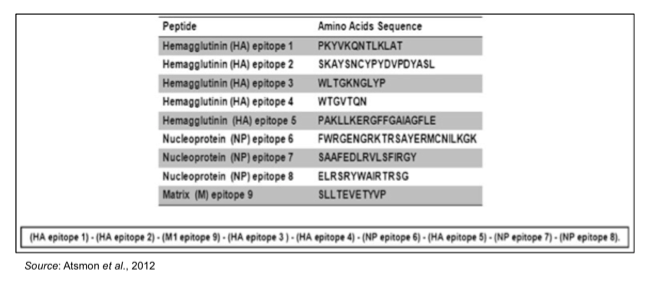
The peptides were selected based upon their ability to elicit either a B- or T-cell immune response and each of them has the ability to bind to a wide array of human leukocyte antigen (HLA) proteins (both Class I and Class II), which are responsible for presenting peptides to the immune system. Some may question the use of peptides from proteins located inside the virus, however there is a strong rationale for their use. It has long been known that a mild influenza infection in animals provides protection against a subsequent, more severe challenge with a virus harboring different HA and NA (Yetter et al., 1980). This effect appears to be mediated by both CD4+ and CD8+ T-cells that recognize conserved regions on viral proteins (Furuya et al., 2010). The CD4+ T-cells that are specific for conserved internal viral antigens also potentiate antibody responses to the HA of subsequently encountered viruses (Scherle et al., 1986). The end result is that immunizing with conserved internal viral antigens results in an increased immunological response to infection following subsequent exposure to influenza viruses.
M-001 Clinical Trial Results
Thus far, M-001 has been tested in 479 participants through five different clinical trials, with the details presented in the following chart. In each of the trials, the vaccine was shown to be safe and able to induce a robust immune response. Due to the fact that M-001 does not target the variable region of HA, the HAI assay (which is utilized to test the effectiveness of currently available seasonal influenza vaccines) cannot be employed as a surrogate endpoint for determining vaccine efficacy when M-001 is administered on its own. Thus, the company has developed additional immunological assays to determine immunogenicity. In addition, in its first stage in bringing M-001 to market, the company is pursuing a “prime-boost” strategy, where M-001 is given prior to immunization with the traditional seasonal influenza vaccine, in which case the HAI assay can be utilized to compare immunogenicity to currently available influenza vaccines. The results from some of those trials are presented below.
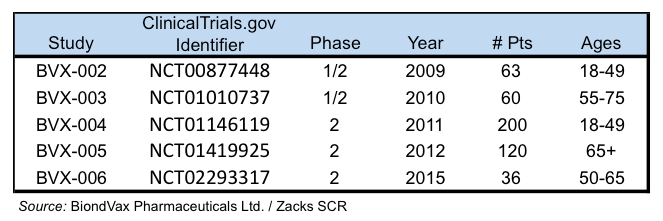
BVX-002 (Atsmon et al., 2012): This was a single-center, randomized, placebo controlled, single blind first-in-human study to examine the safety and immunological response to M-001 in healthy adults age 18-49. For safety purposes, three subjects were dosed once with 0.125 mg of M-001 and monitored for 7-9 days before the rest of the patients were administered the planned doses. There were four dosing cohorts, and within each cohort subjects were randomized in a 2:1 fashion to receive either 0.25 mg or 0.5 mg M-001 (n=10) or placebo (n=5), with or without adjuvant. The results showed that M-001 was well tolerated with only mild and moderate adverse events (AEs), with no significant difference between vaccine and placebo recipients for AEs. A robust humoral (antibodies to M-001) and cellular (PBMC proliferation to viral peptides) immune response was noted for participants immunized with M-001, and while there were greater humoral responses in patients immunized with M-001 plus adjuvant, there did not appear to be a difference in cellular response between subjects dosed with adjuvant and those without.
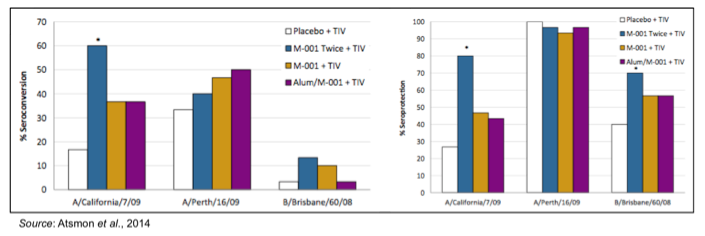
BVX-005 (Atsmon et al., 2014): This was a two-center, randomized, placebo controlled study in a total of 120 elderly volunteers (age 65+). The subjects were randomized 1:1:1:1 into four parallel groups to receive either 1) two sequential non-adjuvanted 0.5 mg M-001, or 2) a single non-adjuvanted 0.5 mg M-001, or 3) a single adjuvanted IM injection of 0.5 mg M-001, or 4) one placebo injection. All participants subsequently received the seasonal trivalent influenza vaccine (TIV) three weeks following the last M-001 or placebo injection. The primary outcome measures were safety, tolerability, and tolerance of M-001 with secondary outcomes being humoral and cellular immune responses. The results showed that priming with M-001 enhanced seroconversion towards all three strains in that season’s influenza vaccine (denoted on the y-axis in the figure below). The following figure shows the percentage of patients that tested positive for seroconversion (defined as a mean fold increase in anti-HA antibody levels of ≥ four-fold from levels detected in sera collected on day 0, and reaching a level of ≥1:40 post-immunization) and seroprotection (defined as the number of participants per cohort expressing anti-HA antibody levels of ≥1:40 post-immunization). Addition of an adjuvant did not appear to offer any additional immunostimulatory effect.
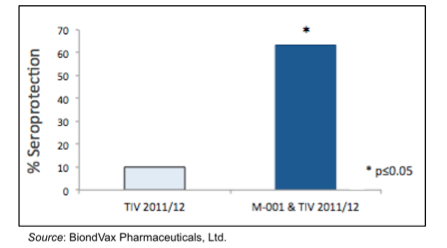
In 2015, a new ‘Swiss’ epidemic influenza strain (H3N2: A/Switzerland/9715293/13) emerged that did not exist in 2011, which was when the BVX-005 trial took place and the participants in the trial were immunized with M-001. Blood serum samples from the participants in the BVX-005 trial were exposed to the ‘Swiss’ influenza strain, with results showing that greater than 60% of the M-001 vaccinated group had seroprotection against this new Swiss strain, compared to only 10% of those immunized with just the seasonal vaccine. This suggests that M-001 may offer a broader, long-lasting immune response not just to strains currently in existence, but to future strains that do not even exist yet!
Final Phase 2 Clinical Trials for M-001
BiondVax has initiated two Phase 2 clinical trials that will involve a total of 372 participants; one that is ongoing in Europe (BVX-007) and one that will soon start admitting participants in the U.S. (BVX-008). As mentioned previously, the BVX-007 trial has completed enrollment and the results are currently being analyzed. The BVX-008 trial will take place in the U.S. and will be fully funded by the National Institutes of Health (NIH) and conducted by the National Institute of Allergy and Infectious Diseases (NIAID).
BVX-008: This will be a Phase 2 clinical trial being conducted by the NIAID, which is part of the NIH. The double blind, multicenter, randomized, placebo controlled trial is expected to enroll 150 adults (18-45) and will examine the use of M-001 as a primer vaccine to be given several weeks before the H7N9 avian pandemic vaccine. The primary outcome will be safety and tolerability with secondary endpoints examining humoral and cellular immune responses. We anticipate this trial will begin in the next few months with results available in 2017.
Financial Update
On November 28, 2016, BiondVax announced financial results for the third quarter of 2016. The company reported a net loss of $0.6 million, which included $0.6 million in R&D expenses, $0.3 million in G&A expenses, and a $0.3 million non-cash gain due to the revaluation of options. The company continues its excellent fiscal management, as total cash burn for the third quarter was $0.3 million. The company exited the quarter with approximately $7.9 million in cash, cash equivalents, and marketable securities. We anticipate the company has sufficient capital to fund operations for at least the next 12 months.
Valuation Methodology
We value BiondVax using a probability adjusted discounted cash flow model that takes into account potential revenues from the sale of M-001 as 1) a seasonal primer for influenza vaccine in the elderly; 2) a pandemic primer for a national stockpile; and 3) a stand-alone independent universal influenza vaccine. At this point, we are assuming that the company will enter into one or more partnerships with larger pharmaceutical companies that will result in BiondVax receiving royalties (we model 15% for all indications) on the sale of M-001.
As a primer for both the seasonal vaccine in the elderly and a pandemic stockpile, we model for the current Phase 2 clinical trials to be completed by the first half of 2017. This will allow for an end-of-Phase 2 meeting with the FDA and initiation of a Phase 3 program in 2018, regulatory filings in 2020, and approval in 2021.
In the U.S., there were approximately 135 million doses of the influenza vaccine administered last year with approximately 20% of those administered to the elderly. Assuming a 33% penetration rate which will use M-001 as part of prime-boost vaccine, then at approximately $20 per dose (based on a midpoint between the Fluzone HD geared to the elderly price of $28 and the standard Fluzone price of $8 per dose) it is a potential $200 million opportunity just in the U.S. We believe the rest of the world represents a potential $300 million peak opportunity. We apply an 18% discount rate and a 50% probability of approval to arrive at a net present value for M-001 as a primer for seasonal vaccination in the elderly of $41 million.
Another market is the pandemic primer for national stockpile. The critical workforce in the U.S. is approximately 15% of the population (20 million people), and 1/3rd of the stockpile is replaced annually (given a shelf-life of three years). At $12 per dose that represents another $240 million annual opportunity. We apply an 18% discount rate and a 50% probability of approval to arrive at a net present value for M-001 as a primer for a pandemic vaccine of $34 million.
As a stand-along universal vaccine, we anticipate Phase 3 trials initiating in 2019 with a regulatory filing in 2021 and approval in 2022. By that time we model for approximately 140 million doses of the influenza vaccine being administered in the U.S., and with a peak market share of 25%, we model for peak revenues of over $700 million. We apply an 18% discount rate and a 33% probability of approval to arrive at a net present value for M-001 as a stand-along universal vaccine of $36 million.
Combining the net present value for each of the company’s development programs along with the company’s current cash total and expected operating burn of $15 million, we arrive at a net present value for the company of approximately $105 million. Dividing this by the company’s fully diluted share count of 6.2 million ADSs leads to a valuation of approximately $17 per share.
For a free copy of the full research report, please email scrinvestors@zacks.com with BVXV as the subject.
SUBSCRIBE TO ZACKS SMALL CAP RESEARCH to receive our articles and reports emailed directly to you each morning. Please visit our website for additional information on Zacks SCR and to view our disclaimer.