By Grant Zeng, CFA
NYSE:CANF
Update on CF101 for RA
On Jan. 5, 2016, Can-Fite (NYSE:CANF) announced that the company has submitted its Phase III clinical study protocol to the Institutional Review Board (IRB) of Barzilai Medical Center in Israel and will file similar submissions in several European countries, Canada and the U.S.
The Phase III protocol submission in Israel follows a successful meeting that Can-Fite concluded on December 8, 2015 with the Medical Products Agency (MPA) in Sweden regarding the European registration of CF101 in the treatment of RA. During the meeting, Agreement was reached on MPA's expectations for the registration plan and the Phase III patient population, dosing, study endpoints, treatment duration and placebo management.
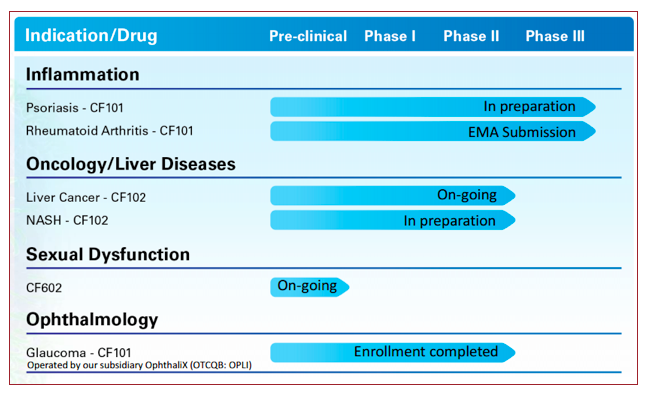
Can-Fite plans to file its Phase III protocol with the European Medicines Agency (EMA) for CF101 in the treatment of rheumatoid arthritis in the first quarter of 2016. Initiation of patient enrollment is anticipated in the second or third quarter of 2016.
The Company plans to conduct a Phase III, multicenter, randomized, double-blind, placebo-controlled, parallel-group study that will investigate the efficacy and safety of CF101 administered orally twice daily for 16 weeks to patients with active rheumatoid arthritis treated with conventional drugs.
- The study will have three arms, a 1 mg CF101 dose, a 2 mg CF101 dose and placebo, given orally twice daily in the form of tablets.
- Approximately 456 patients are expected to be enrolled in the study, where sample size has been estimated to demonstrate definitive efficacy of CF101 based on the ACR20 response.
- The A3 adenosine receptor biomarker will be evaluated prior to treatment and its correlation to patients' response to the drug will be analyzed upon study conclusion.
Over the several clinical experiences with CF101 for RA, Can-Fite has learned and identified the relationship between A3AR expression and response for CF101. Based on these findings, the company’s last Phase IIb trial demonstrated positive data of CF101 for the treatment of RA patients based on the level of A3AR expression. The planned Phase III trial uses the same criteria for screening RA patients, and therefore has a high possibility that it will replicate the results of the last Phase IIb trial.
Update on CF101 for Psoriasis
Can-Fite is now completing the design of its Phase III study protocol for CF101 in the treatment of psoriasis which the Company plans to file with the EMA in the first half of 2016 and anticipates initiating patient enrolment in the fourth quarter of 2016.
The Company previously reported positive data from further analysis of its completed Phase II/III study that suggests CF101 as a potential systemic therapy for patients with moderate-severe psoriasis.
Patient Enrollment Completed in CF101 Phase II Glaucoma Study
On Dec. 7, 2015, Can-Fite announced that its subsidiary, OphthaliX has completed patient enrollment for its Phase II trial of CF101 in the treatment of glaucoma.
The Phase II trial is being conducted in Europe and Israel and full enrollment of 88 patients has been achieved. The study is a randomized, double-masked, placebo-controlled, parallel-group study of the safety and efficacy of daily CF101 administered orally in subjects with elevated intraocular pressure (IOP). The objective of this study is to determine the safety and efficacy of oral CF101 in lowering IOP when administered twice a day for 16 weeks in subjects with elevated IOP.
The study is being conducted with two cohorts (44 patients in each cohort, 3:1 ratio). In the first cohort patients were treated with 1 mg CF101 and placebo. Blinded results from this cohort showed that the drug had a favorable safety profile and was well tolerated. In the second cohort, dosage was increased, with patients receiving 2 mg of CF101 and matching placebo, given orally every 12 hours for 16 weeks.
Top line results are expected in mid-2016.
According to GlobalData, the treatment market for glaucoma will reach $3 billion by 2023 across the seven major markets of the US, France, Germany, Italy, Spain, UK, and Japan, representing a moderate overall Compound Annual Growth Rate (CAGR) of 2.4%.
Most glaucoma drugs on the market today are generic eye drops. The key advantages of CF101 are its oral administration and excellent safety profile. CF101 has the potential to increase patient compliance and be more convenient for the patient.
CF101 has an issued patent in the U.S. for the reduction of IOP, which expires in 2030. Several similar applications are pending in major global markets.
Update on CF102
The Ongoing Phase II Trial of CF102 for Liver Cancer
Can-Fite initiated a global Phase II trial in December 2014. This is a randomized, double-blind, placebo controlled trial to be conducted in the U.S., Europe and Israel with an estimated 78 patients to be enrolled. CF 102 is being evaluated for efficacy and safety as a second-line treatment for advanced HCC in subjects with Child-Pugh B cirrhosis who failed Nexavar (sorafenib) as a first line treatment. Patients are treated twice daily with 25 mg of CF102.
The primary endpoint of the study is overall patient survival. Secondary endpoint include: time to progression (TTP), progression-free survival (PFS), objective response (OR) rate, and disease control (DC) rate.
CF102 has Orphan Drug Status in the U.S. and in Europe for the treatment of HCC. CF102 is approved for Compassionate Use for liver cancer by Israel's Ministry of Health.
Can-Fite anticipates completing enrollment in 1H16.
CF102 Expanded into NASH
In late November 2015, Can-Fite announced the expansion of its lead cancer drug candidate CF102 into new indication for non-alcoholic steatohepatitis (NASH).
The expansion is based on the compelling pre-clinical data on CF102 in the treatment of NASH. The company recently concluded preclinical study of CF102 in liver disease. In the study, CF102 revealed its capability to improve liver pathology in a NAFLD (non-alcoholic fatty liver disease)/diabetes animal model of NASH.
In the press release, the company summarized the preclinical data of CF102:
- CF102 had a statistically significant reduction in NAFLD activity score compared to placebo.
- CF102 reduced liver-to-body weight compared to placebo.
- Representative photomicrographs of H&E-stained liver sections showed improved pathology in animals receiving CF102 vs. placebo.
- CF102 decreased plasma ALT and triglycerides levels in the livers of NASH-model compared to placebo.
- Liver sections from the placebo group exhibited severe micro- and macrovesicular fat deposits, hepatocellular ballooning and inflammatory cell infiltration, whereas the CF102 treated group showed a significant decrease in steatosis, ballooning and lobular inflammation compared to the placebo group.
In prior preclinical studies, CF102 has shown efficacy in the treatment of liver regeneration and function following liver surgery.
Can-Fite plans to file a Phase II study protocol with IRBs for its first human clinical study of CF102 in the treatment of NASH in 2Q16.
Our Takeaway
We believe the expansion of CF102 into NASH represents an important milestone for Can-Fite in its clinical development.
Non-alcoholic fatty liver disease (NAFLD) is the build-up of extra fat in liver cells that is not caused by alcohol. It is normal for the liver to contain some fat. However, if more than 5% - 10% percent of the liver’s weight is fat, then it is called a fatty liver (steatosis). The more severe form of NAFLD is called non-alcoholic steatohepatitis (NASH). NASH causes the liver to swell and become damaged.
NAFLD affects about 30% of adults and 10% of children in the US, among which 10-30% will develop NASH. 25-40% NASH patients will develop progressive liver fibrosis, while 20-30% NASH patients with advanced fibrosis will develop cirrhosis, which could lead to liver cancer.
NAFLD/NASH represents a multibillion-dollar market, but currently there are no FDA approved medicines for the treatment of NAFLD/NASH.
CF102 is currently being evaluated as a second-line treatment for HCC through a global Phase II trial. Can-Fite has received Orphan Drugs Designation for CF102 for this indication in Europe and the U.S., as well as Fast Track Status in the U.S. Data from the Phase II HCC study is expected in 2016.
The addition of NASH further expands CF102’s liver disease franchise. The company plans to initiate a Phase II study in 3Q16.
CF102 is currently in a Phase II clinical trial for the treatment of liver cancer (hepatocellular carcinoma). CF102 has been granted orphan drug status and fast track designation for liver cancer by the US FDA. In October 2015, the European Medicines Agency (EMA) granted Orphan Drug Designation to CF102 for the indication of HCC.
Update on CF602
CF602 is an allosteric modulator that enhances the affinity of the natural ligand, adenosine, to the A3AR. In October 2015, Can-Fite reported new findings for its CF602 drug candidate showing a defined mechanism of action in erectile dysfunction (ED) similar to sildenafil (Viagra®) in a rat model of diabetes mellitus. CF602 demonstrated effects on erection superior to that of Viagra in animal studies.
Can-Fite plans to file an Investigational New Drug (IND) application with the FDA for CF602 Phase I study in 4Q16.
Balance Sheet Boosted by Recent Financing
As of September 30, 2015, Can-Fite had cash and cash equivalents of $14.5 million.
In September, 2015, the company closed a registered direct offering with institutional investors for gross proceeds of $9 million. In connection with the offering, the Company issued 2,068,966 registered American Depository Shares (ADSs) of Can-Fite at a purchase price of $4.35 per ADS in a registered direct offering. Additionally, for each ADS purchased by investors, the investors received an unregistered warrant to purchase one-half of an ADS. The warrants have an exercise price of $5.25 per ADS, shall be exercisable six months following the issuance date and will expire five and one-half years from the issuance date.
Further in October, 2015, the same institutional investors who participated in September’s round have invested again in Can-Fite's registered direct offering. This time, Can-Fite will issue 1,109,196 registered American Depository Shares (ADSs) of Can-Fite at a purchase price of $4.35 per ADS in a registered direct offering. Additionally, for each ADS purchased by investors, the investors will receive an unregistered warrant to purchase 40% of an ADS. The warrants have an exercise price of $5.25 per ADS, shall be exercisable six months following the issuance date and will expire five and one-half years from the issuance date. Can-Fite received gross proceeds of approximately $4.8 million.
These two new financings not only boost Can-Fite’s balance sheet immediately, but further validate its technology and clinical programs.
Current cash at hand can carry the company’s operations into mid-2017 according to our financial model.
Very Attractive Valuation
We recently upgraded Can-Fite shares to Buy with a 12-month price target of $7.50 per share. Our call was based on the multiple achievements the company has made in the past 6 months and the compelling valuation.
Can-Fite is a late stage development biopharmaceutical company focused on the development of orally available small molecule therapeutic products for the treatment of autoimmune-inflammatory, oncological, ophthalmic diseases and sexual dysfunction. The company has three lead candidates in each category: CF101 for autoimmune disease (RA and Psoriasis)/glaucoma, CF102 for liver cancer/NASH, and CF602 for sexual dysfunction.
The most advanced candidate is CF101. Can-Fite has completed a couple of Phase II studies of CF101 for RA with the most recent one achieving statistically significance based on the A3AR expression level as enrollment criteria. The company plans to initiate a Phase III trial of CF101 for RA late this year using the same enrollment criteria.
For psoriasis, Can-Fite also completed a Phase II and a Phase II/III study of CF101. The Phase II study achieved statistically significant results, but the Phase II/III failed its initial primary endpoint (PASI75 in 12 weeks). However, further analysis indicated that CF101 achieved multiple statistically significant results (PASI50, 75, 90, 100 in 32 weeks). We think the cumulative and linear improvement in CF101's efficacy over a longer period of time is a very significant finding for Can-Fite and the psoriasis treatment market. Based on the new data and the favorable safe profile, Can-Fite intends to continue the development of CF101 for the treatment of psoriasis and has initiated work on the design of the next advanced–stage clinical trial protocol.
We are especially encouraged by the fact that CF101 has the potential as a first-line systemic therapy for patients with moderate-severe psoriasis and for patients who do not want to be treated with the current systemic drugs due to safety issues. Currently there is no universally accepted first-line systemic therapy for patients diagnosed with psoriasis, and therefore CF101, an orally bioavailable drug with an excellent safety profile can be positioned for this unmet need.
For CF102, Can-Fite is conducting a global Phase II trial as a second line treatment for advanced HCC in subjects with Child-Pugh B cirrhosis who failed Nexavar (sorafenib) as a first line treatment. Top line data from this Phase II trial are expected to be available in mid-2016. Can-Fite’s strategy to test CF102 in HCC patients who are Child-Pugh B and have failed sorafenib is very risky, however it is warranted based on the positive preclinical data and Phase I/II data showing the drug to be both safe and effective in that cohort. The reward could be immense if the strategy pays off, as there is no current treatment option for advanced liver cancer patients. As we discussed above, Can-Fite just expanded CF102 into NASH and a Phase II clinical trial is expected to be initiated in 3Q16.
Can Fite is also developing CF101 for glaucoma with a Phase II trial ongoing.
The big change since our previous neutral report comes from the company’s Phase II/III trial of CF101 for psoriasis. Initial results failed the primary endpoint (PASI75 in 12 weeks). However, further analysis of the data indicated that CF101 achieved multiple positive results including PASI50, 75, 90, and 100 in 32 weeks. Moreover, the PASI 90 subset analysis further suggests a higher and significant (p=0.026) CF101 response rate of 26.9% among patients previously untreated with systemic psoriasis therapy compared to patients pre-treated with systemic drugs. Based on the new data, we believe CF101 has the increased probability to succeed in the newly planned advanced Phase III trial which will begin in early 2016.
Based on the new updates, we think current market price does not reflect the intrinsic value of Can-Fite anymore.
For RA, we estimate the company will initiate the Phase III trial in 3Q2016, file an NDA in late 2017, and receive approval in late 2018 or early 2019. For psoriasis, we estimate the company will initiate the Phase III trial in 4Q2016, file an NDA in late 2017 or early 2018, and get approval in late 2018 or early 2019.
For CF102, we estimate that upon completion of the Phase II trial a Phase III trial will be initiated in 2017, with an NDA filing in 2019 and approval in 2020. There is a very slim chance that the data from the Phase II trial will be good enough to request approval, however we do not see this as likely enough to include in our model.
Based on our long term financial model, Can-Fite will achieve profitability in 2020 with an earnings of $0.78 per ADS based on total revenue of $85 million. We believe a P/E multiple of 28 x is appropriate for the valuation of the company. Based on this relative valuation metric, we come up with a new price target of $7.5 per ADS using 30% discount rate for 4 years. Our price target values the company at $105 million based on 14 million ADS outstanding. This is still conservative in our view.
But keep in mind the risks. Our valuation assumes the final approval of the company’s three lead clinical programs including RA, psoriasis and liver cancer. Any clinical/regulatory failure or delay will have a significant negative impact on the company’s shares. Cash burn is also on our close watch list. As the company moves its clinical programs into advanced stage, R&D expenses will soar. Current cash balance can only last into 2017. The company will need to tap the capital market for further financing before it become cash flow positive in 2020. Any equity related financing will dilute existing shareholder base and will have negative impact on share price. But overall, the company has a favorable risk/award profile for investors with a long term investment horizon.
READ THE FULL RESEARCH REPORT HERE
SUBSCRIBE TO ZACKS SMALL CAP RESEARCH to receive our articles and reports emailed directly to you each morning. Please visit our website for additional information on Zacks SCR and to view our disclaimer.