By Brian Marckx, CFA
NASDAQ:CASM
NASDAQ:BABY
NASDAQ:MASI
NYSE:MDT
Today Zacks Small Cap Senior Med-Tech Analyst, Brian Marckx, CFA, initiated coverage of CAS Medical Systems. See below for free access to the 25-page report.
SNAPSHOT
CAS Medical Systems, Inc (NASDAQ:CASM) is an established medical device company engaged in the manufacture and sale of non-invasive monitoring products. Over 30 years ago they brought to market the first blood pressure cuff designed specifically for neonates. Their product offerings evolved over the years into a collection of unrelated low margin monitoring products. However, in the past few years the company has largely transformed their menu from low-margin commodity products to higher-margin medical disposables through investment and growth in their tissue oximetry product line and the divestiture of their legacy products.
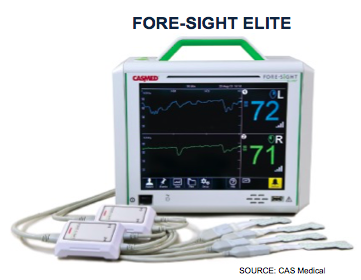
Lead products are the FORE-SIGHT line of tissue oximeters (and disposable sensors) which includes ELITE, a second-generation model that launched in September 2013 and which has been the major impetus to the 37% and 24% revenue growth of their tissue oximetry segment in 2014 and 2015, respectively. FORE-SIGHT ELITE neonatal and pediatric sensors were launched in September 2015 which are expected to further steepen the revenue curve as this segment comprises ~25% of the total market.
The company recently began to divest most of its lower-margin legacy portfolio (“Traditional Monitoring”), shedding their blood pressure cuffs in 2010, vital signs monitoring products in late-2015 and non-FORE-SIGHT neonatal disposable products in March 2016. OEM non-invasive blood pressure measurement products are the only remaining legacy devices. Divestitures in Traditional Monitoring has allowed CASM to shift more of their focus to exploiting the higher growth and bigger margin opportunities afforded by the FORE-SIGHT product line and the tissue oximetry segment in general.
Cerebral oximeters are used to monitor the level of oxygen in the blood. Low levels of cerebral oxygen can result in brain injury, leave a person with permanent cognitive impairment and even result in death. While cerebral oximetry is not currently considered standard of care during surgery, there has been a consistent trend towards greater adoption among anesthesiologists. This is being driven by more evidence supporting the cost and patient-outcome benefits of accurate brain oxygen monitoring as well as studies showing that cerebral desaturation events occur in up to 60% of certain common surgeries but are often undetected by current standard monitoring techniques.
Not all cerebral oximeters provide the same amount of information or level of accuracy. Over 200 manuscripts, clinical studies and publications have referenced FORE-SIGHT since 2005. This includes a study by the University of California San Francisco which showed that FORE-SIGHT outperformed competing devices and a study by Duke University which indicates that ELITE (the second-gen device) is even more accurate.
The FORE-SIGHT system consists of a monitor and higher margin disposable sensors. Management’s goal is to transition from a medical capital equipment company to one which primarily provides disposables to an installed base. The growing monitor installed base is providing a multiplier effect to sensor sales, resulting in rapidly improving profitability and increasing the proportion of total tissue oximetry revenue contributed by consumables.
As of the end of 2015 cumulative monitor shipments stood at 1,708, up almost 29% from the end of 2014. In 2015 revenue from continuing operations (i.e. excluding the divested vital signs monitoring and neonatal disposable products) grew 15% year-over-year. This includes 25% growth in disposable sensor sales which helped push gross margin up by almost 525 basis points, improved operating loss of more than 10% and resulted in significantly lower cash burn. Gross profit is expected to also benefit from the lower manufacturing and service costs of ELITE as compared to the first generation FORE-SIGHT monitor.
CASM pegs the current worldwide market for cerebral oximetry at approximately $100 million but expects this to rapidly expand due to further penetration in surgical procedures where it is already seeing moderate and growing use as well as initial adoption in others. If it becomes standard of care in surgical applications, management believes the global cerebral oximeter market could be worth as much as $500 million or more. The ICU is a possible follow-on opportunity, a market which could be worth more than double that of the surgical space.
Much of CASM’s unit placement and revenue growth appears to be coming at the expense of competitors’ market share as hospitals are increasingly switching to FORE-SIGHT. Management estimates that approximately one-half of new accounts are coming from competitor-switching and the other half from hospitals’ initial adoption of tissue oximetry. Nine of the top twenty adult cardiac hospitals in the U.S. are now using CASM’s oximeters and utilization is increasing - in 2015 sensor sales to existing domestic customers increased by 10%.
The company is looking to further leverage FORE-SIGHT’s performance-leading message and recently increased headcount in their direct sales force from 14 to 22 in order to expand on their current ~20% share of the U.S. market. And in late 2015 they brought on an experienced medical device sales executive to lead their domestic sales efforts. Some of the growth in FORE-SIGHT utilization is also extending to international markets where the products are sold via third-party distributors. International total tissue oximetry and sensor sales increased 17% and 55%, respectively, in the fourth quarter 2015 driven by additional gains in larger territories including China, Japan, Germany and the U.K.
The U.S. market is where CASM is focusing most of their efforts. Management is guiding for FORE-SIGHT revenue growth of 20% in 2016, driven mostly from domestic sales and facilitated by sales force productivity gains, continued market share gains and growing contribution from the recent introductions into the neonatal and pediatric markets. Meanwhile, international sales growth expectations are less robust due to unfavorable currency exchange rates, pricing pressures and year-over-year comparisons which will compete against distributor stocking orders from early 2015.
Investment Considerations
Traditional Monitoring
The company has now divested most of their legacy portfolio (“Traditional Monitoring”), which now only includes OEM non-invasive blood pressure measurement products. CASM divested their 740 brand vital signs monitoring products in late-2015 and their non-FORE-SIGHT neonatal disposable products in March 2016 as they continue to shift more of their focus to the FORE-SIGHT product line and the tissue oximetry segment in general. While we expect the traditional monitoring segment to continue to generate some revenue, the proportional contribution will likely continue to slide as CASM leverages the more significant growth opportunities surrounding FORE-SIGHT.
Excluding the 740 product line and the non-FORE-SIGHT neonatal disposable products which have been reclassified as discontinued operations, sales of traditional monitoring products were approximately $4.6M in 2014, accounting for about 27% of total sales. Revenue in this segment fell 11% in 2015 to $4.1M, contributing only about 21% of total revenue. On the Q1 2016 earnings call (May 2016) management guided that they expect sales in this segment to remain roughly flat in 2016 but for FORE-SIGHT sales to grow by more than 20%. If that happens, traditional monitoring‘s contribution will fall to less than 18% or less.
FORE-SIGHT
FORE-SIGHT, and particularly FORE-SIGHT ELITE in the U.S. market, is what represents the most significant growth opportunity for the company. Total FORE-SIGHT sales increased 24% to $15.4M in 2015, with disposable sensor revenue increasing 25% (+$2.6M) including 22% growth in the U.S. The first quarter of 2016 marked the 24th consecutive quarter of double-digit growth in U.S. sensors sales. We think there are several reasons why this streak will continue – some of which are related to the overall cerebral oximetry market and others which are specific to CASM.
Increasing adoption of cerebral oximetry
CASM estimates that worldwide annual sales of tissue oximetry products (monitors and consumables) currently sits at about $100M but expects this to grow to around $500M or more. This is expected to be driven by increasing adoption of cerebral oximetry in both the customer channel (i.e. – more hospitals using it) and the procedural channel (i.e. – use in additional types of surgeries and conditions), growth of both of which is being driven by the large and growing list of clinical evidence supporting its benefits. As we detailed earlier, there is a plethora of clinical data showing; a.) cerebral oxygen desaturation events are commonplace during certain surgeries and are associated with adverse patient outcomes as well as increased healthcare costs and b.) NIRS can rapidly and effectively identify CDEs can empower clinicians to improve patient outcomes and reduce what might otherwise be extended hospital stays and related cost.
Important to understand is that while cerebral oximetry has been around for decades, adoption had been low, perhaps due to a lack of accuracy in historic monitors and lack of data supporting its utility. This has recently started to change. Most or all of the tissue oximeter manufacturers continue to sponsor or otherwise support additional clinical studies, case reports and white papers aimed at further broadening the supporting evidence of the clinical utility and effectiveness of cerebral oximetry. We think this will drive further adoption of cerebral oximetry in general, promote increased use in surgery where it has already experienced a meaningful level of use such as in CABG and draw greater interest in others such as complex thoracic surgical procedures or shoulder surgery using the ‘beach chair’ position where adoption remains more nascent.
FORE-SIGHT’s competitive performance
While industry data supporting the benefits of cerebral oximetry such as the ability to better identify CDEs and resultant improved patient outcomes and lower healthcare costs should have the effect of benefitting all manufacturers, head-to-head clinical evidence indicating superior accuracy of FORE-SIGHT over Medtronic’s (NYSE:MDT) INVOS, the unquestionable market leader (by installed base), appears to be resulting in customers switching to CASM’s device at the expense of competitors’. Management estimates ~one-half of new accounts are coming from competitor-switching and the other half from hospitals’ initial adoption of tissue oximetry.
ELITE’s benefits
Compared to the first-generation model, FORE-SIGHT ELITE provides greater accuracy as it emits five wavelengths of light instead of just four, providing for greater ability to sort out confounding variables (i.e. minimizes “noise” even further) and allows for monitoring of four channels (instead of just two) of patient data. Additional channels allow for the monitoring of both cerebral and somatic (i.e. body) tissue oxygenation. In addition, ELITE has a larger viewing screen touch-screen controls and has been designed as to have lower manufacturing and servicing costs. Customers are clearly finding value in the enhancements of ELITE as first-generation users have rapidly upgraded to the new model. These benefits are also showing up in the market share wins against competitors. CASM expects to add other functionality which could potentially include continuous hemoglobin measurement. And in addition to facilitating revenue growth, the lower manufacturing and servicing costs should show up in wider gross margins.
Bigger installed base + increasing utilization = sensor sales multiplier effect
FORE-SIGHT net cumulative worldwide shipments as of 2015 year-end were 1,708 units, up 29% (+26% in the U.S.) from 1,329 units at the end of 2014 (note that conversions from 1st-gen to ELITE are not considered new monitor placements) which was 42% greater than the 935 units on the market as of the close of 2013. Management has guided for another ~400 units (net) to be sold in 2016, which would push the total installed base up to about 2,100. Nine of the top twenty cardiac hospitals are now using FORE-SIGHT. Expect the customer base within the cardiac segment, but also in other areas of specialization on proxy label expansion by anesthesiologists, to continue to grow.
Utilization per account is also increasing. In 2015 ‘same-store’ accounts (i.e. – those in existence for at least one year) increased their sensor purchases by an average of 10% as compared to 2014. At least part of this increased usage relates to hospitals incorporating FORE-SIGHT into more and different types of applications and procedures – which is essentially analogous to expansion of the indications that it is appropriate for (i.e. label expansion). This is particularly telling, as it indicates that anesthesiologists may be using FORE-SIGHT in procedures where it is less commonplace – which relates to the expectation (as we discussed above) that adoption of cerebral oximetry will broaden within the procedural channel.
More customers plus increased utilization per customer is a leverage effect which will result in steeping of the sensors sales curve. We are modeling sensors and monitoring sales growth of 8% and 24% in 2016 and even more leverage in 2017 when we look for sensors sales to increase 31%. This leverage effect also benefits profitability given the wider gross margins on the sensors (i.e. –‘razor blade’) as compared to that of the monitors (i.e. – ‘razor’).
Pediatric / neonatal applications
FORE-SIGHT ELITE neonatal and pediatric sensors were launched in September 2015 and are expected to further steepen the revenue curve. This is a big segment, comprising ~25% of total U.S. tissue oximetry. While adult cerebral oximetry uses two sensors (on each side of the forehead) and is mostly limited to surgical procedures, pediatric/neonatal tissue oximetry may use sensors on the body as well as the head (i.e. more sensors used per application) and is commonly used in the ICU, as well as during surgery. As such, this represents a sizeable opportunity. Management noted on the Q4 2015 earnings call that their pediatric/neonatal offering is already being well-received and, similar to the adult version, they are seeing first-generation FORE-SIGHT users converting to ELITE neonatal/pediatric and also scoring new customer wins.
Sales force expansion
The company is looking to further leverage FORE-SIGHT’s performance-leading message and recently increased headcount in their (U.S.) direct sales force from 14 to 22 and expects to incrementally add to this. As the new reps climb the productivity learning curve revenue-per-rep should increase. CASM is already seeing improvement in productivity from the newly-hired sales people.
Disposables business model
Management’s goal is to transition into mostly a disposables company – that is, one which generates the vast majority of revenue from FORE-SIGHT sensors. This affords several benefits;
- the heavy-lifting in terms of sales and marketing with a razor/razor-blade business model is establishing a meaningful installed base (selling the ‘razor’ – i.e. FORE-SIGHT monitor)
- as consumables (‘razor blade’ - i.e. FORE-SIGHT sensors) feed an already established monitor installed base, re-orders require relatively minimal resources to sell and follow-on orders become predictable
- not only do the consumables require less resources and effort to sell, they also carry most of the margin
So as CASM leverages its business model discussed above, not only should sensors sales grow significantly faster than monitors, blended gross margin should also continue to expand up towards the sensors’ margin. Likewise, there should be meaningful improvement in operating expenses as a percentage of sales – due to a combination of more revenue to dilute the fixed-cost portion of SG&A and less-resource and cost intensive sales proposition of sensors as compared to that of the monitors.
This transition to a disposables company is well underway as disposables are growing to account for a larger portion of both total oximetry sales as well as total overall product sales. On a continuing operations basis, FORE-SIGHT sensors accounted for 84% and 61% of tissue oximetry and total overall products sales (pro forma for exclusion of vital signs and non-FORE-SIGHT sensors businesses), respectively, in 2014. In 2015, these grew to 85% and 67% and we are modeling 86% and 71% for 2016.
This transition has and should continue to benefit margins. Gross margin in 2014 was 44.5% which grew to 49.2% in 2015. We are modeling gross margin of 53.1% in 2016, which could actually end up being conservative given that GM was 52.8% in Q1 2016. Gross margin should benefit from manufacturing efficiencies as well.
Valuation
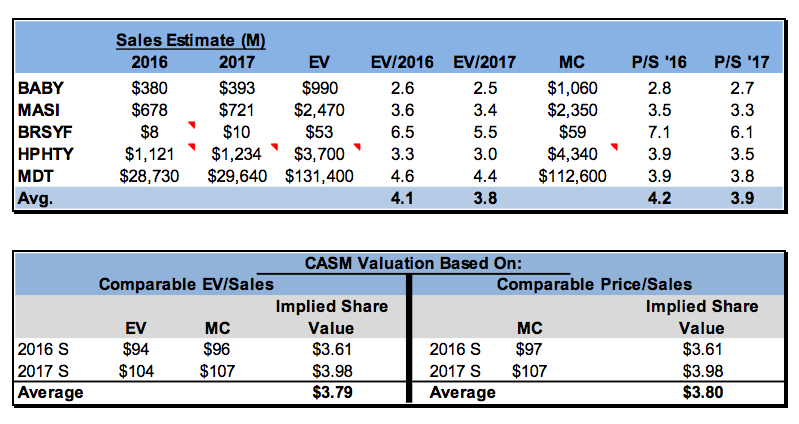
We value CASM using comparable EV/S and P/S ratios of other publicly traded companies in the tissue oximeter, patient monitoring and cardiac surgery industries including direct competitors Masimo Corporation (NASDAQ:MASI), Hamamatsu Photonics (HPHTY) and Medtronic (MDT). As the other tissue oximetry competitors are not publicly traded, we have rounded out our comparable cohort with companies which have similar exposure to CASM’s end markets including Brainsway (BRSYF), a manufacturer non-invasive brain stimulation devices and Natus Medical (NASDAQ:BABY), which makes monitoring and detection devices for neonatal neurological disorders.
Both EV/S and P/S value CASM at approximately $4/share, indicating the market is substantially undervaluing the stock. We are initiating coverage of CASM with a $4/share price target.
READ THE FULL INITIATION REPORT HERE
SUBSCRIBE TO ZACKS SMALL CAP RESEARCH to receive our articles and reports emailed directly to you each morning. Please visit our website for additional information on Zacks SCR and to view our disclaimer.