By Brian Marckx, CFA
NASDAQ:CBMX
Largest Study To-Date Further Reinforces CMA Superiority Over Karyotyping
While several studies over the last number of years, including the widely cited Reddy et al and Wapner et al studies which have positively influenced reimbursement policy, have all indicated that chromosomal microarray analysis (CMA) is the preferred genetic testing modality versus karyotyping due to the former's proven greater accuracy, that it provides more substantive clinical information and is able to be used on fresh as well as preserved (i.e. FFPE) tissue, none was as large as CombiMatrix's (NASDAQ:CBMX) recently published study which included over 8k samples.
The study, published (in advance online) in Genetics Medicine on June 23, 2016 and titled Comprehensive genetic analysis of pregnancy loss by chromosomal microarrays: outcomes, benefits, and challenges, further reinforced the superiority of CMA over karyotyping and could be another catalyst to driving demand for CBMX's CMA testing products and services.
Lead by Dr. Trilochan Sahoo, CBMX's VP of Clinical Affairs and Director of Cytogenetics, investigators collected 8,298 tissue samples - most of which were due to recurrent pregnancy loss but also due to fetal demise, stillbirth, neonatal death and certain fetal structural abnormalities. Of the 8,118 samples that were eventually tested (most were tested with CBMX's SNP-based microarray) ;
- 6,196 (76%) were fresh POC samples
- 1,823 (23%) were FFPE samples
- 99 (1%) were a variety including amniotic fluid, cultured cells, DNA and cord blood
Of the 8,118 samples that were tested by CMA;
- 91% (7,396) were successfully processed (the most common reason for test failure was insufficient or no fetal tissue) which include;
- 92% (5,725 / 6,196) of the fresh POC samples
- 86% (1,575 / 1,823) of the FFPE samples
- 97% (96 / 99) of other non-FFPE samples
This 91% success rate further supports the use of CMA and compares to a historical rate (as established in various other clinical trials) as low as 60% to 80% with karyotyping, which has been considered the standard pregnancy loss testing methodology. The relatively low success rate of karyotyping relates to culture failure and significant false-positive rates due to maternal cell contamination (MCC).
Culture failure (i.e. tissue dies) occurs in as many as 20% - 55% of products of conception, making karyotyping much less reliable than CMA given that the latter analyzes DNA extracted directly from tissue, can analyze non-living tissue and usually does not require culturing. MCC relates to cells of the mother cross-contaminating the fetal culture which can produce erroneous results with karyotyping. False-negative results due to MCC have been reported as high as 50% or more. As CMA can detect and differentiate the maternal DNA, MCC is much less likely to cause erroneous results.
Other well-documented drawbacks of karyotyping is the relatively long turnaround time for performing the test and that it can not be used with tissue that has been preserved with formalin-fixed, paraffin-embedded (FFPE).
Results:
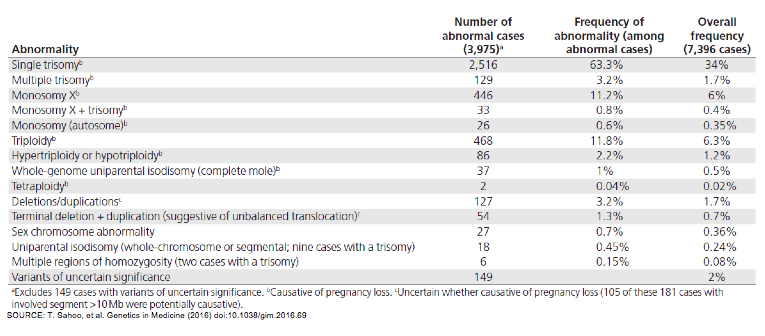
As noted, 91% )7,396) of samples were successfully processed. Abnormal results were found in 54% (3,975) and normal results in 44% (3,272) of all samples. 2% (149) of all samples showed variants of unknown significance.
Of the 5,821 fresh and non-FFPE samples, 45% had an abnormal result. Of the 1,575 FFPE samples (which karyotyping would be unable to process), 49% were abnormal.
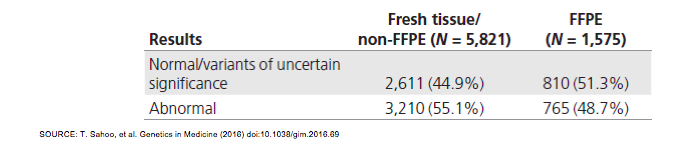
Perhaps particularly noteworthy is that the investigators found approximately 94% of results which had abnormalities would be expected to have been cause for pregnancy loss or fetal demise. In addition, the SNP-array was able to provide additional information compared to traditional testing methods including whole-genome uniparental isodisomy or molar pregnancy. The investigators surmised that approximately 5.6% of cases with reportable findings would not have been identifiable with karyotype or FISH analysis. And when taking into account the 21% of reportable samples which were FFPE and that MCC could provide erroneous results with those traditional testing methods, the authors note that, "it is reasonable to suggest that the outcomes from microarray analysis are significantly superior to those of conventional cytogenetics".
READ THE FULL RESEARCH REPORT HERE
SUBSCRIBE TO ZACKS SMALL CAP RESEARCH to receive our articles and reports emailed directly to you each morning. Please visit our website for additional information on Zacks SCR and to view our disclaimer.