By
Brian Marckx, CFA
NASDAQ:CBMX
Q3: New Records In Revenue, Customers, Pricing, Margins, Cash Collections, Profitability
Déjà vu, except even better. CombiMatrix (NASDAQ:CBMX) reported financial results for the third quarter ending September 30th. Not only was this the sixth straight quarter of improving profitability but sequential operating loss fell by an impressive 31%, from $1.2M in Q2 2016 to just $846k in Q3, marking the first time that operating loss fell below the $1M mark.
Management has done a noteworthy job of growing the top line through a combination of test volume growth, expansion of the customer base (to a current record of 257), improved cash collections and higher average test pricing (or reimbursement). But, in our opinion, what is even more impressive is that they’ve done so while also shedding expenses and improving margins. The result has been revenue growing 26% yoy through the first nine months of 2016 (including 29% in Q3) and average gross margin and operating loss improving from 45.6% and $4.9M to 53.6% and $3.5M over the same period.
The company is getting ever-closer to reaching profitability. In the Q2 earnings release management announced their expectations of reaching cash flow positive by Q4 2017 – they reiterated that goal with the Q3 earnings release.
And, importantly, we characterize the improved profitability as ‘high quality’ and what reasonably could be expected to be replicable given that these are the products of CombiMatrix’s direct efforts and/or favorable changes in industry fundamentals. CBMX has been actively engaged in their fate by targeting geographic areas with favorable reimbursement, sponsoring or otherwise supporting evidence-based studies, communicating with payers and optimizing their product portfolio to include cash-pay products. The company’s recent implementation of a new compensation model and other efficiency initiatives has resulted in a rapid and substantial shedding of expenses. And favorable changes in payers’ coverage decisions, CBMX’s investments in billing and collections resources and their deft updates to their product portfolio have contributed to margin expansion and greatly improved cash collections.
As a reminder, following CBMX's announced Q1 results we noted in our May 6th update that "results were what we would characterize as very good in general and even more compelling on the reimbursement side, particularly in miscarriage testing. Q1 could prove to be an inflection point of sorts on the reimbursement and insurance coverage fronts." We doubled-down on that supposition when CBMX reported strong Q2 results. We are tripling down on that with the even stronger results in Q3.
Average pricing in each of the six itemized testing categories continues to be very strong and particularly so in the reproductive health microarray segment (i.e. prenatal, miscarriage analysis and CombyPGS), which is expected to continue generate outsized growth for the company. Average reimbursement in CBMX’s reproductive health segment increased by 20% through the first nine months of 2016 as compared to the same period in 2015.
Miscarriage analysis, which accounts for approximately 70% of the reproductive health microarray portfolio’s revenue, and just over 50% of CBMX’s total diagnostic services revenue, is the main driving force behind the significant increase in average reimbursement as well as the company’s total revenue growth. Positive coverage decisions by payers (already 22 have revised in 2016) as a result of more clinical evidence supporting the use of CMA in miscarriage testing along with CBMX's direct efforts in facilitating the customer billing and reimbursement process have helped push up average reimbursement in this segment (i.e. miscarriage testing) by 25% in just the last 12 months. This, along with growing demand for miscarriage analysis testing, success of the recently launched PGS (IVF) test, laboratory and operating efficiencies, and concentrating sales efforts in reimbursement-friendly areas is pushing up revenues, margins and cash flow to new records.
Miscarriage analysis…
We noted in our recent updates that while it appeared recent coverage decisions were making a positive impact to average per test miscarriage pricing, we felt there needed to be more history before we could make a more determined commitment in upwardly revising our forecasted miscarriage reimbursement. But, now with three consecutive quarters of very strong pricing, continued action by more insurers including CMA as ‘medically necessary’ for the evaluation of pregnancy loss, growing database of evidence supporting the use of CMA and management's industry insight indicating this positive shift will continue, have all contributed to us meaningfully upwardly revising our forecasted miscarriage pricing.
And while miscarriage analysis volumes came in slightly lower than our estimates over the last two quarters, at least a portion of this was due to a certain customer bringing testing in-house. Importantly, CBMX noted on the Q3 call that they added “several large accounts” over the last six months and we fully expect miscarriage testing volumes to accelerate going forward. And despite this miss to our number in Q3, miscarriage volumes and revenue both exhibited strong growth on both yoy and sequential basis.
Miscarriage analysis generated $1.6M in revenue in Q3 on 990 tests sold – this compares to $1.2M (+42%) and 866 (+14%) tests in Q3 2015 and $1.4M (+11%) and 901 (+10%) tests in Q2 2016. Average pricing in Q3 was $1,638 – while not a record, it remained very strong and largely consistent with 1H 2016 ($1,624). Average pricing through the first nine months of 2016 was $1,629, 25% higher than the same period in 2015 ($1,302).
While miscarriage testing had already been a major catalyst to the company’s growth, with it now accounting for 50%+ of total revenue, volumes growing in the double digits (save for the non-fundamental slide in Q2) and already carrying one of the highest average payment rates, the recent supporting industry fundamentals and CBMX’s plan to dedicate an even greater focus on this area could result in an ever-steepening revenue curve. The recent jump in average pricing is not only benefitting revenue it is also having a dramatic positive effect on margins and profitability. In addition to certain lab efficiencies, the 25% yoy growth in average miscarriage pricing helped push gross margins up by an average of 800 basis points (45.6% vs 53.6%) over the same period. This includes a 1,040 b.p. difference in the most recent quarter (43.6% vs. 54.0%).
I
VF (CombiPGS, Multi-PGS, PGD)…
While CombiPGS (IVF test) volumes were largely flat on a sequential basis in Q3, they continue to show strong yoy growth. PGS volume was 199 in Q3, up 57% from 127 in Q3 2015. And while volume was approximately flat from 200 in Q2 2016, importantly average pricing per test continues to demonstrate strong growth both yoy and sequentially. Average pricing in Q3 was $1,437, up 23% from $1,173 in Q3 2015 and 14% higher than Q2 of this year. In fact the relatively strong pricing in the most recent period pushed PGS total revenue up to $286k, which is a new record and 13% higher than the previous best ($252k in Q2 2016). Management noted that PGS pricing is benefitting in part from testing a greater average number of embryos per patient.
CBMX recently launched PGS on a Next Gene Sequencing (NGS) platform which provides benefits of even greater accuracy and greater throughput should further benefit demand and testing volume. CBMX’s IVF business could also see incremental benefit from their recently launched multi-cycle PGS offering as well as the more recently introduced PGD test. PGD tests an embryo for specific genetic disorders or genetic abnormalities based on the genetic status of the parents (which may be carriers of certain genetic abnormalities). Similar to PGS, PGD is offered on a per-embryo or multicycle basis. If PGD adoption is as swift as PGS has been, it will be needle-mover for CBMX – this, along with the newly launched PGS-NGS test will be something to keep on eye on. And with all of these tests being cash pay, CBMX avoids being at the mercy of insurers’ coverage decisions, making cash flow and collections more predictable.
Prenatal…
Prenatal had slipped fairly consistently over the course of 2015 – going from 324 tests sold in Q1 to just 228 in Q4. Sequential volume has ticked back up to 264 in Q1 and 294 in Q3 of this year, although on a yoy basis volumes are down 8% through the first nine months of the year. We suspect an issue since early 2015 may have been CBMX’s distribution partner, Sequenom (SQNM), driving a push of their NIPT tests. And LabCorp’s (LH) recent acquisition of Sequenom may shake things up even more. But, on the positive side, management noted that they have been able to pick up some of Sequenom’s accounts to which they can now sell direct. As such, we think prenatal could return to consistent sequential growth.
And there are other reasons to be optimistic about the prenatal business. This includes the recent improvement in average reimbursement (up 7% through the first nine months of 2016), recent updated recommendations from ACOG and SMFM supporting the use of CMA for prenatal diagnosis and additional recent clinical evidence highlighting the significant accuracy issues (i.e. susceptibility to high rates of false-positive and false-negative results) of NIPS. And while NIPS demand remains robust, and could benefit further from a recent update by the American College of Medical Genetics and Genomics (ACMGG) recommending use of it for screening of Patau, Edwards and Down Syndrome in place of conventional screening, its accuracy issues mean that CMA will continue to be used as a confirmatory diagnosis. In fact ACMG's recent recommendation notes that
, "For some patients the goal in prenatal screening may be to maximize the detection of fetal genetic diagnoses. In this cenario, fetal diagnostic testing (e.g., chorionic villous sampling or amniocentesis) followed by chromosomal microarray (CMA) using fetal DNA should be offered, and NIPS may not be the best choice."
Pediatric…
Pediatric volume growth was flattish in 2015. Through the first nine months of 2016 volume fell to 1,454 from 1,557 (-6%) in the same period 2015. But due to a favorable move up in pricing, on a revenue measure pediatric performed slightly better, falling just 2% ($1,687 to $1,647). Despite the recent softness, we continue to think pediatric has some room for incremental volume growth going into 2017.
Non-array…
While not considered CMBX’s bread-and-butter focus, non-array has and continues to be an important contributor. Non-array volume and revenue grew 51% and 69%, respectively, in 2015 accounting for almost 10% of total revenue. The first nine months of 2016 saw sequential and yoy volume growth of non-array of 16% and 18%, respectively. But, despite the strong growth of the segment, non-array pricing, while fairly stable, remains at roughly 25% of CBMX’s average microarray tests. As such, while still meaningful contributor to revenue, we don’t expect this segment to be much of a driver of the top-line or of margins.
Totals… Billable tests:
- Volume: Q3 set a new record in total billable tests at 2,835 – up 14% yoy and 2% sequentially
- Diagnostic Revenue: Q3 also set a new record in revenue at $3,211 - up 29% yoy and 5% sequentially
Reproductive Health: this is CBMX’s major area of focus.
- Volume: Q3 set a new record in total billable Reproductive Health tests at 1,483 - up 17% yoy and 6% sequentially
- Revenue: Q3 set a new record in reproductive health revenue at $2,316 is up 39% yoy and 6% sequentially
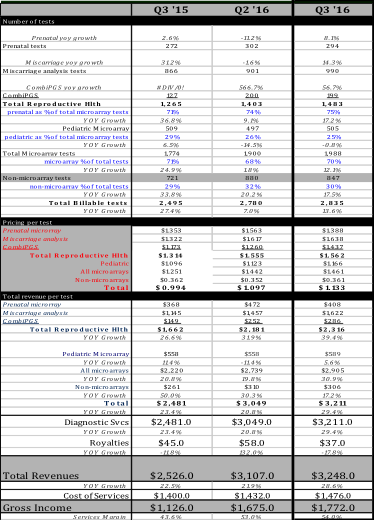
Relative strength in pricing particularly in miscarriage and prenatal, coupled with CBMX's direct efforts in facilitating the customer billing and reimbursement process, pushed service margin up to 54% which is a new record and ahead of our 52% estimate. Service margin in the comparable periods were 43.6% in Q3 2015 and 53% in Q2 2016. The recent big jump in margin, coupled with strong pricing on miscarriage, positive industry fundamentals, recent favorable coverage decisions and CBMX's own successful efforts in facilitating collections have prompted us to make another upward revision to our service margin estimates. In fact management noted that they believe 50%+ GM is sustainable going forward.
Q3 OpEx was $2.6M, significantly better than our $3.2M estimate. CBMX continues to see greater leverage in OpEx with ramping revenue, productivity gains from the sales force and efficiency efforts. Management also noted on the Q3 call that they have implemented a compensation policy for new hires which places greater emphasis on production and which has also had a significant positive benefit to OpEx. Noteworthy is that Q3 witnessed the greatest leverage in operating expenses that CMBX has experienced on not only a percentage of sales basis, but due to the very strong service margin, even more so on a percentage of gross income basis. Operating expenses were 1.46x gross income in Q3 2016 – this compares to 2.37x in all of 2015, 2.76x in 2014 and 3.16x in 2013. It is also significantly better than the 1.72x in Q2 2016 - the prior best. This highlights how the growth in test volume and improvement in pricing and margins is moving CBMX closer to profitability.
The $3.1M in cash collections also were a new record. CBMX used $813k in cash for operations in Q3 and exited the quarter with $4.3M in cash. Management believes the current cash balance is sufficient to fund operations for at least the next 12 months. Based on the current burn rate and expectations that revenue and profitability continue to improve, it's possible the current cash balance could be sufficient to fund operations until Q4 2017 - which is when management is forecasting being to the point of cash flow break even.
For a free copy of the full research report, please email scrinvestors@zacks.com with CBMX as the subject.
SUBSCRIBE TO ZACKS SMALL CAP RESEARCH to receive our articles and reports emailed directly to you each morning. Please visit our website for additional information on Zacks SCR and to view our disclaimer