By
Brian Marckx, CFA
NASDAQ:CBMX
Q2: Record revenue, record total billable test volumes, record gross margin, record cash reimbursement, fifth consecutive quarter of improving operating loss and guidance to be at cash flow B/E by Q4 2017
As a reminder, following CombiMatrix's (NASDAQ:CBMX) announced Q1 results we noted in our May 6th update that "results were what we would characterize as very good in general and even more compelling on the reimbursement side, particularly in miscarriage testing. Q1 could prove to be an inflection point of sorts on the reimbursement and insurance coverage fronts."
Based on CBMX's Q2 results, we are doubling down on that supposition. Average pricing in each of the six itemized testing categories was relatively very strong and particularly so in the reproductive health microarray segment (i.e. prenatal, miscarriage analysis and CombyPGS), which is expected to continue generate outsized growth for the company. Positive coverage decisions by payers (already 15 have revised in 2016) as a result of more clinical evidence supporting the use of CMA in miscarriage testing along with CBMX's direct efforts in facilitating the customer billing and reimbursement process have helped push up average reimbursement in this segment by 26% in just the last 12 months. This, along with growing demand for miscarriage analysis testing, success of the recently launched PGS (IVF) test, laboratory and operating efficiencies, and concentrating sales efforts in reimbursement-friendly areas is pushing up revenues, margins and cash flow to new records.
Fundamentals point to this trend continuing and, based on the following comment in the Q2 earnings release, management clearly believes the same. “We expect improved financial and operational performance throughout 2016 and 2017 with continued growth in revenue and test volume, along with consistent cash reimbursement and prudent expense management,” added Mr. McDonough. “Given our current outlook, we expect to reach positive cash flow from operations by the fourth quarter of 2017.”
Miscarriage analysis…
We noted in our Q1 update that while it appeared recent coverage decisions were making a positive impact to average per test miscarriage pricing, we felt there needed to be more history before we could make a more determined commitment in upwardly revising our forecasted miscarriage reimbursement. While we still have not jumped in with both feet, two consecutive quarters of strong pricing, continued action by more insurers including CMA as ‘medically necessary’ for the evaluation of pregnancy loss, growing database of evidence supporting the use of CMA and management's industry insight indicating this positive shift will continue have all contributed to us meaningfully upwardly revising our forecasted miscarriage pricing.
And while miscarriage analysis volumes came in softer than what we had anticipated in Q2, this was due to a certain customer bringing testing in-house and we fully expect volumes to accelerate going forward. And while loss of the customer resulted in a slight yoy slip in volumes, this was more than offset by significant growth in reimbursement. Miscarriage analysis generated $1.4M in revenue in Q2 on 901 tests sold – this compares to $1.2M (+22%) and 916 (-1%) tests in Q2 2015 and $1.6M (-10%) and 995 (-9%) tests in Q1 2016. Average pricing in Q2 was $1,617 – while not a record, it remained very strong and largely consistent with Q1 ($1,630). Average pricing in 1H 2016 was 26% higher than the year earlier period ($1,624 vs. $1,290).
While miscarriage testing had already been a major catalyst to the company’s growth, with it now accounting for 50%+ of total revenue, volumes growing in the double digits (save for the non-fundamental slide in Q2) and already carrying one of the highest average payment rates, the recent supporting industry fundamentals and CBMX’s plan to dedicate an even greater focus on this area could result in an ever-steepening revenue curve. The recent jump in average pricing is not only benefitting revenue it is also having a dramatic positive effect on margins and profitability. In addition to certain lab efficiencies, the 26% yoy growth in average miscarriage pricing from 1H 2015 to 1H 2016 helped push gross margins up by an average of 690 basis points (45.4% vs 52.3%) over the same period. This included an 840 b.p. difference in the most recent quarter (44.6% vs. 53.0%).
IVF (CombiPGS, Multi-PGS, PGD)...
CombiPGS (IVF test) volumes continue to show strength, up 20% to 200 tests from 167 in Q1 2016 (the test launched in Q2 2015 so yoy comparisons are still not meaningful). Total PGS revenue grew 14% over the same period with average pricing moving slightly lower ($1,260 vs $1,329). Indications are that demand remains strong for the test now that the market has had a chance to kick the tires on it.
CBMX recently launched PGS on a Next Gene Sequencing (NGS) platform which provides benefits of even greater accuracy and greater throughput should further benefit demand and testing volume. CBMX’s IVF business could also see incremental benefit from their recently launched multi-cycle PGS offering as well as the more recently introduced PGD test. PGD tests an embryo for specific genetic disorders or genetic abnormalities based on the genetic status of the parents (which may be carriers of certain genetic abnormalities). Similar to PGS, PGD is offered on a per-embryo or multicycle basis. If PGD adoption is as swift as PGS has been, it will be needle-mover for CBMX – this, along with the newly launched PGS-NGS test will be something to keep on eye on. And with all of these tests being cash pay, CBMX avoids being at the mercy of insurers’ coverage decisions, making cash flow and collections more predictable.
Prenatal…
Prenatal had slipped fairly consistently over the course of 2015 – going from 324 tests sold in Q1 to just 228 in Q4. Sequential volume has ticked back up to 264 in Q1 and 302 in Q2 of this year, although on a yoy basis volumes are down 15% from 1H 2015. We suspect an issue since early 2015 may have been CBMX’s distribution partner, Sequenom (SQNM), driving a push of their NIPT tests. The distribution agreement may be affected however, as LabCorp (LH) recently announced intentions to acquire Sequenom. If that happens CBMX may have the opportunity to pick up these accounts directly. Management indicated on the call that they expect prenatal to continue to post positive growth, including contribution from several new accounts which recently came onboard.
And there are other reasons to be optimistic about the prenatal business. This includes the recent improvement in average reimbursement (up 9% through the first six months of 2016), recent updated recommendations from ACOG and SMFM (discussed below) supporting the use of CMA for prenatal diagnosis and additional recent clinical evidence highlighting the significant accuracy issues (i.e. susceptibility to high rates of false-positive and false-negative results) of NIPS. And while NIPS demand remains robust, and could benefit further from a recent update by the American College of Medical Genetics and Genomics (ACMGG) recommending use of it for screening of Patau, Edwards and Down Syndrome in place of conventional screening, its accuracy issues mean that CMA will continue to be used as a confirmatory diagnosis. In fact ACMG's recent recommendation notes that, "For some patients the goal in prenatal screening may be to maximize the detection of fetal genetic diagnoses. In this scenario, fetal diagnostic testing (e.g., chorionic villous sampling or amniocentesis) followed by chromosomal microarray (CMA) using fetal DNA should be offered, and NIPS may not be the best choice."
Pediatric…
Pediatric volume growth was flattish in 2015. In 1H 2016 volume fell to 949 from 1,048 (-9%) in the same period 2015. But due to a favorable move up in pricing, on a revenue measure pediatric performed slightly better, falling just 6% ($1,129 to $1,058). Despite the recent softness, we continue to think pediatric has some room for incremental volume growth going into 2017.
Non-array…
While not considered CMBX’s bread-and-butter focus, non-array has and continues to be an important contributor. Non-array volume and revenue grew 51% and 69%, respectively, in 2015 accounting for almost 10% of total revenue. 1H 2016 saw sequential and yoy volume growth of non-array of 16% and 21%, respectively. But, despite the strong growth of the segment, non-array pricing, while fairly stable, remains at roughly 25% of CBMX’s average microarray tests. As such, while still meaningful contributor to revenue, we don’t expect this segment to be much of a driver of the top-line or of margins.
Totals…
Billable tests:
- Volume: Q2 set a new record in total billable tests at 2,780 – up 7% yoy and 5% sequnetially
- Revenue: Q2 also set as new record in revenue at $3,049 - up 21% yoy and 4% sequentially
Reproductive Health: this is CBMX’s major area of focus.
- Volume: total billable Reproductive Health tests were 1,403 - up 9% yoy and down 2% sequentially (the sequential drop was due to the lost miscarriage customer)
- Revenue: Q2 set a new record in reproductive health revenue, despite the sequential slip in volumes. $2,181 is up 32% yoy and 1% sequentially
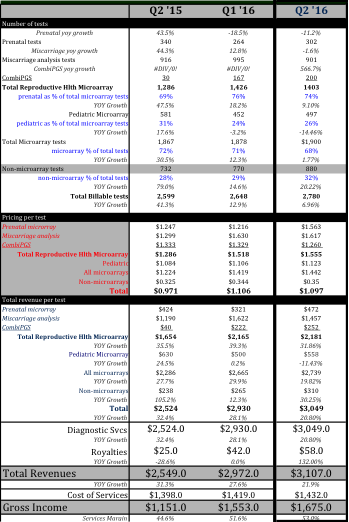
Relative strength in pricing particularly in miscarriage and prenatal, coupled with CBMX's direct efforts in facilitating the customer billing and reimbursement process, pushed service margin up to 53% which is a new record and well ahead of our 46.5% estimate. Service margin in the comparable periods were 44.6% in Q2 2015 and 51.6% in Q1 2016. The recent big jump in margin, coupled with strong pricing on miscarriage, positive industry fundamentals, recent favorable coverage decisions and CBMX's own successful efforts in facilitating collections have prompted us to make another upward revision to our service margin estimates. In fact management noted that they believe 50%+ GM is sustainable going forward.
Q2 OpEx was $2.9M, slightly better then our $3.0M estimate. CBMX continues to see greater leverage in OpEx with ramping revenue, productivity gains from the sales force and efficiency efforts. Noteworthy is that Q2 witnessed the greatest leverage in operating expenses that CMBX has experienced on not only a percentage of sales basis, but due to the very strong service margin, even more so on a percentage of gross income basis. Operating expenses were 1.72x gross income in Q2 2016 – this compares to 2.37x in all of 2015, 2.76x in 2014 and 3.16x in 2013. It is also significantly better than the 1.94x in Q1 2016 - the prior best. This highlights how the growth in test volume and improvement in pricing and margins is moving CBMX closer to profitability.
The $3M in cash collections also were a new record. CBMX used $871k in cash for operations in Q2 exited the quarter with $5.2M in cash. Management believes the current cash balance is sufficient to fund operations for at least the next 12 months. Based on the current burn rate and expectations that revenue and profitability continue to improve, it's possible the current cash balance could be sufficient to fund operations until Q4 2017 - which is when management is forecasting being to the point of cash flow break even.
Several Recent Events Could Catalyze Additional Revenue Growth Including; Updated Prenatal Testing Guidelines, Additional Evidence of Superiority of CMA vs. Karyotyping and Beneficial Revisions to Insurers’ Coverage Policies…
Largest Study To-Date Further Reinforces CMA Superiority Over Karyotyping
While several studies over the last number of years, including the widely cited Reddy et al and Wapner et al studies which have positively influenced reimbursement policy, have all indicated that chromosomal microarray analysis (CMA) is the preferred genetic testing modality versus karyotyping due to the former's proven greater accuracy, that it provides more substantive clinical information and is able to be used on fresh as well as preserved (i.e. FFPE) tissue, none was as large as CBMX's recently published study which included over 8k samples.
The study, published (in advance online) in Genetics Medicine on June 23, 2016 and titled Comprehensive genetic analysis of pregnancy loss by chromosomal microarrays: outcomes, benefits, and challenges, further reinforced the superiority of CMA over karyotyping and could be another catalyst to driving demand for CBMX's CMA testing products and services.
Lead by Dr. Trilochan Sahoo, CBMX's VP of Clinical Affairs and Director of Cytogenetics, investigators collected 8,298 tissue samples - most of which were due to recurrent pregnancy loss but also due to fetal demise, stillbirth, neonatal death and certain fetal structural abnormalities. Of the 8,118 samples that were eventually tested (most were tested with CBMX's SNP-based microarray) ;
- 6,196 (76%) were fresh POC samples
- 1,823 (23%) were FFPE samples
- 99 (1%) were a variety including amniotic fluid, cultured cells, DNA and cord blood
Of the 8,118 samples that were tested by CMA;
- 91% (7,396) were successfully processed (the most common reason for test failure was insufficient or no fetal tissue) which included;
- 92% (5,725 / 6,196) of the fresh POC samples
- 86% (1,575 / 1,823) of the FFPE samples
- 97% (96 / 99) of other non-FFPE samples
This 91% success rate further supports the use of CMA and compares to a historical rate (as established in various other clinical trials) as low as 60% to 80% with karyotyping, which has been considered the standard pregnancy loss testing methodology. The relatively low success rate of karyotyping relates to culture failure and significant false-positive rates due to maternal cell contamination (MCC).
Culture failure (i.e. tissue dies) occurs in as many as 20% - 55% of products of conception, making karyotyping much less reliable than CMA given that the latter analyzes DNA extracted directly from tissue, can analyze non-living tissue and usually does not require culturing. MCC relates to cells of the mother cross-contaminating the fetal culture which can produce erroneous results with karyotyping. False-negative results due to MCC have been reported as high as 50% or more. As CMA can detect and differentiate the maternal DNA, MCC is much less likely to cause erroneous results.
Other well-documented drawbacks of karyotyping is the relatively long turnaround time for performing the test and that it can not be used with tissue that has been preserved with formalin-fixed, paraffin-embedded (FFPE).
Results:
As noted, 91% )7,396) of samples were successfully processed. Abnormal results were found in 54% (3,975) and normal results in 44% (3,272) of all samples. 2% (149) of all samples showed variants of unknown significance.
Of the 5,821 fresh and non-FFPE samples, 45% had an abnormal result. Of the 1,575 FFPE samples (which karyotyping would be unable to process), 49% were abnormal.
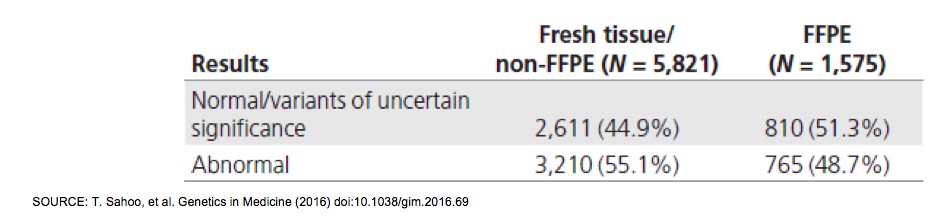
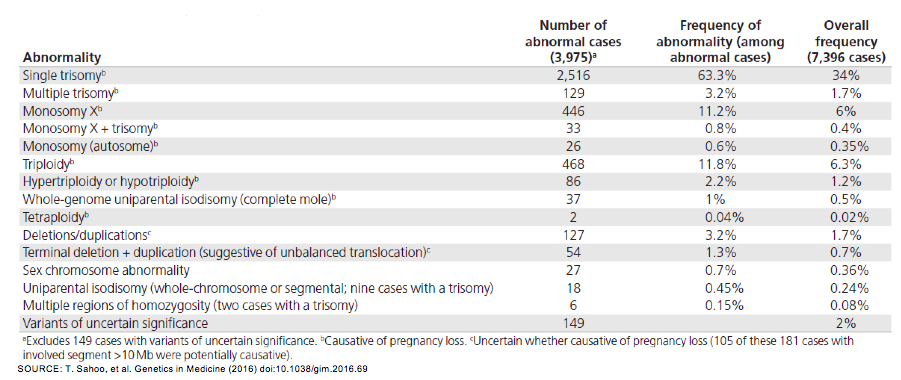
Perhaps particularly noteworthy is that the investigators found approximately 94% of results which had abnormalities would be expected to have been cause for pregnancy loss or fetal demise. In addition, the SNP-array was able to provide additional information compared to traditional testing methods including whole-genome uniparental isodisomy or molar pregnancy. The investigators surmised that approximately 5.6% of cases with reportable findings would not have been identifiable with karyotype or FISH analysis. And when taking into account the 21% of reportable samples which were FFPE and that MCC could provide erroneous results with those traditional testing methods, the authors note that, "it is reasonable to suggest that the outcomes from microarray analysis are significantly superior to those of conventional cytogenetics".
ACOG / SMFM Updated Recommendations Provide Further Support for Use of CMA
On March 1, 2016 ACOG and SMFM released two Practice Bulletins; Prenatal Diagnostic Testing for Genetic Disorders, which replaces a December 2007 Bulletin, and Screening for Fetal Aneuploidy, which replaces a January 2007 Bulletin. The updated information provides greater clarity on the potential risks of chorionic villous sampling (CVS) / amniocentesis and updated recommendations for the use of CMA as well as for confirmatory testing following a positive result from a screening test (such as NIPT).
For prenatal testing, amniocentesis and CVS sampling involves inserting a needle or thin catheter into the uterus where a sample of amniotic fluid or placental tissue is taken. These samples are then analyzed for chromosomal abnormalities using techniques such as CMA and karyotyping. While sampling directly from amniotic fluid and placental tissue provides greater and more accurate information compared to less invasive techniques such as NIPT which analyze cell-free fetal DNA (cfDNA) from the mother’s blood, the invasive nature comes with risks - the most significant of which is pregnancy loss (i.e. miscarriage). Given the risk of miscarriage, some clinicians have recommended that amniocentesis or CVS only be considered for women older than 35 years of age or those that are otherwise at higher risk of having a baby with aneuploidy.
While there has not been a consensus from national governing bodies in terms of the degree of risk of pregnancy loss due to amniocentesis and CVS, it has been believed to be as high as 1.5% or more. However, a recent meta-analysis (Procedure-related risk of miscarriage following amniocentesis and CVS: a systematic review and meta-analysis) by R. Akolekar et al. published in the journal Ultrasound in Obstetrics and Gynecology which looked at studies aggregating a total of almost 43k women who underwent amniocentesis and almost 9k who underwent CVS, found the risk of pregnancy loss was much lower than previously believed. The meta-analysis found that “the added procedure-related risks of miscarriage following amniocentesis and CVS are in the region of 0.1% and 0.2%, respectively”. The authors also note that, “It may be that these risks are unrelated to the invasive procedure, but instead may reflect the pregnancy characteristics of the women undergoing invasive testing. It is essential that pregnant women should be provided with accurate estimates of procedure-related risks associated with invasive testing to allow them to make appropriate choices rather than provide them with exaggerated risks based on historical data, which may unnecessarily deter women from testing.”
This study and the lowered risk of amnio/CVS-related miscarriage are cited in the updated ACOG and SMFM Practice Bulletins as is a recommendation that all pregnant women be offered prenatal assessment for aneuploidy by screening or diagnostic testing regardless of age. Given that risk of miscarriage has been the most significant concern associated with amnio and CVS procedures, findings from this study and subsequent recognition by ACOG and SMFM of substantially less risk than previously believed could result in facilitation of greater use of CMA confirmatory testing, including that offered by CBMX. The Bulletins also recommend pre- and post-test counseling be offered to patients – which has been a focus for CBMX in an effort to help drive adoption of CMA as well as to differentiate themselves from competing CMA providers.
And other recommendations in the Practice Bulletins also support the use of CMA as the most definitive technology to identify aneuploidy. The benefits of CMA, as noted in the Bulletins include;
- “chromosomal microarray analysis can be performed either directly on uncultured tissue or on cultured cells” (while karyotyping requires samples to be cultured)
- “chromosomal aberrations that are smaller than the resolution of conventional karyotype also can result in phenotypic anomalies; these copy number variants can be detected in the fetus using chromosomal microarray analysis”
- when structural abnormalities are detected by prenatal ultrasound examination, chromosomal microarray will identify clinically significant chromosomal abnormalities in approximately 6% of the fetuses that have a normal karyotype. For this reason, chromosomal microarray analysis should be recommended as the primary test (replacing conventional karyotype) for patients undergoing prenatal diagnosis for the indication of fetal structural abnormality detected by ultrasound examination”
- “chromosomal microarray analysis has been found to detect a pathogenic (or likely pathogenic) copy number variant in approximately 1.7% of patients with a normal ultrasound examination and a normal karyotype, and it is recommended that a chromosomal microarray analysis be made available to any patient choosing to undergo invasive diagnostic testing”
In regard to cfDNA screening tests, the Bulletins note their potential for false-positive and false-negative results (the risk of which has been widely cited in numerous studies) and therefore;
- cfDNA should not be used as a substitute for diagnostic testing (i.e. CMA)
- “all women with a positive cfDNA test result should have a diagnostic procedure [such as CMA] before any irreversible action, such as pregnancy termination, is taken”
- "women whose cfDNA screening test results are not reported, are indeterminate, or are uninterpretable should receive further genetic counseling and be offered comprehensive ultrasound evaluation and diagnostic testing because of an increased risk of aneuploidy”
- women with a positive screening test result for fetal aneuploidy should be offered further detailed counseling and testing”
Insurers Revise Policies to Define CMA as ‘Medically Necessary’ for Recurrent Pregnancy Loss
Since the beginning of this year at least 15 insurers have revised their policies to include coverage of recurrent pregnancy testing. This includes major and mid-tier payers. CBMX recently cited Cigna Health Services, BC/BS of North Carolina, Premera BC/BS and Life Wise of Oregon as revising their medical policies to include CMA as ‘medically necessary’ for the evaluation of pregnancy loss. ‘Medically necessary’ essentially means that there is no ambiguity in terms of whether the procedure will be covered. If this trend continues with other insurers revising policies for specific coverage of CMA for pregnancy loss, it would almost certainly be a meaningful benefit to CBMX and demand for their miscarriage analysis tests. The company’s strong Q1 results, including record sales volume of miscarriage tests, suggests that these recent favorable policy decisions may already be making an impact.
We also note that spotty or otherwise inconsistent insurance coverage has been somewhat of a headwind and was one of the reasons why CBMX expanded their portfolio to include products such as the CombiPGS IVF test which is cash-pay and unaffected by insurers policy decisions. It was also a reason why CBMX picked their spots geographically – focusing on areas of the country where insurance coverage was more favorable. So anything that improves the third-party payor environment as it relates to CMA and reproductive health has the potential to have a direct and positive benefit on CBMX and demand for their products.
OUTLOOK
Our 2016 revenue growth, including +18% from reproductive health services testing, is driven from the recent expansion and increasing productivity of the sales force, incremental sales force additions, new payor contracts, more insurers starting to cover recurrent pregnancy loss testing, increasing number of billable customers, greater awareness of the benefits of CMA analysis, improved pricing and some incremental growth from new products. Relative to the sale force, management has noted increased productivity per rep, which they think will continue to help drive revenue higher – we think as additional add-to-the-bag products come online there will be even more room for productivity gains.
Average pricing is one variable that could be particularly influential to updates to our model – including through the remainder of 2016. As noted, 1H saw very strong pricing in miscarriage and gains in IVF and prenatal as well. And while we have made some recent upward revisions to our pricing, revenue and margin forecasts.
Beyond 2016 we think contribution from the additional, aforementioned, catalysts begin to make a more substantial impact. We also think it is not unreasonable to believe that additional future studies and publications will provide further insight into the human genome, soften certain current headwinds to adoption of CMA (i.e. - provide more knowledge related to variants of unknown significance) and provide support for the utility of chromosomal microarray analysis in the prenatal space. These catalysts should result in steepening of the rate of adoption of chromosomal microarray analysis. This, coupled with the company's competitive positioning and our assumption that CBMX continues to grow their distribution footprint, provide what we believe will be a position of strength for CBMX in terms of being able to increase penetration of their target prenatal markets and grow revenue over the long-term. Additional new product launches could prompt an upward revision to our forecast, particularly as it relates to our out-years.
See below for free access to our updated report on CBMX which includes our financial model and valuation.
READ THE FULL RESEARCH REPORT HERE
SUBSCRIBE TO ZACKS SMALL CAP RESEARCH to receive our articles and reports emailed directly to you each morning. Please visit our website for additional information on Zacks SCR and to view our disclaimer.