David Bautz, PhD
NASDAQ:CERC
Business Update
Acquires Rights to Anti-Epilepsy Drug
On September 26, 2016, Cerecor, Inc. (NASDAQ:CERC)
announced the acquisition of CERC-611 (formerly LY3130481) from Eli Lilly. As part of acquisition, Cerecor will make a $2 million upfront payment to Eli Lilly, with $750,000 paid upon signing of the agreement and the other $1.25 million due when the first patient in a multiple ascending dose Phase 1 study is dosed. CERC-611 is a TARP-γ8-dependent AMPA receptor antagonist and is being developed as a treatment for epilepsy.
Epilepsy
Epilepsy is a neurological disorder that affects approximately 65 million individuals worldwide, including 3 million in the U.S. (Epilepsy Foundation). Every year, approximately 150,000 people in the U.S. are diagnosed with epilepsy. A diagnosis of epilepsy is made if someone suffers from two or more unprovoked seizures separated by at least 24 hours. Seizures are characterized by a sudden surge of electrical activity in the brain. They are potentially life-threatening and have a profoundly negative impact on a patients’ life and well-being.
Standard of care treatment currently consists of anti-epileptic drugs (AEDs), of which there are a number of different options. The AEDs that are available do help some patients by decreasing the frequency and magnitude of seizures, however a significant proportion of epileptics (30-40%) are resistant to treatment. For those who respond to treatment there are number of side effects to AEDs, including sleepiness, fatigue, poor coordination, and nausea.
AMPA Receptor Antagonists as Epilepsy Treatments Glutamate is a major neurotransmitter in the central nervous system. Glutamate receptors are classified into two groups: the α-amino-3-hydroxy-5-methyl-4-isoxazolepropionate (AMPA) receptor and the N-methyl-D-aspartate (NMDA) receptor are
ionotropic receptors while metabolic and heterotrimeric GTP-binding protein-linked glutamate receptors (mGluRs) are
metabotropic receptors (
Palmada et al., 1998). The inhibition or down-regulation of AMPA receptors is seen as a potential therapy for central nervous system (CNS) disorders involving excessive neuronal activity, as the majority of fast synaptic transmission within the CNS is controlled by AMPA receptors.
Administration of glutamate receptor agonists is known to evoke seizures in rodents (
Tang, 2005), while AMPA receptor antagonists are potent anticonvulsants and include a number of currently available anti-epileptic drugs, including perampanel and talampanel. Unfortunately, due to the non-specific nature of AMPA receptor binding by these drugs, they carry a number of side effects including dizziness, ataxia, and falling. This results in AMPA antagonists having a very narrow therapeutic window; too little drug and there is no anti-epileptic effect while too much drug results in excessive side effects (
Rogawski, 2011).
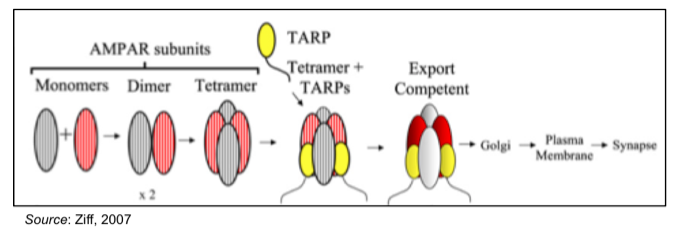
AMPA receptors are composed of tetrameric combinations of subunits GluR1-4 (GluRA-D). In addition to the pore-forming subunits, there exist a class of proteins that bind to the cytoplasmic, C-terminal domains of the subunits and regulate trafficking of the AMPA receptors (
Barry et al., 2002). The Transmembrane AMPA Receptor Regulatory Protein (TARP) family includes members (γ1-γ8) that bind to most, if not all, AMPA receptors in the brain and modulate their activity (
Hashimoto et al., 1999). Several TARPs have brain-region specific expression, with TARP- γ8 being predominantly expressed in the hippocampus, with very little expression in the hindbrain, midbrain, or thalamus (
Tomita et al., 2003). Thus, antagonism of AMPA receptors that are bound to TARP-γ8 offers the potential to affect conditions marked by excessive excitatory transmission within the hippocampus, such as temporal lobe epilepsy, while mitigating systemic side effects that would normally be found through non-selective AMPA receptor antagonism.
Scientists at Eli Lilly identified a compound (LY3130481) that selectively bound to and antagonized TARP-γ8 AMPA receptors (Gardinier et al., 2016). LY3130481 was shown to protect rats from clonic convulsions induced by subcutaneous administration of pentylenetetrazole with an ED50 of 1.7 mg/kg. This was in contrast to the currently available AED perampanel, which had an ED50 of 10.6 mg/kg in the same model. The effects on motor impairment in rats was tested in an inverted screen test, in which LY3130481 did not impair the ability of rats to climb to the top of an inverted screen at doses up to 100 mg/kg. Perampanel at a dose of 30 mg/kg fully impaired the ability of the rats to climb the inverted screen. These data support that hypothesis that a selective AMPA receptor antagonist is likely to have potent anti-seizure properties with minimal impact on motor function.
Conclusion
Cerecor has taken over all development of CERC-611 and we anticipate the company filing an IND and initiating a single-ascending dose study in healthy volunteers in the first half of 2017, which will be followed up by a multiple ascending dose study. Positive results from these studies with no safety signals seen will de-risk the program, and we anticipate including the compound in our model at that time.
While epilepsy treatments are available, they are less than ideal, particularly in regard to the number of patients that do not respond to treatment and the narrow therapeutic index and undesirable side effects they cause. Even with their shortcomings, sales for AEDs totaled $5.1 billion in 2015 and are expected to increase to $8.5 billion in 2022 (Evaluate Pharma). A targeted treatment such as CERC-611 has the potential to address AEDs shortcomings and make an impact in a large addressable market, and we look forward to following the development of this compound as it enters the clinic next year.
As a reminder, Cerecor will announce results from two Phase 2 studies of its lead compounds in the fourth quarter of 2016. Results from the Phase 2 study of CERC-301 in major depressive disorder are set to be released in November 2016, while results from the Phase 2 study of CERC-501 in smoking cessation will be released in December 2016. Our probability adjusted discounted cash flow model yields a valuation of $12 per share. The stock is currently trading at a significant discount to this valuation, and we believe that positive data from the company’s ongoing Phase 2 clinical trials is likely to cause an increase in the share price more in alignment with our valuation.
For a free copy of the full research report, please email scrinvestors@zacks.com with CERC as the subject.
SUBSCRIBE TO ZACKS SMALL CAP RESEARCH to receive our articles and reports emailed directly to you each morning. Please visit our website for additional information on Zacks SCR and to view our disclaimer.