By David Bautz, PhD
NASDAQ:CFRX
Results From CF-301 Phase 1 Clinical Trial Presented
On April 9, 2016, ContraFect Corp. (NASDAQ:CFRX) presented results from the Phase 1 clinical trial of CF-301, the company’s lead lysin product, in healthy volunteers at the 26th European Congress of Clinical Microbiology and Infectious Disease (ECCMID). In the following, we provide an analysis of the data that was presented at the conference along with the key takeaways from the Phase 1 clinical trial.
Brief Background on Lysins
Lysins are natural anti-bacterial hydrolytic enzymes that are produced from a bacteriophage, a virus that infects and kills bacteria. Once inside the bacteria, bacteriophages replicate and produce lysins. Lysins degrade (lyse) bacterial cell walls from the inside, resulting in the bursting of the bacteria. The bursting of the bacteria releases the bacteriophage to infect neighboring bacteria, and so on and so forth. ContraFect’s technology involves the production and purification of a recombinant form of a lysin to use as an anti-bacterial agent. Lysins are delivered to the infected area and lyse the bacterial cell wall from the outside directly upon contact. This video shows both how lysins produced by bacteriophage and recombinant lysins introduced exogenously destroy bacteria cells.
CF-301 Phase 1 Clinical Trial Design
CF-301 is a lysin currently being developed for the treatment of bacteremia (infection of the bloodstream) caused by Staphylococcus aureus, including all drug-resistant phenotypes. Previous preclinical results showed that CF-301 has potent inhibitory activity on over 250 different S. aureus strains, exhibits robust anti-biofilm activity, and effectively synergizes with standard of care antibiotics.
In 2015, ContraFect conducted a Phase 1 clinical trial of CF-301 in healthy volunteers (NCT02439359). This was a randomized, double blind, placebo controlled, dose ranging trial that took place in the U.S. and was designed to test the safety, tolerability, and pharmacokinetics of a single intravenous dose of CF-301, which is the first lysin allowed by the U.S. FDA to enter human clinical trials.
Up to four dosing cohorts were planned (0.04, 0.12, 0.25, and 0.4 mg/kg/dose) with up to six subjects (four active, two placebo) planned for each cohort. CF-301 was administered intravenously over a two-hour infusion. An independent Data Safety Monitoring Board (DSMB) analyzed unblinded safety and pharmacokinetic (PK) data at pre-determined points to evaluate whether dosing should continue as planned. There was a pre-specified stopping rule based on Cmax exposure in the 1.9 to 2.2 μg/mL range.
Subjects remained in the clinic from Day -1 to Day 4. Safety was analyzed through physical exams, vital signs, EKGs, testing for CF-301 anti-drug antibodies (ADA), immunoglobulin E (IgE), and ex vivo basophil activation (BAT) on Days -1, 5, 8, 14, and 28. The IgE and BAT tests were performed to check for hypersensitivity to CF-301.
Phase 1 Results
Twenty subjects were dosed (11 male/9 female; 13 active/7 placebo) amongst each of the four planned dose levels. There were no serious adverse events (AEs), no hypersensitivity reactions to CF-301, and no study stopping rules were met. There were five non-serious AEs reported by four subjects: two subjects who received CF-301 reported headache, contact dermatitis, and allergic rhinitis while two subjects who received placebo reported viral upper respiratory tract infection and viral infection. Importantly, there were no clinically relevant changes in vital signs, EKGs, or laboratory results. The breakdown of AEs is presented in the following table.
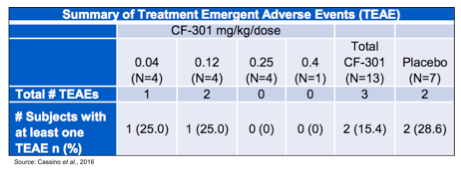
While the values were not given on the poster, it was reported that nine of thirteen (69%) subjects who received CF-301 generated anti-CF-301 ADA titers of “variable magnitude”. It is not surprising that a majority of the subjects dosed with CF-301 developed antibodies to the compound since it is a foreign protein. These antibodies are unlikely to be physiologically relevant for patients receiving a single dose of CF-301, however what effect they may have on the ability to re-dose a patient will need to be examined in future clinical studies.
Perhaps most importantly in regards to immunological response, no subjects tested positive for CF-301 BAT activation and only one subject tested weakly positive for anti-CF-301 IgE at Day 28. The cutoff for positivity of anti-CF-301 IgE was >0.1 kU/L and the subject who tested positive had a value of 0.18 kU/L. The same subject then tested negative for anti-CF-301 IgE on Day 90, thus this appears as though it was a transient response. There did not appear to be a relationship between anti-CF-301 ADA and either the BAT or the IgE assays.
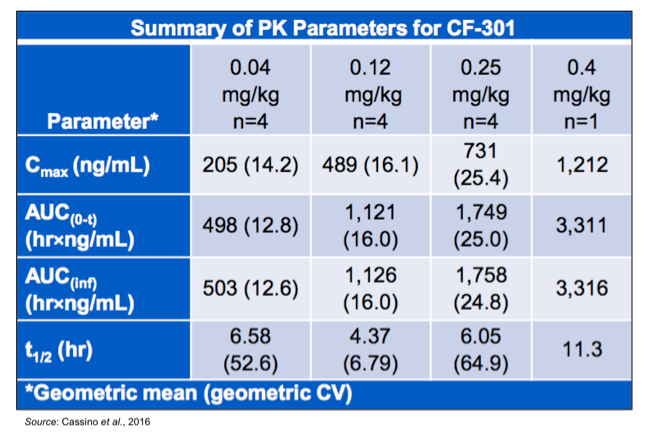
PK parameters showed that as the dose of CF-301 increased, Cmax and area under the curve (AUC) increased in a dose-related but less than a dose-proportional manner, although there was no indication of a plateau in dose response. The following table gives a summary of the PK parameters from the trial.
In summary, results from the CF-301 Phase 1 clinical trial showed the compound to be well tolerated with no serious AEs reported. While a majority of subjects developed ADAs, these did not correlate with any hypersensitivity reactions. These results are very important for the company, as there does not appear to be any increased risk of hypersensitivity reaction through injection of a lysin. The company had previously indicated that a CF-301 dose of 0.25 mg/kg, along with standard of care antibiotics, is anticipated to be effective at treating S. aureus bacteremia. The results from this study give us confidence that there will not be any safety-related issues with this dose level in future clinical trials.
Conclusion and Recommendation
The positive results from the Phase 1 study were an important de-risking event for the company, as CF-301 does not appear to trigger any type of hypersensitivity reactions. The company continues to work on the Phase 2 clinical trial protocol for CF-301, which will be a multicenter, randomized, double blind, placebo controlled trial with a superiority comparison between CF-301 combined with standard of care antibiotics compared to placebo with the standard of care antibiotics. We anticipate the company finalizing the trial protocol and initiating the trial in the second half of 2016. Based upon the successful completion of the Phase 1 study, we recently increased our price target from $10 to $12 and we continue to be highly enthusiastic about the lysin technology and ContraFect’s prospects.
READ THE FULL RESEARCH REPORT HERE
SUBSCRIBE TO ZACKS SMALL CAP RESEARCH to receive our articles and reports emailed directly to you each morning. Please visit our website for additional information on Zacks SCR and to view our disclaimer.