By David Bautz, PhD
NASDAQ:CFRX
Financial Update
On March 15, 2016, ContraFect Corp. (NASDAQ:CFRX) announced financial results for the fourth quarter and full year ending December 31, 2015. As expected, the company did not report any revenues for either the quarter or the full year. Net loss for the fourth quarter of 2015 was $7.6 million, or $0.28 per share, and was comprised of $4.9 million in R&D expenses and $2.6 million in G&A expenses. For the full year, the company reported a net loss of $25.1 million, or $1.08 per share, which was comprised of $15.0 million in R&D expenses and $10.1 million in G&A expenses. The company exited 2015 with approximately $32.9 million in cash and cash equivalents, due in part to gross proceeds of approximately $9.6 million through the exercise of approximately 4.8 million Class B Warrants, which represented close to 70% of the total amount of Class B Warrants that were issued as part of the company’s IPO. The Class B Warrants that were not exercised expired on Nov. 2, 2015. We estimate the company has sufficient capital to fund operations through the end of 2016.
As of Mar. 9, 2016 the company had approximately 27.5 million shares outstanding. In addition, there are approximately 4.3 million stock options and 13.5 million warrants for a fully diluted share count of approximately 45.3 million shares. While the Class B Warrants have expired, the company still has Class A Warrants outstanding that trade on the NASDAQ under the ticker CFRXW. The 6.9 million Class A Warrants are exercisable at $4.80 per share, expire on January 31, 2017, and are callable if the stock trades at $9.60 per share or more for a period of 20 trading days. If those warrants were exercised, that could result in potential gross proceeds of approximately $33 million.
CF-301 Update
ContraFect’s lead lysin product is CF-301. A lysin is a naturally occurring anti-bacterial hydrolytic enzyme that is produced by bacteriophages, which are virus’ that infect and kill bacteria. Lysins are highly evolved enzymes that are able to target one of the five bonds in peptidoglycan (murein), the main component of bacterial cell walls. A typical lysin, such as CF-301, comprises two domains separated by a short linker region. The N-terminal domain catalyzes the hydrolysis of peptidoglycan whereas the C-terminal domain binds to the cell wall substrate, often a carbohydrate, which confers a great specificity and decreases the chance for bacterial resistance. Due to this, the use of lysins as antibacterial agents is designed to combat drug resistance to currently used antibiotics.
CF301 will initially be targeted for the treatment of bacteremia, or infections of the bloodstream. Most studies estimate the incidence of S. aureus bacteremia (SAB) ranging from 20-50 cases/100,000 population (Klevens et al., 2007; Benfield et al., 2006; El Atrouni et al., 2009). Prior to the advent of antibiotics, the mortality rate from SAB was close to 80% (Mendell, 1939). The introduction of antibiotics, coupled with greater standards of care, has reduced the mortality rate, which appears to have stabilized at approximately 20% (Turnidge et al., 2009). SAB can frequently lead to infective endocarditis (IE), an infection of the endocardial surface of the heart (Fowler et al., 2005). The prevalence of IE is estimated to be anywhere from 11 to 50% of patients with SAB. Development of IE leads to an increased risk of embolic event and death (Miro et al., 2005).
The treatment of choice for S. aureus infections is penicillin, however in most countries penicillin resistance is extremely common. Resistance to penicillin is due to the activity of the enzyme penicillinase, which cleaves the β-lactam ring of the penicillin molecule. Penicillinase-resistant β-lactam antibiotics include methicillin, oxacillin, and flucoxacillin. S. aureus strains that have acquired resistance to methicillin have an altered penicillin-binding protein (PBP2a) that has lower affinity for binding β-lactam antibiotics, thus rendering them ineffective. Strains that have acquired this resistance are referred to as methicillin-resistant S. aureus (MRSA). The current gold standard for treatment of MRSA is vancomycin. However, vancomycin is far from ideal due to poor tissue penetration, slow bactericidal activity, and a number of side effects (Gould, 2008). Additional antibiotics utilized include teicoplanin, tegecyline, linezolid, daptomycin, and televancin. Each of those medications has their own shortcomings, including the development of resistance, thus there exists a significant unmet medical need for newer therapies, particularly those that are not susceptible to the development of resistance.
Pre-Clinical Data Shows Synergy With Standard-of-Care Antibiotics
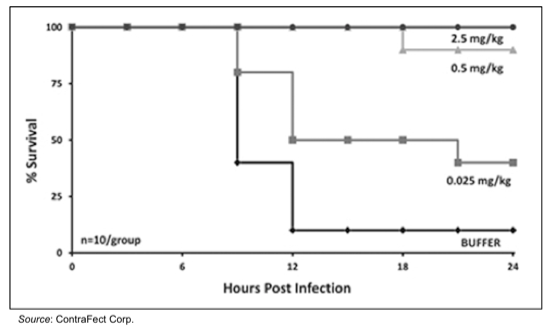
ContraFect has obtained a large amount of data showing how CF-301 is effective both as a monotherapy and when used in combination with standard-of-care (SOC) antibiotics. The company has utilized a bacteremia model in mice that are infected with MRSA and then treated three hours after being infected. The following figure shows that there is a dose response for CF-301 in the bacteremia model, with 90% of mice treated with 0.5 mg/kg surviving the experiment and a 100% survival rate for mice treated with 2.5 mg/kg.
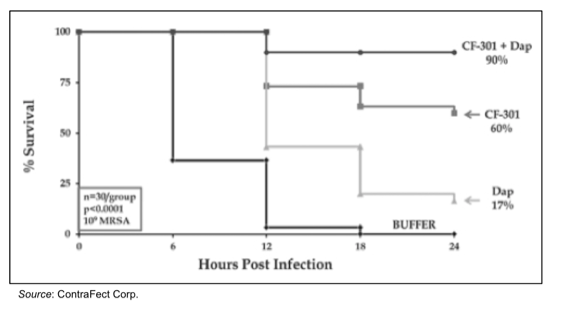
An additional model that the company utilized is a drug failure bacteremia model, where the mice are dosed with such a high burden of bacteria that the SOC antibiotics fail to offer appreciable cure rates. The following figure shows that daptomycin as a monotherapy (at a dose that is equivalent to what human’s are treated with) only has a 17% cure rate, CF-301 as a monotherapy (dosed at 5.25 mg/kg) has a 60% cure rate, but the combination of daptomycin and CF-301 results in a 90% cure rate. Results such as these have been shown in over 30 different experiments, where the combination of CF-301 and SOC antibiotics was always superior to either treatment alone, which provides a strong rationale for the company’s strategy of developing CF-301 to be used in conjunction with SOC antibiotics in clinical trials.
Positive Results From Phase 1 Trial of CF-301
On December 15, 2015, ContraFect Corp. (CFRX) announced the successful completion of the Phase 1 clinical trial of CF-301 (NCT02439359). The trial was a randomized, double blind, placebo controlled, dose ranging Phase 1 study in healthy volunteers to determine if there were any adverse effects seen with single administrations of CF-301 at various doses, as well as to determine the pharmacokinetic parameters of the molecule. The independent Data Safety Monitoring Board (DSMB) that was monitoring the trial reviewed safety, tolerability, and pharmacokinetic data from healthy volunteers in all the planned cohorts and found no clinical adverse safety signals associated with CF-301. This is very encouraging news, as CF-301 is the first lysin to be tested in a clinical trial and thus showing that the drug can be safely administered to humans is an important first step in its development. The company is planning to report the full results from the trial at an upcoming scientific conference in the second quarter of 2016.
Next Steps in Development of CF-301
The company is currently putting together the clinical trial plan for a Phase 2 clinical trial, which will be in patients with bacteremia, including those with endocarditis, which is caused by both MRSA and MSSA. It will be a multicenter, randomized, double blind, placebo controlled trial with a superiority comparison between CF-301 combined with the SOC antibiotics compared to placebo with the standard of care antibiotics. Endpoints will include elimination of bacteremia along with various clinical and microbiological outcomes. Safety, tolerability, and pharmacokinetics will also be examined. How many patients will be enrolled and how long the trial will take are still unknown at this point, however we anticipate that the trial will cost anywhere from $10 to $20 million to run. We anticipate the company finalizing the trial protocol and initiating the trial in the second half of 2016.
CF-404 Update
CF-404 is a mixture of monoclonal antibodies that target different strains of the influenza virus. The distinguishing characteristic of CF-404 is that the antibodies target conserved regions of the virus that are not prone to high rates of mutation. A new influenza vaccine is necessary each year due to the fact that the different strains of the influenza virus are constantly changing. By targeting the portions of the virus that are not prone to mutation, the company is able to develop one therapeutic that will not need to be continually reformulated.
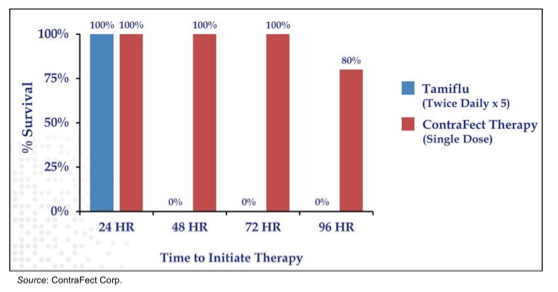
ContraFect will be positioning CF-404 as a therapeutic option for the approximately 200,000 individuals who are hospitalized each year due to influenza, although the total number of influenza-related hospitalizations for the 2014-2015 influenza season was over 970,000. Preclinical data shows that CF-404 is effective in a mouse model of the H1N1 virus even when dosed up to 96 hours post-infection. This is in stark contrast to Tamiflu® (oseltamivir), an antiviral medication that must be administered within 24 hours of infection in the same model, as shown in the following figure.
The company is planning on conducting additional manufacturing and pre-clinical studies to support filing an investigational new drug (IND) application in 2016, with initiation of Phase 1 clinical trials shortly thereafter.
Management Changes
On March 22, 2016, ContraFect announced that Julia Gregory, the company’s current CEO, would be retiring and that Steven C. Gilman, the company’s Chairman, would be taking over as Chairman and Interim Chief Executive Officer. Dr. Gilman joined ContraFect as Chairman in June 2015. He had previously served as the Chief Scientific Officer and Executive Vice President at Cubist Pharmaceuticals, Inc., which was acquired by Merck in January 2015. Prior to working at Cubist, Dr. Gilman was Chairman of the Board and CEO of ActivBiotics, a privately held biopharmaceutical company. He also worked at Millenium Pharmaceuticals, Inc. where he held a number of roles including Vice President and General Manager of the inflammation franchise, where he led all aspects of the group from early gene discovery to product commercialization. Prior to Millenium, Dr. Gilman was Group Director at Pfizer Global R&D, where he was responsible for drug discovery of novel antibacterial agents. Dr. Gilman’s prior experience with discovering and commercializing antibiotics is a valuable asset for ContraFect as the company continues development of CF-301 and the additional lysin products, and we are confident he will continue to move the company forward during the search for a new CEO.
Conclusion and Recommendation
Following the successful completion of the Phase 1 study of CF-301, ContraFect’s stock price went from approximately $3 to over $5 as investors greeted the news enthusiastically. However, the recent negative sentiment in the biotech sector has resulted in a pullback in ContraFect’s stock price, which we view as a compelling buying opportunity since the successful Phase 1 data has helped to de-risk the CF-301 program. Based upon the Phase 1 results, we recently increased our target price from $10 to $12, and we continue to be highly enthusiastic about the lysin technology and ContraFect’s prospects. We continue to rate the stock a ‘Buy’ and believe that investors interested in companies developing novel antimicrobial therapies should view the current downturn in the biotech sector as a prime opportunity to initiate or add to a position in ContraFect.
READ THE LATEST FULL RESEARCH REPORT HERE
SUBSCRIBE TO ZACKS SMALL CAP RESEARCH to receive our articles and reports emailed directly to you each morning. Please visit our website for additional information on Zacks SCR and to view our disclaimer.